A 1946 Perspective from the United States on Future Warfare


A vintage article from 80 years ago in *Flying* magazine (February 1946 issue), which I think will be of interest to readers and colleagues.
THE BUTTON WAR
Author: WILLIAM ROGER
Radio- and television-controlled nuclear missiles will soon surpass our current understanding of air power.
For many years, a standard plot device in pseudoscientific pulp fiction has been the mad scientist who invents a substance that allows him to rule the world—or, alternatively, destroy it. The plot invariably features a button that, when pressed, activates the all-powerful substance.
The problem with this story is that, in its key elements, truth has surpassed fiction.
Shortly after the end of the war in Europe, two leading British Air Force generals [1] discussed the possible nature of future air warfare. They grimly acknowledged that, drawing on the combined technical expertise of the Allies and Germany and the progress made during the war, two people on different continents would soon be able to press two buttons and destroy the world. The future will tell when this terrible event will become possible. All that can be said with certainty now—six months after the United States’ victory in the greatest war in history, achieved primarily through aviation—is that the air force that won this war is already obsolete. The chief witness to this assertion is General Henry Arnold, commander of our own victorious Army Air Forces. In his final report on the combat operations of the U.S. Army Air Forces, General Arnold used a term favored by pseudoscientific science fiction writers: “spaceships”—only the general did not put the term in quotation marks.
“Designing such a device is already practically feasible today. Research will undoubtedly lead to its creation in the foreseeable future.”
– General Arnold said.
If advances in military science, as confirmed by the recently concluded hostilities, are an indication of what future wars will be like, then a “push-button war” is an inevitable reality. The creation of a single device—the atomic bomb—has transformed the art of mass destruction from the realm of science fiction into reality. Thus, atomic explosives are the core around which other deadly weapons will be developed.
Woven into this futuristic picture are rockets and aircraft controlled by radio and television, contactless fuses, radars, various types of jet engines, spy organizations operating around the world, and training programs necessary to ensure a successful “push of the button” for both defensive and offensive purposes.
Imagine the potential destructive power of a nuclear missile launched from a position thousands of miles away from its target, capable of reaching a speed of 3,000 miles per hour (4,827 km/h) and can be guided via radio or television during a specific section of its flight path. Such a missile, equipped with a contactless fuse pre-set to detonate the nuclear warhead at an altitude that ensures maximum destruction, gives a good idea of what a “push-button war” is.
A rocket engine will make it possible to reach unprecedented speeds. Early research in rocket engineering, conducted for the U.S. Army Air Corps, were aimed at facilitating the takeoff of heavily loaded aircraft from small airfields and providing a brief increase in speed to achieve high flight performance in combat under extreme combat conditions. The enemy used rocket engines to power offensive weapons. Among such models were the V-2 ballistic missile, the radio-controlled Rheintochter III anti-aircraft missile—which the Germans planned to use against our bombers—and the Viper [Bachem Ba 349 Natter]—a manned, vertically launched rocket aircraft designed to attack enemy aircraft with cannons, rockets, and ramming attacks.
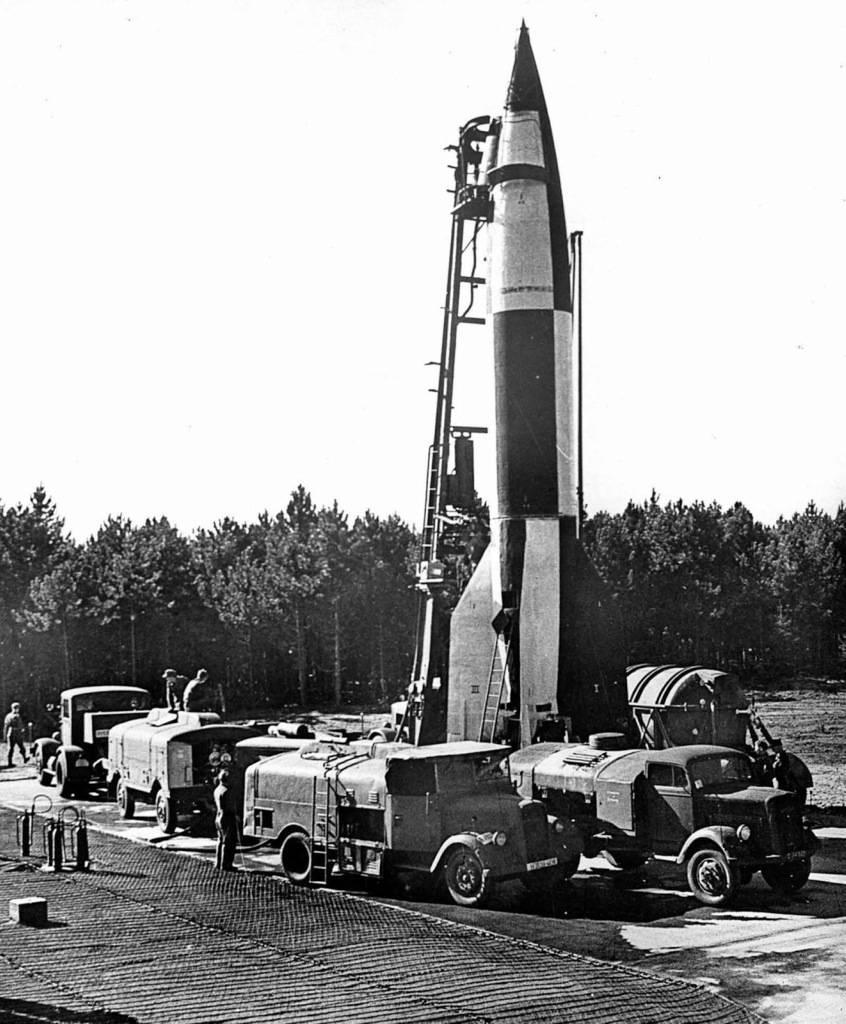
A German V-2 ballistic missile on the launch pad at the Peenemünde test center. Photo courtesy of kiddyclub.ru
Certain shortcomings make the Viper rocket plane unsuitable for a button-pushing war. For example, its speed of 620 miles per hour (998 km/h) would be too low, and its flight duration of only a few minutes would be insufficient to cover any significant distance. Furthermore, guiding such a rocket-powered aircraft to its target requires manual control by an experienced pilot, which means training personnel capable of withstanding high g-forces. The altitude this missile interceptor must reach will be limited by the altitude at which a human can remain conscious, even with a pressurized cabin and an oxygen mask.
Thus, as General Henry Arnold asserts, we are forced to take into account not only the probability but also the certainty that spacecraft, nuclear power, radio control, and television control will lead to the use of “push-button control” in any future war. General Arnold’s statement notes the decline of our current air power:
“The weapons we have today are museum pieces for tomorrow, when the B-29 will be on display at the Smithsonian Institution alongside the Wright brothers’ and Lindbergh’s airplanes.
It will be replaced by bombers carrying 50 metric tons of bombs, equipped with jet or rocket engines, and capable of flying at supersonic speeds around the world.”
Since atomic bombs have paved the way for a new era of destruction, we must consider possible means of protection against them.
General Arnold proposes three options for defending against such weapons.
“First, we must try to ensure that there is no secret production of atomic bombs anywhere in the world. Second, we must develop all possible measures for active defense against an attack with an atomic bomb as soon as it is launched, and third, we could restructure our country in such a way that it would be as vulnerable as possible to an atomic bomb attack, by completely decentralizing our cities and moving vital industries underground.”
Arnold’s second proposal—the pursuit of active defense—leads to the likely use of guided missiles that would track an incoming ballistic missile and, using a device such as a non-contact fuse—attempt to destroy it far from its intended target or force it to change course. If such a device can be perfected and used against ballistic missiles traveling at a speed of 3,000 miles per hour (4,827 km/h) and ascending to an altitude of 70 miles (113 km), offensive tactics will soon require the use of spacecraft that, as General Arnold predicts, will operate beyond the Earth’s atmosphere.
These spacecraft will detonate their explosives closer to the target, making them harder to detect and significantly reducing the time available to take countermeasures. Launching such missiles from various and unexpected directions will generally make an attack more successful and leave defenses more vulnerable.
General Arnold stated that, in the context of a “button-push war,” one of the most important means of air defense—capable of being used for both offensive and defensive purposes—is a non-contact fuse or a similar device based on the same principle. This detonation device is so sensitive that it will be triggered by the heat of a human body if a person enters a room where the fuse has been activated. At long ranges, such a device can be guided toward enemy power plants or steel mills, which emit more heat than the surrounding terrain or structures.
In an offensive scenario, a ballistic missile with a nuclear warhead—relying on no guidance system other than radio control and equipped with a contactless fuse—can be directed toward a target at supersonic speeds —this is a true weapon of “push-button warfare.” For defensive purposes, a guided missile with a similar contactless fuze could be directed to seek out and destroy an attacking projectile by “homing in” on the approaching missile. In a “push-button war,” this constitutes defense.
The means of propulsion for these guided missiles are not limited solely to rocket engines. When nuclear energy was mentioned as a possible source of propulsion, General Arnold stated that, in his opinion, it is currently most prudent to focus on the use of atomic bombs for offensive purposes rather than to seek ways to use atomic energy to power aircraft. Such a development, he added, seems to be quite a long way off—so far off, in fact, that it is currently difficult to predict the design, specifications, and types of aircraft or spacecraft intended for operation in the ionosphere that could be powered in this way.
Not all experts in the field of nuclear energy share this view; some of them believe that we are quite close to harnessing this baseload energy source.
Using this type of energy in a rocket engine could solve the problem of the mismatch between size, mass, fuel supply, and explosives—which are so disproportionate in the German V-2 ballistic missile. Despite the rocket’s enormous size and mass, its warhead contained only one metric ton of explosives. Our current fuel is somewhat better than the mixture of alcohol and oxygen used by the Germans, but it is not yet efficient enough for economical operation over long distances. Once this problem is solved and the rocket’s flight path can be controlled via radio or television, a massive warhead filled with nuclear explosive material, triggered by a sensitive non-contact fuse, will make this missile a terrifying prospect in a “push-button war.”
Other types of jet propulsion can also be used to achieve the extremely high speeds required by manned or unmanned aircraft and missiles. The German V-1 flying bomb, equipped with a pulsating air-breathing jet engine, demonstrated the ability to strike enemy targets. However, the flight of this rocket, which was controlled by a gyroscope, was imprecise, and the flying bomb itself was vulnerable to attacks by high-speed fighter jets and radar-guided anti-aircraft missiles.
In the “button war,” unmanned radio-controlled and television-controlled jet aircraft will complement manned fighter jets. Bell Aircraft has already successfully adapted its Airacomet aircraft for radio control and conducted tests of the aircraft in unmanned mode. Curtiss-Wright has developed a radio-controlled “flying machine” that reached a speed of 1,400 miles per hour (2,253 km/h). Both of these inventions represent steps toward the development of “push-button control.”
Some of the jet propulsion combinations that could be used in robot warfare include: (1) a motor-compressor air-breathing jet engine—a piston engine combined with a gas turbine and a mechanically driven air-breathing jet engine; (2) a turboprop engine—a gas turbine combined with a propeller; (4) a turbojet engine—a gas turbine combined with jet thrust; (5) a direct-flow jet engine—continuous jet thrust generated by the aerodynamic compression of the oncoming airflow; and (6) pulsating jet engine—an engine with pulsating jet thrust. The importance of each of these types of jet propulsion in any future war is underscored by General Arnold’s comment:
“Right now, these strange-sounding words mean more to Americans than any other six words I know.”
Protection against a war unleashed at the push of a button is not limited to electronic and nuclear means. Our intelligence capabilities must evolve in step with our scientific progress. General Arnold emphatically stated that
“Our previous understanding of the necessary volume of intelligence is insufficient to meet the demands of modern warfare.”
Ensuring reliable protection against the horrors of button-war means obtaining detailed and timely information on all aspects of civilian and military activity within the territory of an enemy or potential enemy. This includes constantly updated knowledge of the political, social, industrial, scientific, and military life of that potential adversary, both in peacetime and in wartime.
General Arnold said that we must be aware of all factors that could affect potential military operations. Future targets may be very large or extremely small—for example, guided missile launch sites—and destroying them with precision bombing will require accurate advance intelligence. The importance of scientific and technical intelligence increases when one realizes that, in a “push-button war,” the destruction of such targets would likely be entrusted either to unmanned radio-controlled aircraft or to television-guided missiles.
When the various factors that make up “button warfare” are taken together, it is possible that a future invasion of any enemy country might unfold along the following lines:
First, radio- and television-guided missiles equipped with destructive nuclear warheads are launched from positions located far from the target. This could serve as an initial “preparatory strike,” in which such an attack is supplemented by ionospheric spacecraft launching similar nuclear bombs with non-contact fuses set to detonate at an altitude that will cause the most extensive destruction. Radar stations equipped with jamming devices will scan defensive areas for signs that the enemy is launching its own missiles; at the first sign of such activity, guided missiles will be launched into the sky to intercept, deflect, or destroy these defensive missiles.
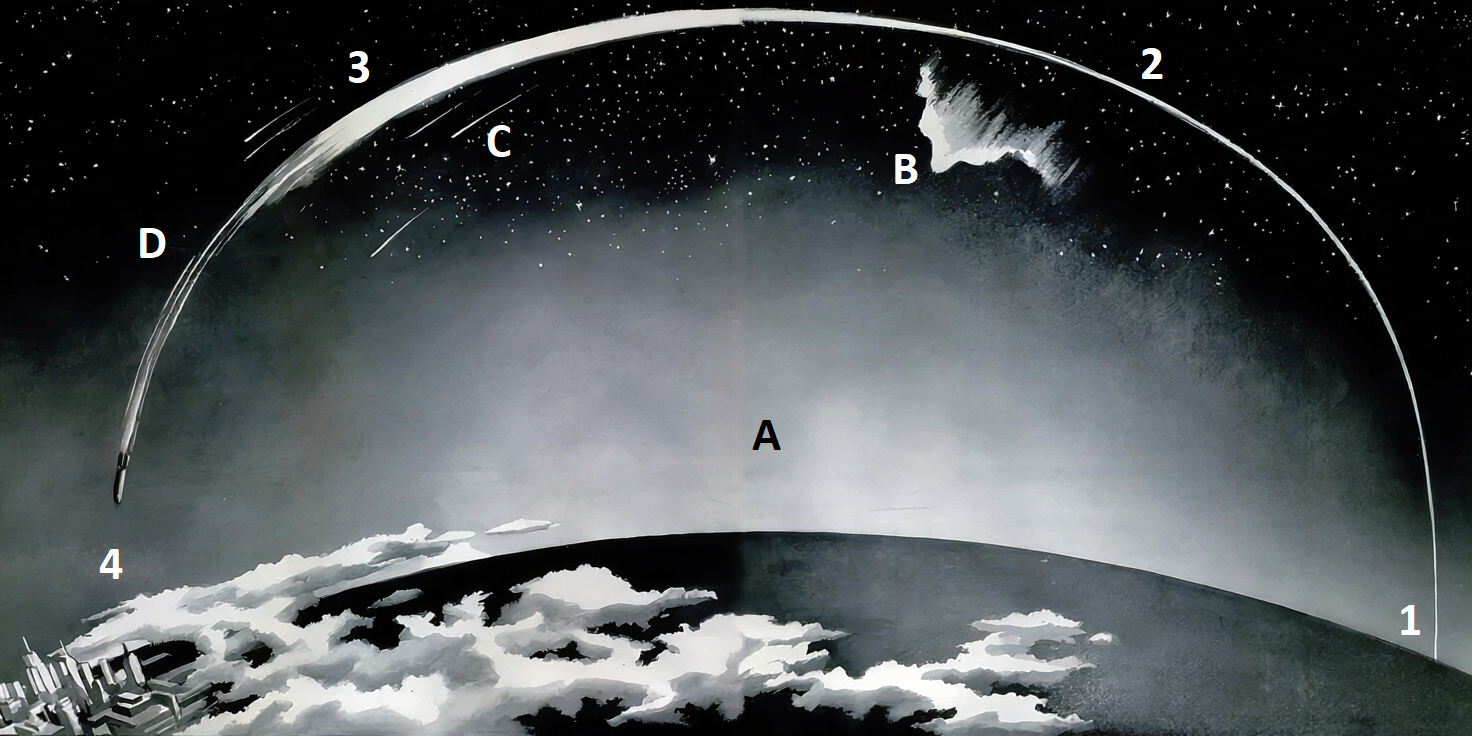
In the wars of the future, ballistic missiles carrying nuclear warheads will travel long distances, passing through the ionosphere at a speed of 3,000 miles per hour (4,827 km/h), reaching altitudes of 70 miles (113 km) or more. Guided ballistic missiles, powered by more advanced fuel and equipped with more destructive warheads than those used in the German V-2 rockets, have already turned air warfare into a “push-button war.” The numbers and letters indicate: 1) the missile launch at 2:00 a.m. on Tuesday; 2) the missile’s speed in the ionosphere, approximately 3,000 miles per hour (4,827 km/h); 3) the rocket reaches an altitude of approximately 70 miles (113 km); 4) the rocket reaches its target at 9:00 p.m. on Monday; A) the highest altitude ever reached by a human is 72,395 feet (22,066 m). This altitude was reached by Americans Albert W. Stevens and Orville A. Anderson in the “Explorer II” balloon; B) the northern lights; C) meteors; D) the twilight limit
Airborne armies numbering in the hundreds of thousands, armed with state-of-the-art technology, could follow an attack by ballistic missiles carrying nuclear warheads, flying to the target area in high-speed aircraft equipped with turbojet or similar engines. These aircraft could be followed by long formations of supply aircraft.
Tactical support for attacking forces can be provided by massive bombers carrying 50 metric tons of explosives each. Air cover can be provided by supersonic unmanned missile or jet aircraft controlled via radio or television from ground control stations or from command-and-control aircraft in the air.
Although such visions of war are hard to imagine, General Arnold’s words—as well as concrete evidence obtained through scientific progress—clearly show what we will face if a new war breaks out. The destruction suffered by Germany and Japan today will be insignificant compared to the destruction of a future war.
General Arnold points out that adequate preparation for such an event is an urgent necessity:
“Although the United States must use all its physical and moral strength in the cause of peace, we must recognize that, for the foreseeable future, effective protection against nuclear weapons will depend on our ability to immediately launch offensive operations using overwhelming force.”
APPENDIX. STATISTICS ON THE U.S. ARMY AIR FORCE IN EUROPE
During combat operations in Europe, the U.S. Army Air Forces flew a total of 1,690,371 combat sorties. Of this total, heavy bombers accounted for 30%, but they accounted for 70% of the total tonnage of bombs dropped. U.S. Army Air Forces aircraft destroyed 20,609 enemy aircraft in the air—45% were shot down by heavy bombers, and fighters destroyed 52%.
| Aircraft Types in Use | [1] | [2] | [3] | [4] | [5] | [6] | [7] |
| Heavy bombers | |||||||
| B-17 | 29,508 | 640036 | 6659 | 418 | 4603 | 4688 | 1,6% |
| B-24 | 226775 | 452508 | 2617 | 352 | 1932 | 3626 | 1,6% |
| Total: | 518283 | 1092544 | 9276 | 770(1) | 6535 | 8314 | 1.6% |
| Medium bombers | |||||||
| B-25 | 63177 | 84980 | 193 | 189 | 139 | 380 | 0,6% |
| B-26 | 129943 | 169382 | 402 | 117 | 454 | 911 | 0,7% |
| Total: | 193120 | 254362 | 595 | 306 | 593 | 1291 | 0,7% |
| Light bombers | |||||||
| A-20 | 39492 | 31856 | 11 | ––––– | 25 | 265 | 0,7% |
| A-26 | 11567 | 18054 | 7 | ––––– | 6 | 67 | 0,6% |
| Total: | 51059 | 49910 | 18 | ––––– | 31 | 332 | 0,7% |
| Fighter Jets | |||||||
| All-American | 23373 | 8014 | 84 | 17 | 52 | 177 | 0,8% |
| P-38 | 129849 | 20139 | 1,771 | 749 | 1951 | 1758 | 1,4% |
| P-39 | 30547 | 121 | 14 | 18 | 5 | 107 | 0,4% |
| P-40 | 67059 | 11014 | 481 | 40 | 341 | 553 | 0,8% |
| P-47 | 423435 | 113963 | 3082 | 3202 | 4591 | 3077 | 0,7% |
| P-51 | 213873 | 5668 | 4950 | 4131 | 4218 | 2520 | 1.2% |
| P-61 | 3637 | 141 | 58 | –––– | 11 | 25 | 0,7% |
| Spitfire | 28981 | 212 | 256 | 3 | 184 | 191 | 0,7% |
| Beaufighter | 6706 | –––– | 24 | –––– | 27 | 63 | 0.9% |
| Mosquito | 449 | –––– | –––– | –––– | –––– | 10 | 2,1% |
| Total: | 927909 | 159272 | 10720 | 8160 | 11380 | 8481 | 0,9% |
[1] Number of combat sorties
[2] Tonnage of bombs
dropped[3] Number of enemy aircraft shot down
[4] Number of enemy aircraft destroyed on the ground
[5] Number of enemy aircraft damaged in the air and on the ground
[6] Total U.S. losses (likely including those destroyed and damaged)
[7] Total U.S. losses per combat sortie
(1) The monthly summary for the European theater of operations lists 3,079 enemy aircraft damaged or destroyed on the ground by heavy bombers. The model and extent of damage are not specified.
[1] In the text of the article, “air marshal” (lieutenant general of aviation) is rendered as “byakin”
Source: William Roger, “Push Button Warfare,” *Flying*, February 1946, pp. 38–39, 106, 108, 110
This translation was first published at – https://vk.com/@710541705-push-button-warfare