A Feudal Lord Had His Own Armed Men, Court, and Taxes: How the Medieval Seigneurial System Really Worked

Imagine a small French village in the twelfth century. A few dozen peasant households, a church, fields, pastures, woodland, a mill, and somewhere nearby, a fortified residence or castle rising above the countryside. A peasant grows grain on his holding, but part of the harvest—or a payment in money—must go to the lord. To grind that grain, he may be required to use the lord’s mill and pay again. If a dispute breaks out with a neighbor, it may be settled in a local court. If armed raiders appear in the area, protection is expected from the same lord or his men.
Where, in all of this, is the state?
The king exists. People know his name, his coins may circulate at the market, his authority is recognized, and in a major war he can potentially assemble the largest military force. Yet an inhabitant of such a village might go for years without seeing a royal official. State administration in the modern sense may simply not exist anywhere nearby.
The lord, however, does.
This is why the seigneurial system is one of the keys to understanding medieval society. It was not merely a large landed estate, nor simply a territory where a wealthy feudal lord exploited peasants. It represented a fundamentally different organization of power, one in which property, justice, taxation, military force, and personal obligations had not yet been separated in the way we take for granted today.
To understand the Middle Ages, we first have to forget the modern state.
First Things First: What Exactly Was a Seigneurie?
Terminology is the first problem. When discussing the Middle Ages, words such as “fief,” “manor,” “estate,” and “seigneurie” are often used almost interchangeably. But they do not mean exactly the same thing.
A fief was primarily property or a source of income granted to someone within a relationship of vassalage. Usually this meant land, although in principle various revenue-producing rights could also be granted. A vassal received a fief from a lord and in return accepted certain obligations, above all loyalty and service.
A manor is a term particularly associated with medieval England and generally refers to an economic and administrative unit centered on a landed estate.
A seigneurie was broader.
It included not only land belonging to a lord but also the collection of rights he could exercise over a particular territory and the people living there. Depending on the region, period, and local circumstances, a lord might possess the right to collect payments, administer justice, control forests and pastures, organize markets, charge tolls, operate mills, and demand particular services from the population.
And these rights did not necessarily all belong to the same person.
One individual might own the land. Another might receive part of its revenues. A third might possess certain judicial rights. The Church might collect the tithe. Above the local lord might stand a more powerful lord, above him a count or duke, and somewhere at the top of the structure stood the king.
To modern eyes, this looks chaotic.
To medieval society, it was normal.
Power did not exist solely as control over territory. It was composed of rights, privileges, customs, and personal obligations that could overlap with one another.
A Small State Inside a Larger One?
Consider an imaginary French seigneurie in the twelfth century.
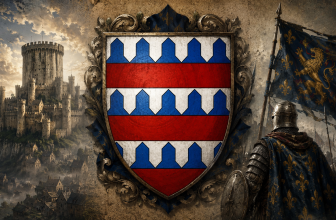
At its center stands the lord’s fortified residence. This need not be an enormous stone castle with massive towers. The center of a modest knight’s estate could be far less impressive.
Around it lie one or several villages, fields, meadows, forests, and roads. Somewhere there is a mill. Perhaps there is a market. Nearby stands a church.
The lord receives income from the land.
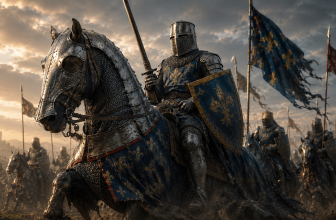
He has armed retainers.
He may administer justice.
He collects certain payments.
In some places, he controls important parts of the local economy.
A sufficiently large estate might even possess a small administrative apparatus of its own: stewards, judicial officers, collectors, and other representatives of the lord.
It begins to look almost like a miniature state.
But the word almost is crucial.
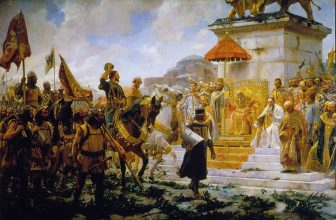
The lord was not usually an independent sovereign. His rights existed within a larger system. He might be the vassal of another nobleman, who in turn might owe allegiance to someone still more powerful, with the king occupying the theoretical summit of the hierarchy.
In simplified form, it might look like this:
peasant → local lord → great noble → count or duke → king.
Actual medieval society immediately complicates this neat pyramid.
The same man could have several lords for different possessions. A powerful count might behave almost like an independent ruler in one region while simultaneously being the king’s vassal for another. Marriage, inheritance, and family relationships constantly rearranged the system.
The English Plantagenets provide one of the most striking examples.
The king of England was a sovereign monarch in his own kingdom, yet for his possessions in France he could simultaneously be a vassal of the king of France. During the twelfth century, the English Crown at times controlled so much territory in France that the English monarch possessed lands far greater than the personal domain of his nominal French overlord.
A king could therefore be more powerful than his own lord.
And yet, legally, he could remain that lord’s vassal in relation to particular lands.
Medieval society was perfectly capable of living with such contradictions.
How Did a Lord Make Money?
This raises another question. If the seigneurie was the foundation of a lord’s power, where did the money come from to maintain a castle, weapons, horses, servants, and military expeditions?
Land remained the principal source of wealth.
Part of an estate could form the demesne—the land whose revenues went directly to the lord. Other plots were held and worked by peasant households.
But relations between peasants and lords could take many forms.
In some places, peasants surrendered part of their harvest. Elsewhere they paid fixed dues in produce. Monetary payments became increasingly common in many regions. Some estates retained labor services, requiring peasants to spend a certain number of days working directly on the lord’s demesne.
The system was constantly changing.
As trade and the money economy expanded, payments in kind and labor obligations were increasingly converted into cash. This could be more convenient for the lord: instead of receiving grain, chickens, or several days of labor, he received money that could be spent on weapons, cloth, horses, or other goods.
But particularly interesting sources of revenue were the so-called banalities.
In some regions, the lord possessed exclusive rights over important pieces of local infrastructure.
Need to grind grain?
Use the lord’s mill and pay the required fee.
Need to bake bread?
In certain areas, villagers were required to use the lord’s oven.
In wine-producing regions, similar rights could apply to wine presses.
From a modern perspective, the arrangement looks almost like a monopoly over infrastructure.
The lord earned money not merely because he owned land. He controlled some of the bottlenecks of the local economy.
Add road and bridge tolls, market dues, payments for access to forests or pastures, and judicial fines, and it becomes clear why a collection of seigneurial rights could sometimes be nearly as valuable as the land itself.
But What Did the Peasant Get?
Here it is easy to fall into the opposite extreme and imagine the relationship in the simplest possible terms: the lord owned everything, the peasant worked, and the lord took whatever he wanted.
Medieval reality was more complicated.
The relationship was profoundly unequal, but it was usually regulated by custom.
A peasant household might use the same holding for generations. Established obligations, hereditary rights, and rules governing access to common land, forests, and pastures could all exist. If a lord attempted to change long-established customs arbitrarily, he might face resistance, legal disputes, or collective conflict with the village.
Moreover, the word “peasant” conceals a wide range of different legal statuses.
A free farmer and an unfree serf were very different people in legal terms.
The same village could contain free peasants, personally dependent people, tenants, and landholders occupying their plots under different arrangements.
This is why the popular image in which virtually every medieval peasant was a serf is misleading.
Seigneurial relations also involved more than obligations flowing upward.
The lord was expected to maintain order, protect his domain, and respect established rules. This certainly did not make lord and peasant equal partners, but neither can the system be reduced to the principle that whoever carried the sword could simply impose whatever rules he wished.
Medieval society took custom extremely seriously.
At times, custom could restrict a lord’s power more effectively than written law.
The Most Important Power: The Right to Judge
If there is one function that best demonstrates the significance of seigneurial authority, it is not collecting harvests or even providing military protection.
It is justice.
Imagine an ordinary dispute.
Two peasants argue over the boundary between their plots. Someone’s pig has destroyed a neighbor’s field. A question arises over inheritance. Someone has failed to perform an obligation. One villager accuses another of theft.
Where do they go?
Today, the answer seems obvious: there is a state judicial system.
In the twelfth century, the answer could be very different.
The dispute might be heard in a local court.
And the lord’s court did not necessarily consist of the lord sitting on a throne and personally issuing judgments. Local inhabitants or landholders who knew customary law could participate and testify as to how similar cases had traditionally been settled.
Justice was simultaneously an instrument of power and a source of income: certain offenses resulted in fines payable to the lord.
But the most important point was something else.
The court showed ordinary people who actually possessed authority.
The king might be hundreds of miles away.
The seigneurial court was nearby.
Then What Was the King For?
And here we arrive at the central paradox.
If the local lord collects payments, judges the population, commands armed men, and controls the land, why have a king at all?
Because the seigneurie could manage local affairs, but it could not completely replace higher authority.
The king was a source of legitimacy, a supreme arbiter, a military leader and, increasingly, an important source of law. He could summon major vassals, organize large-scale wars, confirm privileges, and intervene in conflicts among the nobility.
Yet for a long time the capabilities of monarchy were limited.
A modern state can tax millions of citizens directly, transfer the money into a central budget, and maintain a professional army, police force, judiciary, and enormous bureaucracy.
An eleventh- or twelfth-century king usually possessed nothing comparable.
To raise an army, he relied on his vassals.
To administer distant territories, he depended on local elites.
To collect revenues, he had to work through existing rights, customs, and agreements.
Feudal fragmentation, therefore, was not simply the result of weak kings.
To a considerable degree, it reflected the technological and economic limits of the period.
Directly administering every village was extraordinarily difficult and expensive.
It was far easier to create a system in which much of local government was exercised by people who were already there.
The Lord Owed Something Too
The lord’s authority also came at a price.
A vassal who received a fief accepted obligations toward his own lord.
The best known of these was military service.
When war began, a lord might require his vassal to appear personally and bring a specified number of armed men. Other obligations could include attending councils, providing assistance for certain extraordinary expenses, and participating in judicial proceedings.
The relationship was reinforced by a personal oath.
And here we find another fundamental difference from the modern state.
Today, a citizen is required to obey the law regardless of whether he personally knows the president, judge, or tax official.
The feudal system was built to a significant degree upon personal relationships.
A particular man performed homage to another particular man.
One promised loyalty and service.
The other promised protection and recognition of his rights.
This meant that death, inheritance, or a personal conflict between two individuals could create enormous political problems.
The system was not bureaucratic.
It was personal.
A Castle Was More Than a Fortress
This also helps explain the importance of the medieval castle.
We tend to think of it primarily as a military structure.
But within a seigneurie, a castle or fortified residence performed many more functions.
It was the lord’s home.
An administrative center.
A place where supplies and documents could be stored.
A symbol of authority.
Sometimes a court.
And in times of danger, a fortress.
A stone tower rising above a village conveyed roughly the same message as a modern government building flying a national flag: authority resides here.
Except medieval authority did not belong to an impersonal institution.
It had a name.
Why Did the System Begin to Disappear?
The seigneurial system proved extraordinarily durable. Elements of it survived for centuries, and in some countries particular seigneurial rights outlived the Middle Ages themselves.
But gradually, a very different world began to emerge around it.
Cities grew.
Trade expanded.
More obligations were converted into money.
Monarchies developed professional administrations.
Royal courts expanded their reach.
Taxation became more regular.
Then came an especially important change: kings increasingly gained the ability to transform money directly into military power.
Previously, a monarch needed a feudal lord who, under the terms of vassalage, would bring armed men to war.
Now the king could collect taxes.
And use the money to hire soldiers.
That fundamentally changed the balance of power.
At the same time, royal courts gradually pushed aside local jurisdictions, towns acquired or purchased privileges, and central administrations penetrated deeper into local society.
Functions that had once been united within the seigneurie began to separate.
The land might remain the property of an aristocrat.
But justice increasingly belonged to the king.
Taxes went to the state.
The monarchy maintained the army.
The administration controlled the roads.
Gradually, a transformation was taking place whose importance extends far beyond the history of feudalism.
Power was becoming separated from property.
A World in Which Power Belonged to the Land
This is why the seigneurial system is far more interesting than simply being one form of feudal landholding.
It reveals a society organized according to principles profoundly unfamiliar to modern people.
Today, someone may own thousands of hectares of land without possessing any right to judge the people living nearby. The owner of a mill cannot force an entire village to use only his mill. The wealthiest businessman in a region does not automatically gain the right to collect taxes or demand military service from his employees.
We draw a clear distinction between private property and public authority.
The medieval world often did not.
Land generated income.
Income supported armed men.
Landholding came with rights.
Rights created power.
Power was reinforced by custom and personal oaths.
And above all of this stood other landholders, other rights, and other oaths.
This is why the familiar schoolbook image of the feudal pyramid is both useful and misleading. It illustrates the general principle of hierarchy, but conceals the most important reality: medieval Europe was not a neat ladder running from peasant to king. It was an enormous network of overlapping rights and obligations.
The seigneurie was one of the fundamental nodes in that network.
And that is why the medieval seigneurial system should not be understood simply as a weak or primitive version of the modern state. It belonged to an entirely different political order, one in which the state had not yet monopolized justice, taxation, military force, and local government.
To truly understand the Middle Ages, we need to forget for a moment the familiar map of Europe with its clearly drawn national borders and imagine another map instead—a map of castles, villages, estates, judicial rights, feudal oaths, ecclesiastical possessions, and dozens of overlapping jurisdictions.
On a modern map, the central question is who controls the territory. On a medieval map, it was often more important to ask: who holds the right?
And it was the answer to that question that shaped the world of lords, vassals, and peasants that we now call feudal Europe.