We previously published a news article on this website about the Bogulnik unmanned system; you can read it here. In this article, we’d like to present a contrasting viewpoint and also delve deeper into the weaknesses of this mortar system.
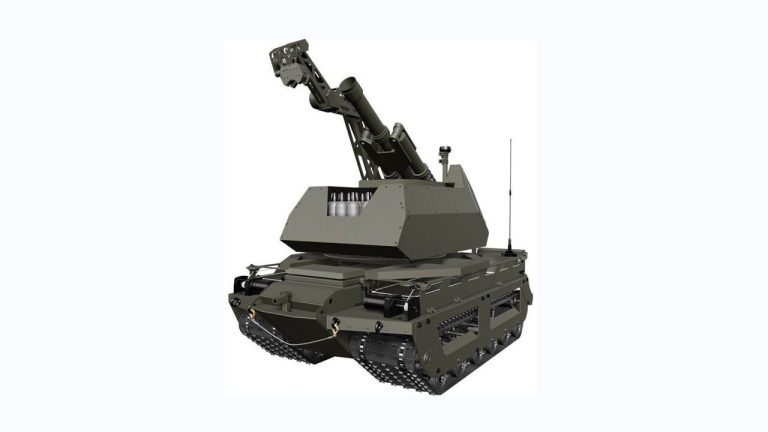
The idea of a robotic mortar seems almost ideal for modern warfare. A mortar is one of the most vulnerable weapons on the battlefield: the crew is forced to operate in the open, is quickly detected, and comes under return fire. The logic is simple—remove the people, leave the weapon. The “Bagulnik-82,” mounted on an unmanned platform, is built precisely on this principle.
But if you take a close look at the implementation itself, it becomes clear that the problem isn’t with the idea, but with how it was implemented.
The Right Problem—A Controversial Solution
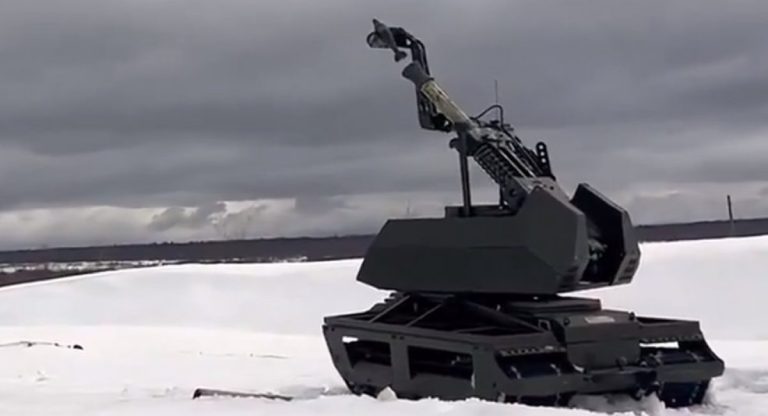
Conceptually, the system solves a real-world problem. 82-mm mortars are limited to short ranges and leave the crew highly vulnerable, especially in conditions where the front line is saturated with drones. The robotic platform allows personnel to be removed from the area of effect and fire to be conducted remotely.
From this perspective, “Bagulnik” is a logical step forward.
But that’s when things really get interesting.
Automation that makes everything more complicated
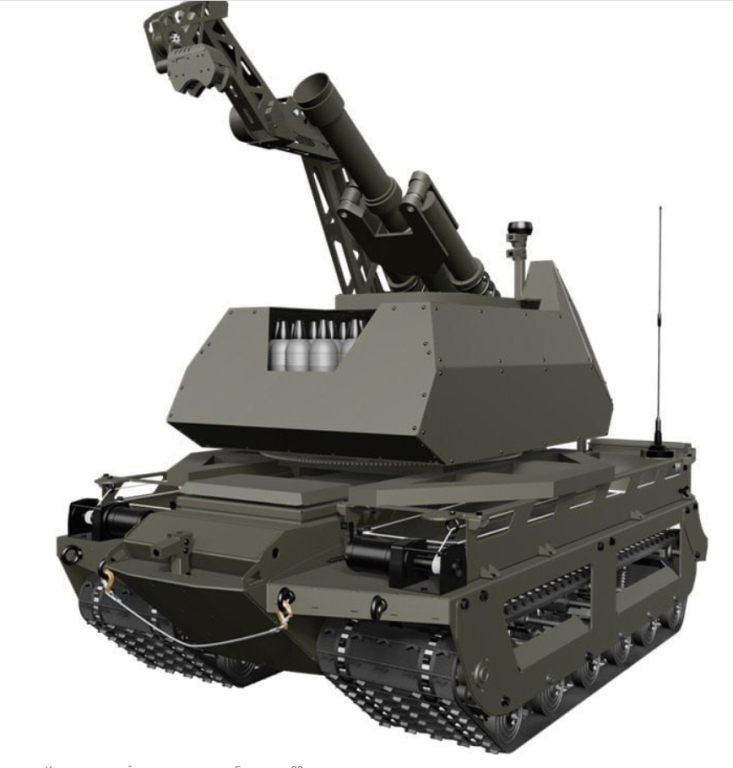
The system’s key feature is its automatic loading mechanism. Instead of a simple mechanism, it uses a robotic arm that picks up the mine and lowers it into the barrel.
On paper, it looks like a sound approach. In practice, however, it creates several problems at once:
— complex mechanics with many moving parts —
highly susceptible to dirt, snow, and
debris — risk of malfunction during intense fire
Such a system essentially mimics human actions, but it does so through complex mechanics, which are, by definition, less reliable.
This is where the main question arises: Is such complexity justified for a weapon that has traditionally been valued for its simplicity?
Platform Vulnerability
The mortar itself is mounted on a lightweight unmanned chassis. And that’s yet another weak point.
During a shooting:
—
Recoil occurs — the center of gravity shifts —
the risk of tipping over increases
These problems are common to light UGVs in general, but they are exacerbated in the case of a mortar.
Let’s add this:
— Vulnerability to FPV drones —
Dependence on
communication — Limited protection
And we end up with a system that, in theory, reduces the risk to the crew, but remains extremely vulnerable itself.
Rate of Fire vs. Reliability
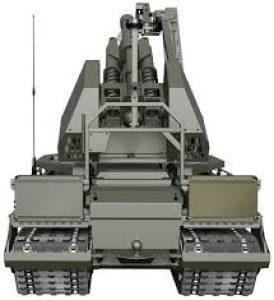
An automatic loading mechanism offers a certain advantage—the ability to maintain a steady rate of fire without human intervention. In demonstrations, reloading takes just a few seconds.
But this raises a classic dilemma:
The more complex a system is, the higher the probability of failure.
In real combat situations, where:
—
dirt —
debris —
vibrations — damage
Any complex mechanism tends to perform worse than it does in the lab.
Automation Without Simplification
The main problem with “Bagulnik” is not that it is a robotic system. The problem is that automation has not led to simplification.
Ideally, the robot should:
— be cheaper
— simpler
— easier to replace
Here, however, the opposite is true:
— complex
design — expensive
components — high maintenance requirements
In fact, this is an attempt to adapt a classic mortar for use on a robot without revising the weapon’s architecture itself.
So, in the end,
“Bagulnik-82” is a prime example of a transitional phase.
On the one hand, there is a clear desire to get people out of the danger zone.
On the other hand, there is no simple and reliable solution to this problem.
The system is operational, it fires, and it is being demonstrated during tests.
But the question remains:
to what extent it is suitable for widespread use in actual combat conditions.
Conclusion
The concept of a robotic mortar is logical and in high demand.
However, implementing it using complex mechanics makes the system vulnerable.
In modern conflicts, it is not the most technologically advanced system that wins.
Rather, it is the one that:
— easier
— more reliable
— replenishes faster
And it is precisely in these areas that “Bagulnik” still raises too many questions.