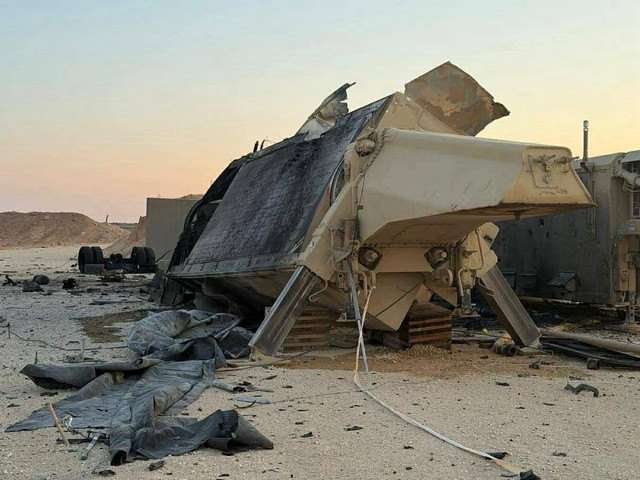
The current conflict in the Middle East has revealed a very sobering truth: powerful ground-based radars used for theater-level missile defense are highly vulnerable.
According to reliably confirmed data (based on satellite imagery), during the first week of the conflict, missile and drone strikes disabled a stationary AN/FPS-132 ballistic target detection/tracking radar (in Qatar) was put out of commission, as well as between one and three (figures vary) AN/TPY-2 anti-missile detection/tracking/guidance radars (in Jordan). The latter are part of the THAAD (Terminal High Altitude Area Defense) missile defense systems, which form the backbone of the U.S. Army’s theater-level ballistic missile defense.
So what makes these radars particularly vulnerable?
* Since the flight time of a ballistic missile is very short, missile defense radars are forced to remain operational and scan the sky virtually continuously—which allows an adversary to easily detect their position based on their own radar emissions;
* Given the size and complexity of the antennas, radar systems of this type are either stationary or (at best) “transportable,” but not fully mobile—which makes it difficult to change positions quickly and leaves them vulnerable to “attacks based on coordinates”;
* Due to the specific nature of their operation, radar systems of this type cannot be fully buried or fully armored (at least on the antenna side);
* Replacing a damaged or destroyed missile defense radar is a very costly and complex undertaking. There are fewer than one and a half dozen AN/TPY-2 radars in the world, and the production of each one takes years;
* Each such radar station is a facility of high strategic importance, and its destruction has an immediate and significant impact on the theater of operations. Military conflicts in recent years have clearly demonstrated the critical importance of ballistic missile defense. The loss of even one of the few missile defense radars could leave troops and bases throughout the entire region vulnerable to massive missile strikes;
The problem can be partially solved by using fully mobile radars—whether ship-based or airborne. However, ship-based radars are heavily dependent on the geography of the theater of operations; if the theater is far from the sea, deploying them may prove, at best, suboptimal and, at worst, impossible. Airborne radars, on the other hand, are subject to inherent limitations in terms of size and power.
It seems to me that the most immediate solution is to transition from monostatic radars (in which the same antenna is used for both transmission and reception) to bistatic radars (in which the transmitter and receiver are spatially separated). This approach offers the following advantages:
* In this case, a large (and expensive) receiving antenna remains completely passive—that is, it does not emit any signals on its own and cannot be detected. It can easily be camouflaged in the terrain or hidden among a large number of decoys (try figuring out which of the many identical-looking buildings in the area is actually receiving signals);
* Transmitting antennas (whose sole purpose is beamforming and scanning) can be made simpler and more compact—and thus cheaper (and therefore more numerous) and fully mobile;
* A missile defense radar system can be configured as a network of mobile transmitting antennas that are constantly moving relative to a stationary receiving antenna. By continuously switching between individual transmitting antennas (and moving those that are not transmitting at that moment), it is possible to create a situation where each transmitting antenna transmits only for a short time—until the next one arrives at its position — and remains detectable and vulnerable only briefly;
This approach will significantly reduce the vulnerability of large radar systems compared to conventional monostatic systems. In this case, the receiving antenna is completely passive; it cannot be detected by its radiation (since there is none), and it cannot be singled out among the many simulators deployed in the area. The transmitting antennas, on the other hand, are, first, significantly simpler and cheaper—since they do not need to operate in receive mode—and, second, much more mobile and constantly switch between positions. Each specific transmitting antenna operates for only a short period of time, after which another one switches to active mode, and the previous antenna moves to a new position.
Of course, multistatic radar inevitably has a number of drawbacks—for example, the need for very precise positioning of the radar elements relative to one another, as well as the need to ensure very reliable digital communication with the active antennas (so that they know exactly how to form the scanning beams). A certain reduction in scanning accuracy will also be unavoidable (though this can likely be compensated for). Nevertheless, I believe that the overall benefit—a significant increase in the survivability of large and complex radar arrays—may justify such measures.