When a computer overheats, the usual advice is to clean it, improve the airflow, and check the fans. SpaceX proposes a far more radical relocation: send computing hardware into orbit. Up there, no clouds block the solar panels, there is no need to find land near a powerful electricity supply, and the surrounding environment is the vast emptiness of space.
At first glance, it sounds like the perfect location for a huge data centre. Especially if you forget that a fan is useless in a vacuum.
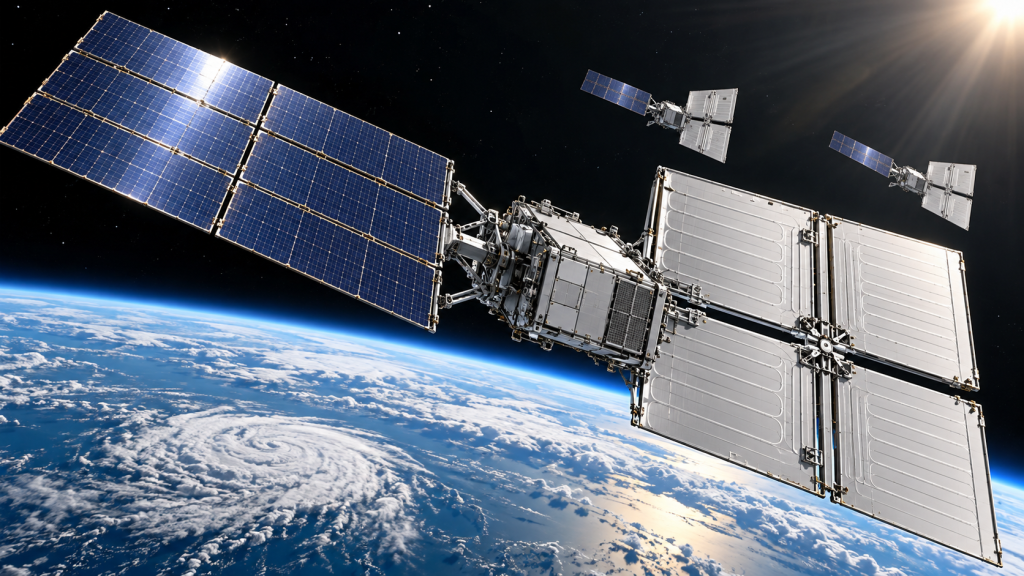
The project is called Starmind. SpaceX wants to build a network of satellites carrying computing hardware for artificial intelligence. The company’s website lists up to 250 kilowatts of peak power and 175 kilowatts of average power for each satellite’s computing payload. Those figures alone raise a difficult engineering question: where does all the heat from a flying server room go?
The Power Plant Flies with the Computer
The idea has a very down-to-earth motivation. Building a data centre involves more than buying processors and putting up a building. It needs electricity, network connections, and cooling. At high power levels, a suitable location becomes a valuable resource in its own right.
In orbit, the solar panels can travel with the servers. Particularly attractive are orbits that follow the boundary between day and night: with the right orbital parameters, a satellite receives sunlight almost continuously. Google’s Suncatcher project is exploring a similar approach.
The solar power installation would nevertheless be substantial. Using the original report’s figure of 250 watts of electrical output per square metre, generating 250 kilowatts would require 1,000 square metres of panels. That is straightforward arithmetic, before allowing for losses, solar-cell degradation, or power consumed by the satellite’s supporting systems.
Imagine a square nearly 32 metres on each side. It must then be folded for launch, survive the rocket’s vibrations, and unfold in space. And alongside the solar panels, another large structure will have to deploy.
Space Is Cold, but the Computer Does Not Know That
On Earth, heat can be transferred to air or water and carried away. Around a satellite, there is virtually no air. A cooling fluid inside the spacecraft can collect heat from the processors, but that heat still has to go somewhere.
Spacecraft therefore use radiators: specialised surfaces that emit infrared radiation to shed heat. Their performance must be calculated with sunlight, Earth’s radiation, and the spacecraft’s orientation in mind.
Almost all the electricity consumed by computing equipment eventually becomes heat. Even if an AI produces a magnificent sonnet, most of the energy spent creating it remains inside the satellite. That energy must be carried from the chips to the radiators and radiated into space.
This explains the unusual appearance of an orbital data centre. A block of electronics, relatively small compared with its deployed structures, will be surrounded by enormous surfaces: some collect solar energy, while others help dispose of it.
Easier Cooling Could Mean Running Hotter
Radiators have a useful property: as their temperature rises, they emit substantially more energy. Thermal radiation depends on the fourth power of absolute temperature, measured in kelvins.
For illustration, an ideal radiating surface at 100°C emits roughly 1.8 times as much energy as one at 50°C. That calculation assumes equal surface area and properties, without external heating.
This creates an incentive to let the equipment run hotter. Higher coolant and radiator temperatures can reduce the required cooling surface — and therefore the mass that must be launched into orbit.
But a chip’s temperature and a radiator’s temperature are different. Heat still has to pass through materials and connections, and every component must remain within its operating limits. Setting a processor’s temperature close to 100°C does not solve the problem by itself. NASA specifically emphasises the need to consider the temperature limits of both the equipment and the cooling hardware.
Engineers will have to find an operating regime in which the satellite radiates heat effectively while its expensive electronics last long enough.
Flying Servers Need to Stay Close Together
Another problem emerges when several satellites work on the same computing task. They need to exchange data quickly. If communication is slow, some expensive hardware will spend its time waiting for neighbouring machines rather than doing useful work.
That is the reasoning behind compact orbital clusters. Satellites communicate through optical links and attempt to maintain short distances between them. Google is researching a similar architecture: solar-powered spacecraft carrying processors and connected by a laser network.
On Earth, server racks are bolted to the floor, with cables running between them. In orbit, every member of the cluster is moving, experiencing disturbances, and maintaining its position relative to the others. Each laser link also has to point accurately at its receiver.
The result is an unusual server room in which every rack is an independent spacecraft. It must compute, cool itself, collect sunlight, and stay connected to its neighbours simultaneously. Fast data transfer depends partly on how well the entire cluster flies.
A Million Satellites Would Need Constant Replacement
One million spacecraft is the scale specified in SpaceX’s application. The FCC notice located during verification confirms that the application was accepted for filing and opened for public comment. It does not authorise deployment of the entire constellation.
Even as a proposed upper limit, the figure is extraordinary. Consider the hypothetical scenario in the original report: each satellite weighs four tonnes and lasts five years. These are assumptions for assessing the scale, rather than established specifications for the future system.
Maintaining one million operating spacecraft would require replacing an average of 200,000 satellites annually. Their combined mass alone would reach 800,000 tonnes a year, excluding rockets, propellant, and ground equipment. That works out to roughly 550 new satellites every day.
Nor should five years be treated as a proven, universal lifespan for processors in space. The outcome depends on the orbit, radiation shielding, electronics design, and acceptable failure rate. All of this needs testing aboard real spacecraft.
Those first steps are already being taken. On 1 October, Google announced that a Suncatcher prototype had reached orbit to investigate how its processors perform under spaceflight conditions.
SpaceX planned to begin demonstrating orbital computing in 2027. There is still a considerable distance between such tests and a vast commercial network.
Starmind has an understandable appeal: collect energy where solar panels face little interference from night or weather. The next challenge is turning that energy into computing cheap enough to justify the launch, cooling, and replacement costs. And when the first server freezes somewhere above Earth, sending an administrator over with a spare power supply will no longer be an option.