On April 19, 2019, Toronto was supposed to host an almost perfect philosophical showdown for the internet age. On one side stood Jordan Peterson, the Canadian psychologist who by then had become one of the world’s best-known public critics of Marxism, political correctness, and the contemporary radical left. On the other was Slavoj Žižek, the Slovenian philosopher who openly drew on the Marxist tradition and had long enjoyed a reputation as perhaps the most famous “communist” among Western public intellectuals. Even the title of the event seemed to leave little room for ambiguity: “Happiness: Capitalism vs. Marxism.”
The roles appeared obvious. Peterson would defend capitalism; Žižek would defend Marx. One would attack the disastrous historical record of communism, while the other would expose the contradictions and injustices of capitalism. The audience would listen, decide whose arguments were stronger, and choose a winner.
But somewhere in the middle of the discussion, something strange became apparent. Peterson had indeed come prepared to argue against Marxism. Žižek, however, had almost no intention of defending the kind of Marxism Peterson had prepared to attack. Even more surprisingly, the two men repeatedly discovered points of agreement so substantial that the advertised ideological confrontation itself began to look almost misleading.
And that is precisely why the debate remains more interesting than its original billing.
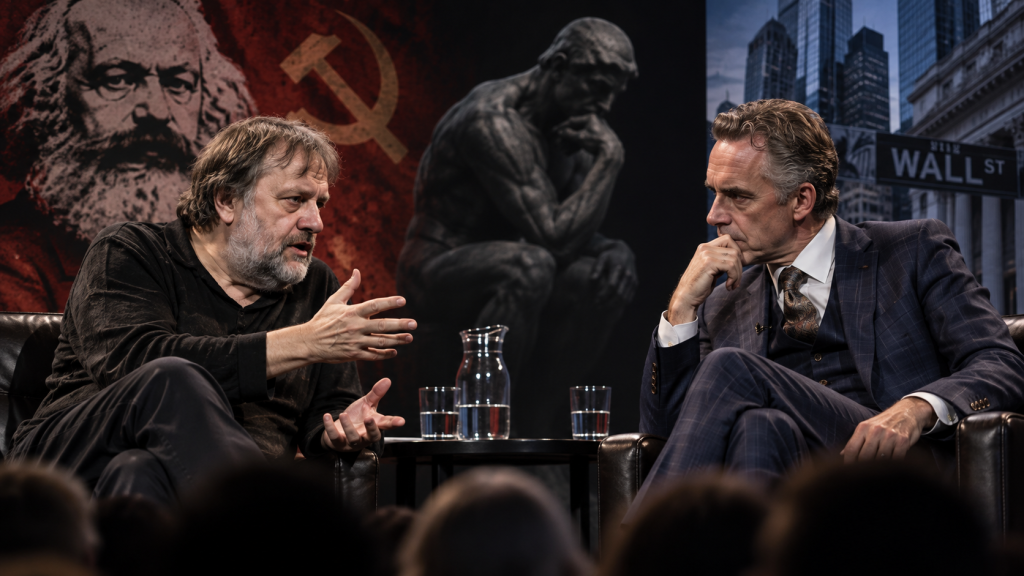
Peterson Prepared for Marx
https://youtu.be/lsWndfzuOc4?si=PoIos8_fQcGhBRen
Peterson approached the assignment quite literally. If the debate was called “Capitalism vs. Marxism,” then Marxism itself had to be examined first. A substantial part of his opening statement was therefore devoted to The Communist Manifesto. Peterson attacked several of its fundamental propositions: the interpretation of history primarily through class struggle, the division of society into antagonistic classes, the moral elevation of the proletariat over the bourgeoisie, the insufficient attention paid to other forms of human hierarchy, and the assumption that abolishing private property could eliminate the fundamental causes of social conflict.
There was a coherent logic behind the argument. Human society, Peterson maintained, is far too complicated to be reduced to a single axis — rich against poor, owners against workers. People organize themselves into countless hierarchies based on competence, education, status, attractiveness, professional success, and many other characteristics. Even if economic inequality could somehow be abolished, envy, competition, status seeking, and differences between individuals would remain.
For Peterson, therefore, the problem with classical Marxism runs considerably deeper than economics. He regards the very attempt to explain the immense complexity of society primarily through a struggle between oppressors and oppressed as fundamentally mistaken.
As an opening position, it was powerful.
There was only one problem.
The man sitting opposite Peterson was already familiar with much of this criticism — and shared a surprising amount of it.
When Peterson later asked Žižek why a thinker with such an unconventional philosophy continued to associate himself with Marxism at all, Žižek gave a revealing answer. He explained that he had long rejected many traditional Marxist assumptions. What interested him was not the utopian side of Marxism or the simplified formulas of the Manifesto, but Marx’s analysis of capitalism’s dynamics and more sophisticated political works such as The Eighteenth Brumaire of Louis Bonaparte.
More importantly, Žižek described his own intellectual position through a seemingly paradoxical move: not forward from Marx, but backward toward Hegel. The Marxist confidence that history has a direction — and that people can understand this direction and consciously become agents of historical transformation — was itself something Žižek regarded with suspicion.
And at that point, the entire structure of the debate began to wobble.
Peterson had prepared to attack an ideology according to which history has a direction, capitalism is doomed, the proletariat is the historical agent of transformation, and revolutionary change can create a fundamentally more just social order.
Žižek’s response was, in effect: I don’t believe we know where history is going either.
So what exactly were they supposed to argue about?
Then Where Are the Marxists?
The real confrontation began somewhat later — and this time on Peterson’s territory.
Žižek turned his attention to a concept Peterson had frequently used: “postmodern neo-Marxism.” Peterson used the term to describe an intellectual tendency in which the old Marxist framework of class struggle had supposedly been transferred to identities. Instead of bourgeoisie and proletariat, politics was increasingly organized around different groups of oppressors and oppressed.
Žižek asked an extraordinarily simple question:
Who, specifically, are these neo-Marxists?
The question was uncomfortable precisely because Žižek knew the intellectual territory extremely well. He asked for names and himself pointed toward genuine contemporary Marxist thinkers such as David Harvey and Fredric Jameson, while emphasizing that they were hardly the central figures of the politically correct cultural mainstream Peterson was attacking.
Peterson’s answer was more substantial than some later summaries of the debate suggested. He acknowledged the obvious theoretical contradiction: postmodernism is deeply suspicious of grand universal theories of history, while Marxism is itself precisely such a theory. Peterson nevertheless argued that the connection had emerged differently. After the moral catastrophe of the Soviet and Maoist experiments, he suggested, the old conflict of bourgeoisie versus proletariat had been repackaged into a universal model of oppressor versus oppressed, with identities replacing economic classes.
It was the preservation of this conflict structure that Peterson regarded as the Marxist inheritance.
And then came a small but revealing philosophical trap.
Žižek largely agreed with Peterson’s description of the mechanism.
But then he pointed out: this transformation of class politics into identity politics is precisely what makes it non-Marxist.
The disagreement becomes almost elegant in its simplicity. Peterson says: look, the Marxist structure survived; only classes were replaced by identities. Žižek replies: if you removed economic relations, class structure, and the project of changing the organization of society, why continue calling the result Marxism?
Here Žižek gained a genuine advantage. Not because he proved that radical left-wing politics or identity conflicts did not exist, but because he forced Peterson to defend the precision of his terminology. Peterson himself acknowledged the theoretical contradiction between postmodernism and Marxism, even while maintaining that a practical political synthesis between elements of the two was possible.
But then something even stranger happened.
It turned out that Žižek also despised much of the cultural phenomenon Peterson was criticizing.
Two Opponents Suddenly Discover a Common Opponent
One might have expected Žižek to defend political correctness, contemporary identity politics, and the radical academic left.
Instead, he attacked them himself — but from the opposite direction.
For Peterson, excessive fixation on identity is dangerous because it encourages individuals to understand the world as an endless struggle between groups and undermines the principle of individual responsibility.
For Žižek, the problem is almost the reverse: contemporary identity politics is not radical enough. It endlessly debates language, symbols, cultural representation, and proper forms of interpersonal behavior while potentially leaving the organization of the economy and the distribution of actual power largely untouched.
Žižek describes this tendency as a kind of hyper-moralization and effectively interprets it as an admission of political defeat: when changing the structure of society appears impossible, politics retreats into regulating behavior and language. That is precisely why he refuses to regard this politics as a genuine continuation of Marxism.
The difference between Peterson and Žižek remains substantial, but the front line suddenly moves.
Peterson says: do not reduce the individual to membership in a group.
Žižek says: do not mistake cultural struggle for changing society.
And both end up attacking the same phenomenon from opposite philosophical positions.
But the real strangeness of the debate appears somewhere else entirely.
It emerges when the two men finally turn to the word placed at the very center of the event’s title.
What If Happiness Shouldn’t Be the Goal at All?
Formally, Peterson and Žižek were supposed to discuss happiness under capitalism and Marxism. The question seemed almost measurable: which system produces more prosperity, freedom, security, and opportunity?
Žižek instead dismantled the premise.
He is deeply suspicious of the idea that human beings genuinely want to be happy in any simple sense. Our desires are contradictory. We can spend years pursuing something only to discover, once we obtain it, that we no longer want it. We can unconsciously create obstacles to our own desires. Sometimes a person needs not so much to obtain the desired object as to preserve the possibility of continuing to desire it.
Building a society that simply “gives people what they want” is therefore considerably more complicated than it appears.
And here Peterson suddenly finds himself remarkably close to Žižek.
For Peterson, happiness has never been the central criterion of a good life either. Human existence inevitably contains suffering, loss, illness, and death. The task, therefore, is not to maximize pleasure but to find meaning, accept responsibility, and become capable of voluntarily carrying a necessary burden.
One reaches this conclusion through psychoanalysis, Hegel, and Lacan.
The other through psychology, religious narratives, and the idea of individual responsibility.
Yet the conclusion sounds surprisingly similar:
A person who makes happiness the direct goal of life may, precisely for that reason, fail to achieve it.
At this point, the expected debate between capitalism and Marxism almost completely stops functioning.
Because the two supposed ideological enemies unexpectedly agree on something much more fundamental: a rather pessimistic understanding of human nature.
Žižek Turned Out to Be Too Pessimistic a Marxist
One of Peterson’s classic objections to revolutionary politics is that it is excessively optimistic about human beings. If social conflict is assumed to arise primarily from defective social relations, it becomes tempting to believe that changing the system will produce a new kind of person.
Žižek once again refuses to play the role assigned to him.
He openly says that he does not believe in human goodness, has no intention of underestimating evil, and considers envy especially important. To illustrate the point, he tells an old Slovenian story: God offers a peasant anything he wants, but warns him that his neighbor will receive twice as much. The peasant thinks for a moment and replies: take one of my eyes.
The joke carries a serious argument. A political theory cannot safely assume that once exploitation disappears, people will automatically become rational, benevolent, and cooperative. Žižek explicitly distances himself from such optimistic anthropology.
And this leaves Peterson without the opponent he expected.
Because much of Peterson’s criticism of revolutionary Marxism is built precisely on distrust of utopian assumptions about human nature.
The “Marxist” sitting opposite him effectively replies:
I don’t trust them either.
But that does not mean the argument is over.
On the contrary, only now does the genuinely interesting disagreement begin.
Peterson Fears the System. Žižek Fears the System Won’t Be Enough
Strip away the political labels and the fundamental difference between the two men becomes much easier to see.
Peterson begins with the individual.
Human beings are imperfect, limited, envious, status-conscious, competitive, and prone to error. Every social system will reflect these characteristics. That is precisely why projects promising to radically reconstruct society are so dangerous: the concentration of power required to implement them may create something far worse than the injustice they were intended to eliminate.
Change should therefore begin primarily with the responsibility of the individual, while large-scale social engineering should be approached with extreme caution because its consequences cannot be reliably predicted.
Žižek approaches the problem from the other direction.
Yes, human beings are imperfect. Yes, revolutionary experiments can end catastrophically. Yes, capitalism has demonstrated an extraordinary ability to generate wealth, adapt, innovate, and survive its own crises.
But another question remains:
What do we do with problems that individual action cannot solve?
Ecological threats, biotechnology, global economic processes, and the management of common resources are, for Žižek, examples of situations in which individual responsibility is necessary but potentially insufficient. This is where his continued interest in the communist idea emerges — not necessarily as a ready-made Soviet-style system, but as a question about mechanisms for collectively managing things that cannot simply be left to private interests.
And here the real debate finally appears.
Peterson fears what happens when we give a system too much power to correct imperfect human beings.
Žižek fears what happens when we place too much faith in the ability of imperfect individuals, acting separately, to solve systemic problems on their own.
That is a far more serious disagreement than “capitalism good, capitalism bad.”
And it has no simple answer.
So Who Actually Won?
After the debate, the internet almost inevitably tried to declare a winner. Some gave the victory to Žižek because Peterson appeared insufficiently prepared for contemporary Marxist philosophy. Others favored Peterson because Žižek never offered a convincing alternative to capitalism.
But the question itself misses something important.
Peterson did reveal a weakness in his preparation: he arrived primarily with a critique of The Communist Manifesto, while the philosopher sitting opposite him had long ceased to understand Marxism primarily through the Manifesto. Žižek, meanwhile, successfully challenged Peterson’s broad category of “postmodern neo-Marxism” and forced him to explain more precisely what he meant by it.
But Žižek did not “destroy capitalism” either. He offered no finished system to replace it. In fact, his own position was strikingly pessimistic: humanity faces serious problems, yet we possess no ready-made blueprint for the future.
And that is why the debate of April 19, 2019 turned out to be far more interesting than its advertising promised.
The audience came to watch capitalism collide with Marxism.
Instead, it got a conversation between two pessimists.
One was asking:
How do we change the world without making it dramatically worse?
The other:
What if not changing it is no longer an option?
Perhaps that is why there could never really be a definitive winner. Peterson came to demolish Marxism. Žižek refused to defend the Marxism Peterson had prepared to demolish. And after more than two hours, both men were left facing a far more uncomfortable problem.
Not the choice between capitalism and communism.
But the question of how we can build a society at all if human beings are imperfect, perfect systems do not exist, and some problems still require collective solutions.
And neither Jordan Peterson nor Slavoj Žižek had a ready answer to that.