The Aircraft Is Still Beyond the Horizon—But America’s 180 Antennas Can Already See It

The HAARP facility in Alaska has an extraordinary reputation. It has been accused of controlling the weather, triggering earthquakes, and even manipulating the human mind. Its real work has always been rather less dramatic: the powerful transmitter was used to study the ionosphere and conduct experiments in long-range radio communication. Now this Cold War legacy has found a new purpose—helping the military detect aircraft beyond the reach of conventional radar.
In September 2026, HAARP became the transmitting element of an experimental over-the-horizon radar system. The facility at Gakona beamed high-frequency signals toward the ionosphere, while a new 16-element receiving array developed by MITRE and installed at Cold Bay attempted to detect aircraft over the Bering Sea and the Gulf of Alaska. The trials marked the final stage of a three-year US-Canadian program seeking an affordable way to close the enormous gaps in radar coverage across the Arctic.

Radar Meets the Horizon

Conventional radar is almost always constrained by the curvature of the Earth. The lower an aircraft or cruise missile flies, the later it appears above the radar horizon. More stations can be built, antennas can be raised, or airborne early warning aircraft can be kept constantly in the sky, but all three solutions become exceptionally expensive in Alaska. Distances are vast, roads are scarce, and supplying and maintaining a remote outpost can quickly turn into a military operation of its own.
Over-the-horizon radar approaches the problem differently. Instead of directing a shortwave signal straight at the target, it sends it upward. The ionosphere bends the radio waves back toward the Earth’s surface, allowing the radar to monitor areas hidden beyond the normal horizon. A single installation can watch an enormous region that would be far beyond the reach of a conventional ground-based station.
The Alaskan experiment divided the work between two widely separated sites. HAARP, with its field of 180 antennas and a transmitter capable of delivering up to 3.6 megawatts, served as a giant “flashlight,” while MITRE’s comparatively small station listened for the returning signals. This is known as a bistatic arrangement: the transmitter and receiver are located in different places. The experiment paired an old and extremely powerful facility with a new low-cost receiver to determine whether a useful system could be created without constructing another radar giant.
Cooperative Targets in the Sky
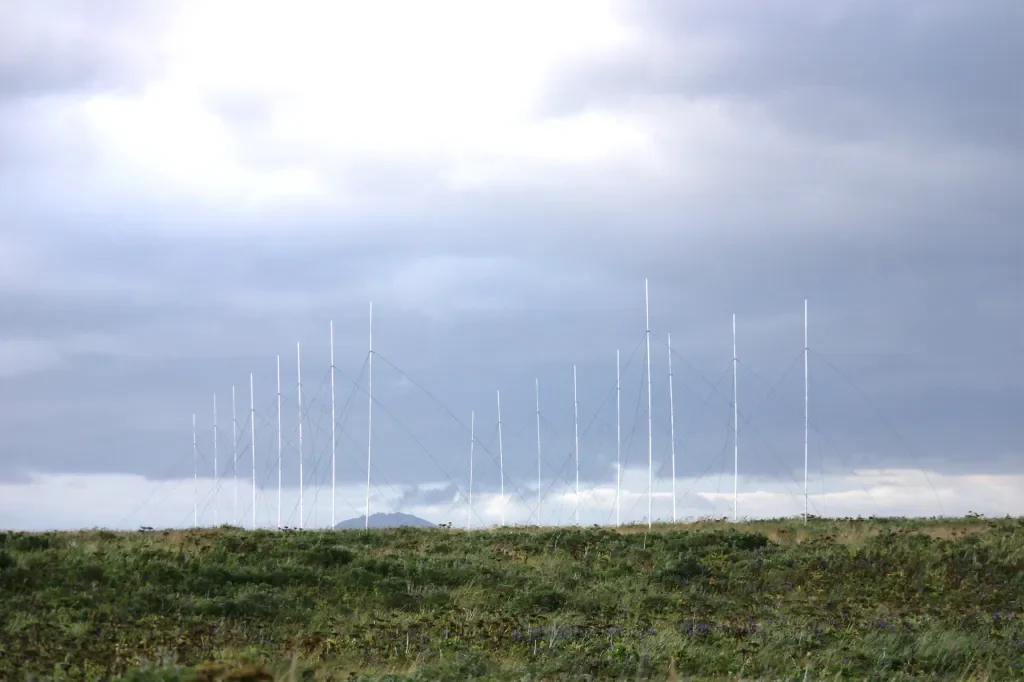
The military did not limit the experiment to computer simulations. E-3 Sentry airborne warning aircraft, KC-135 tankers, and HC-130J search-and-rescue aircraft flew over the sea. Their precise positions were known to the researchers, allowing detections made by the experimental system to be compared directly with each aircraft’s actual location.
The preliminary results were encouraging. The system achieved genuine skywave detections beyond the horizon, and its observations correlated with the routes of the cooperative aircraft. A detailed analysis of the data is still underway, so the military has not disclosed the system’s maximum range, tracking accuracy, or ability to distinguish between closely spaced targets.
That uncertainty points to the principal weakness of this kind of radar. It can reveal activity hundreds or even thousands of kilometres away, but it generally cannot produce the same clear picture as a conventional radar. The ionosphere continually changes with the time of day, solar activity, and geomagnetic conditions. Along with aircraft returns, the receiver must deal with large amounts of interference and reflections from the surface. An over-the-horizon radar is good at answering the question, “Has something appeared out there?” Precise identification and weapons guidance still require other sensors.
Why HAARP?
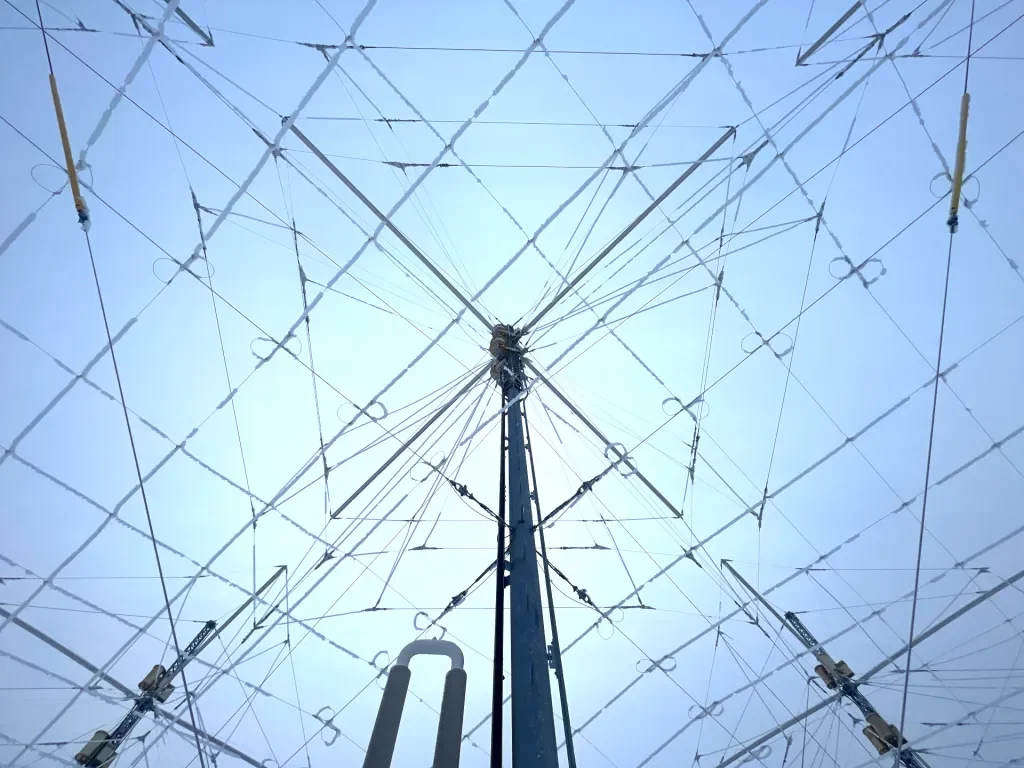
HAARP was built in the 1990s with the involvement of the US Air Force, US Navy, and DARPA. In 2015, the facility was transferred to the University of Alaska Fairbanks and became a civilian research site. Its vast antenna field, however, remained in place. For the new experiment, the military did not have to construct a powerful transmitter from scratch—one already existed in an almost ideal location.
There is no confirmation that HAARP will be permanently transformed into an operational element of an early-warning network. Officially, this was only an experiment intended to show how existing infrastructure could be combined with emerging technology. Any suggestion that the facility will receive a permanent military role remains speculation for now.
The problem itself is not going away. The existing North Warning System was designed primarily to watch approaches across the polar region. American and Canadian forces must now also monitor maritime approaches, low-flying cruise missiles, and aircraft arriving from less predictable directions. Placing a conventional radar on every empty stretch of coastline is simply impossible.
The old HAARP facility has therefore proved useful for precisely what it has always really been: an exceptionally powerful radio transmitter designed to work with the ionosphere. This time, however, the signal returning from the sky is not being used for another scientific experiment. It is being used to spot an aircraft hidden beyond the curvature of the Earth—and that real mission may be more interesting than any of the legends that have surrounded HAARP for the past three decades.