The Thirteen Friends of Fieramosca: How a Drunken Tavern Quarrel Helped Create the Italian Nation

Thirteen French knights against thirteen Italian ones. The stakes: honour, weapons, horses and ransom. At the heart of the dispute was an insult supposedly made over wine in the company of prisoners. And on the field where the two sides met, the future of Italy was not at stake—the country did not yet exist—but a question that would mean much more to Italians three centuries later: could people from different lands think of themselves as one nation?
The fight took place on February 13, 1503, near Barletta in southern Italy. The Italians won. In military terms, it was a minor episode in the war for the Kingdom of Naples. But centuries later, novelists, artists, politicians and filmmakers turned it into a story of national pride. So the phrase “a drunken quarrel created the Italian nation” is a striking one, but it contains a measure of truth: the quarrel did not create a state, but it helped create the idea of a shared Italy.
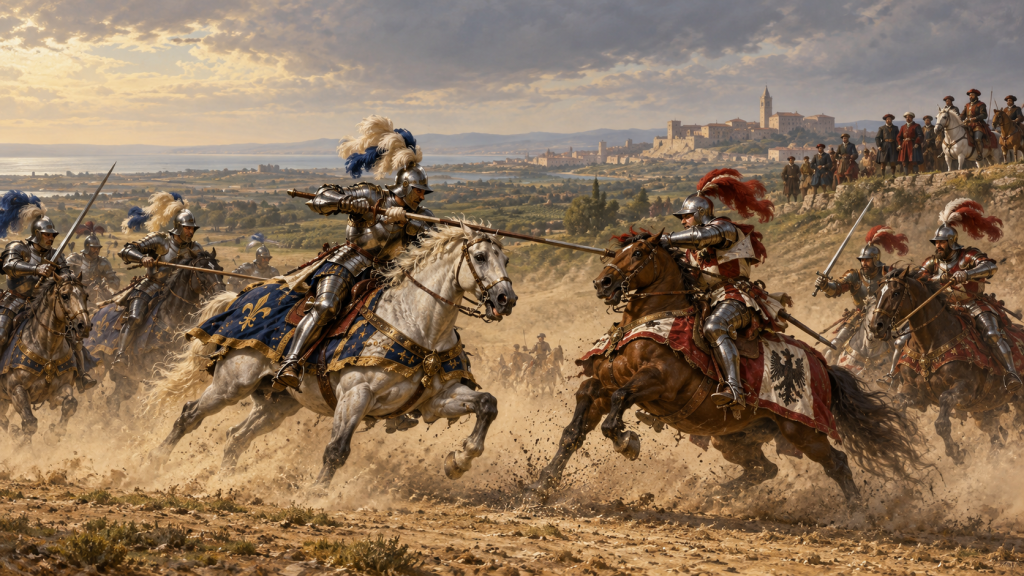
Italy before Italy
In the early sixteenth century, Italy was not a unified country but a peninsula divided among kingdoms, duchies, republics and the domains of powerful families. Cities formed alliances and abandoned them; military commanders changed employers in search of money and land. Italians fought one another and served the French, the Spanish and local rulers. The “Italian team” at Barletta was Italian by the knights’ origins, but it was not the army of an Italian state.
The chief prize in the struggle for control of the peninsula’s south was the Kingdom of Naples. Louis XII of France and Ferdinand II of Aragon had first agreed to divide it between them, then quarrelled over the spoils. War returned to Apulia. The Spanish commander Gonzalo Fernández de Córdoba took up position in Barletta, while the French surrounded the city and tried to cut its supply lines. Instead of one decisive battle, there were raids, skirmishes and cavalry clashes. The encounter between the thirteen knights grew out of this war of ambushes and raids.
Among the men fighting on the Spanish side was Ettore Fieramosca, a nobleman from Capua, a town near Naples. He had grown up at the court of the Aragonese kings and was not a man who suddenly rose to defend a homeland he had never known. His family had long served the Aragonese rulers of Naples. Like many soldiers of his time, Fieramosca found himself on one side in a world where military service, personal connections and political calculation were closely intertwined—more closely than later patriotic legends were willing to admit.
An insult over dinner
In the winter of 1503, the Spanish took French prisoners. Among them was a knight known in the sources as La Motte; later accounts give different versions of his name. The prisoners were invited to dine with their captors. According to the familiar story, the conversation turned to the military qualities of the French and Italians. La Motte supposedly praised the Spanish but called their Italian allies cowards who did not know how to fight.
The insult reached Prospero Colonna, an Italian commander in Spanish service. Another version says that a Spaniard, Íñigo López de Ayala, stood up for the Italians and boasted that his Italian soldiers were every bit as brave as the French. An argument followed, and the two sides agreed to settle it according to the rules of chivalry: thirteen men from each side would meet in combat.
In later retellings, the whole scene plays like a film: a long table, jugs of wine, a noisy company, an arrogant prisoner and a sudden wager on a duel. The historical episode is indeed associated with a dinner and an insult, but the exact words and details of that evening come from later accounts. The point was what lay behind the words: in armies where Italian and Spanish units fought together, a claim that Italians were cowards struck at the honour of specific allies.
Thirteen is a number with a fine dramatic ring, especially when the story is told centuries later. But the explanation that it was chosen because thirteen was an unlucky “baker’s dozen” should not be taken as fact. The number was part of the terms of the challenge; accounts of who proposed it and why call for caution.
Fieramosca and his men
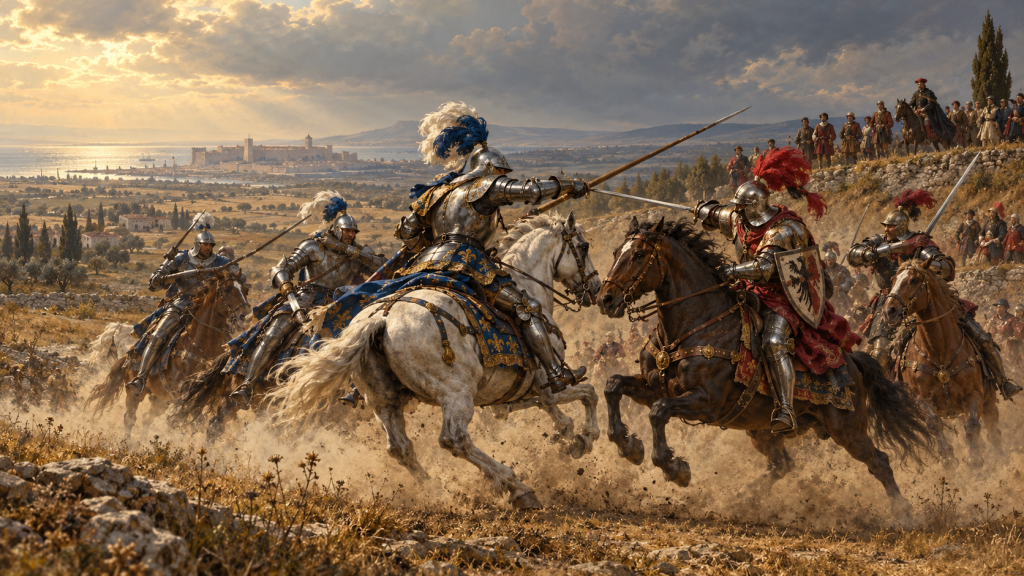
Prospero Colonna was tasked with assembling the Italian team. He chose fighters from among the men serving the Spanish, and Fieramosca became their captain. The participants included Gianni Capoccio, Gianni Bracalone, Francesco Salamone, Marco Corollario and Fanfulla da Lodi—the last of whom would acquire stories of his own.
These were not random men summoned after dinner to prove they had courage. They were professional soldiers for whom fighting on horseback was part of the trade. The stakes included their lives, their freedom and valuable equipment. Under the terms, the losers would surrender their horses and weapons, and ransom would be paid for prisoners. Later accounts often turn the terms into a prize fund, adding an exact sum for each winner. Those details should not be repeated as certain without reliable confirmation.
The French had no reason to treat the encounter as a joke, either. La Motte himself led them. And although later stories portray the French as overconfident and unprepared to pay, the challenge had been arranged in advance, with rules, judges and guarantees. It was a dangerous contest, but not a sudden brawl outside a tavern.
This is where it becomes especially easy to turn people into symbols. In the legend, Fieramosca already knows he is fighting for Italy. In reality, he fought for the honour of Italian soldiers and for his own reputation, while serving under a Spanish commander. Later, that combination—an Italian hero in a foreign army—became a powerful and convenient image: the country was still divided, but its sons were already capable of standing together.
The day of the challenge
On February 13, 1503, the teams met on a field between Andria and Corato. Soldiers and local people watched the contest. Later accounts described a vast crowd, with spectators filling the walls of neighbouring towns and the surrounding hills. It is difficult to confirm an exact number. A large gathering is entirely plausible, but “ten thousand spectators” is best left among the story’s attractive exaggerations.
The French began with a mounted charge. Accounts differ on the details, but the outcome is clear: the Italians withstood the attack, the French formation broke up, and the French fighters were gradually put out of action. Some were captured; others were driven from the field. La Motte lost to Fieramosca. The Italians were declared the winners and returned to Barletta with their prisoners.
That is why the familiar score of “13–0” works best as a modern joke, not as an exact tally. The Italians won, but this was not a story of thirteen Frenchmen killed and no Italian casualties. Treccani’s encyclopaedic account says that some Frenchmen were captured, others were driven from the field, and the Italians returned to Barletta with their prisoners.
People like to see the fight as a triumph of tactics over brute force: the Italians supposedly dodged the French charge, lured them into an awkward fight, then finished them with swords and axes. Particular manoeuvres may well have mattered. But the detailed choreography—who retreated where, who set a trap, and when the melee began—is often described with more confidence than the sources allow. Later accounts do more than say who won; they explain why the victory was deserved.
After the fight, the victors were welcomed in Barletta with honours. The French prisoners followed behind them. La Motte had to accept defeat and retract his words. It is a perfect ending: first the insult, then the fight, then a public admission of error. Even if the legend has adjusted some details, its dramatic structure is already complete.
A victory that did not decide the war
For the war between France and Spain, the encounter changed almost nothing. The struggle for Naples continued, and the campaign was decided by other battles. On April 28, 1503, the Spanish defeated the French at Cerignola; in May, Gonzalo de Córdoba occupied Naples. That was the work of armies, commanders, artillery and strategy—not thirteen mounted duels. Treccani’s biographical dictionary explicitly notes that the challenge had no decisive effect on the outcome of the war.
But the Challenge of Barletta had another life. To its contemporaries, it may have been remembered as a successful episode in the war and a source of pride for a particular city. It did not become a national symbol straight away. The story had three centuries of remembering, forgetting and reinterpretation ahead of it.
How a knightly duel became a national myth
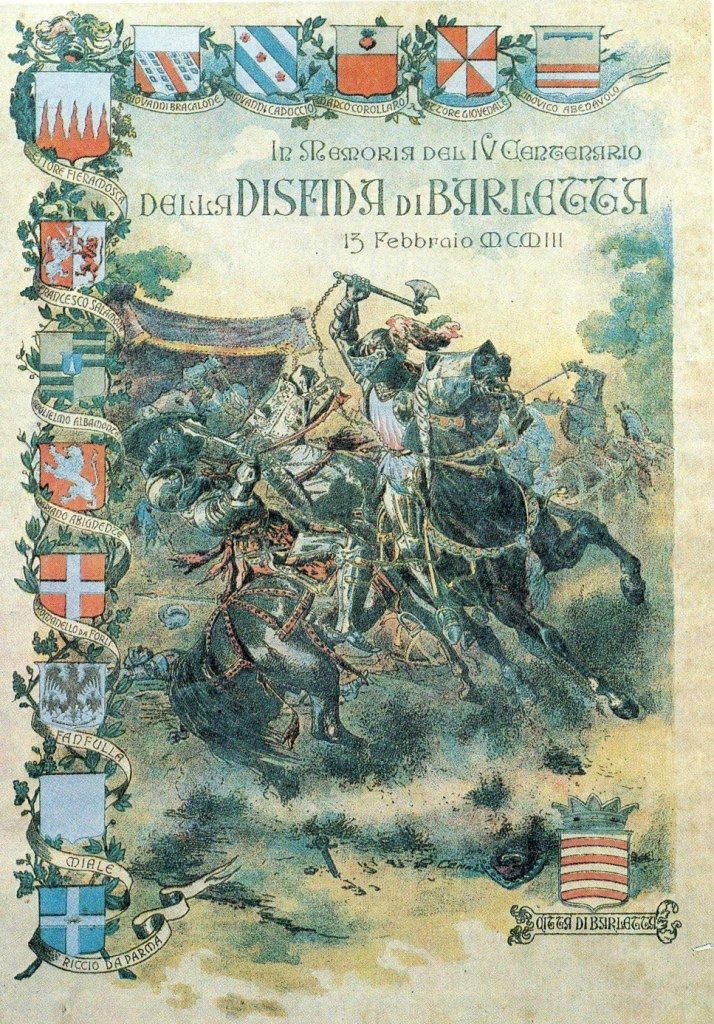
In 1833, the writer and politician Massimo d’Azeglio published the novel Ettore Fieramosca, or The Challenge of Barletta. It was not a documentary account. In the book, a love story and a series of adventures unfold against the image of an Italy ruled by foreigners. The heroes must prove that the ancient valour of the Italians has not disappeared.
D’Azeglio did more than retell an old event. He gave it a meaning his nineteenth-century readers could understand, at a time when Italy remained divided and subject to strong foreign influence. Treccani notes that the writer wanted to create a novel that ordinary people could understand and that would “set the Italians alight.” Other scholars describe the Challenge of Barletta as a myth that strengthened a sense of national community in a country only then taking shape as a unified state.
Fieramosca thus became, for new generations, a hero who seemed to fight for Italy before Italy existed. It did not matter, in this version, that the historical knights served the Spanish or that their victory did nothing to stop the Spanish conquest of the south. A national myth does not have to be a battle report. Its power lies elsewhere: it selects a scene from the past in which people can recognise themselves and find the answer they want.
In the nineteenth century, Italians needed an answer to the question of whether they shared something beyond borders, local interests and different rulers. The story of the duel offered a vivid image: thirteen fighters from different lands stand together, answer for one another’s honour and defeat a stronger opponent. To a historian, the picture is incomplete. To the national imagination, it is almost perfect.
Later, the story found its way into monuments, school lessons, paintings and films. Each new retelling added its own colour. In some versions, Fieramosca became an almost flawless hero; in others, his comrades came to the fore. The tavern where the argument supposedly began became a place of remembrance. It became easier to imagine the legendary evening as the starting point: there is the table, the insult, the challenge—and a few weeks later, a field where the Italians prove their worth.
What Barletta “created”
The Challenge of Barletta did not create Italy in the way that treaties, armies and political decisions create a state. In 1503, it did not unite the peninsula or persuade Italians to stop serving foreign monarchs. But centuries later, the story of the challenge became part of a shared narrative about Italy. It turned a complicated past into a simple image: the country might be divided, but its honour could be shared.
In that sense, the legend is more than decoration, and it does more than conceal awkward details. It became a historical fact in its own right. The real fight took place in 1503; the national meaning attached to it came later—in novels, monuments and collective memory.
A drunken quarrel in a tavern did not create the Italian nation in a single evening. But it became a story in which that future nation could see itself. Perhaps that is why the thirteen knights of Fieramosca outlived the kings they fought for.