Two Charges on a Tanker’s Hull: Why Limpet Mines Have Again Become the Strait of Hormuz’s Greatest Fear

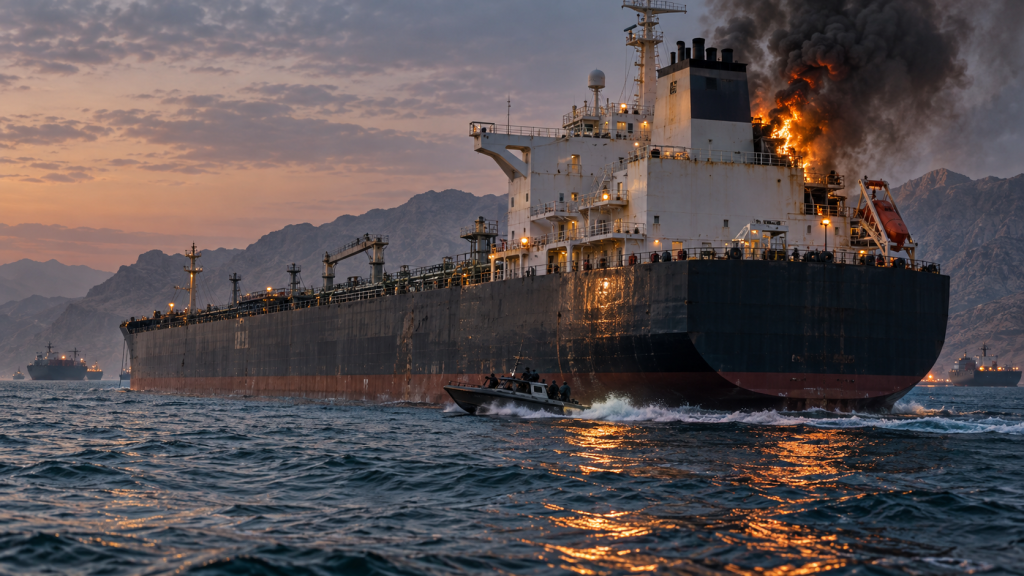
The attack on the tanker Louise 1 required no ballistic missiles, strike drones, or naval mines waiting beneath the surface. A small boat approached the vessel while it was transiting the Strait of Hormuz. Two explosive devices were attached to the hull, and the boat withdrew. One of the charges detonated, starting a fire in the engine room.
According to the United Kingdom Maritime Trade Operations center, the devices were placed above the waterline. Sources cited by the Financial Times and Reuters claimed that Iranians had carried out the attack using limpet mines. No publicly available investigation has yet conclusively identified those responsible, but the method closely resembles attacks conducted in 2019.
At first glance, such an operation appears remarkably primitive for one of the world’s most important maritime routes. In reality, that simplicity is precisely what makes it so dangerous. An inexpensive mine delivered by an ordinary boat can disable a multimillion-dollar tanker, increase insurance rates, disrupt shipping, and help push oil toward $120 per barrel.
A mine that does not have to find its target
This type of magnetic explosive device is known as a limpet mine, named after the marine mollusk that clings tightly to rocks and ships’ hulls.
The device is attached to a vessel’s metal plating with powerful magnets. Inside are an explosive charge and a fuse, which may be timed, remotely activated, or triggered by predetermined conditions. There is no need to penetrate the hull, board the ship, or gain access to its interior. The attacker simply has to approach closely enough to press the mine against the side.
Traditionally, limpet mines are associated with combat swimmers and maritime saboteurs. They attach the charges below the waterline so that seawater rapidly floods the damaged compartments following the explosion. In the Strait of Hormuz, however, the devices were reportedly placed above the water from a small boat.
This method is considerably faster and simpler. Nobody has to enter the water, and a boat crew can attach the charge within seconds. Placing it above the waterline reduces the likelihood of sinking the ship but can still destroy equipment, start a fire, and bring the tanker to a halt.
If the engine room was deliberately targeted, the chosen location was particularly significant. A ship that remains afloat but loses propulsion inside a narrow and congested strait creates almost as much disruption as a sunken vessel. It must be towed away, traffic has to maneuver around it, and other captains begin anticipating the next attack.
A minefield that does not appear on any chart
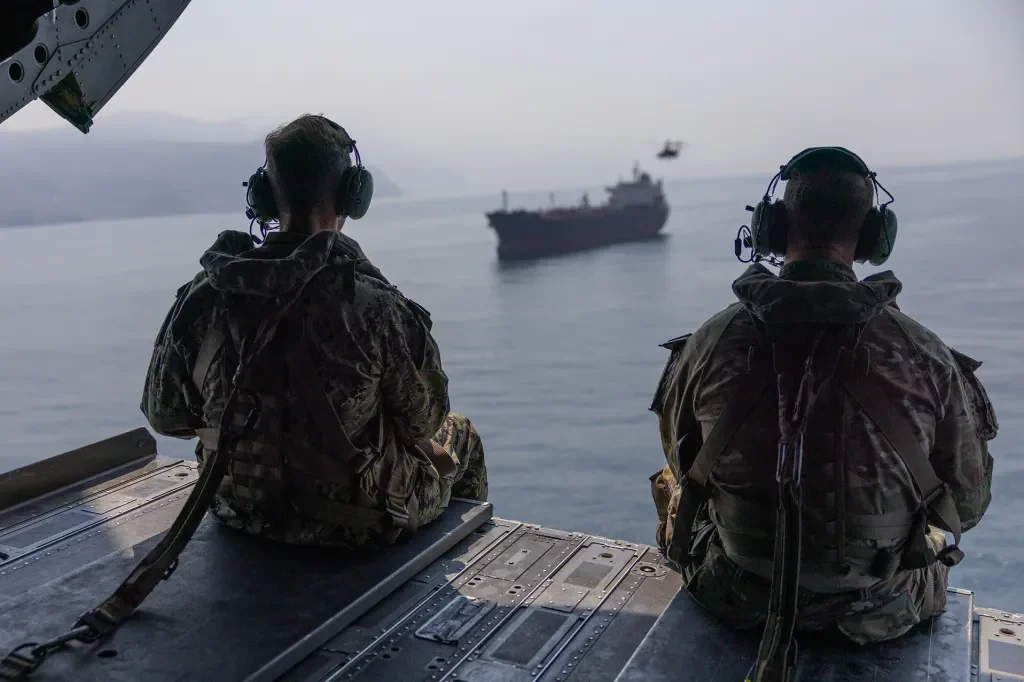
Shortly before the attack was reported, U.S. Central Command chief Admiral Brad Cooper said the primary transit routes through the Strait of Hormuz had been cleared of Iranian naval mines. Technically, this does not contradict what happened to Louise 1.
Conventional naval mines are laid in advance. They may rest on the seabed, remain moored beneath the surface, or drift through the water. Sonars, underwater vehicles, helicopters, and specialized minesweepers can search for them. Once a mine is discovered and destroyed, the route can be declared safe.
A limpet mine bypasses that entire system. Until the moment of attack, it remains inside a boat and is indistinguishable from ordinary cargo. A minesweeper cannot detect it ahead of the tanker because no minefield yet exists. The minefield appears directly on the selected vessel’s hull.
A cleared shipping lane therefore does not guarantee safety. The seabed can be surveyed and the navigation channel monitored, but it is impossible to sweep every speedboat, fishing vessel, or small craft capable of approaching a merchant ship.
In this sense, the limpet mine belongs less to traditional mine warfare than to maritime sabotage. Its principal delivery system is not a submarine or minelayer but a person capable of disappearing among dense civilian traffic.
How did the boat get close enough?
The Strait of Hormuz offers almost ideal conditions for such operations. It carries a vast flow of tankers, container ships, tugboats, warships, fishing vessels, and local craft. At its narrowest point, the strait is approximately 33 kilometers wide, but commercial shipping is concentrated within much tighter traffic lanes.
A large tanker cannot abruptly alter course or rapidly accelerate. Its movements are predictable, while its high sides create blind spots close to the hull. Radar may clearly detect an approaching boat, but it cannot explain the crew’s intentions.
Merchant crews cannot treat every small craft as hostile. Otherwise, ships would have to fire constantly in a region crowded with civilian traffic. Even armed guards must first identify the threat, warn the intruder, and determine whether it is genuinely attempting an attack.
A small high-speed boat needs only to exploit that pause. It approaches under the appearance of a patrol, fishing, or service vessel, reaches the tanker’s side, and attaches the charge before the crew fully understands what is happening.
This is why the presence of warships, helicopters, and unmanned surface vessels cannot solve the problem completely. They may escort particularly important convoys, but they cannot remain alongside every commercial vessel throughout the entire passage.
A method already used in 2019

The last known incident of this scale occurred in June 2019, when the tankers Kokuka Courageous and Front Altair were damaged in the Gulf of Oman. The United States claimed that limpet mines had been attached to their hulls.
The Pentagon released video and photographs that appeared to show an Iranian boat approaching Kokuka Courageous and removing an unexploded device from its hull. A small magnetic attachment remained on the ship’s plating after the mine had been removed. Iran denied responsibility, while the Japanese shipowner disputed certain elements of the American account.
Despite the political controversy, the basic method of attack was demonstrated relatively clearly. A large mine was held against the hull by a ring of magnetic attachments, while its explosive charge was powerful enough to inflict serious damage on the ship’s external plating and equipment.
The attack on Louise 1 suggests that the method has not disappeared. More importantly, it may now have been used not in the more open waters of the Gulf of Oman, but inside one of the most heavily monitored maritime passages in the world.
Why a cheap mine can be more useful than an expensive missile
An anti-ship missile can inflict considerably greater damage. It may destroy the superstructure, start a major fire, or sink the vessel. But a missile launch is highly visible, requires a relatively complex launching system, and almost inevitably reveals the general area from which the attack originated.
A limpet mine works differently. It produces no radar signature during its final approach, requires no guidance system, and can be delivered by a boat that outwardly resembles dozens of other vessels. Its use does not require a major warship.
There is also a political advantage. Missile wreckage can reveal the weapon’s type and provide clues about its manufacturer. Following a mine explosion, the evidence may sink or remain only as small metal fragments. Those responsible retain the ability to deny involvement, forcing their opponents to build a case from surveillance footage, intelligence reports, and circumstantial evidence.
The attacker does not even have to sink the tanker. Sometimes it is enough to demonstrate that its hull can be reached. After one successful attack, every unidentified boat becomes a potential mine carrier, while every passage through the strait requires additional security.
The weapon acts through fear as much as through explosives.
How two charges can raise the price of oil
Approximately one-fifth of the world’s seaborne oil trade passes through the Strait of Hormuz. Even a temporary disruption immediately affects global markets because pipelines and alternative ports cannot fully replace the route.
By the end of October, Brent crude had already risen above $117 per barrel, its highest level in more than four years. A single attack on one tanker cannot produce such an increase by itself, but it reinforces expectations of further disruption.
Observers recorded 28 confirmed and reported attacks on ships in the Strait of Hormuz and surrounding waters during October — more than in any previous month. Every new incident raises war-risk insurance premiums. Shipowners demand additional compensation, while some companies may temporarily suspend operations along the route.
Alternative routes are not always available. For cargoes that can be redirected around Africa, the voyage becomes thousands of kilometers and several weeks longer. More fuel is consumed, fewer vessels remain available for new journeys, and freight rates increase.
A mine costing only a few thousand dollars can therefore produce an economic effect vastly disproportionate to its price. It damages more than the ship’s hull; it also damages the market’s confidence that oil will arrive on time.
Can tankers be protected?
The first line of defense is continuous observation of surrounding boats. Additional cameras, thermal imagers, and radars allow crews to identify an approaching vessel earlier. Lookouts can be posted on deck, while spotlights, acoustic devices, water cannons, and armed security teams provide additional layers of protection.
Warships and unmanned surface vessels can establish a protective zone around a convoy. Helicopters and drones can monitor suspicious boats before they approach merchant shipping. Once the vessel leaves the danger area, its hull should be inspected because a mine may have been fitted with a long-delay fuse.
All these measures, however, increase transportation costs and cannot provide a complete guarantee. The Strait of Hormuz is too congested, and too many ships pass through it. Constantly escorting every tanker would require a fleet comparable in scale to a major naval operation.
Defense must also work perfectly every day. The attacker needs to succeed only once.
A weapon aimed at confidence
The attack on Louise 1 did not close the Strait of Hormuz and, according to the available information, did not sink the tanker. Judging it solely by the size of the hole in the hull would nevertheless be a mistake.
If a small boat really managed to approach a transiting vessel, attach two explosive charges, and escape, then even a shipping route cleared of conventional mines and patrolled by military forces remains vulnerable.
A limpet mine does not have to stop the entire flow of oil. It only has to make captains expect the next explosion, insurers raise their rates, and oil markets include the risk of the strait’s closure in the price of every barrel.
That is why an almost century-old technology can once again prove more dangerous than many modern missiles. A missile strikes one selected ship. A limpet mine makes every other ship afraid.