Vladimir Nagirnyak. “A Shameful Act of Brutal Piracy on the High Seas”

An article by Vladimir Nagirnyak from the WEARSPOT website, dated July 14, 2016.
Contents:
At the outset of both world wars of the 20th century, the opposing sides sought to “play by the rules,” without violating treaties and conventions governing the conduct of hostilities. In addition to these documents, soldiers on both sides tried to be guided by universal human morality, demonstrating the best human qualities toward the enemy. In both wars, this sense of chivalry was quickly discarded—the dehumanization of the enemy occurred too rapidly in the context of global conflict, and such a way of waging war was simply too disadvantageous. This makes episodes such as the sinking of the British ship *Royal Sceptre* on September 5, 1939—which was viewed very differently by the Germans and the British—all the more interesting today.
With the entry of the Western powers into World War II, the sea became the main theater of operations, where Great Britain and Germany once again “crossed swords” for the first time in twenty years. Unlike the army, the navy did not engage in a standoff with the enemy along the Maginot and Siegfried Lines; therefore, it can be said that during the first months of the war, the British and Germans shed blood not on land, but at sea.
It is worth noting that, bound by treaties governing the conduct of naval warfare, the adversaries actively sought to cast off these legal “shackles,” vigorously accusing each other of violations. Consequently, propaganda barrages began from the very start of the war, and German submariners—as the most active participants in the conflict—were the first to come under fire.
“Atenia”: The First Shot in the Propaganda War
As is well known, the first ship sunk by a submarine during World War II was the British liner “Athenia” (SS Athenia), which was sunk by the German U-30 commanded by Oberleutnant zur See Fritz-Julius Lemp a few hours after Britain declared war on Germany. It is now well known that Lemp torpedoed the “Athenia” by mistake, but his actions dealt a major blow to the leadership of the Kriegsmarine and the Reich. The deaths of citizens of neutral countries, including the United States, on the liner allowed the British to accuse the Germans of violating the rules of naval warfare, and newspapers around the world, just as they had 20 years earlier, were flooded with headlines about German “submarine pirates.”
Berlin did not remain silent, accusing the British of lying. Here is what Nikolai Bazhenov, a Russian aviation and naval historian, writes in his article “Captain Lemp’s Two Mistakes”:
“The Ministry of Propaganda immediately cross-checked the report from London with information from the Kriegsmarine command. After receiving assurances from the sailors that there were no German submarines near the area where the liner sank, the ministry, on Hitler’s orders, issued a denial of the German navy’s involvement in the incident. Subsequently, a theory was put forward that the ship had been sunk by a British mine.”
As a result, in order to rule out even the slightest suggestion that the liner had been sunk by a German submarine, the Kriegsmarine command even ordered the falsification of U-30’s combat log. The Nuremberg Tribunal put an end to the controversy surrounding the “Atien” incident, definitively establishing that the ship’s sinking was caused by an attack by a German submarine, as well as the fact that the submarine’s logbook had been altered to conceal this information. However, it is worth noting that in September 1939, this was the only instance in which German submariners violated Article 22 of the 1930 London Naval Agreement, also known as the “Submarine Protocol.”
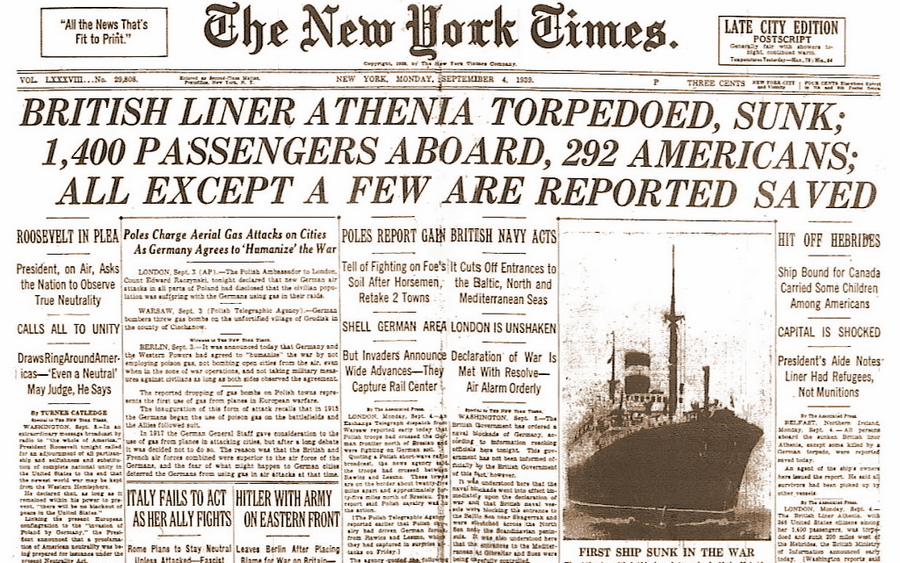
On the morning of September 4, 1939, the sinking of the *Atenia* made headlines around the world
Nevertheless, Lemp gave the British a reason to believe that the Third Reich’s submariners would act just as their predecessors had during World War I, and to launch a propaganda campaign accusing the Germans of piracy and crimes at sea. In this matter, the British faced one significant problem—German submarines in September 1939 no longer made such mistakes. This led to a number of embarrassing incidents, one of which involved the First Lord of the Admiralty, Sir Winston Churchill, the future Prime Minister of Great Britain.
The Sinking of the Steamship “Royal Scepter”
In late August 1939, Admiral Dönitz, commander of the German submarine forces, dispatched virtually all of his ocean-going submarines to the North Atlantic, including 12 Type VII submarines. The submarines were deployed in a line stretching from the northwestern coast of Scotland to the Bay of Biscay, outside the range of coastal aviation. Six Type VIIB submarines, which had a larger fuel capacity than the Type VIIA, took up positions southwest of Ireland. Among them was U-48, commanded by Lieutenant Commander Herbert Schultze. The submarine commanders were ordered to begin operations against merchant ships in the open ocean if Great Britain and France responded to German aggression against Poland by declaring war. On September 3 at 12:30 p.m., all German submarines received a radio message from the commander: “War with England. Act in accordance with the laws of prize.”
The first vessel detected by U-48 was the Swedish tanker *Abadan*, sailing in ballast to Mexico. The “Swedish ship” appeared in Schulze’s periscope at 14:22 on September 4. After spending more than half an hour closing in on the ship while submerged, U 48 surfaced at 3:01 p.m. and stopped the tanker with a point-blank shot from its deck gun. The Swedish captain came aboard the submarine with the ship’s documents. After reviewing the papers, the Germans released the *Abadan* at 3:50 p.m.
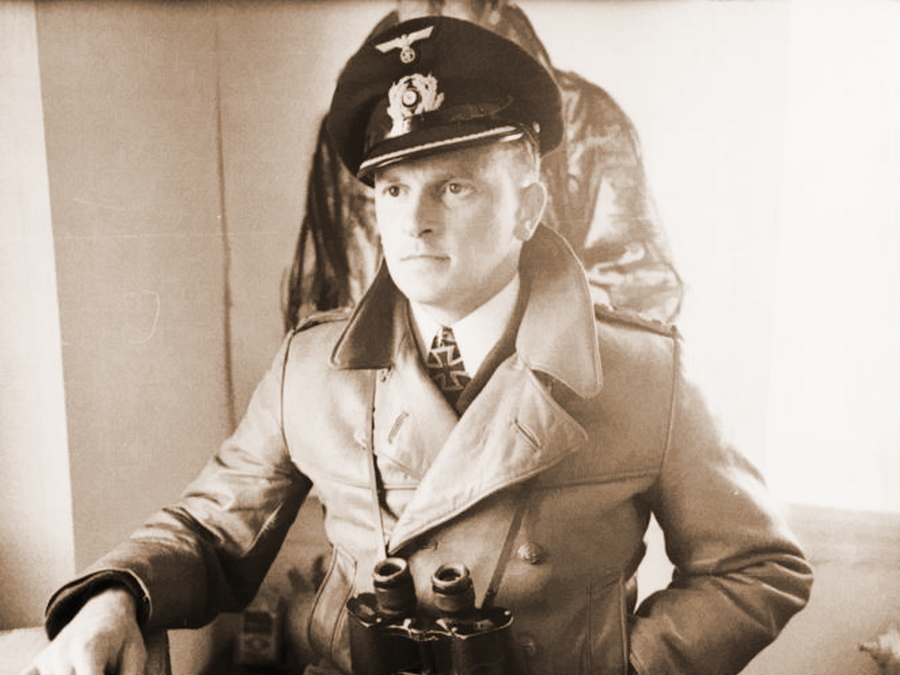
Herbert Schulze (1909–1987) was one of the most successful German U-boat commanders, with 169,709 GRT to his credit
That same evening at 6:02 p.m., Schulze spotted another tanker but was unable to catch up to it due to rough seas. Three men from the upper watch on U-48 were nearly swept overboard. The submariners were saved by the fact that their life belts were fastened to the bridge railing.
The next day, September 5, the weather improved, and the submarine continued its search for the “merchants” in the ocean. At 11:28, the upper watch spotted an unidentified vessel through binoculars. Schulze submerged and began closing in on it while submerged. At 12:00, having closed to a sufficient distance from the steamship, U-48 surfaced to inspect it. However, the appearance of the submarine did not prompt the “stranger”—which was sailing without a flag—to slow down. The “merchant ship” hoisted the British flag, increased speed, and began transmitting the “SOS” signal (according to another account, the steamer was transmitting the “SSS” signal, established by the British Admiralty to indicate an encounter with a submarine). It was the British dry cargo ship *Royal Sceptre*, sailing from Buenos Aires to Belfast with a cargo of wheat and corn.
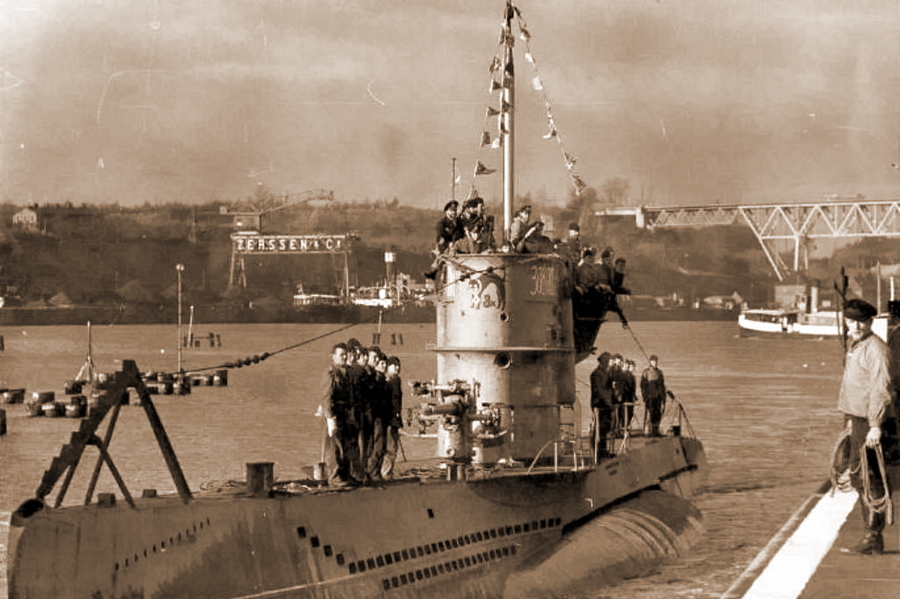
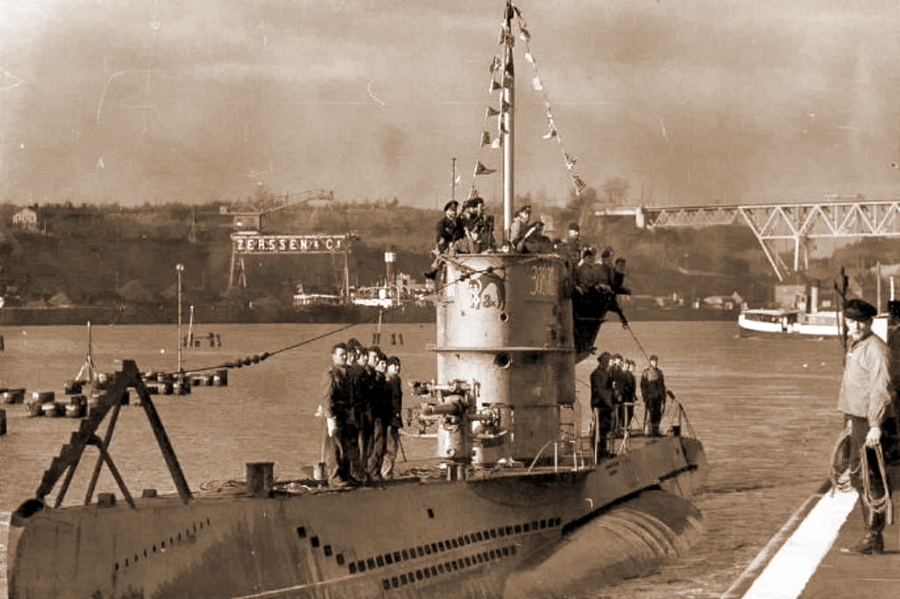
The submarine U-48 returns from its final mission, decked out with pennants marking the ships it sank. It was the most successful submarine in the Kriegsmarine, and its three commanders were awarded the Knight’s Cross. Furthermore, it is believed that not a single crew member lost their life on board during its entire service life.
As Norwegian historian Geirr H. Haarr writes in his book, when a surfacing submarine was spotted from the ship, First Officer Norman Hartley (Norman Hartley), who was on watch on the bridge, ordered the ship to turn so that the submarine would be astern. After that, the *Royal Scepter* was to go full speed ahead to avoid capture. At the same time, Hartley ordered the captain to be summoned to the bridge and instructed him to begin transmitting a signal that the steamship was being pursued by a submarine.
Schulze set off in pursuit. After the boat’s radio operator reported that the vessel was transmitting a radio signal, the commander of U-48 ordered the gunners to open fire to destroy it. The pursuit, accompanied by gunfire, lasted 25 minutes, after which, having taken several hits, the steamship slowed down and its crew began launching lifeboats. During the shelling, the steamship’s captain, James Gair, was killed, and nine people were wounded.
After ceasing fire, Schulze waited patiently for the crew to leave the steamship. As the lifeboats moved away, the radio operator was still on board the *Royal Scepter*, and Schulze noted this in his logbook: “The crew is lowering the lifeboats. The ship continues radio transmissions; the radio operator bravely remains on board.” U-48 approached one of the lifeboats, and the German commander ordered it to return and pick up the remaining radio operator. Once this was done, at 1:38 p.m. the submarine fired a single torpedo at the ship, and it sank.
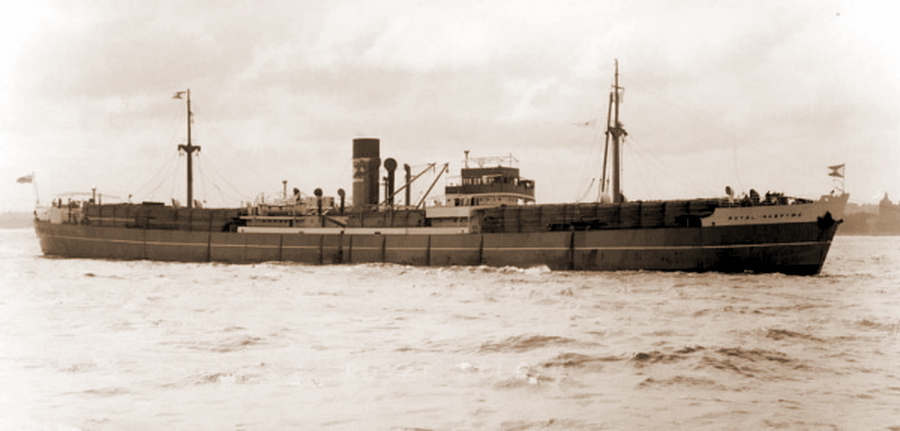
The British merchant ship “Royal Scepter”—a steamship with a tonnage of 4,853 GRT, built in 1937
Approaching the lifeboat again, Schulze asked the first mate of the *Royal Scepter* if they had enough water and food and if there were any wounded on board. Hartley replied that they had enough of everything and that all the sailors were fine. Nevertheless, the commander of U-48 decided not to leave the British sailors, bobbing in their lifeboats on the waves, to their fate. He planned to stop the first steamship he came across and inform its captain of the location of the crew of the sunken ship.
At 3:05 p.m., U-48 spotted the British ship *Browning*. After raising a pennant reading “Stop the ship immediately” through the periscope, the submarine began closing in on the steamer. However, the crew of the *Browning* had no intention of heeding any signals from the Germans. In a panic, the British rushed to lower their lifeboats and soon abandoned the ship. Schulze had to strain his vocal cords, shouting to convince the sailors to return. Eventually, this had the desired effect, and the British, likely very surprised by this turn of events, heeded the German commander’s call. After that happened, U-48 moved closer to their side. Schulze shouted, “Hold a course of 180 degrees; a British ship was sunk 13 miles from here—you’ll see its crew there.” The steamship picked up speed and soon reached the scene of the recent events, picking up the crew of the *Royal Sceptre*.
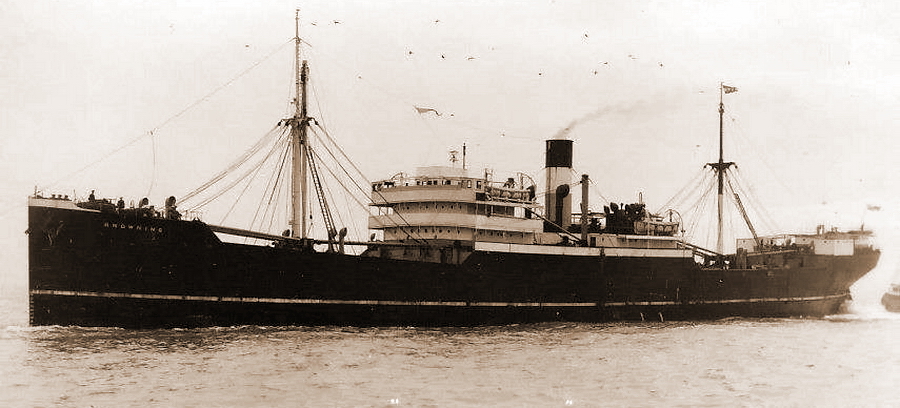
The British merchant ship “Browning”
It is interesting to note that Schulze warned the *Browning* against using the radio; however, it appears the British did not heed his advice. The War at Sea Directorate’s combat log entry for September 5 contains a note regarding the interception of a radio transmission from the *Browning*: “On September 5 at 14:50, the crew of the British vessel *Browning* (5,332 GRT) was ordered by a submarine to abandon ship. Sunk at 14:58 (coordinates).”
Dönitz assumed that this was Schulze’s doing, but soon learned that the *Browning* had in fact been sent out by U-48 to pick up people from the lifeboats. Nevertheless, this British steamship was destined to meet its doom at the hands of a submarine. On November 12, 1942, during an attack on Convoy KMS-2 by the German submarine U 593, the *Browning* was sunk.
Churchill’s Blunder
Believing that the crew of the *Browning* would take care of the surviving sailors from the *Royal Scepter*, Schulze set a course north to leave the scene. The *Browning* followed the course indicated by the commander of U-48 and soon spotted the lifeboats from the *Royal Scepter*. What happened next caused some embarrassment for the British Admiralty.
After picking up the crew, the *Browning* set off on its route to Brazil. For the remainder of the voyage, the crew of the British ship heeded Schulze’s warning not to use the radio and observed radio silence. As a result, when London received a distress signal from the *Royal Scepter*, they assumed the ship had been sunk by a German submarine and that its crew and passengers had perished. American submarine warfare historian Clay Blair wrote:
“Unaware that they had been rescued, Churchill mistakenly assumed that ’40 or 50′ crew members had perished in the lifeboats. He likened this to ‘murder’ and demanded that London publicize this ‘arbitrariness’ to the fullest extent. He argued that what had happened should be characterized as a ‘shameful act of brutal piracy on the high seas.’”
The *Browning* arrived in Brazil two weeks later, and thanks to Reuters, the world learned that the crew of the *Royal Sceptre*, who had been “buried” at sea by the First Lord of the Admiralty, was alive. This cast the Admiralty—and Churchill personally—in a somewhat unfavorable light, but the embarrassment was quickly forgotten: the war was just beginning, and soon such statements surprised hardly anyone.
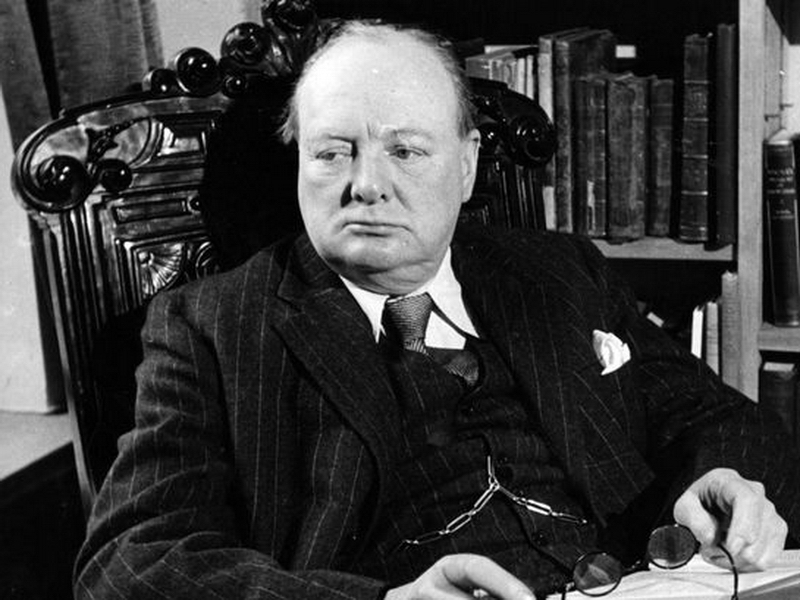
Winston Churchill in 1939
It is worth noting one particularly intriguing fact. As it turned out, Herbert Schulze issued a direct challenge to Winston Churchill himself. A week later, during the same mission, U-48 sank the British steamship *Firby*, after which Schulze indulged in an extraordinary stunt. He sent an open-text radiogram with the following content:
“Tell Mr. Churchill: I sank the British ship *Firby*. Coordinates: 59.40 N, 13.50 W. Please rescue its crew. Signed: German submarine.”
If we translate this situation into the language of fishermen and the modern internet, the German commander was literally “trolling” the First Sea Lord of Great Britain. Churchill’s reaction to this becomes clear from an interview that American journalist William Shirer conducted with Schulze on September 29, 1939, after the latter’s return from that very mission during which the *Royal Scepter* and the *Firby* were sunk. Shearer wrote:
“There were two points in the text (and it was precisely those that made the whole text so interesting to me) that changed my perspective. The commander recounted how he sank the British ship *Royal Scepter* and, risking his own life, arranged for its crew to be rescued by another British ship, the *Browning*. Now I recall how, a few days earlier, London had reported that the *Royal Scepter* had been sunk without warning; all 60 passengers and crew members were presumed dead. I wondered who was right.
Captain Schulze also told me during our interview that he was, in fact, the very submarine commander who had sent that very scathing radio message to Mr. Churchill, in which he provided the coordinates of where the British ship had been sunk so that the First Lord could arrange for the crew’s rescue. But a day or two earlier, Mr. Churchill had told the House of Commons that the German submarine commander who sent the message had already been taken prisoner.”
In closing, I would like to say a few words about the main character of this story—Herbert Schulze. The commander of U-48 was so successful in his operations that he was awarded the Knight’s Cross, second only to Günther Prien (Günther Prien), becoming the first German submarine commander to reach the coveted 100,000 GRT mark. Schulze commanded his submarine until June 1940, after which he was forced to leave his post and go ashore for medical treatment. The submarine ace suffered from a condition common among submariners of that era—kidney disease.
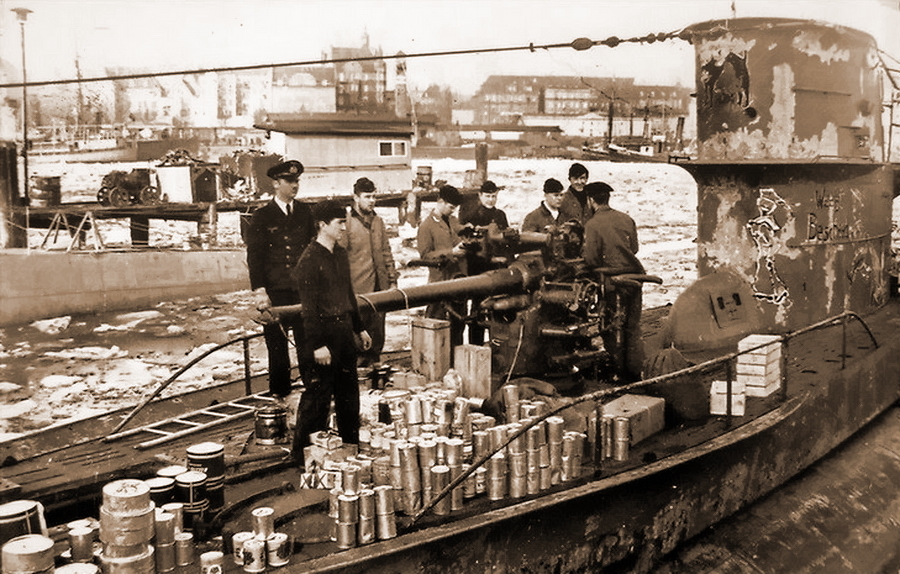
Loading provisions onto the U 48 for its next mission. The poor condition of the paint on the conning tower and the ship’s sides is immediately apparent.
In December 1940, Schulze returned to U-48 and undertook three more missions aboard it, for which he was awarded the Oak Leaves to the Knight’s Cross. In July 1941, Schulze left the navy for good, accepting the position of commander of the submarine flotilla in La Rochelle.
When it comes to Herbert Schulze’s personal qualities, his nickname says it all. The crew members of U-48 called their commander “Vaddi”—they considered him the best commander in the fleet and trusted him completely, believing he could get them out of any dangerous situation without losing his sense of humor.
The author would like to thank Evgeny Skibinsky for his assistance in preparing this article.
Sources and References
-
-
- NARA T1022 (captured German Navy documents)
- Wynn, K. *U-Boat Operations of the Second World War*. Vol. 1–2 – Annapolis: Naval Institute Press, 1998
- Busch, R., and Roll, H.-J. German U-boat Commanders of World War II – Annapolis: Naval Institute Press, 1999
- Ritschel, H. Abridged Version of the War Diaries of German U-Boats, 1939–1945, Vol. 1, Norderstedt
- Blair, C. Hitler’s U-boat War: The Hunters, 1939–1942 – Random House, 1996
- Haarr, G. H. *The Gathering Storm: The Naval War in Northern Europe, September 1939–April 1940* – Naval Institute Press, 2013
- Bush, R., and Roll, H.-J. The Submarine War 1939–1945. German U-boat Successes from September 1939 to May 1945. Volume 3 – E.S. Mittler & Sohn Publishers, Hamburg-Berlin-Bonn, 2001
- http://uboat.net
- http://www.ubootarchiv.de
- http://ahoy.tk-jk.net
- http://www.privateletters.net
-
Source: http://warspot.ru/6584-postydnyy-akt-zverskogo-piratstva-v-otkrytom-more