An article by Alexei Kozlenko from the WARSPOT website, dated September 24, 2018
Contents:
In 1962, a 6th–7th-century burial ground belonging to the Alemanni was discovered in the town of Niederstotzingen in southern Germany during road construction. Archaeologists discovered the remains of thirteen people buried there, accompanied by rich grave goods: military equipment, various weapons, and luxury items. Extensive research eventually revealed that the burial ground belonged to a family of military nobility that had used it for at least three generations. Based on DNA analysis of the remains and the objects placed in the graves, scientists were able to reconstruct the kinship ties between the individuals and the complex relationships they were involved in during their lifetimes.
Alemannic Burial Ground
The Alemanni were a Germanic confederation of tribes that emerged in the early 3rd century in the territories bordering the Roman frontiers along the Upper Rhine and the Danube. During the 3rd and 4th centuries, they repeatedly invaded the Roman provinces of Upper Germany and Raetia. After the fall of the Western Roman Empire, the Alemanni settled in the lands between the upper Rhine and the northern foothills of the Alps. In the mid-5th century, the borders of their kingdom stretched from Strasbourg (Argentoratum) on the Rhine to Augsburg (Augusta Windelica) on the Danube. In 496, the Alemanni were defeated by the Franks at the Battle of Zülpich (Tolbiac). After another defeat at the Battle of Strasbourg in 506, they were forced to submit permanently to the authority of the Frankish king Clovis and his successors from the Merovingian dynasty.
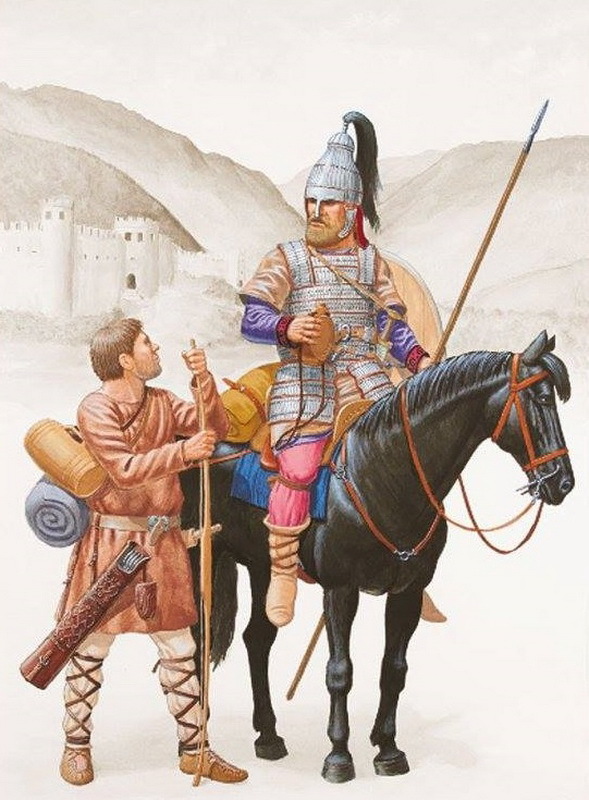
Reconstruction of the warriors from the Niederstotzingen 12B burial site
During their integration with the Franks in the 6th–8th centuries, the Alemanni adopted the custom of burying their deceased relatives in family burial grounds, accompanied by numerous grave goods. The burial ground in Niederstotzingen dates to between 580 and 630. Twelve burials were discovered there, containing the remains of thirteen people: ten adults and three children. All of the interred individuals whose gender could be determined were men. All age groups were represented among them: two (Nos. 4 and 5) were infants under two years of age, one (No. 2) was a boy aged 9–11, one (No. 6) was a teenager aged 14–17, five (Nos. 3A and 3C, 10, 12A, and 12C) young adults aged 20–30, one (No. 12B) middle-aged man aged 30–40, two (Nos. 1 and 9) men aged 40–50, and one (No. 3B) elderly man aged 50–60. One of the graves was empty and contained women’s jewelry. It is possible that the remains of the woman who was originally buried here were later reburied elsewhere. The fact that the burial consists entirely of men is unusual for this period and may indicate that the individuals buried here belonged to the Frankish military elite.
Genography
Recently, an international team of researchers sequenced (determined the sequence of amino acids in proteins and nucleotides in nucleic acids) the complete genomes of all thirteen individuals buried in Niederstotzingen. The preservation of DNA varied among the bodies: the researchers were able to sequence between 1% and 75% of the genome. In eleven cases, the DNA was preserved well enough to determine the sex of the remains: all of them turned out to be men. In eight of these eleven cases, the researchers were even able to determine the degree of kinship among the individuals. Five (Nos. 1, 3A, 6, 9, and 12B) were related to one another at least to the second degree—as parents and children, nephews, or grandchildren. Three (Nos. 3B, 3C, and 12C) were not related to the others in any way. They may have come from another region and been incorporated into the family as adopted children or younger members.
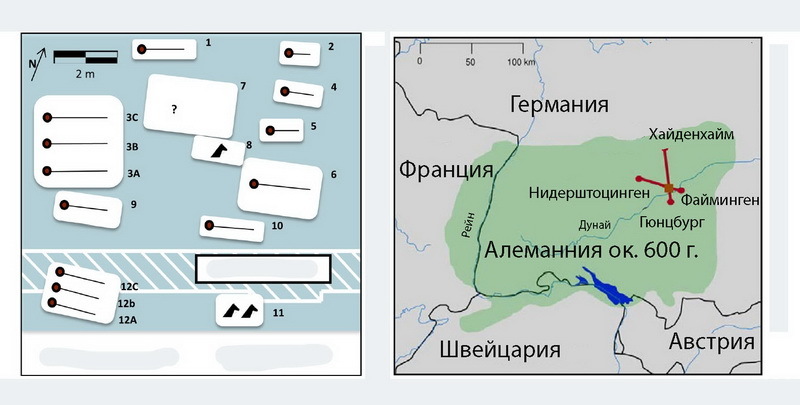
Funeral Arrangements in Niederstotzingen
To construct a preliminary family tree, the researchers combined autosomal SNPs, NRY haplotypes, mitochondrial DNA haplotypes, and age data. It is possible that pairs 9 and 1, 9 and 3A, and 1 and 6 are related as father and son. Pairs 1 and 3A, and 9 and 12B are brothers, as they share the same maternal haplotype (K1a and X2B4, respectively). Pairs 3A and 6, 1 and 12B, 6 and 9, and 3A and 12B are second-degree relatives; that is, they could have been uncle and nephew or first cousins. The infant buried in grave No. 4 has the same mtDNA haplotype (X2b4) as adults 9 and 12B, which means they could all be related through their mother. However, there is no additional genomic information to confirm this possibility. The resulting genealogical tree is based on the assumption that the individuals died within a relatively short period of time. However, archaeological evidence suggests that the burial ground may have been in use for at least two generations between 580 and 630, which allows for several alternative versions of the family tree.
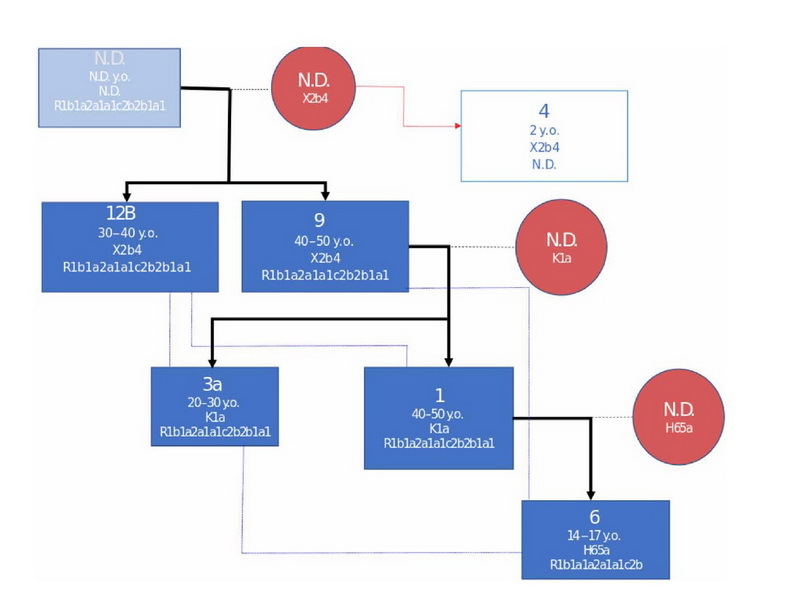
Reconstruction of the family tree of the family from Niederstotzingen
Based on their predominant genetic profiles, all the individuals buried in Niederstotzingen can be divided into two groups. The northern group includes Nos. 1, 3A, 6, 9, 12B, and 12C—their genes are characteristic of the modern population of Western Europe. The southern group consists of Nos. 3B and 3C, whose genes are most commonly found among modern inhabitants of the Caucasus, southern Europe, and the Middle East. All members of the northern group were buried in graves containing rich grave goods, often of imported origin, which link them to various regions of Europe. Nevertheless, strontium and oxygen isotopes extracted from their tooth enamel indicate that they were locally born. Only two individuals, No. 3B (southern group) and No. 10 (for whom there is insufficient data), show non-local strontium isotope signatures. The δ18O values suggest that they may have originated from a higher-altitude region, possibly from the Swiss Alps.
Triple Burial
Graves No. 3 and No. 12, in which three bodies were buried side by side, attracted particular attention from researchers. In Merovingian cemeteries of the early Middle Ages, double and triple burials are quite rare. Most often, they are associated with mass burials of those killed in battle. Alongside the hypothesis of a shared death in battle, scholars have suggested the possibility of family ties among those buried in the common grave, or that they voluntarily followed one another as a result of bonds of dependence or comradeship in arms that existed between them during their lifetimes. We cannot rule out the possibility that they all died in quick succession and were then buried together in a mass grave.
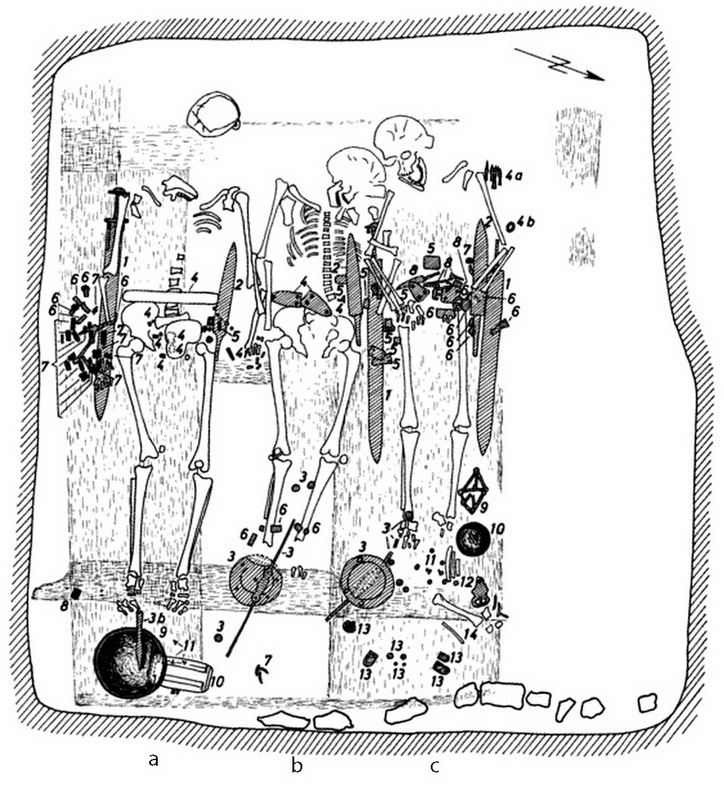
Triple Burial No. 3: Position of the Bodies and Grave GoodsTriple Burial No. 3: Position of the Bodies and Grave Goods
Since Burial No. 12 had been partially destroyed at the time of its discovery, the researchers focused their attention on Burial No. 3. This is a wooden chamber that contained not only human remains but also the bones of a horse and a dog. The southernmost skeleton in the grave, No. 3A, was that of a young man between the ages of 20 and 30, tall (176–178 cm) and of sturdy build. He was buried with a set of weapons consisting of a sword, a knife, two spears, and a shield. In addition, a precious bridle decorated with silver plates, two hair combs, and a bronze basin for washing hands were placed in the grave next to him. The silver plates on his belt were decorated with Byzantine ornamentation, and the tip of one of the spears was of Lombard origin. These items may have indicated that, during his lifetime, he had participated in campaigns in Italy.
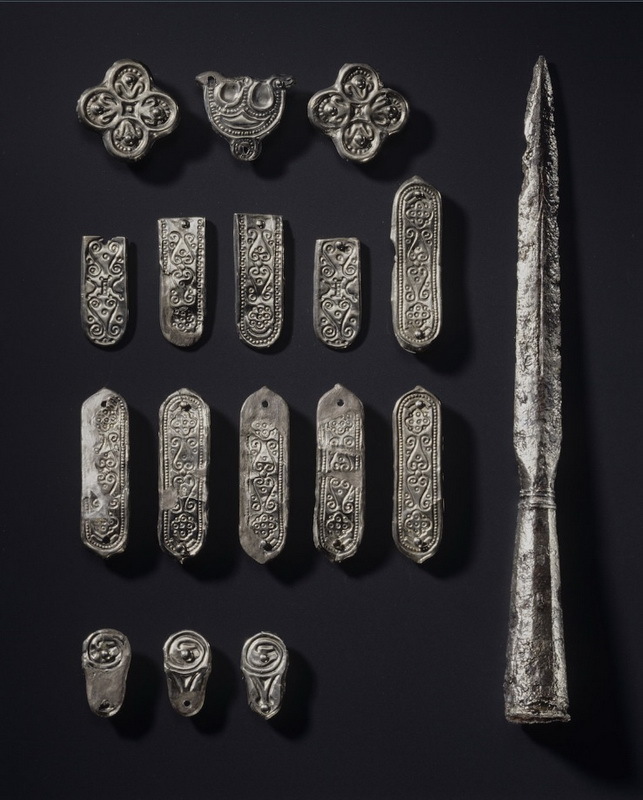
Silver belt plates of Byzantine manufacture and a Lombard spearhead that belonged to No. 3A. templeilluminatus.com
Skeleton No. 3B belonged to a 50–60-year-old man who was 170 cm tall and who must have led a very eventful life: traces of wounds were preserved on his bones. A sword blow that left a notch in his skull caused him to lose sight in one eye. The deceased was laid to rest in a grave with a sword, a shield, and a single-edged sax. His belt was not particularly ornate. At the deceased’s feet lay an iron hoop 8 cm in diameter, which has been interpreted as the remains of a drinking horn. It is possible that this man served as a cupbearer during his lifetime. He lay in the grave holding hands with the third occupant, their heads turned toward each other, suggesting a close personal relationship during their lifetimes.
This third individual (No. 3C) was a young man between the ages of 20 and 30, standing 165 cm tall. The grave goods placed next to him included a sword, a broad-bladed axe, a shield, and a belt, as well as a leather quiver or pouch containing seven arrowheads. Also found here were a 60-cm-long iron chain with a double end, a massive bronze bell, a part of a horse’s harness—presumably part of the same set as the bridle placed next to 3A—as well as what are believed to be the remains of a wooden saddle. According to the researchers’ conclusion, the chain and bell also belonged to the horse’s harness. Most likely, this man was a stablehand during his lifetime and cared for his master’s horse and dogs. Food remains were found next to him: beef, pork, and chicken.
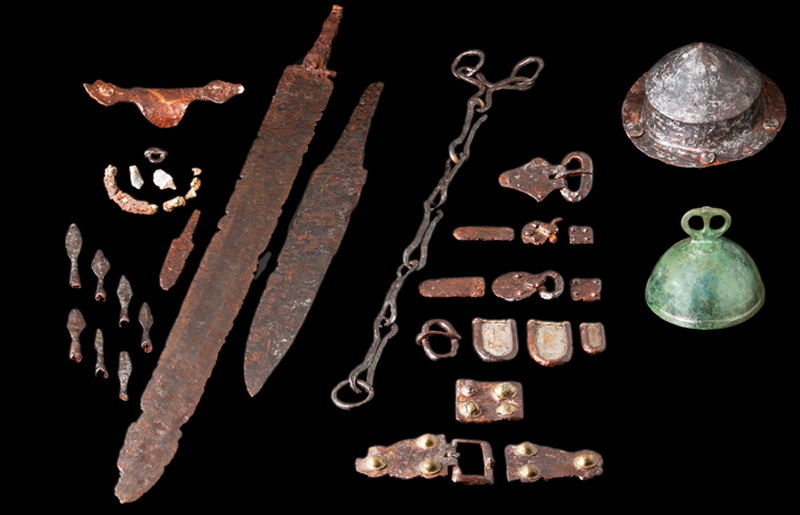
Funeral goods belonging to the individual buried in Grave No. 3C. ag.worldpronews.com
Genetic analysis confirmed a number of long-standing hypotheses. The individual designated as No. 3A was found to be related to the other family members buried in Niederstotzingen, while Nos. 3B and 3C were adopted children in this family. Their genes are more characteristic of people native to the Caucasus and the eastern Mediterranean. It is also interesting that No. 3B, who was of more advanced age, grew up somewhere in a higher-altitude region, while No. 3C was a local. Most likely, both were servants who voluntarily followed their master into the grave, or who died shortly after his death. The objects placed in the grave with them provide strong support for this hypothesis. One was a cupbearer, the other a groom in the service of a noble master. Both of these positions are well known at the Carolingian court of a later period.
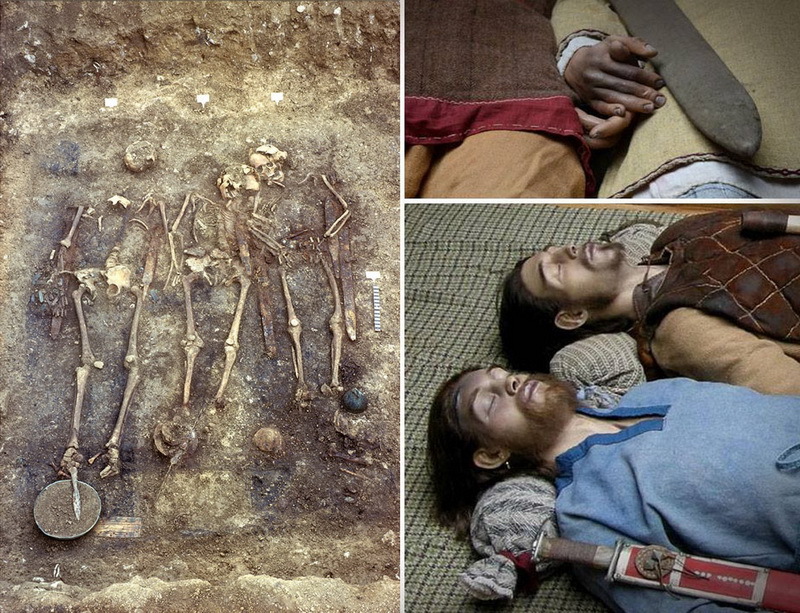
Triple Burial No. 3 from Niederstotzingen: The Position of the Bodies and Their Modern Reconstruction
Cultural Identity
The rich grave goods, which—in accordance with pagan beliefs—were placed in the grave alongside the bodies, were intended to demonstrate the deceased’s high social status, as well as the wealth and generosity of his family, during the solemn funeral ritual. Many of these objects were imported and had traveled from very distant places to where archaeologists discovered them. These include Frankish swords from the Rhine region, belt ornaments from the Kingdom of the Lombards in northern Italy, and a helmet and armor of Byzantine manufacture. These artifacts can tell us about the extensive connections of the family from Niederstotzingen, the journeys undertaken by its members, and, to some extent, their cultural identity.
Burial No. 9 is the largest and richest of the entire burial ground. It contains the remains of a tall man between the ages of 40 and 50 who had a severe limp during his lifetime due to an injury to his femur. DNA analysis suggests he may have been the progenitor of the entire family. Among the grave goods placed in his tomb, items of Frankish origin predominate: a luxurious sword with a silver ring-shaped pommel and a scabbard adorned with pearls, as well as precious horse harness and a belt with gold and silver inlays. A bronze tableware set, consisting of a jug and a basin for washing hands, also comes from this same burial. An identical basin was found among the grave goods of a young man from Burial No. 3A, who was very likely his son. The custom of washing one’s hands was associated with the banquet culture of the Germanic nobility and was likely adopted from the Romans at some point.
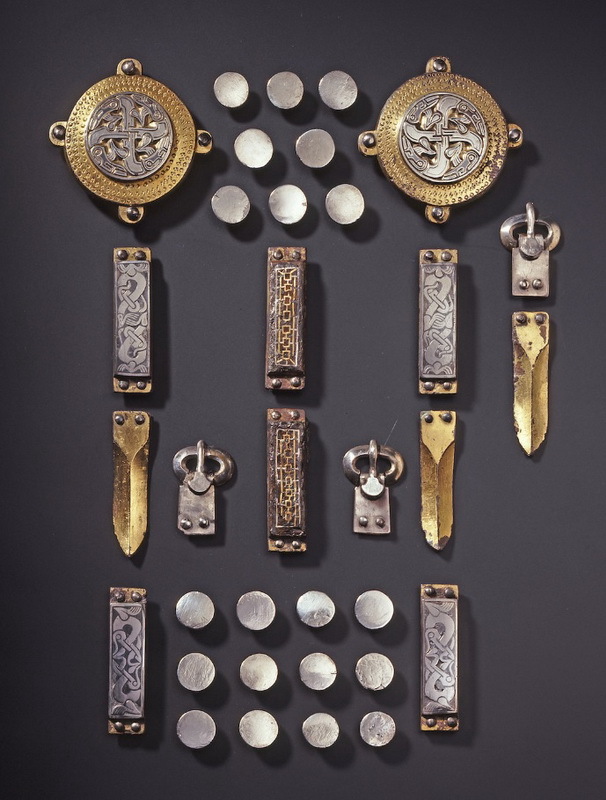
Precious Frankish-made harness from Burial No. 9. templeilluminatus.com
In the adjacent triple burial No. 12, the brother of the previous individual (No. 12B)—a mature man aged 30–40—found his final resting place. Buried alongside him in the same grave were two other, younger men (Nos. 12A and 12C), aged 25–30. They may have been his servants, since one of them, No. 12C, was definitely not related to the others. All of them were also buried with swords, knives, belts, and bridles. The most interesting object placed in the grave is an iron lamellar helmet with a nose guard, cheek guards, and a chain-mail coif, as well as lamellar armor, which included a breastplate with shoulder guards and separately worn greaves. The entire suit of armor consists of more than five hundred plates fastened together with leather straps. The military equipment is most likely of Byzantine origin. Fibers of the precious silk fabric in which the helmet’s visor was wrapped have been preserved to this day.
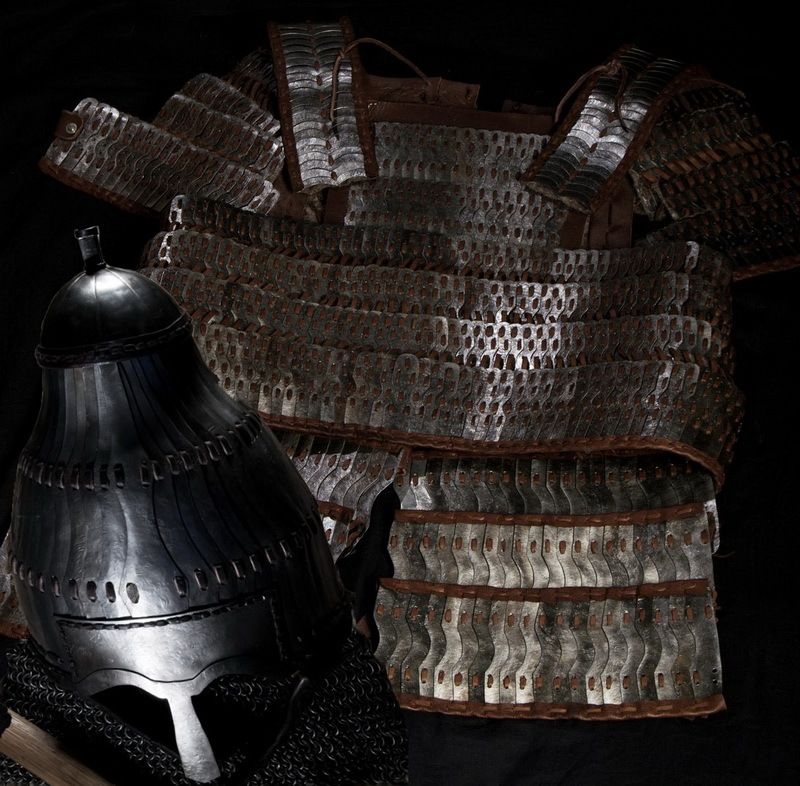
A Byzantine-made helmet and lamellar armor from Burial No. 12. Modern reconstruction
Belt buckles and silver belt fittings, as well as elements of horse harnesses found in a wide variety of burials, indicate that their owners had ties to the Lombard Kingdom in Northern Italy. These finds are characteristic of the entire southwestern region of Germany and are described by archaeologists as the “Lombard horizon.” Their presence is seen as evidence that those buried in Niederstotzingen were involved in the clashes between the Franks and the Lombards in northern Italy between 585 and 591. The Byzantine imports found in the graves may have been war trophies or part of a tribute. The absence of similar finds in the Frankish territories proper west of the Rhine is, however, striking. Nevertheless, intensive contacts between the Alemannic-occupied lands along the Danube and the territories beyond the Alps are an indisputable fact.
Bibliography
-
-
- Paulsen, P. Alemannic Noble Tombs at Niederstotzingen / P. Paulsen. — Stuttgart, 1967.
- Schneider, T. Multiple Burials of Men in the Merovingian Period / T. Schneider // Journal of Medieval Archaeology. — 2008. — Vol. 38.
- Schneider, T. Warriors (Male and Female) in Alamannia — Schneider: New Findings on the Niederstotzingen Burial Ground / T. Schneider // Schwäbische Heimat. — 2011. — Vol. 4. — pp. 470–474.
- Werner, J. Noble Graves at Niederstotzingen near Ulm and at Bokchondong in South Korea / J. Werner. — Munich, 1988.
- O’Sullivan, N. Ancient genome-wide analyses infer kinship structure in an Early Medieval Alemannic graveyard / N. O’Sullivan et al. // Science Advances. — 2018. — Vol. 4.
-