The Greenland Conflict: Some Reflections on the U.S.-European Standoff

Contents:
Let me make one thing clear right away: I’m not going to get into “what got into Trump that he suddenly needed Greenland.” The 1951 Greenland Agreement (reaffirmed in 2004) already grants the U.S. the right to station in Greenland any troops and equipment the Americans deem necessary. What interests me is the very possibility of a Euro-American conflict provoked by this desire—and its support by at least a portion of the American public.
The theater of (potential) military operations is, on the whole, quite unique. Greenland covers an area comparable to that of all of Western Europe—yet its population is only 56,000. Most of this vast island is an icy desert; virtually the entire population is concentrated in small towns and villages along the coast. Under such conditions, any ground operations are virtually impossible, and the struggle for control of the island will be waged almost exclusively at sea and in the air.
* To establish control over Greenland, the Americans must establish control over the Labrador Sea—which separates Greenland from Canada—and, to the extent possible, over the southern part of the Greenland Sea and the Danish Strait;
* The Europeans’ objective, therefore, is to prevent the Americans from carrying out these missions, disrupt their communications, and hinder the Americans’ establishment in Greenland;
As my friend pointed out, the situation effectively presents Americans with a reverse GUIK gap—Americans find themselves in a position where, in order to achieve their goals, their fleet must break through NATO barriers in the North Atlantic while moving along a hostile (Canadian) coastline. An interesting reversal compared to the Cold War situation…
For the sake of simplicity, let’s assume that the U.S. is deploying the forces at its disposal in the Atlantic (since the constant threat of confrontation with China over Taiwan prevents the U.S. Navy from redeploying significant reinforcements from the Pacific), and the EU is represented by the existing coalition of “defenders of Greenland,” consisting of the United Kingdom, France, Germany, Norway, Sweden, Denmark, and the Netherlands.
* The United States’ main advantage in the conflict is the strength of the U.S. Navy. It is difficult to accurately estimate the number of ships currently at the disposal of the 6th Fleet command; this information is, after all, classified. However, there is reasonably reliable data available that allows us to draw certain conclusions.
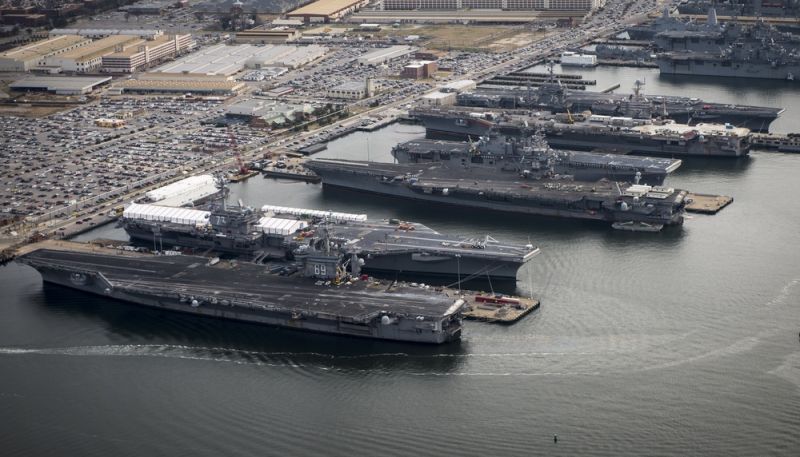
Currently, the fully manned nuclear-powered supercarriers CVN-77 “George Bush” and CVN-75 “Harry Truman” are deployed. The newest (albeit problematic) supercarrier, CVN-78 “Gerald Ford,” is completing its deployment but may have its deployment “extended.” Another nuclear-powered supercarrier assigned to Norfolk, the CVN-69 “Dwight D. Eisenhower,” is currently undergoing repairs.
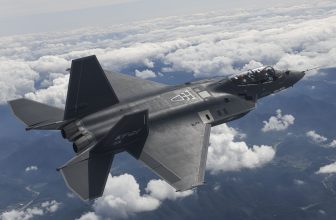
Their major drawback, however, is that the wings deployed on these carriers have not been retrofitted to accommodate the new F-35C stealth fighters and are equipped only with older F/A-18E/F “Super Hornet.” Nevertheless, each aircraft carrier is capable of deploying up to 48 strike aircraft—the total strength of the three wings will thus amount to 144 aircraft, not counting support aircraft (such as the E-2 “Hokai”) and logistics aircraft (such as the EA-18G “Growler”)
Nuclear-powered supercarriers could be supported by three multi-purpose amphibious assault ships: the LHD-1 “Wasp,” the LHD-3 “Kearsarge,” and the LHD-5 “Bataan.” In addition to their primary role as amphibious helicopter carriers, these ships can also serve as light aircraft carriers—each can carry up to 20 Harrier or F-35B vertical takeoff and landing aircraft from Marine Corps squadrons. Two of the three LHDs have been re-equipped for the F-35B, while the third is currently equipped only with “Harrier” aircraft.
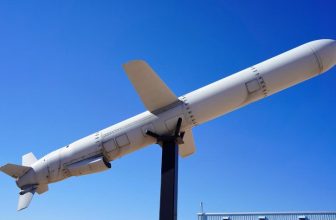
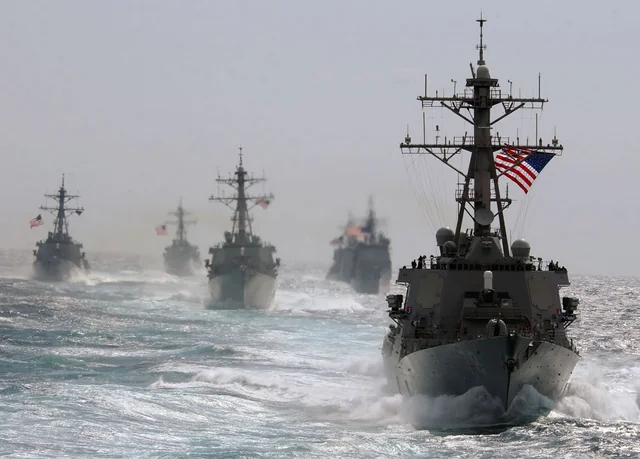
In terms of surface combatants, the U.S. Navy can deploy one guided-missile cruiser (CG-64 “Gettysburg,” Ticonderoga-class) and 15 to 20 Arleigh Burke-class guided-missile destroyers in the Atlantic. All of these ships are large, multi-purpose vessels equipped with the Aegis combat management system and capable of both providing area air defense for formations and striking ground targets. Their relative weakness is the lack of specialized anti-ship missiles on the modern series of destroyers (Flight II); for surface combat, they are forced to rely on the SM-6 anti-ship missiles and modern versions of the “Tomahawk.”
Without a full complement of modern escort ships, the 6th Fleet can rely on 7–10 operational littoral combat ships (LCS) of the “Freedom” and “Independence” classes. Although these vessels can hardly be considered optimally suited for operations in high latitudes, they can still perform certain combat functions—such as coastal operations (for which they were designed) and anti-submarine patrols. It is also entirely possible to deploy a number of large “Legend”-class cutters from the U.S. Coast Guard as combat units; these ships are well-suited for Atlantic operations and are designed to accommodate heavy armament.
Also assigned to U.S. Atlantic ports are 22 Virginia-class and Los Angeles-class multipurpose nuclear submarines, of which 12 to 14 are typically ready for deployment at any given time.
Thus, the U.S. 6th Fleet can deploy in the Atlantic 3 nuclear-powered aircraft carriers, 3 UDCs/light aircraft carriers, 15–20 air defense destroyers, 10–15 light vessels, and 12–15 nuclear-powered multi-purpose submarines in the Atlantic.
Potentially, of course, the Americans could try to redeploy reserves from other theaters—primarily from the Pacific. However, it seems virtually impossible that China would not try to take advantage of the moment when American attention and forces are diverted to escalate the situation around Taiwan.
* A major drawback for the U.S. is its unfavorable starting position. The Americans simply do not have their own bases—or sufficiently friendly foreign bases (Canadian territory, which has openly declared its support for Greenland, cannot be considered as such)—in the vicinity of Greenland. The nearest air and naval bases on U.S. soil are more than 2,000 kilometers away from the southern tip of Greenland as the crow flies—or more than 3,200 kilometers by sea.
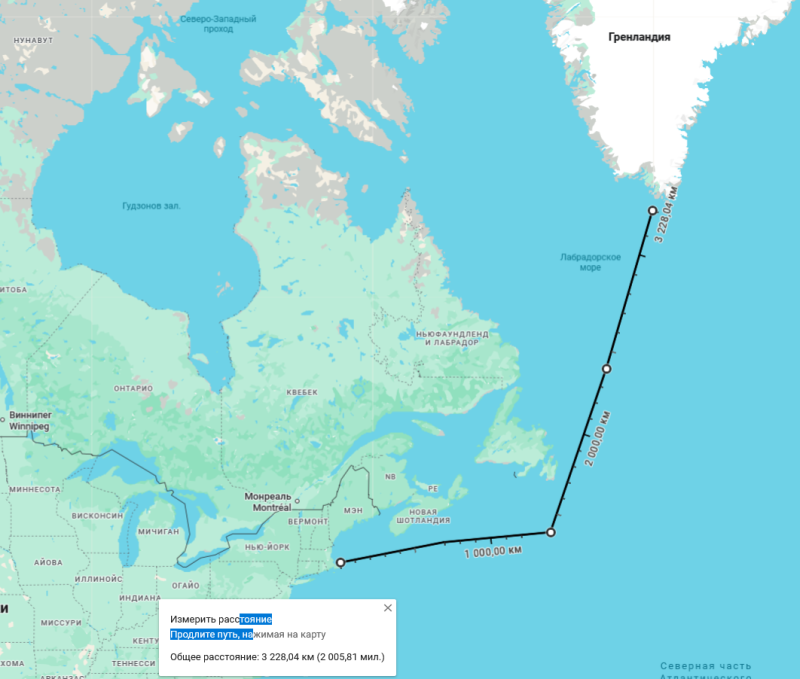
Such a distance essentially rules out an extremely important component of the U.S. armed forces—the USAF’s tactical aviation—from consideration. In combat operations near Greenland, the Americans will have to rely exclusively on:
— carrier-based aircraft;
— those tactical aircraft that can be deployed to bases in Greenland directly during the conflict;
— sorties by USAF B-1 and B-52 strategic bombers equipped for anti-ship operations;
In turn, maritime access to Greenland for Americans is also difficult due to the need to pass through the Labrador Sea—whose coastline is controlled by Canada (which has already expressed its support for Greenland).
* A fundamental problem for the United States is the presence of American troops in Europe. In the event of a conflict, approximately 100,000 American military personnel, civilian base staff, and family members would find themselves—de facto—held hostage on the territory of countries opposed to the United States. It is clear that an organized withdrawal of American units from Europe amid a raging conflict would be impossible; the only options would be a rapid evacuation or the internment of personnel. Most of the equipment and weapons will inevitably have to be left behind for the Europeans.
* The EU’s main advantage in the conflict is its strategic position. Its forward operating base in the region is Iceland, a massive “unsinkable aircraft carrier” located right halfway between Europe and Greenland.
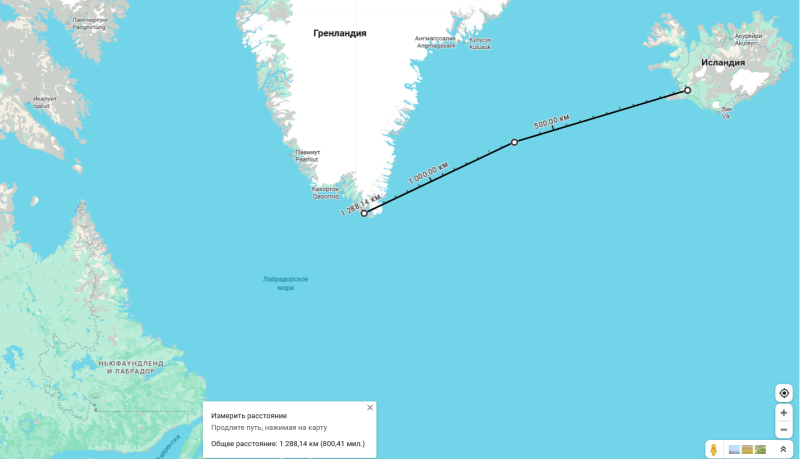
Located just 650 kilometers from the nearest Greenlandic coastline (and 1,200 kilometers from the southern tip of Greenland and Narsasuaq Airport), Iceland offers Europeans the opportunity to compensate for the weakness of their carrier-based aviation with land-based aviation. Operating from airfields in Reykjavík, European aircraft (Typhoon fighters and Tornado fighter-bombers) can control Greenland’s eastern coast even without in-flight refueling. The use of in-flight refueling, meanwhile, potentially allows Europeans to strike against U.S. naval forces in the Labrador Sea and U.S. garrisons on the west coast of Greenland.
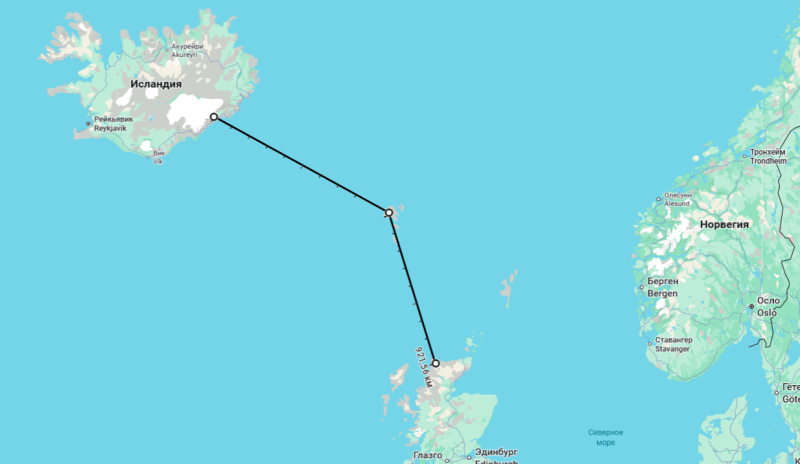
For its part, Iceland itself is located about 900 kilometers north of the British Isles, 1,100 kilometers off the coast of Norway, and—most importantly—just 500 kilometers from the Faroe Islands. This advantageous geographical location allows Europeans to ensure the security of their communication lines and—not least—to thwart American attempts to launch strikes against Iceland itself.
Using Iceland as a base, Europeans could establish a continuous air and sea transport route to Greenland—and use it to disrupt the U.S. supply chain in the Labrador Sea.
European Fleet
The British fleet includes two supercarriers—the *Queen Elizabeth* and the *Prince of Wales*—but these ships are non-nuclear, lack catapults, and are significantly inferior in capability to their American counterparts. Not to mention that the backbone of their air wing consists of American F-35B stealth fighters, meaning the aircraft carriers’ combat effectiveness depends on the potential adversary. France has the “Charles de Gaulle,” a multipurpose nuclear-powered aircraft carrier that is more versatile but still inferior to its American counterparts.
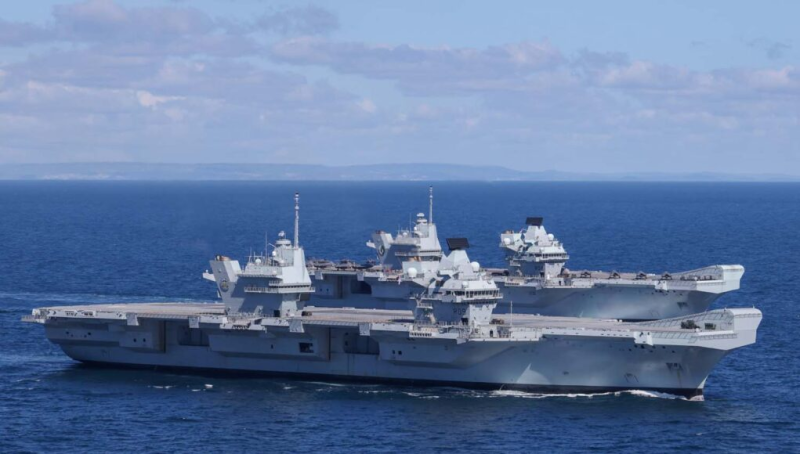
In total, three European aircraft carriers can deploy 76–80 carrier-based combat aircraft. That is, practically half as many as the Americans. The situation is further complicated by the different tactical and technical characteristics of the aircraft. Therefore, it is generally clear that the EU’s carrier-based aviation will inevitably be relegated to a secondary role and used only to a limited extent—primarily to provide cover for deployed surface task forces, in coordination with coastal aviation.
Among surface combatants equipped with area defense systems, the British Navy has six large Type 45 destroyers with the PAAMS combat management system—however, no more than 2–3 of them are operational at any given time. The French Navy has two large “Horizon”-class frigates equipped with the PAAMS combat management system and two smaller FREMM-AAW-class frigates (specialized in air defense missions).
The navies of Denmark, the Netherlands, and Germany have a total of ten large ocean-going frigates equipped with European area-defense combat management systems—however, these ships are armed with American missiles. Finally, Norway has four frigates equipped with the American “Aegis” combat management system and American weaponry.
A significant advantage for the Europeans is that they have a large fleet of modern frigates—about three dozen in total. Unlike the American LCS, European ships are larger and well-optimized for both escort operations in the Atlantic and combat as part of surface task forces.
As for submarine forces, only Britain and France have nuclear-powered submarines—five multipurpose vessels each. The German and Swedish navies also have ten diesel submarines with air-independent propulsion systems; although they are inferior to nuclear submarines in terms of speed and range, they are practically comparable in combat effectiveness. Finally, Norway and the Netherlands have six diesel-electric submarines (unlikely to be suitable for forward deployment, but capable of providing defense).
Thus, the EU could deploy 3 aircraft carriers (one nuclear-powered), 3–4 helicopter carriers, 15–20 destroyers and large air defense frigates, about 20–25 escort frigates, 7–8 nuclear-powered and 12–16 diesel-electric submarines (10 of which are equipped with air-independent propulsion systems).
Although these forces appear, “on paper,” to be comparable to those of the United States, it is important to understand that while the U.S. Navy is a unified structure with a single chain of command, European forces are composed of the national navies of several countries. Cooperation among them, although well-established within NATO, is still not ideal; ships from different countries vary greatly in type, equipment, and tactical deployment patterns. As a result, the European fleet operating as a unified force is inevitably weaker tactically than the “sum of its parts.”
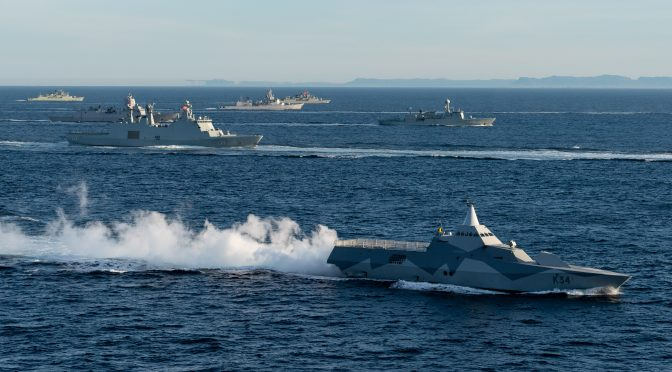
On the other hand, in a number of respects, the EU navies have a technical and material advantage over the U.S. Navy. The wide variety of combat systems used by EU navies makes it difficult to develop effective countermeasures against them (I would remind you that, through NATO structures, both sides are quite familiar with each other’s equipment!). The anti-ship missile systems of European forces are, on average, heavier than those of the U.S.—which could be decisive in surface combat in the North Atlantic. Finally, European navies have a large number of light vessels (missile boats and corvettes) which, although not suited for operations on the open ocean, can be effectively used to defend the coasts of Greenland and Iceland.
* A fundamental problem facing the European Union is the significant—and in some respects critical—dependence of the armed forces of its member states (excluding France) on American weapons, military equipment, and ammunition. The majority of the European Union’s air force consists of American-built aircraft armed with American missiles and bombs. In the event of a conflict with the United States, securing spare parts and maintenance for a significant portion of the European arsenal would become problematic (if not impossible). A rapid replacement of American weapons with European ones is also unrealistic given the obvious industrial limitations.
* Canada’s position plays a critical role in the conflict. Given its geographic location, Canada “separates” the United States and Greenland; Labrador and Newfoundland serve as a natural barrier between the United States and its strategic target. And since the Canadian government has spoken out quite clearly in support of Greenland, it is entirely possible to expect Canada to enter the conflict on the side of the EU. The deployment of European forces at airfields and harbors in Newfoundland would allow them to effectively seal off the Labrador Sea entirely—while remaining outside the effective range of the United States’ numerous tactical aircraft.
One possible response from the Americans could be a massive air campaign aimed at destroying the RCAF (Royal Canadian Air Force) and to neutralize Canadian air and naval bases used by the Europeans through intensive bombing. This scenario is made significantly easier by the weakness of Canada’s air defense, which, in principle, has no air defense systems other than man-portable ones. However, the rapid deployment of European reinforcements to Canada—primarily air defense units—could render this scenario unfeasible or fraught with heavy losses.
Another possible response by the U.S. could be a ground invasion of Canada and the opening of a ground front with the aim of either occupying Canada or “forcing” it out of the war. This scenario has, first of all, the undeniable advantage of allowing the Americans to deploy the full might of their Army, National Guard, and Air Force together directly from U.S. soil. Canada and the EU would have no means to counter such a combined offensive; the Canadian army is small, and deploying European reinforcements across the Atlantic would be too difficult.
Second, the majority of Canada’s population is concentrated in just three regions in close proximity to the 6,500-kilometer border:
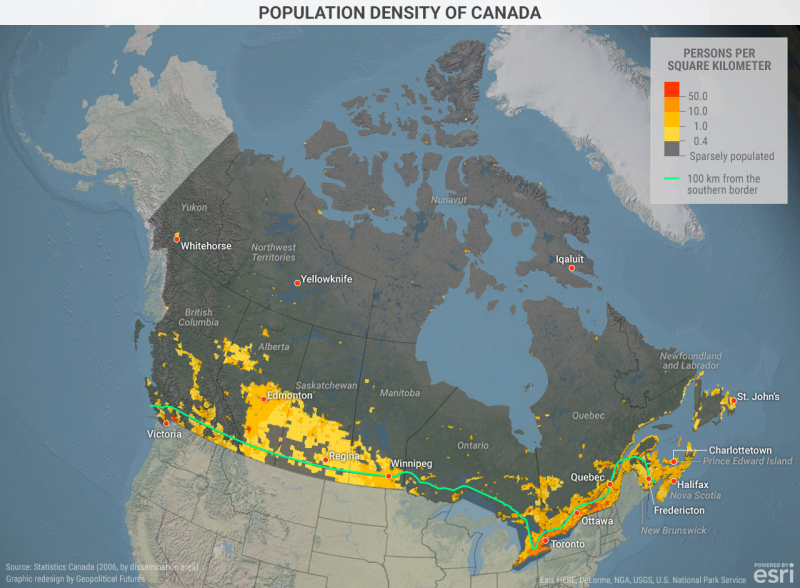
The Canadian Army—which, including reserves, numbers about 45,000 and possesses only a small amount of heavy weaponry—clearly cannot hope to defend this vast territory. In all likelihood, it will not even attempt to do so, focusing instead on defending the “national redoubt” in eastern Ontario and Quebec.
Consequently, most of the populated areas west of Ontario could be occupied by the U.S. Army and the National Guard with virtually no significant resistance; however, the occupation and control of these territories, given their large (well-armed and familiar with the terrain) population, will pose a complex problem—one that is, however, significant only in the long term.
Third, U.S. President Donald Trump has repeatedly made (and continues to make) territorial claims against Canada. In the event of an armed conflict over Greenland, and Canada’s intervention in such a conflict, the desire to “solve both problems at once” will most likely be irresistible to the American elite. This, in turn, automatically puts Canada in a “nothing to lose” position and creates a situation in which thwarting U.S. plans regarding Greenland is the best way for Canada to “avoid being next.”
THEATER OF CONFLICT
Narsasuak—a tiny settlement in the south of the island, valuable solely for the airport located there—will most likely become a critical point for both sides. Narsasuak Airport (and the nearby Kakortok International Airport, currently under construction, with a 1,500-meter runway) serve as a natural stronghold in the south of the island. For the Americans, control over these facilities is the only way to counter the EU’s positional advantage and relieve the burden on carrier-based aviation. For the EU, in turn, control over Narsasuak and Kakortok offers the opportunity to completely block American access to Greenland.
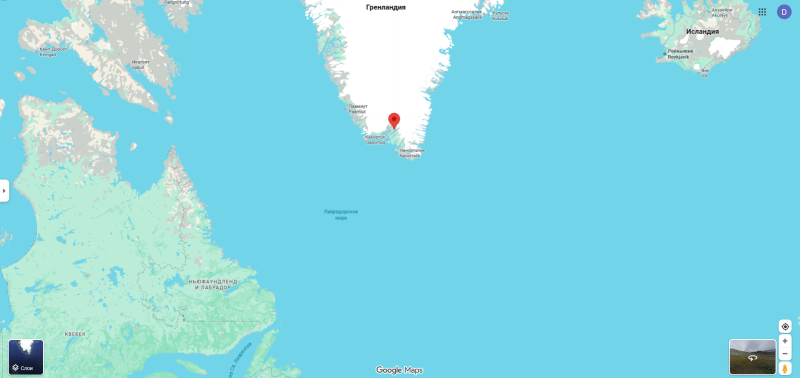
Since both sides understand the importance of Narsasuaka-Kakortok, we can expect both sides to take action aimed at capturing this key location from the very start of the conflict. The most likely move by the Americans, I would surmise, would be a Marine Corps landing, with the aim of quickly establishing control over the airfields and deploying U.S. Marine Corps aircraft there. As for the Europeans, I would expect them to airlift reinforcements to the region at the very start of the conflict (or even before it begins) and to attempt to disrupt the American landing with submarine and air operations from Iceland.
Going forward, as both sides bolster their naval and air reserves, it would be logical to expect an intensification of hostilities south of Greenland. For the Americans, the key objective will be to secure control of the Labrador Sea in order to stabilize their military presence on Greenland’s west coast. For the Europeans, accordingly, the maximum objective will be to drive the Americans out of the Labrador Sea; the minimum objective will be to hold their positions on the east coast of Greenland.
Overall, I would assume that the U.S. Navy will seek to exploit its advantage in maneuverability, avoiding clashes between surface forces and relying primarily on carrier-based aircraft and nuclear submarines. The European fleet, on the other hand, will most likely operate primarily with surface forces, forming battle groups consisting of frigates and destroyers/air defense frigates, and attempting—with the support of land-based aviation—to push the Americans southward.