At some point during the Cold War, engineers stopped asking themselves, “How sensible is this?” and began thinking in a different framework: “Is this even possible?” That is exactly how one of the strangest and, at the same time, most frightening projects of that era came to be—a nuclear-powered cruise missile with virtually unlimited range.
We’re talking about the Pluto project and the SLAM (Supersonic Low Altitude Missile). The idea was extremely simple and, at the same time, radical: to create a missile that doesn’t require conventional fuel and is capable of flying for as long as necessary.
An Engine That Can’t Be Turned Off
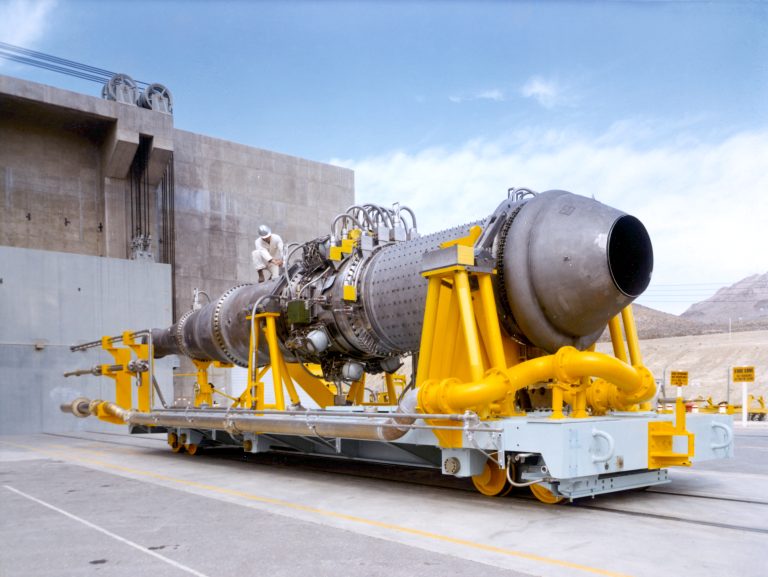
The main component of the project was a nuclear direct-flow air-breathing jet engine.
In a conventional ramjet, air is compressed by the speed of flight, then heated and expelled backward, generating thrust. In the SLAM, a compact nuclear reactor was used instead of fuel. Air passed through it, was heated to extreme temperatures, and provided propulsion.
From a technical standpoint, this seemed like an almost perfect solution. No fuel was required, there were no limits on fuel capacity, and the flight range became virtually unlimited.
But there was one problem.
It was impossible to “make such an engine safe.”
Flying Reactor
Unlike reactors on submarines or ships, there was no adequate protection here. The air passing through the core became radioactive and was released into the atmosphere.
In fact, the rocket itself was a source of radioactive contamination.
And not just at the moment of impact, but throughout the entire flight.
Even testing this system was a challenge in itself. The Tory reactor, developed as part of the project, had to be tested in the Nevada Desert, using special test stands and rail-mounted rigs to ensure proper airflow.
And even under those circumstances, the experiments in question were extremely dangerous.
How it was supposed to work

The concept for its application seemed just as radical.
The rocket was launched using booster rockets, reached supersonic speed, and switched to nuclear propulsion. After that, it could remain airborne for hours, or even days if necessary.
The primary mode is low-altitude flight while navigating around terrain.
This made it an extremely difficult target for air defense systems.
But that wasn’t even the main point.
The SLAM was designed to carry multiple nuclear warheads and attack targets along its route. In essence, it was a “flying platform of destruction” capable of penetrating enemy territory while delivering a series of strikes.
And then—if necessary—just continue the flight.
Why Was This Too Much Even for the Cold War?
On paper, the project looked impressive. But in practice, it had too many problems.
First, the very idea of flying over enemy territory with a nuclear reactor in operation meant inevitable radioactive contamination—not only of enemy territory, but also of potentially neutral territory.
Second, the tests. Launching such a missile under real-world conditions was extremely difficult—any test meant a release of radiation.
And finally, a simpler alternative has emerged.
By the mid-1960s, intercontinental ballistic missiles were being actively developed. They were faster, simpler, and did not cause such side effects.
As a result, the Pluto project gradually lost its purpose.
When Technology Outpaces Common Sense
Work on the project was discontinued in 1964. They succeeded in testing the reactor and validating the concept, but they never got as far as building a fully functional rocket.
And this is precisely the kind of situation where technical success does not lead to practical results.
SLAM could work.
It could fly.
And it might even accomplish its mission.
But the price was too high.
The Final

Project Pluto remains one of the most telling examples of the Cold War.
This isn’t just a story about a rocket.
This is a story about how far engineers can go when constraints are removed.
A rocket that never stops flying.
An engine that can’t be shut off.
A weapon that’s dangerous even when not in use.
Sometimes the most interesting projects are the ones that were never carried out.
And maybe that’s exactly why.