On the Path to Hypersonic Aircraft: China Has Developed a Ceramic Capable of Withstanding 1,800°C

Engineers from Harbin University of Science and Technology in China have developed a material capable of withstanding temperatures high enough to melt metals. The new ultra-high-temperature ceramic (UHT) remains stable when heated to 1,800 °C.
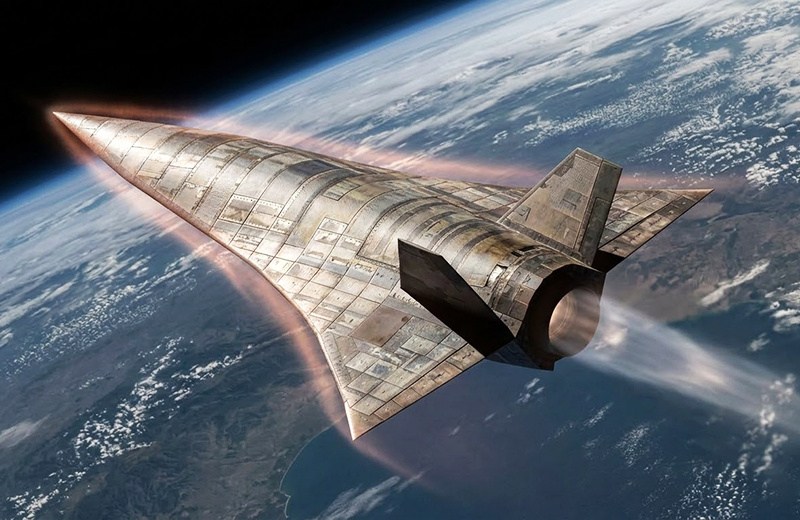
Its flexural strength reaches 824 ± 46 MPa, and its fracture toughness is 7.5 ± 0.5 MPa·m¹/². And these aren’t just dry numbers: based on key performance indicators, this new material significantly outperforms existing counterparts.
A Technological Breakthrough in Materials Science
A research team led by Weibo Xin and Wang Yujin opted for the two-stage spark plasma sintering (SPS) method.
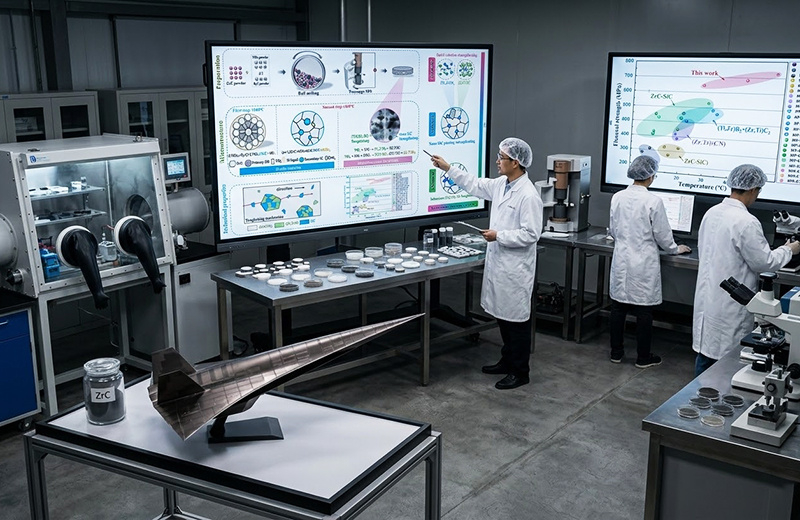
The raw materials used were zirconium carbide (ZrC), titanium disilicide (TiSi₂), and boron carbide (B₄C). The result is a foundation for the aerospace industry of the future. This includes hypersonic vehicles, active propulsion systems, and next-generation nuclear power.
Zirconia has long been considered an ideal candidate for such applications due to its phenomenal melting point. However, its adoption has been hindered by poor sinterability and inherent brittleness.
Traditional methods required extreme heat, which often forced engineers to compromise—improving some of the material’s properties while hopelessly compromising others.
Two-step synthesis method
“We were looking for a way to simultaneously increase the density and crack resistance of ceramics,” explains Weixin Wei, an associate professor at Harbin University of Science and Technology.
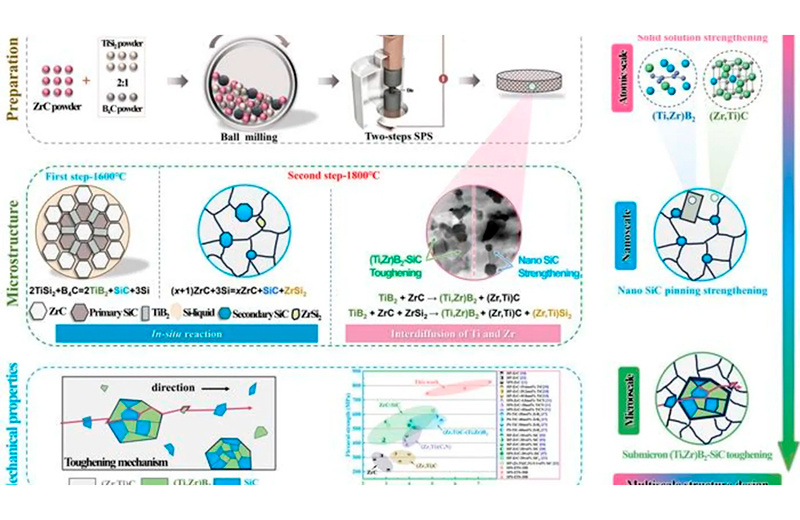
The solution was found in a cascade of chemical reactions that are triggered directly during synthesis. In the first stage, at a temperature of 1600 °C for three minutes, TiSi₂ and B₄C react to form finely dispersed inclusions of titanium diboride (TiB₂) and silicon carbide (SiC).
The temperature is then raised to 1,800 °C. This “temperature cascade” allows for a clear separation of the chemical reaction and diffusion processes. The released silicon atoms react with the ZrC matrix, forming secondary SiC.
Liquid-phase sintering and the mutual diffusion of zirconium and titanium lead to the formation of solid solutions (Zr,Ti)C and (Ti,Zr)B₂, which result in a monolithic structure.
Properties and Microstructure
By using precise proportions of the components—30 mol% TiSi₂ and 15 mol% B₄C—the scientists were able to create a submicrostructure with grain sizes of less than 500 nm.
These tiny particles effectively inhibit the growth of matrix crystals and ensure maximum material density. High-resolution electron microscopy data have confirmed that the orientation of the secondary silicon carbide within the matrix reduces stress in the crystal lattice.
According to the authors of the study, controlling the sequence of reactions and the thermal history fundamentally alters the properties of ceramics. This paves the way for the creation of reliable structures capable of operating under extreme temperature conditions.
Source — https://dzen.ru/a/aamVPb4x1lRn1krl