You Might Not Even Need Radar to Shoot Down an F-15E: How Ordinary Drones Are Becoming an Air-Defense Network

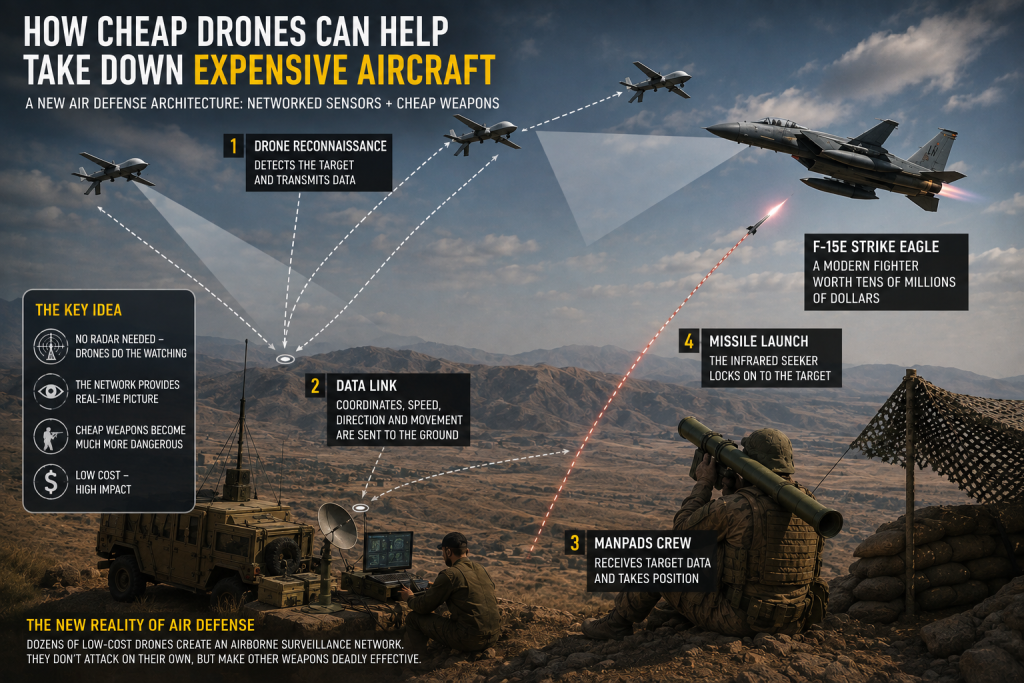
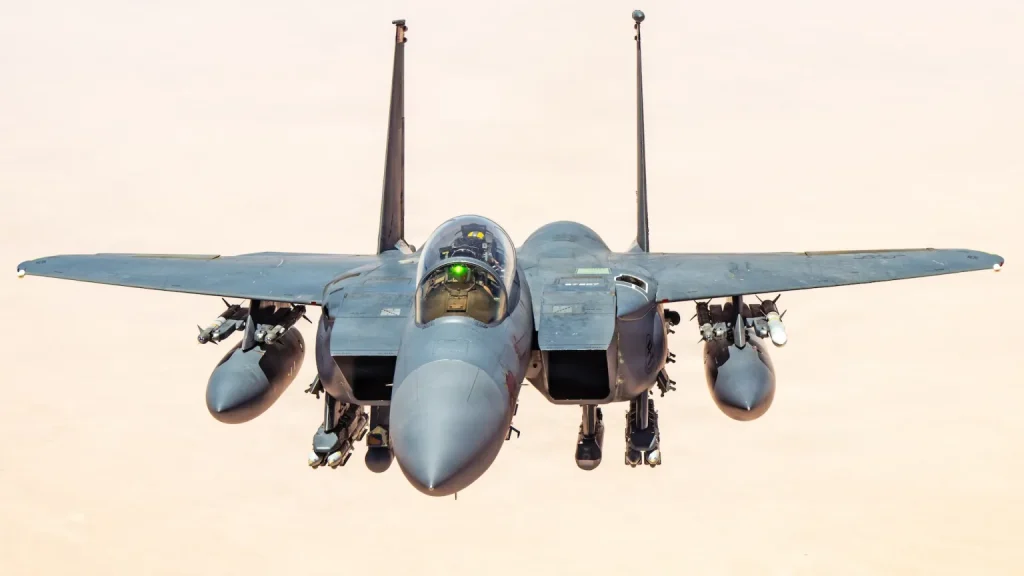
The F-15E Strike Eagle is one of the most capable strike aircraft of its generation. It can carry more than ten tons of weapons, is equipped with a powerful radar and advanced electronic-warfare systems, and was designed to operate at night and at very low altitude. The loss of such an aircraft over Iran on April 3, 2026, was therefore notable in itself. But the story has now taken a far more interesting turn. According to new information, Iran may not have needed to track the F-15E with a conventional radar at all: several drones could have detected the aircraft and relayed its position, speed, and direction to a ground team, after which the Strike Eagle was reportedly hit by a MANPADS missile. If this version is confirmed, the most important part of the story is not the loss of the F-15E itself. It is the possibility that a relatively inexpensive drone carrying a camera can turn an ordinary shoulder-fired missile into part of a distributed air-defense network.
One of America’s Most Capable Strike Aircraft Against a Man With a Missile
First, we need to establish what actually happened.
On April 3, 2026, the U.S. Air Force lost an F-15E Strike Eagle from the 494th Fighter Squadron, based at RAF Lakenheath in the United Kingdom, over Iranian territory. Both crew members ejected. The pilot was recovered relatively quickly, while the search and rescue of the weapon systems officer developed into a large and extremely complicated operation.
Later reports suggested that the aircraft had most likely been hit by a man-portable air-defense system, possibly of Chinese origin.
That alone was remarkable.
The F-15E was specifically designed to penetrate deep into hostile territory, operate at night and at low altitude, while modern Strike Eagles are equipped with far more sophisticated electronic-warfare systems than the original aircraft of the Cold War era.
But even the best self-protection suite cannot make an aircraft invulnerable.
Especially when the crew does not know where the attack is coming from.
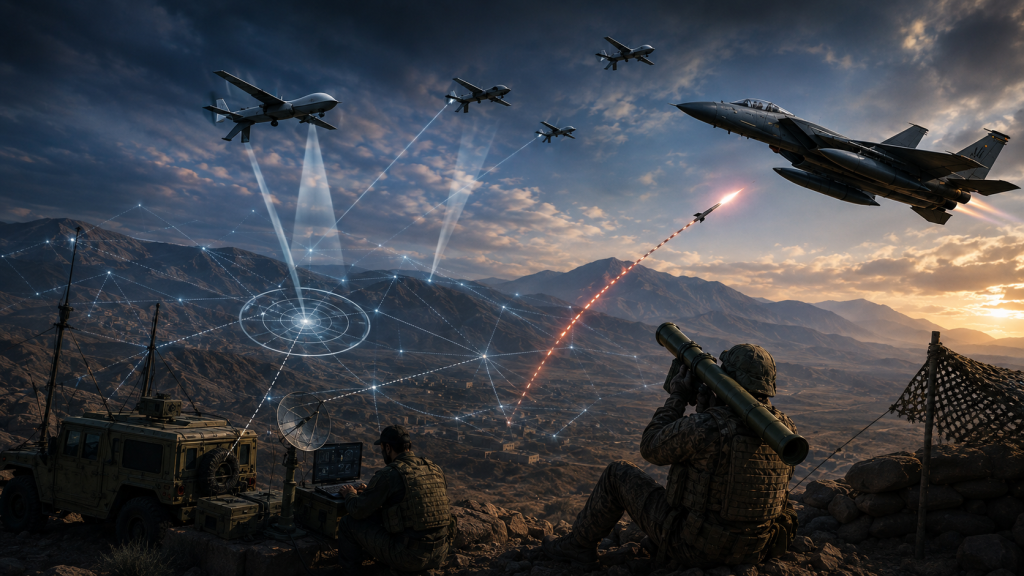
On August 12, TWZ published new details based on reporting by The New York Times and an unnamed senior U.S. military official. According to this account, the Pentagon concluded that Iranian drones had provided commanders with important information about the F-15E — its location, speed, and direction of travel.
That information could then have been used to organize the attack.
And this is where an ordinary story about a lost aircraft becomes a much more interesting story about the future of air defense.
Because the drones themselves may not have fired anything.
They only had to watch.
The Biggest Problem With a MANPADS Is Not Actually the Missile’s Range

A man-portable air-defense system is an extremely unpleasant weapon for military aviation. It is compact, easy to conceal, its crew can be positioned almost anywhere, and the firing position can be abandoned shortly after launch.
But MANPADS have one fundamental weakness.
The operator must first find the aircraft.
The engagement range of such weapons is measured in kilometers, not hundreds of kilometers. The team therefore has to be positioned roughly where the target will actually appear.
Putting a soldier with a missile somewhere across a huge area and telling him to keep watching the sky is not a particularly effective air-defense system.
Traditionally, this problem is solved by the wider air-defense network.
A radar detects an aircraft at long range. Information is sent to a command post and then distributed to individual units. A MANPADS team therefore already knows roughly where the target is coming from.
But radar has a weakness of its own.
It emits.
A powerful radar effectively tells the enemy:
I am here.
Its emissions can be detected by electronic-intelligence systems. The radar can be jammed, attacked with anti-radiation missiles, or destroyed by other precision-guided weapons.
This is why suppressing an enemy air-defense system has traditionally begun by attacking its eyes.
Now remove the large radar from that chain.
And put several small drones into the air instead.
A Camera Worth Thousands Instead of a Radar Worth Millions?
Imagine a highly simplified scenario.
Several UAVs are operating over a particular area. They carry no missiles and have no intention of attacking aircraft themselves. They are equipped only with cameras, perhaps infrared sensors, navigation systems, and data links.
One drone spots an aircraft.
A little later, a second sees it.
Then a third.
The network can already begin estimating the target’s direction of travel and approximate speed. If the drones know their own coordinates and can determine the target’s position with reasonable accuracy, the information becomes even more useful.
A ground team can receive a very simple warning: an aircraft is approaching from a particular direction, it is approximately here, and it should enter your sector in several minutes.
The MANPADS operator no longer needs to search the entire sky for a tiny moving dot.
He only has to watch the part of the sky where the target is expected to appear.
This is essentially the capability now being considered in connection with the lost F-15E. According to the U.S. military official cited by TWZ, drones supplied Iranian commanders with information about the aircraft’s GPS position, speed, and direction of movement.
The most interesting part is that none of this necessarily requires some science-fiction autonomous “drone swarm.”
One drone detects the target.
It sends the information.
Another confirms it.
That alone may be enough to dramatically narrow the search area for ground-based air defenses.
An individual drone in such a network can be extremely cheap compared with a full-sized radar installation. Destroy one and the others remain. Lose another and the network continues operating. Add ten more and the surveillance area becomes larger.
The result is a kind of distributed airborne observation network.
But How Can a Camera Even Detect a Jet Fighter?
At first glance, the idea seems strange. Modern radars exist precisely because the human eye cannot reliably detect aircraft at long distances.
But a drone has one enormous advantage over a person standing on the ground.
Altitude.
A ground observer is restricted by buildings, terrain, trees, and the horizon. A UAV can carry an optical or infrared sensor hundreds or thousands of meters above the surface.
And it does not necessarily have to identify the exact aircraft type or read the serial number on its tail.
For an early-warning network, the first requirement may simply be to establish that an airborne target exists, determine its approximate direction of travel, and pass that information onward.
Modern electronics make the task easier still. Stabilized cameras, thermal imagers, moving-object detection algorithms, and computer vision are no longer technologies available exclusively to the world’s largest militaries.
Multiple dispersed sensors can potentially compare their observations as well.
And this is where quantity begins to turn into quality.
One inexpensive drone is just a flying camera.
Dozens of aircraft spread across a region and connected by data links become a surveillance network.
And What About the Famous “Jellyfish”?
The loss of the F-15E contains another extremely strange detail.
Earlier reports described an account attributed to the Strike Eagle pilot, who allegedly saw an unusual formation of drones shortly before ejecting. According to information reported by CNN and later examined by TWZ, several UAVs appeared to be moving together, with larger aircraft above and smaller ones below.
The formation supposedly resembled a kind of jellyfish.
Another account described what the pilot saw as a “drone minefield.”
But this is where speculation begins.
The pilot had just survived an extremely dangerous situation and was reportedly suffering from a concussion. There is no confirmation that the unusual group of drones he observed was actually the system that helped locate the F-15E.
TWZ specifically notes that the “jellyfish” and the surveillance drones could have been two entirely unrelated phenomena.
That distinction matters.
Because this story does not require a “jellyfish” at all.
It does not require some futuristic swarm in which dozens of drones autonomously communicate and collectively decide how to attack a target.
Several airborne observation posts, a reliable communications network, and people on the ground would be enough.
And that makes the concept not less dangerous, but more dangerous.
Because it is much easier to build.
The F-15E Might Not Even Have Known It Was Being Hunted
This brings us to another interesting point.
When a conventional surface-to-air missile system begins tracking an aircraft with radar, the aircraft’s warning systems may detect the associated electromagnetic emissions. The crew receives information that a radar is operating against them and can take defensive action.
A camera does not illuminate the aircraft with radio-frequency energy.
It simply watches.
If the target’s coordinates are transmitted to a ground team through a separate communications network, the aircraft itself may have no idea that it has already been detected.
The MANPADS operator then waits for the aircraft to appear, acquires it with the missile’s infrared seeker, and launches.
There is another curious detail in the F-15E story.
The New York Times account reportedly claimed that the Strike Eagle’s defensive systems gave its crew only around half a second of warning before the missile struck. TWZ, however, pointed out an important problem: the F-15E is not equipped with a full missile-approach warning system, or MAWS, capable of directly detecting an incoming infrared-guided missile.
Exactly how such a warning could have been generated therefore remains unclear.
And if an infrared-guided MANPADS really was involved, the situation could have been particularly dangerous for the crew.
The enemy radar remains silent.
There may be no conventional radar-lock warning.
The aircraft appears to be flying without anyone actively engaging it.
Yet somewhere ahead, a soldier already knows exactly which part of the sky he needs to watch.
Does This Mean Air Defense Without Radar?
Not quite.
Nobody is about to abandon radar. It remains an extraordinarily powerful tool capable of detecting targets at long range, measuring distance, speed, and altitude, and tracking numerous objects simultaneously regardless of daylight conditions.
A camera mounted on a drone cannot replace all of that.
But it can supplement radar.
And under some circumstances, it can temporarily compensate for its absence.
Imagine an area where major radar installations have been destroyed or are forced to operate only intermittently because of the threat posed by anti-radiation missiles.
A conventional air-defense system begins losing situational awareness.
In the past, that could mean enormous gaps opening in radar coverage.
Today, some of those gaps could potentially be filled by drones.
One carries an ordinary camera.
Another carries an infrared sensor.
A third could carry a compact passive radio-frequency sensor.
A fourth acts as a communications relay.
Instead of one large radar, the defender now has many small sources of information.
Each of them is dramatically less capable than a full-sized radar.
But destroying one of them changes very little.
And that is where the real shift begins.
Air Defense Is Gradually Becoming a Network
For most of the 20th century, air defense was built around a relatively small number of expensive and sophisticated nodes.
A radar.
A command post.
A missile launcher.
A fighter base.
Destroying one of those elements could significantly degrade the entire system.
Modern electronics are gradually changing that architecture.
The sensor no longer has to be physically located next to the weapon that uses its information.
A radar detects a target — another system fires.
A drone spots another target — its data goes to a different weapon.
An airborne early-warning aircraft finds a third — the information is transmitted to a fighter.
A ground-based optical sensor sees a fourth — the coordinates are sent to a MANPADS team.
Ideally, all of these elements become part of a common information environment.
And once that happens, the value of an individual weapon is no longer determined solely by its own technical characteristics.
An old MANPADS that previously could engage only what its operator happened to see suddenly receives external targeting information.
A conventional anti-aircraft gun receives target data from a drone.
A fighter receives coordinates from a ground radar.
The most valuable weapon in such a system is not necessarily the missile.
Sometimes it is information.
And This Is Where the Economics Become Particularly Uncomfortable
The F-15E is a large, two-seat strike fighter weighing tens of tons and designed for some of the most demanding combat missions imaginable. Its value is measured in tens of millions of dollars, it requires extensive infrastructure to operate, and training its crew takes years.
On the opposite side may be a small drone carrying an optical sensor and a soldier with a shoulder-fired missile.
Of course, reducing everything to a simple price comparison would be misleading. A functioning network still requires communications, software, trained operators, command structures, and the weapons themselves.
But the trend is obvious.
In the past, improving air defense primarily meant improving the surface-to-air missile system itself.
A more powerful radar.
A longer-range missile.
A more sophisticated seeker.
Today, it may sometimes be possible to modernize not the weapon, but the information surrounding it.
And an old weapon suddenly becomes much more dangerous.
Something similar has already happened with artillery. A conventional howitzer has not fundamentally changed over the past several decades. But connect it to drone reconnaissance, digital fire-control systems, and rapid coordinate sharing, and its effectiveness can increase dramatically.
The same transformation is now beginning to reach air defense.
Perhaps This Is What the Downed F-15E Really Demonstrated
For now, caution is necessary.
We do not know the exact configuration of the Iranian surveillance network. We do not know which drones were used, what sensors they carried, or how automated the exchange of information actually was. Nor has any connection been proven between the pilot’s reported “jellyfish” and the system that may have helped detect the Strike Eagle.
TWZ itself emphasizes these uncertainties.
But they do not change the broader technological trend.
Because the technical possibility of such a system is no longer science fiction.
And that brings us back to the original paradox.
To increase the chances of destroying one of the most capable strike aircraft of its generation, you do not necessarily need to build a multimillion-dollar surface-to-air missile or an even more powerful radar.
Sometimes you only need to make sure that an inexpensive drone sees the aircraft at the right moment.
And then tells the person on the ground exactly where to look.
That is why the possible role of Iranian drones in the loss of the F-15E may ultimately be more interesting than the loss of the Strike Eagle itself. It illustrates how rapidly the old boundary between a reconnaissance drone and a weapon system is disappearing.
A drone does not even need to carry its own missile to participate in the destruction of an aircraft.
Someone else’s missile becomes its weapon.
And if there are not one but dozens or hundreds of such airborne observers, an uncomfortable possibility emerges: the air-defense system of the future may no longer be identifiable by a giant rotating radar antenna on the horizon.
Because its “radar” may be the entire sky, filled with small drones.
based on https://www.twz.com/air/did-sensors-on-iranian-drones-help-shoot-down-f-15e