A 109-Meter Aircraft: When Will the Giant WindRunner Actually Take Flight?

Throughout aviation history, giant transport aircraft have almost always been created to solve extraordinarily large logistical problems. The Antonov An-225 was developed to carry components of the Soviet space program, the American C-5 Galaxy was designed for strategic transportation of heavy military equipment, while the Airbus Beluga and Boeing Dreamlifter were built to move enormous sections of passenger aircraft between factories. American company Radia, however, wants to go even further and build a transport aircraft whose internal cargo volume would exceed that of anything ever flown before.
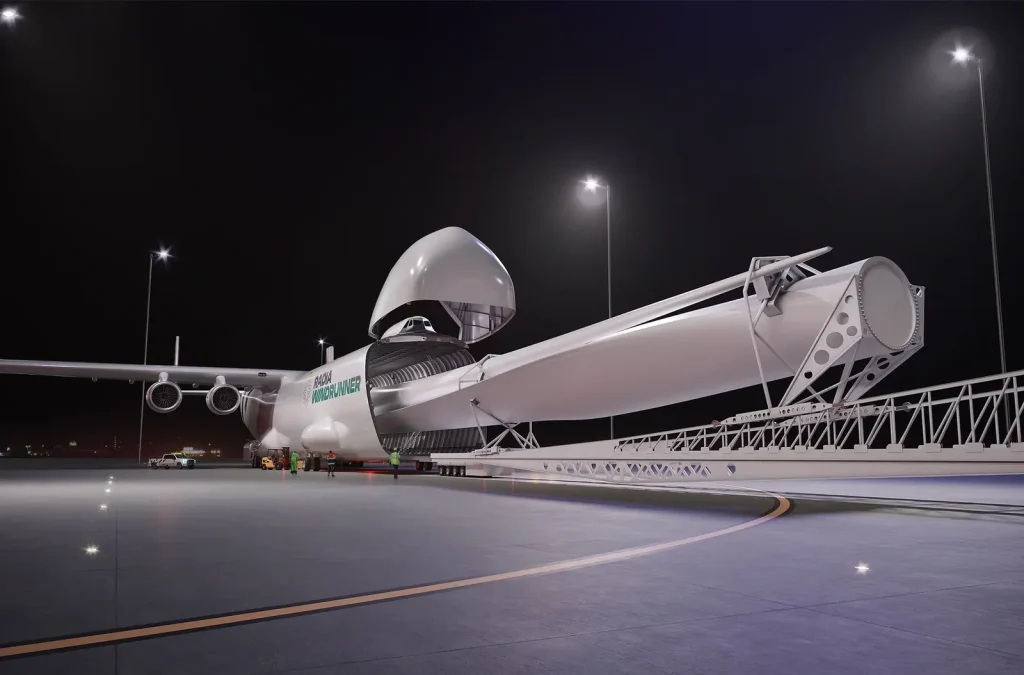
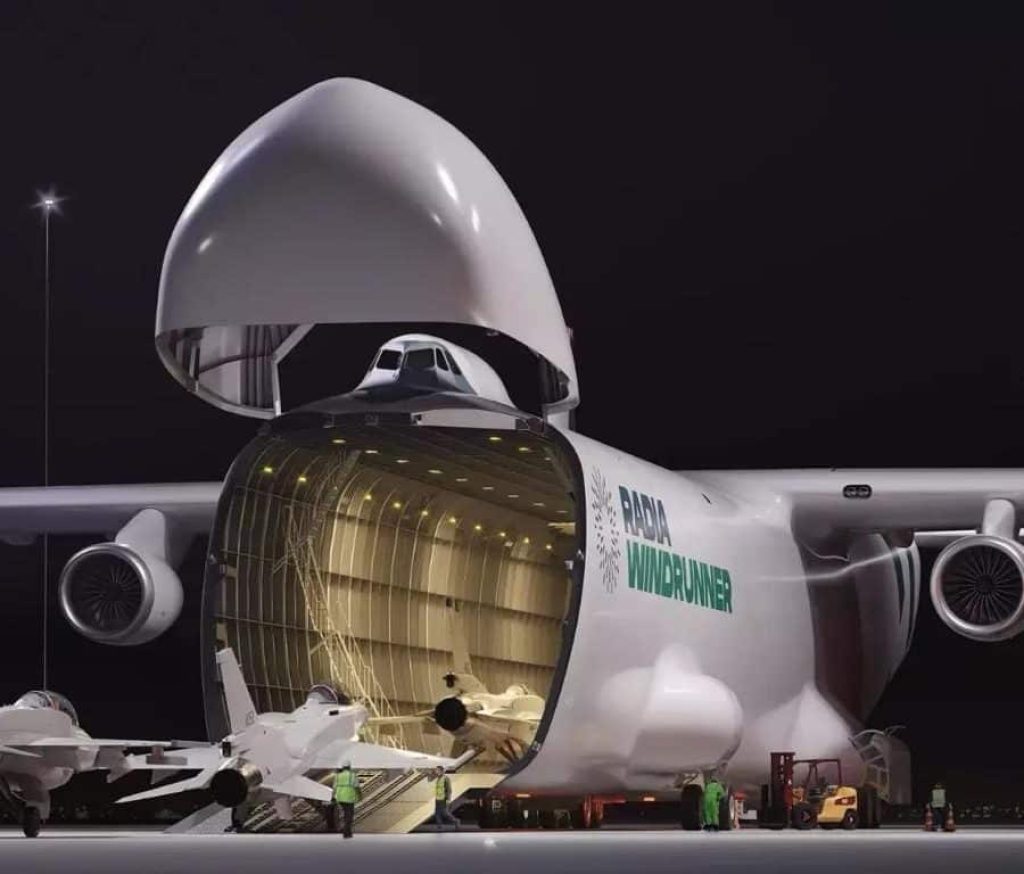
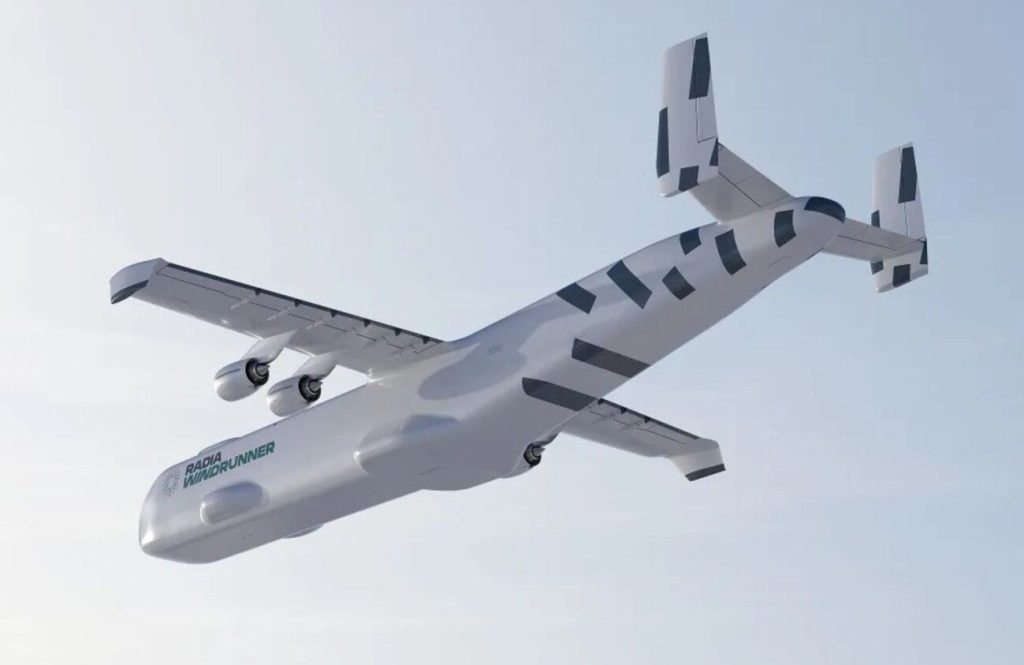
The WindRunner is planned to be 109 meters long, with an 80-meter wingspan and a height of approximately 24 meters. Its cargo compartment is expected to provide around 6,800 cubic meters of volume, while individual cargo items could be as long as 105 meters. For comparison, the An-124 offers roughly 1,160 cubic meters of cargo volume, while the Boeing 747-400F provides around 610 cubic meters. Yet WindRunner is not intended to be a one-off experimental giant. Radia envisions it as a commercial transport aircraft capable of operating from semi-prepared or unpaved runways only about 1,800 meters long.
On paper, it looks almost unbelievable. But during the summer of 2025, reports about the project created a somewhat misleading impression. After Radia announced several new industrial partners, numerous articles suggested that the giant aircraft was approaching production. More than a year later, WindRunner still exists primarily as a digital design and in promotional renderings.
Does that mean the project has stalled?
Quite the opposite. The reality is simply that there is an enormous amount of work between an ambitious aircraft concept and the first flight of what could become the world’s largest cargo aircraft.
Why Does Anyone Need an Aircraft This Enormous?
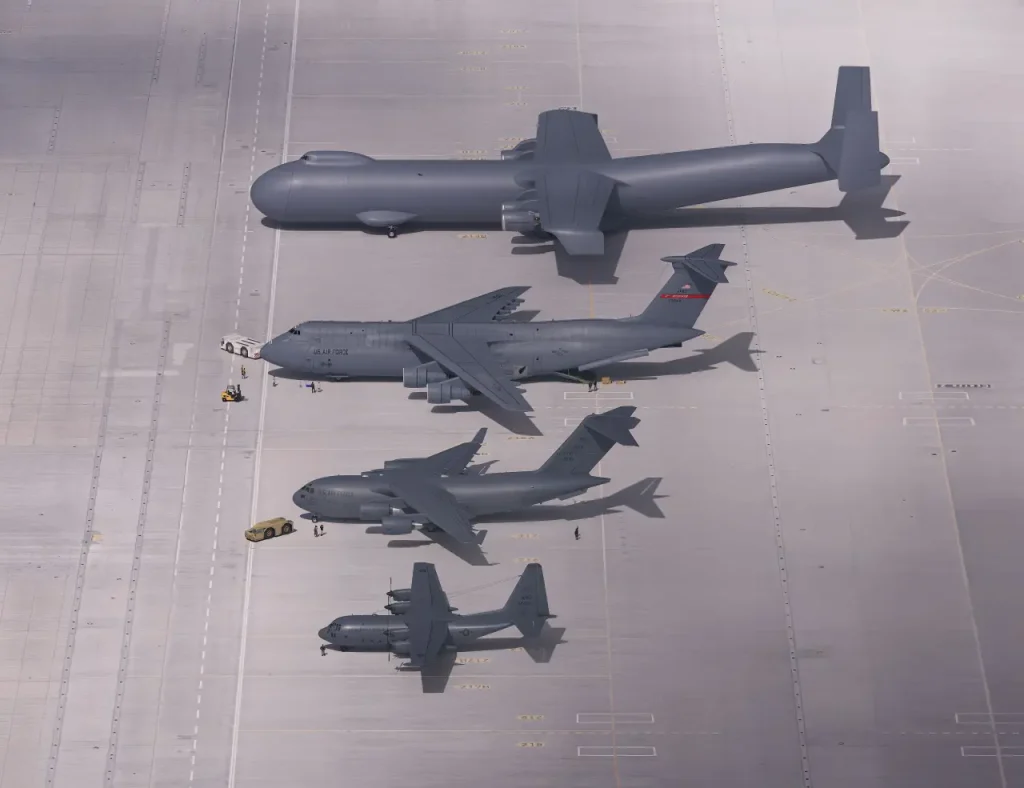
WindRunner did not originally emerge as a competitor to the An-124 or C-5, nor was it conceived as a military transport. Its origins lie in a much more unexpected industry: wind energy.
The efficiency of modern wind turbines generally increases as rotor dimensions grow. Longer blades sweep a larger area and allow the turbine to extract more energy from the wind. Offshore wind farms can accommodate enormous blades because logistics are comparatively straightforward: components can be manufactured near the coast, loaded onto specialized ships, and transported by sea.
On land, the situation is dramatically different.
Imagine a composite structure more than 100 meters long. It may be relatively light for its size, but transporting it through a conventional road network becomes extraordinarily difficult. Bridges, tunnels, power lines, highway interchanges, narrow streets, and even ordinary turns become obstacles.
As a result, the size of onshore wind turbines can be constrained not by what engineers are capable of building, but by whether a truck carrying the blade can physically make it around a corner.
Radia proposed a radical solution: do not transport the blade by road at all.
Instead, WindRunner would pick it up near the factory and fly it directly to the wind farm construction site. A relatively simple semi-prepared runway near the destination would theoretically be enough. This requirement largely explains why WindRunner became so enormous in the first place.
WindRunner Is Huge — But It Does Not Carry That Much Weight
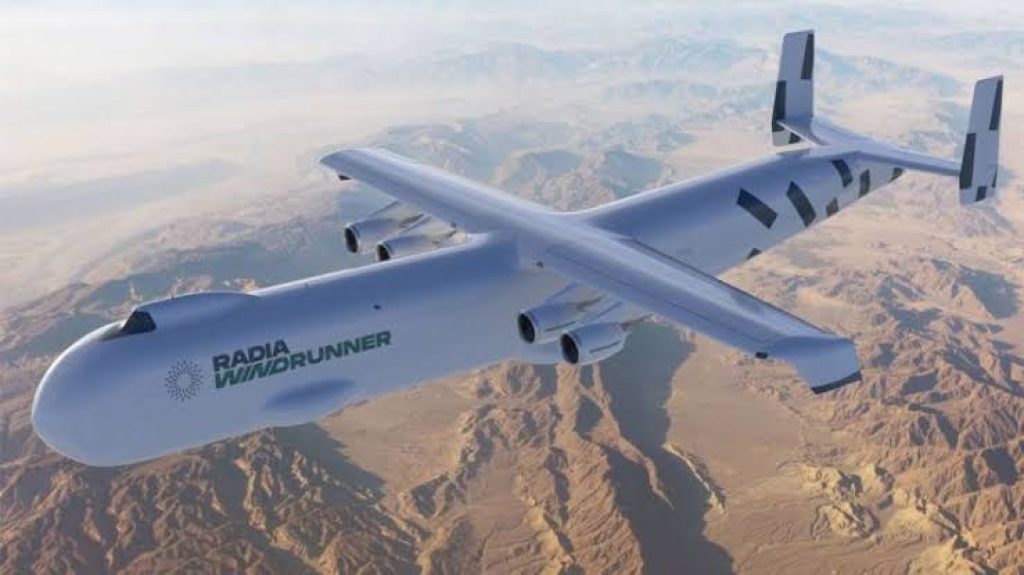
This is one of the most unusual aspects of the entire project. WindRunner is intended to become the world’s largest cargo aircraft not because it can lift a record-breaking payload.
Its planned maximum payload is 72.6 tons. That is far below the roughly 150-ton payload capability of the An-124 and also below that of the C-5M.
The difference is volume.
| Length | 109 m | ~69 m | ~71 m |
| Wingspan | 80 m | 73.3 m | 64.4 m |
| Cargo volume | ~6,800 m³ | ~1,160 m³ | ~610 m³ |
| Maximum payload | 72.6 t | ~150 t | ~113 t |
| Maximum cargo length | 105 m | Much shorter | Much shorter |
| Unpaved runway operations | Yes | Not normally | No |
This is why WindRunner is better described as an outsized-volume transport aircraft rather than a super-heavy airlifter.
Its purpose is to transport objects that become physically too large for existing aircraft long before they become too heavy.
That requirement explains the aircraft’s extraordinary proportions.
A 109-Meter Aircraft Built Around 105 Meters of Cargo
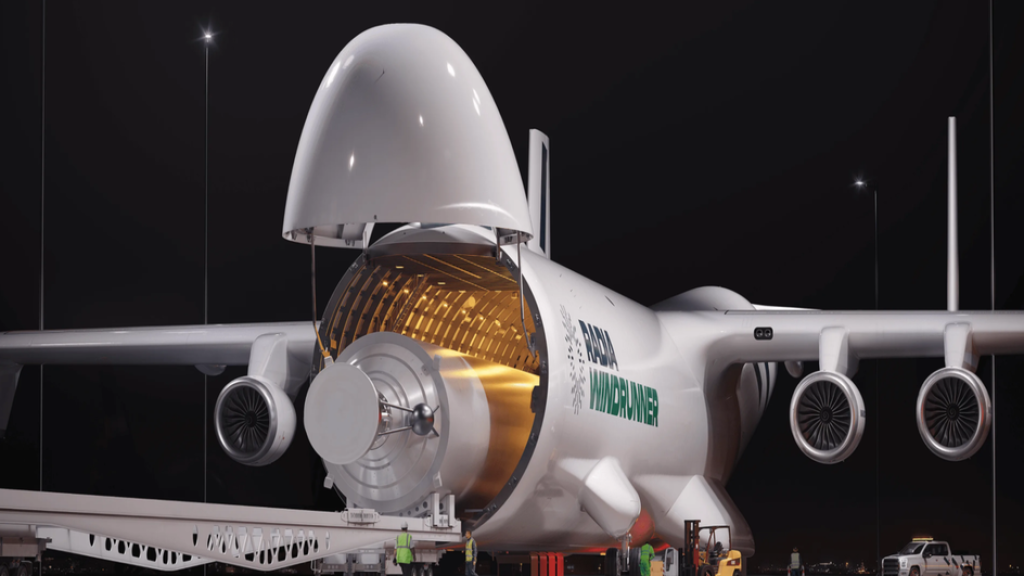
According to Radia’s current figures, WindRunner will be 109 meters long, 80 meters across the wings, and approximately 24 meters high. Maximum cargo dimensions are expected to reach 10 meters in width, 9 meters in height, and an extraordinary 105 meters in length. The company currently quotes approximately 6,800 cubic meters of cargo volume.
Earlier Radia materials cited a figure closer to 7,700 cubic meters. The different numbers found in older publications therefore appear to reflect changes to the evolving design rather than necessarily errors in reporting.
With maximum payload, WindRunner is expected to have a range of approximately 2,000 kilometers, cruise at around Mach 0.6, and operate at altitudes of up to approximately 12,525 meters. For a global strategic transport aircraft, 2,000 kilometers might seem surprisingly limited, but WindRunner was never primarily designed to fly maximum payloads nonstop between continents. Its purpose is to deliver exceptionally large objects directly to places conventional airlifters cannot realistically serve.
And that leads to perhaps the most extraordinary requirement of the entire project.
The World’s Largest Cargo Aircraft Is Supposed to Need Only 1,800 Meters of Dirt
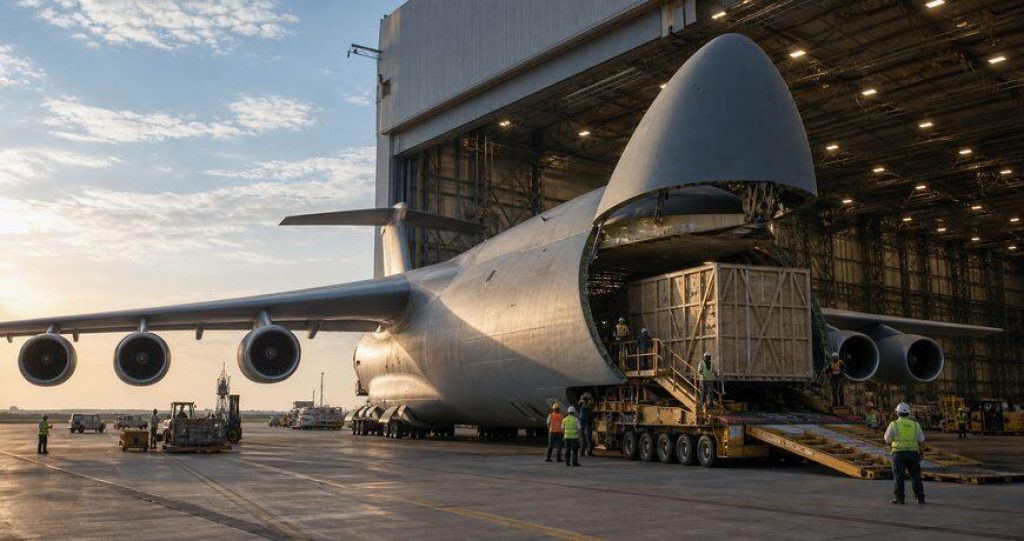
WindRunner is being designed to operate from semi-prepared or unpaved runways approximately 1,800 meters long. This requirement makes the aircraft’s high-lift systems and landing gear particularly important. An aircraft of this size must combine enormous dimensions with relatively low takeoff and landing speeds while distributing its weight across a surface far less robust than the concrete runway of a major international airport.
This is essential to the entire business model.
If every WindRunner flight required the construction of a three-kilometer concrete runway and a full-scale international airport, the concept would largely defeat itself. There would be little point in flying an enormous wind turbine blade directly to a remote construction site if an airport had to be built there first.
The short, semi-prepared runway is therefore not an optional capability.
It is one of the fundamental requirements around which the entire aircraft is being designed.
And it is also likely to be one of the most technically demanding aspects of the program.
The Aircraft Is Already Being Divided Among Factories
This is where substantial progress has been made over the past two years.
In 2024, Radia selected Spain’s Aernnova to work on the wing and engine pylons, while Italy’s Leonardo became involved with the fuselage and AFuzion joined the certification and safety effort. Italy’s MAGROUP Magnaghi Aerospace is working on the landing gear system.
In June 2025, five additional major suppliers joined the program. Spain’s Aciturri took responsibility for the composite empennage, Brazil’s Akaer for the pressurized cockpit, American company Astronautics for avionics and cybersecurity, Element Materials Technology for the fuel system, and Ingenium Technologies for the high-lift system.
Development did not stop there. During 2026, Radia continued expanding its industrial network. France’s Latecoere joined the program to work on electrical wiring and interconnection systems, while Britain’s Stirling Dynamics became involved in flight-control system integration. Radia now speaks of more than 20 industrial and technology partners participating in the program.
The future support infrastructure is also beginning to take shape. Italy’s Atitech is expected to contribute to maintenance, repair, overhaul, and potentially support the future final assembly operation.
This is an important indication of project maturity. A relatively small engineering team can produce impressive renderings and a convincing aircraft concept. Dividing responsibility for the fuselage, wing, landing gear, avionics, electrical systems, flight controls, and other major components among established aerospace suppliers is something very different.
It indicates that WindRunner is gradually becoming an actual industrial program.
But there is still a long way to go before a complete aircraft exists.
So When Will WindRunner Actually Fly?
There is finally a reasonably specific answer.
Radia currently plans WindRunner’s first flight for 2030.
This target now appears in the company’s plans for both commercial and defense applications.
That means reports in 2025 saying that new industrial partnerships were “bringing the aircraft closer to production” were technically correct, but they could easily create a misleading impression about the timetable. Several years of detailed engineering, component manufacturing, prototype assembly, ground testing, and preparation for the flight-test campaign still separate the current program from the first takeoff.
Even 2030 should therefore be treated as Radia’s target, not as a guaranteed date.
Delays would hardly be unusual for an entirely new aircraft of unprecedented dimensions. More importantly, first flight is not the same thing as entry into commercial service. An extensive flight-test and certification campaign would have to follow.
So the most accurate answer is this: if the current schedule holds, the physical WindRunner should emerge toward the end of this decade, with its first flight planned for 2030.
While Radia Was Designing an Aircraft for Wind Turbines, the Military Became Interested
This is where the WindRunner story took an unexpected turn.
Its gigantic cargo hold could be useful for far more than wind energy. In May 2025, Radia entered into a Cooperative Research and Development Agreement with the U.S. Department of Defense and U.S. Transportation Command to assess WindRunner’s potential military logistics applications, including possible use within the Civil Reserve Air Fleet framework.
In September 2025, Radia went further and formally introduced WindRunner for Defense.
The reason for military interest is surprisingly similar to the original wind-energy problem. Modern military equipment is increasingly constrained not only by weight, but by physical dimensions.
Radia has proposed transporting large radar systems, Collaborative Combat Aircraft, mobile hospitals, helicopters, and tiltrotors without extensive disassembly. Promotional concepts for the defense version have shown aircraft such as the CH-47 Chinook and V-22 Osprey inside the WindRunner.
That could fundamentally change certain types of logistics.
Today, a large system may have to be partially disassembled, transported on several aircraft, reassembled at the destination, and then tested before it becomes operational again. If the same system could be transported largely intact, the time saved could matter more than the aircraft’s raw payload capacity.
In That Sense, WindRunner Is the Opposite of the An-225
Comparisons with the Antonov An-225 are inevitable, but also somewhat misleading.
The An-225 was designed as a super-heavy airlifter. Its maximum takeoff weight reached approximately 640 tons, while its payload capacity was around 250 tons. WindRunner, by contrast, is designed to carry only 72.6 tons.
In terms of payload mass, the two aircraft belong to entirely different categories.
WindRunner is intended to win in situations where the cargo simply does not physically fit inside existing transport aircraft.
Radia is therefore effectively focusing on a different parameter of strategic airlift. For decades, the largest cargo aircraft were primarily judged by how much weight they could carry. WindRunner asks whether the more important limitation for some modern cargo might actually be volume and geometry.
Its projected 6,800 cubic meters of cargo space illustrate the difference dramatically.
Radia’s own comparison figures list approximately 960 cubic meters for the C-5 Galaxy and around 590 cubic meters for the C-17. The C-17 can carry roughly 77.5 tons — slightly more than WindRunner’s projected 72.6-ton maximum payload — yet WindRunner would offer more than ten times its cargo volume.
The result is an extremely unusual aircraft: a giant that could lose to a much smaller transport aircraft in terms of payload weight.
And that is entirely intentional.
WindRunner Specifications
As of August 2026, Radia lists the following target specifications:
| Length | 109 m |
| Wingspan | 80 m |
| Height | 24 m |
| Cargo volume | ~6,800 m³ |
| Maximum payload | 72.6 t |
| Maximum cargo length | 105 m |
| Maximum cargo width | 10 m |
| Maximum cargo height | 9 m |
| Range at maximum payload | ~2,000 km |
| Cruise speed | Mach 0.6 |
| Service ceiling | 12,525 m |
| Required runway length | ~1,800 m |
| Semi-prepared/unpaved runway capability | Yes |
| Planned first flight | 2030 |
One point needs to be emphasized: these remain design targets, not demonstrated performance figures. There is no completed aircraft yet on which these claims can be independently verified.
The Main Question Is No Longer Whether Someone Can Draw It
WindRunner has already passed an important stage in its development. A few years ago, it genuinely looked like an extraordinarily ambitious idea: build an aircraft roughly as long as a football field to transport wind turbine blades that cannot navigate conventional roads.
Today, the project looks considerably more serious. Leonardo is involved with the fuselage, Aernnova with the wing, Aciturri with the tail, MAGROUP with the landing gear, Astronautics with avionics, Ingenium with the high-lift system, Latecoere with electrical systems, and Stirling Dynamics with flight-control integration. A network of more than twenty industrial partners has formed around the aircraft, while the U.S. Department of Defense is separately evaluating potential military applications.
But none of that guarantees success.
Radia still has to build the aircraft, prove that a 109-meter giant can safely operate from short semi-prepared runways, complete certification, establish serial production, and — equally important — demonstrate that the economics make sense. Such an unusual aircraft is only useful if transporting giant objects by air proves more attractive than disassembling them, moving them overland, or building alternative infrastructure.
That is why the next several years will be decisive for the program.
So When Will the World See the Largest Cargo Aircraft?
Not tomorrow, and judging by the current schedule, not within the next couple of years either.
WindRunner’s first flight is planned for 2030. Before then, Radia must transform its growing international supplier network into a physical aircraft and complete a massive amount of ground testing. The first flight would then be followed by a separate flight-test and certification program, meaning full commercial operations would logically come later.
But the WindRunner concept has become considerably more interesting than it was when first revealed. The project began with a highly specialized mission: carry a 100-meter wind turbine blade directly to a semi-prepared airstrip near a wind farm. Gradually, it became apparent that exactly the same capability could be useful to the space industry, heavy engineering, humanitarian logistics, and the military.
And this is the real significance of the project.
WindRunner is not trying to become a new An-225 or set a record for the heaviest payload ever lifted. Its designers are solving a completely different problem. The modern world has learned to build enormous satellites, rockets, energy equipment, radar systems, aircraft, and wind turbine blades, while transportation infrastructure is still largely constrained by cargo dimensions established in the previous century.
Radia’s answer is not to make the cargo smaller or disassemble it into pieces.
It is to build the aircraft around the cargo itself.
And if WindRunner really does fly in 2030 with anything close to its projected performance, its most important record may not be its 109-meter length or 6,800 cubic meters of cargo volume. It could establish an entirely new category of transport aviation in which the defining question is no longer:
“How many tons can we lift?”
But rather:
“How enormous an object can we transport in one piece?”