Khabarovsk: Why Russia Is Building a Dedicated Nuclear Submarine for Six Poseidon Underwater Vehicles

Russia’s nuclear submarine fleet now includes a vessel that is difficult to fit into any conventional classification. It is not a ballistic missile submarine like the Borei class, not a multipurpose attack submarine like the Yasen class, and not a conventional cruise-missile carrier. The main weapon of the Project 09851 Khabarovsk is expected to be six enormous Poseidon autonomous underwater vehicles, each powered by its own nuclear reactor.
In August 2026, the submarine entered a new phase of its development. Built by Sevmash, Khabarovsk went to sea under its own power and began factory sea trials. The tests are expected to evaluate the propulsion plant, handling, navigation, acoustic characteristics, and shipboard systems. Construction began back in 2014, while the submarine was launched only on November 1, 2025.
But there is a more interesting question.
Russia already operates a nuclear submarine capable of carrying Poseidons — the K-329 Belgorod, Project 09852, which was commissioned in 2022. Why build another enormous nuclear-powered submarine for the same weapon?
Because despite sharing the same special-purpose armament, Belgorod and Khabarovsk represent two fundamentally different approaches.
Belgorod Was a Conversion. Khabarovsk Was Designed for the Mission From the Start
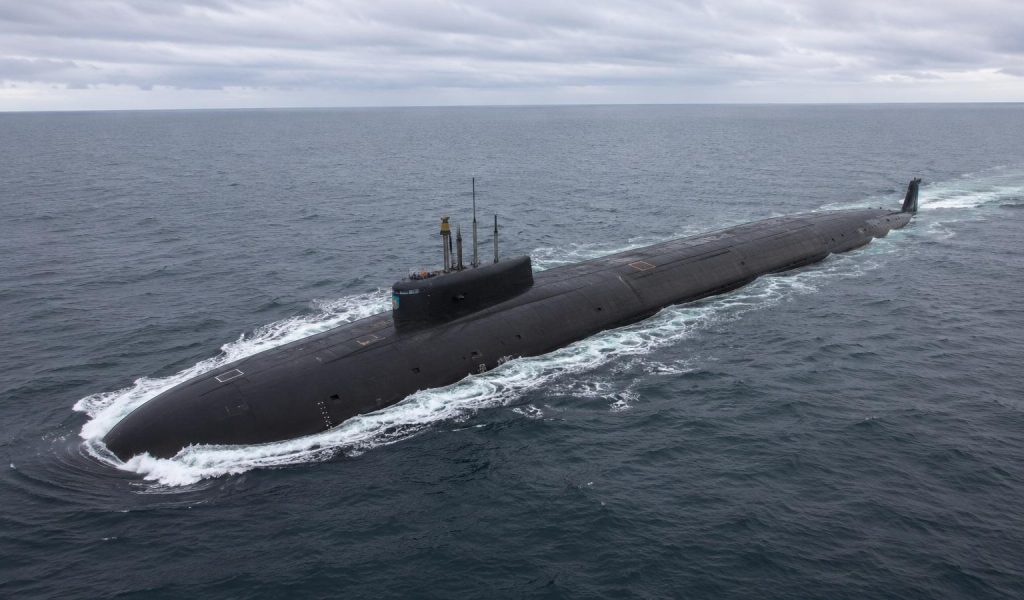
Belgorod is an extraordinary submarine even by Russian standards. It was originally laid down in 1992 as a Project 949A Antey nuclear-powered cruise-missile submarine, belonging to the same family as Kursk.
Construction stopped after the collapse of the Soviet Union. Years later, the unfinished hull was repurposed and extensively rebuilt under the special Project 09852.
The result was a genuine underwater giant.
Belgorod is approximately 184 meters long and about 18.2 meters wide, while its submerged displacement is commonly estimated in open sources at around 24,000 tons. This makes it longer than Russia’s Project 955 Borei-class ballistic missile submarines.
Khabarovsk was developed very differently.
Project 09851 was designed from the outset by the Rubin Central Design Bureau as a special-purpose nuclear submarine for a new generation of underwater systems. Its designers did not have to adapt the enormous hull of an older cruise-missile submarine to an entirely different mission.
As a result, Khabarovsk is significantly more compact than Belgorod.
And it is Khabarovsk, rather than Belgorod, that gives us the clearest indication of what a standardized dedicated Poseidon carrier might look like.
What Do We Actually Know About Project 09851?
An important caveat is necessary here.
There are almost no officially published detailed specifications for Khabarovsk.
Consequently, figures vary significantly between open sources. The submarine’s length, for example, has been estimated at approximately 120–135 meters. Analysis of published imagery by naval specialists suggests a figure of around 135 meters with a beam of approximately 13.5 meters, while earlier estimates put its length closer to 120 meters.
Surface displacement is commonly estimated at approximately 10,000 tons. Other open-source estimates suggest a speed of around 30–32 knots and a crew of roughly 100.
These numbers, however, should be treated as estimates rather than official specifications.
The approximate picture currently looks like this:
| Designer | Rubin Central Design Bureau |
| Builder | Sevmash |
| Laid down | 2014 |
| Launched | November 1, 2025 |
| Factory sea trials began | August 2026 |
| Length | ~120–135 m, estimated |
| Beam | ~13–13.5 m, estimated |
| Displacement | ~10,000 t, estimated |
| Propulsion | Nuclear |
| Propulsor | Probably pump-jet |
| Speed | ~30–32 knots, estimated |
| Crew | ~100, estimated |
| Main special-purpose armament | Up to 6 Poseidon vehicles |
| Status | Factory sea trials |
The uncertainty surrounding even basic dimensions says a great deal about the program. Russia has disclosed considerably less information about Khabarovsk than it has about the Borei or Yasen classes.
There Is Clearly Some Borei DNA in the Design
One of the most interesting aspects of Khabarovsk became apparent after higher-quality photographs of the submarine emerged.
According to naval analysts, Project 09851 appears to combine elements of several existing Russian submarine technologies.
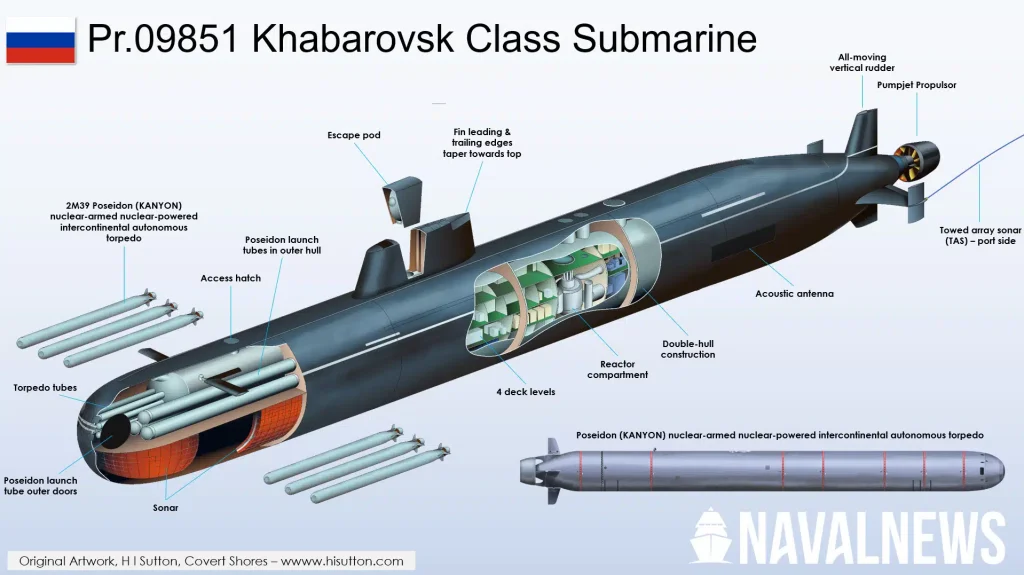
The stern has obvious similarities to the Project 955 Borei ballistic missile submarine, particularly in the overall hull form and apparent use of a pump-jet propulsor. The bow, however, is completely different and appears to have been designed around the enormous underwater vehicles the submarine is expected to carry.
The logic behind such technological reuse is easy to understand.
Developing a nuclear submarine entirely from scratch is extraordinarily expensive. If proven components of the propulsion plant, stern architecture, control systems, and other technologies already exist on the serially produced Borei class, reusing at least some of that technological foundation can reduce development risks.
But beyond that point, Khabarovsk becomes a fundamentally different submarine.
Instead of sixteen enormous launch tubes for Bulava ballistic missiles, it needs to accommodate a completely different kind of weapon.
Six Torpedoes, Each the Size of a Small Submarine
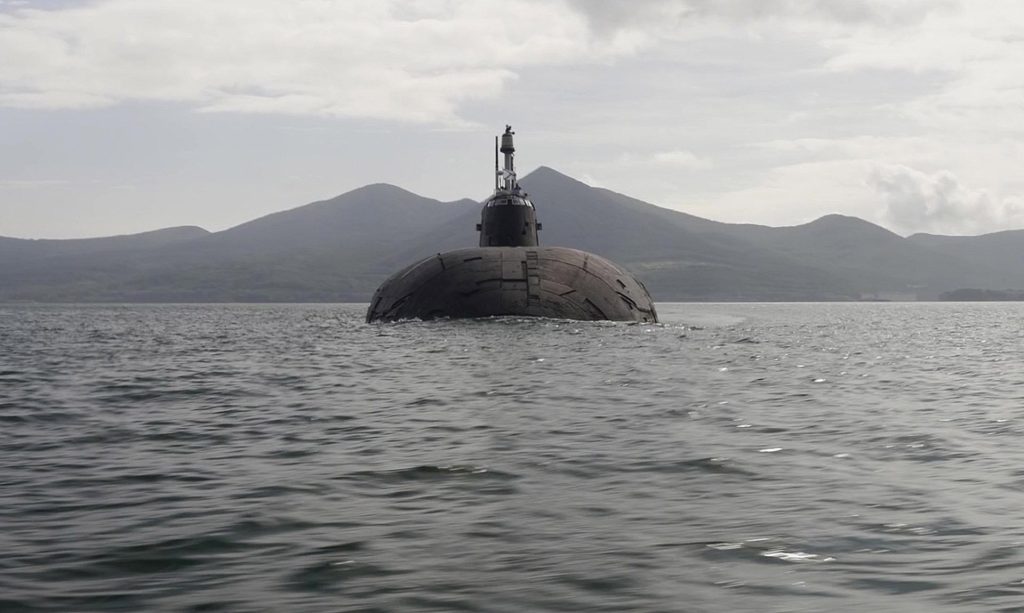
Calling Poseidon simply a torpedo is convenient, but technically it is a highly unusual vehicle.
A conventional modern heavyweight torpedo normally has a diameter of around 533 or 650 millimeters and is several meters long. Poseidon, according to the most widely cited open-source estimates, is approximately 1.8–2 meters in diameter, around 20 meters long, and weighs several dozen tons.
In other words, each vehicle is closer in size to a miniature submarine than to a conventional torpedo.
This explains the unusual architecture of its carrier.
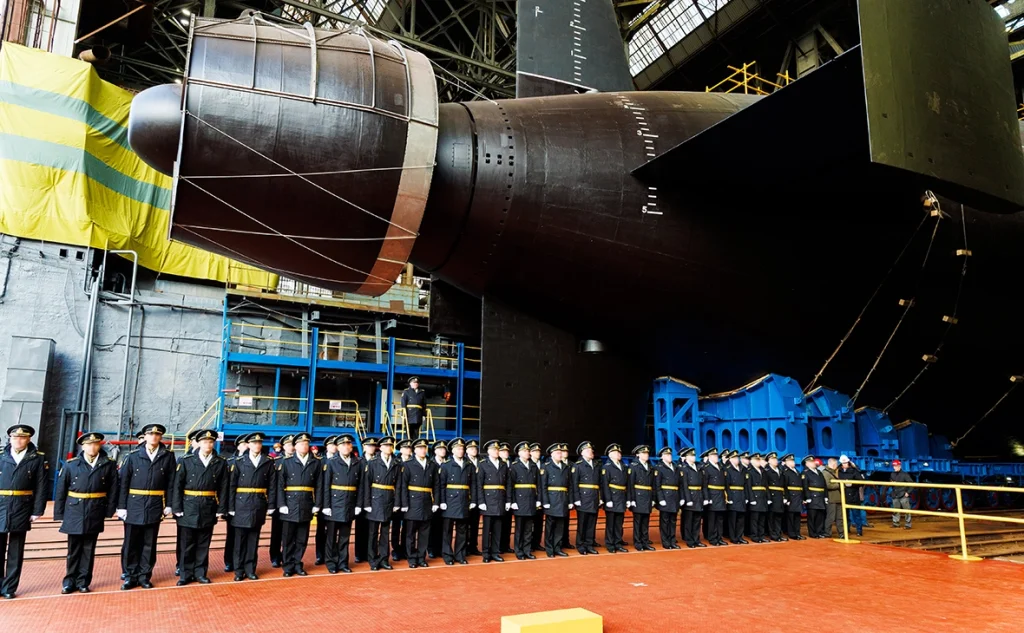
Analysis of photographs of Khabarovsk suggests that the forward section may contain six large launch tubes, arranged three on either side. Visible access hatches and structural features have been cited as evidence for this configuration.
This creates an unusual engineering challenge.
Six conventional 533mm torpedoes would be insignificant in terms of volume aboard a nuclear submarine.
Six vehicles almost two meters in diameter require enormous internal volume, completely different launch mechanisms, and substantial structural reinforcement.
The entire forward section of the submarine effectively has to be designed around them.
Why Is Khabarovsk So Much Smaller Than Belgorod?
The difference becomes striking when the two submarines are placed side by side.
| Origin | Project 949A conversion | Purpose-built design |
| Length | 184 m | ~120–135 m |
| Beam | 18.2 m | ~13–13.5 m |
| Displacement | Up to ~24,000 t | ~10,000 t* |
| Poseidon capacity | Up to 6 | Up to 6 |
| Design ancestry | Antey | Likely incorporates Borei technologies |
| Main concept | Multipurpose special-mission platform | Dedicated carrier |
*Estimated.
This comparison reveals the key advantage of Khabarovsk.
It does not need a 184-meter hull to carry roughly the same number of Poseidon vehicles.
Belgorod retains the legacy of the Project 949A design and also serves as a broader special-purpose platform. Khabarovsk appears to be much more tightly optimized for its specific mission.
That may ultimately make the second submarine more important than the first.
Belgorod demonstrates that Poseidon can be carried aboard a submarine.
Khabarovsk demonstrates what Russia believes a purpose-built Poseidon carrier should actually look like.
But Why Does Poseidon Need a Carrier If It Has Enormous Range?
This is perhaps the most interesting question surrounding the entire concept.
Poseidon has its own nuclear propulsion system. Russian statements have described its range as effectively unlimited.
If the vehicle really can travel intercontinental distances independently, why build a nuclear submarine costing hundreds of millions or potentially billions of dollars to carry it?
At first glance, Poseidon could simply be launched from Russian coastal waters.
But maximum range and practical weapons employment are two different things.
A submarine can covertly transport the vehicle to a preselected area of the ocean. This could reduce the distance Poseidon has to travel to its target, shorten transit time, complicate prediction of the direction from which it might approach, and provide a much wider selection of possible routes.
There is another consideration.
A relatively small autonomous vehicle and a full-size nuclear submarine have very different communications, navigation, and information-processing capabilities.
Khabarovsk therefore becomes more than a transport.
It is a mobile launch platform capable of moving the weapon’s release point thousands of kilometers across the ocean.
Poseidon Is Not Really a Conventional Torpedo
The system first became publicly known under the designation Status-6. It was later named Poseidon and associated with the designation 2M39; Western reporting has also used the name Kanyon.
Its defining feature is its nuclear propulsion plant.
A conventional torpedo is limited by the energy stored in batteries or fuel. Even sophisticated heavyweight torpedoes are designed for ranges measured in tens of kilometers.
Poseidon is conceived as an autonomous underwater vehicle with strategic range.
That explains its enormous dimensions.
It has to accommodate a reactor, power plant, propulsion system, navigation equipment, control systems, and a warhead.
In practical terms, it can be viewed as something closer to a one-way unmanned nuclear-powered miniature submarine.
And that is precisely why it requires a completely different type of carrier.
What About Its Speed and Diving Depth?
This is where spectacular but difficult-to-verify figures become common.
Open-source publications frequently attribute speeds of around 100 knots and operating depths of up to 1,000 meters to Poseidon. These figures have not been independently verified.
There is also a fundamental physical trade-off involved.
Very high underwater speed produces very high levels of noise.
Hydrodynamic drag rises rapidly with speed, while the propulsor and water flow around the hull generate a substantial acoustic signature.
If the vehicle is expected to travel thousands of kilometers while remaining difficult to detect, it would make sense for much of its journey to be conducted at considerably lower speed.
Its maximum speed and actual cruising speed may therefore be very different.
The same applies to depth.
Greater depth can complicate detection and interception, but it also requires a much stronger pressure hull, increasing weight and structural demands.
Public claims about Poseidon’s performance therefore need to be separated from characteristics that can actually be independently confirmed.
Khabarovsk Also Needs to Be Quiet
This is where the apparent use of Borei-derived technology becomes particularly interesting.
A ballistic missile submarine exists primarily to accomplish one mission: remain undetected for as long as possible.
Modern submarines therefore use vibration isolation, optimized hull forms, quiet propulsion systems, and numerous other measures to reduce their acoustic signature.
Project 955 Borei uses a pump-jet propulsor rather than a conventional exposed propeller.
Published photographs indicate that Khabarovsk also uses a pump-jet.
That would make sense.
If the submarine’s job is to covertly deliver strategic weapons to a launch area, outright speed is secondary.
Acoustic stealth becomes one of its most important characteristics.
And that is one of the characteristics that will have to be evaluated during sea trials.
What Is Being Tested Now?
The start of factory sea trials does not mean that Khabarovsk is ready for operational service.
It is the next major stage following completion of dockside construction and fitting-out.
The submarine now has to demonstrate its reactor and propulsion systems under load, operation at different speeds, maneuverability, diving and surfacing characteristics, navigation equipment, communications, and numerous general ship systems.
Acoustics will be particularly important.
For any nuclear submarine, engineers need to determine the vessel’s own noise levels under different operating conditions and identify unwanted sources of vibration.
Factory trials are normally followed by further state trials and eventual acceptance into naval service.
Some estimates suggest that Khabarovsk could potentially enter service by the end of 2026, but the actual timetable will depend on how successfully the trials proceed.
The current deployment to sea is therefore an important milestone, but it is not the end of the program.
Khabarovsk Is Not Supposed to Remain Alone
The broader picture becomes even more interesting when looking beyond the lead submarine.
According to open-source information, Russia is building additional carriers for Poseidon. In particular, Ulyanovsk was reportedly laid down in 2017. It has been associated in published reports with Project 09853, which may represent a further evolution of the concept. Other additional carriers have also been discussed in open sources.
This is a crucial distinction.
A single Belgorod could have been interpreted primarily as a unique experimental and special-purpose platform.
The appearance of Khabarovsk changes that picture.
Construction of additional vessels would indicate an attempt to create a permanent dedicated component of Russia’s submarine forces.
That is why the current sea trials matter more than they might initially appear.
Project 09851 Versus Borei
It is particularly interesting to compare the estimated characteristics of Khabarovsk with Project 955A Borei-A.
Borei is a large nuclear-powered submarine whose principal mission is to carry 16 submarine-launched ballistic missiles.
Khabarovsk does not need that ballistic-missile compartment.
As a result, with what appears to be a broadly similar hull diameter, it can be significantly shorter.
This creates an interesting architecture. In simplified terms, technology associated with a strategic missile submarine — nuclear propulsion, stern configuration, and acoustic-reduction measures — may have been retained, while the vertical ballistic-missile section was replaced by a specialized forward section for extremely large underwater vehicles.
This does not mean that Khabarovsk is simply “a Borei without missiles.”
It is a separate design.
But the technological relationship appears logical and has repeatedly been noted by independent naval analysts.
What Is Khabarovsk’s Real Significance?
Poseidon itself attracts most of the attention. A nuclear reactor inside a giant torpedo-sized vehicle, intercontinental range, and an unusual strategic mission inevitably sound more dramatic than the submarine carrying it.
From an engineering perspective, however, Khabarovsk may be just as interesting.
Belgorod is a unique vessel created through an extensive conversion of a Soviet-era submarine design.
Khabarovsk represents an attempt to turn an unusual concept into a standardized operational naval system.
That explains its significantly smaller dimensions, the apparent reuse of proven Project 955 technologies, the specialized forward section, and the six large launch tubes.
Russia has therefore followed a fairly recognizable development path.
First came an enormous experimental carrier.
Then came a purpose-built submarine.
The next stage would be additional vessels and the infrastructure required to operate them.
Only then would Poseidon fully transition from an unusual standalone project into an established weapons system.
Why Khabarovsk’s Sea Trials Matter More Than the First Voyage Itself
A huge amount remains unknown about Project 09851.
Its exact submerged displacement has not been published. Reliable details about its reactor are unavailable. Its actual operating depth, acoustic signature, and complete weapons fit remain classified. Even estimates of its length differ by more than ten meters.
That uncertainty needs to be kept in mind whenever discussing its specifications.
But several things are already clear.
Khabarovsk is not simply another Belgorod.
It is a significantly more compact nuclear submarine designed from the outset around large special-purpose underwater vehicles. It appears to incorporate some of the technological foundation developed for the Borei class, is expected to carry up to six Poseidons, and is intended to become the first purpose-built operational carrier of the weapon.
That makes the August sea trials an important milestone.
In 2022, Russia received Belgorod — a unique 184-meter special-purpose nuclear submarine.
In 2025, the first purpose-built Khabarovsk was launched.
Now, in 2026, it has gone to sea under its own power for trials.
If those trials are successful and additional carriers do indeed follow the lead vessel, this will no longer be a story about a single unusual experimental submarine.
Russia is effectively creating a separate family of nuclear-powered submarines whose principal strategic weapons are neither ballistic nor cruise missiles, but autonomous nuclear-powered underwater vehicles.
In that sense, Khabarovsk may ultimately be more important to the Poseidon program than the gigantic Belgorod. The first demonstrated that the new weapon could be carried by a submarine. The second is intended to demonstrate whether an entire operational class of submarines can be built around it.