China Is Building Its First Supercarrier: Type 004 Could Be the Biggest Leap for the Chinese Navy in 30 Years

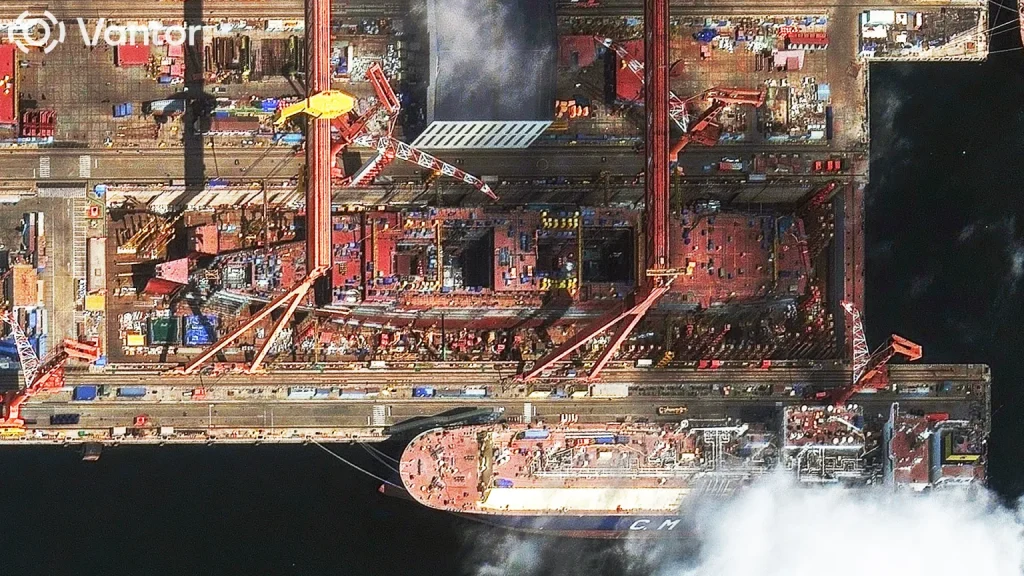
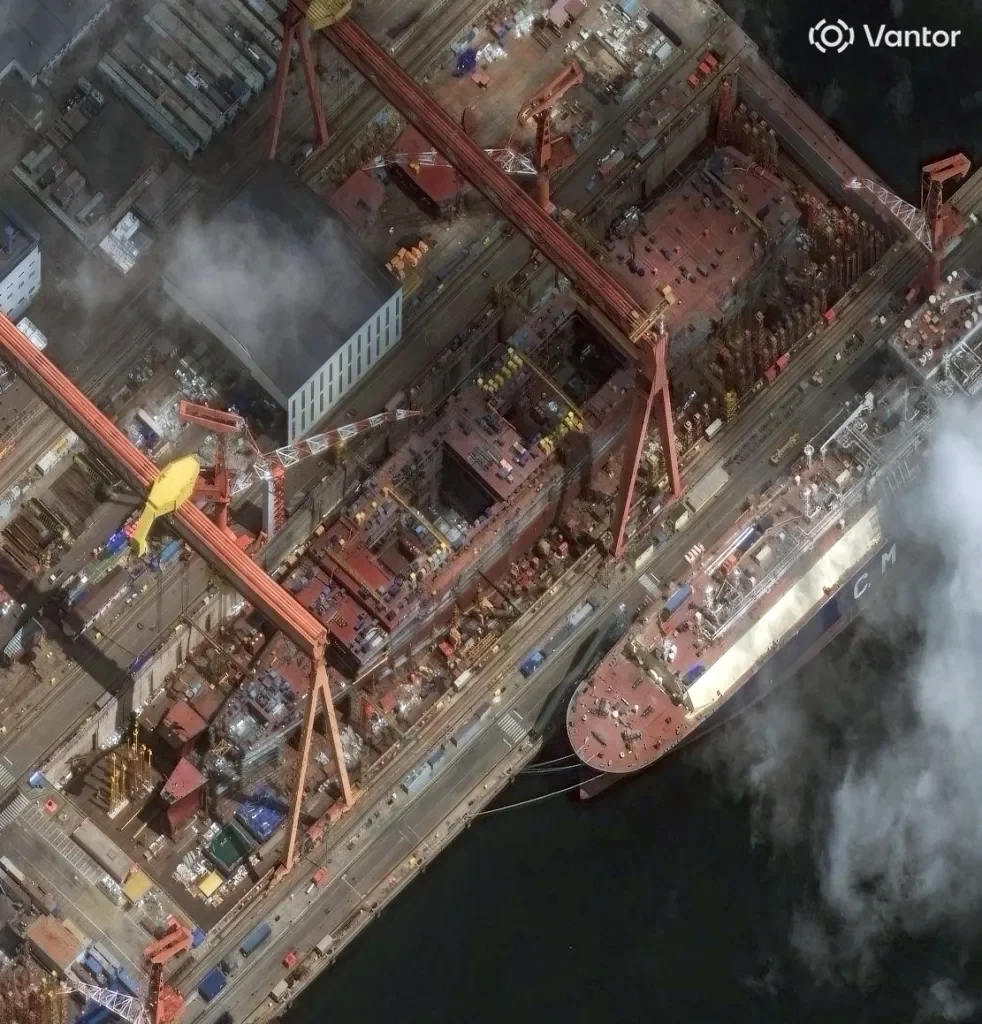
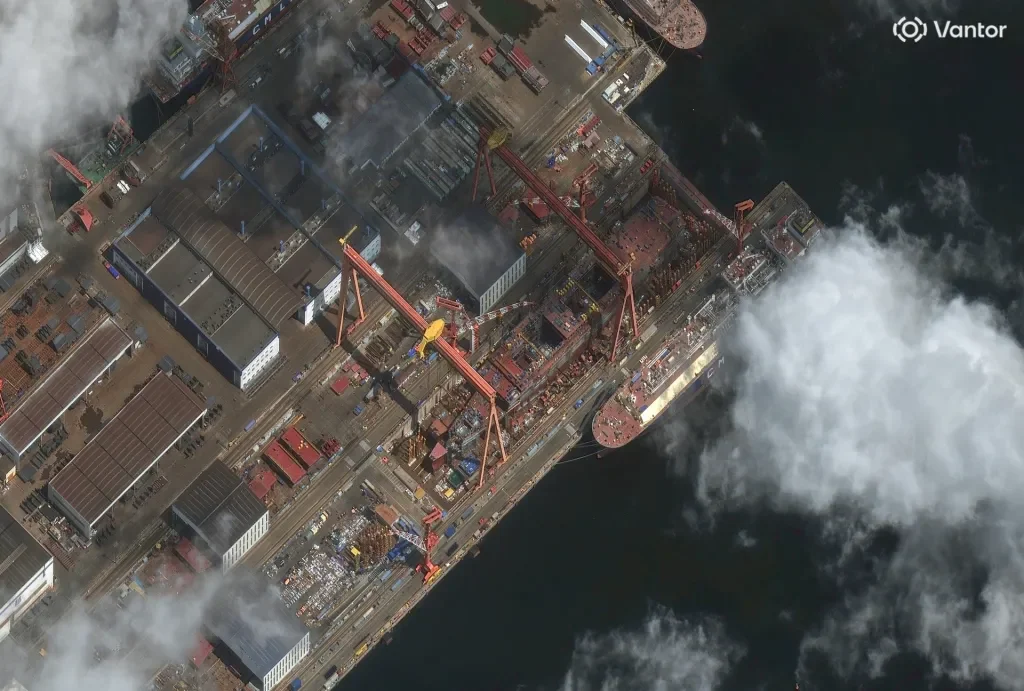
On satellite images of the Dalian shipyard, an enormous hull is becoming increasingly recognizable. A year ago, individual sections of the future vessel still had to be picked out among the shipyard’s sprawling production facilities. By August 2026, however, its bow had already taken on the unmistakable shape of an aircraft carrier. According to The War Zone, the assembled hull has reached roughly 320 meters in length and 46 meters in width at the waterline, while its final dimensions will be larger once the flight deck is completed.
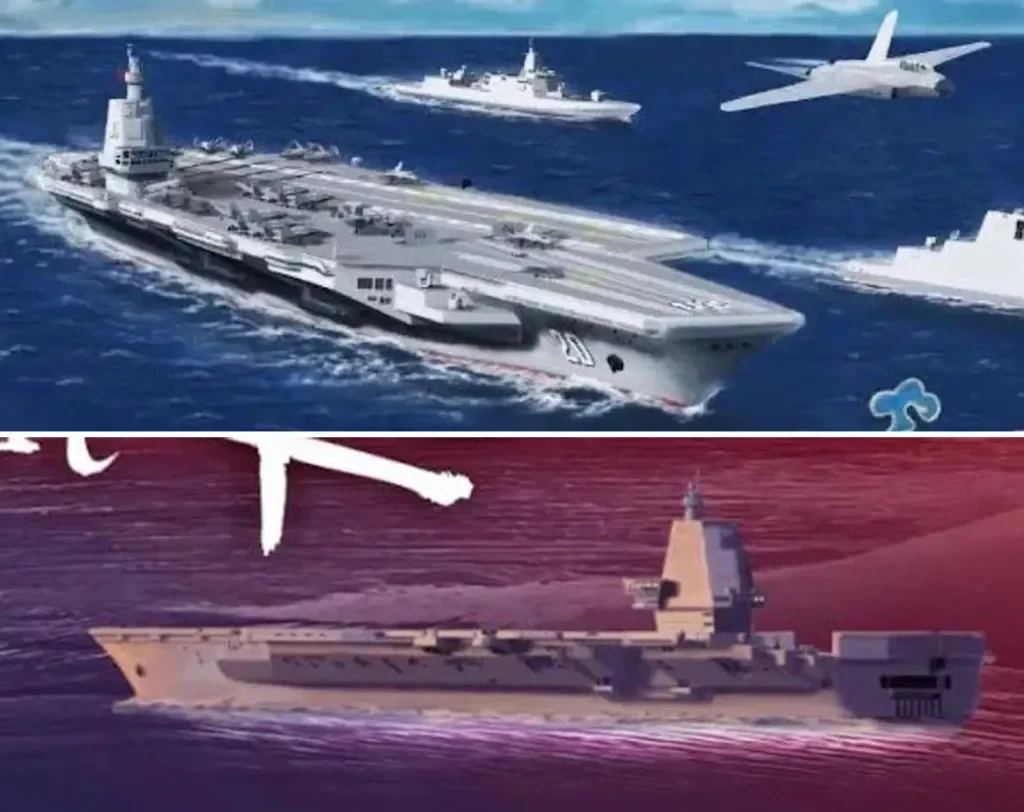
China has officially revealed almost nothing about the ship, but there is now little doubt about its purpose. Dalian is building China’s fourth aircraft carrier, commonly referred to in the West as Type 004.
Its significance, however, goes far beyond size. China’s previous carrier, Fujian, already represented a major technological leap: Beijing abandoned the Soviet-derived ski-jump arrangement and built its first true CATOBAR carrier equipped with electromagnetic catapults. Type 004 appears intended to take the next step. Two large structures have been identified inside the hull that may correspond to protected reactor compartments, while researchers had already uncovered evidence in 2024 of a land-based prototype reactor associated with a Chinese program for a large surface combatant.
If these clues do indeed point to Type 004, China is building its first nuclear-powered aircraft carrier.
And in that case, this is no longer simply another stage in the modernization of the Chinese Navy.
In less than three decades, China will have traveled almost the entire technological path from a rebuilt Soviet carrier to a nuclear-powered supercarrier approaching the scale and architecture of its American counterparts.
It All Began With an Unfinished Soviet Ship
The history of Chinese aircraft carriers becomes particularly striking when viewed in retrospect.
In 1998, China purchased the unfinished Soviet aircraft-carrying cruiser Varyag from Ukraine. Formally, the ship was acquired by a commercial company, and there were even public claims that it would be converted into a floating entertainment complex. In reality, the hull became an extraordinarily valuable learning tool for a country that had never previously operated an aircraft carrier.
In 2002, the vessel finally reached Dalian. Years of examination, restoration, and reconstruction followed.
A decade later, the former Varyag entered service with the People’s Liberation Army Navy as Liaoning.
For China, it was primarily a training carrier — but in a much broader sense than that phrase normally implies. The PLAN had to learn not only how to operate such a huge ship, but also how to create carrier aviation, conduct launches and arrested landings, train deck crews, organize a carrier strike group, and sustain it at sea.
China had effectively acquired a ready-made university for carrier warfare.
Then it began taking the exams.
Shandong Asked the Next Question: Can China Build One Itself?
China’s second aircraft carrier looks remarkably similar to Liaoning.
That was entirely deliberate.
Shandong, known during development as Type 001A, retained the ski jump, angled flight deck, and much of the overall architecture inherited from the Soviet design. But the fundamental difference was not visible from the outside.
It was built in China.
That allowed Chinese shipbuilders to master the complete production cycle themselves — from assembling the hull to installing propulsion, onboard systems, and aviation equipment.
The progression was remarkably logical.
Liaoning taught China how to operate an aircraft carrier.
Shandong taught China how to build one.
The next ship would have to teach China how to design a new-generation carrier of its own.
That ship was Fujian.
Fujian Marked the Break With the Soviet Legacy
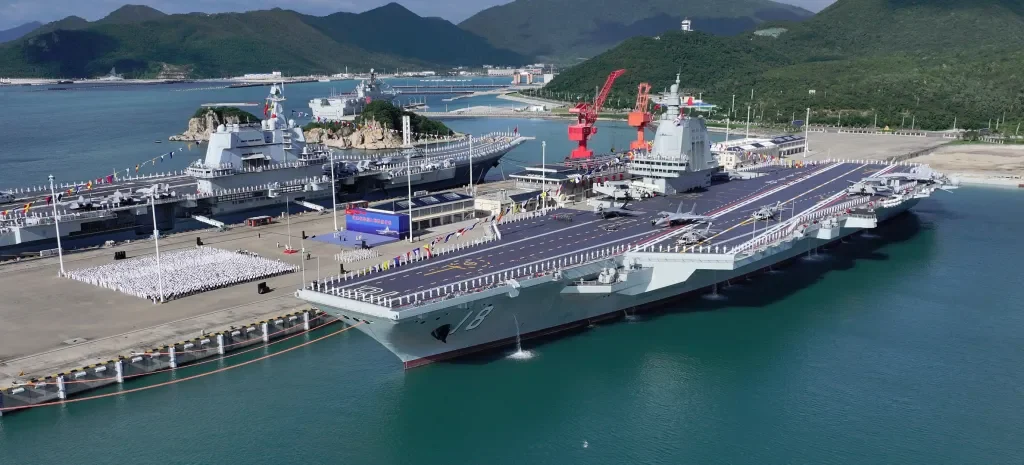
Place Liaoning and Shandong side by side and their common ancestry is immediately obvious.
Fujian is different.
The Type 003 carrier has a full-load displacement generally estimated at around 80,000 tons and a length of roughly 316 meters. But its most important feature is found on the flight deck.
The ski jump is gone.
In its place are three electromagnetic catapults.
China has therefore moved from STOBAR to CATOBAR — the same fundamental carrier architecture used by the United States. More remarkably, China skipped the intermediate generation of steam catapults altogether and went directly to electromagnetic launch systems.
The difference is much more important than it may initially appear.
A ski jump limits aircraft takeoff weight. A carrier fighter may have to compromise between fuel and weapons, particularly when launching from shorter deck positions.
A catapult can launch much heavier aircraft.
That means fighters can take off carrying more fuel and weapons.
But there is an even more important advantage.
A catapult-equipped carrier can properly operate large fixed-wing airborne early-warning aircraft.
KJ-600 May Be More Important Than Another Fighter
China is already testing the carrier-based KJ-600 airborne early-warning aircraft.
The concept is familiar: a twin-engine turboprop with a large radar dome above the fuselage, visually and conceptually similar to the American E-2 Hawkeye.
Aircraft like these transform a carrier from a floating airfield into a genuine center for managing an air battle.
A fighter’s radar is limited by the size of the aircraft and the radar horizon. A large AEW radar operating several kilometers above the sea can see much farther, detect low-flying targets, and coordinate dozens of aircraft across a much larger battlespace.
Liaoning and Shandong cannot efficiently operate an aircraft in the KJ-600 class because they lack catapults.
Fujian can.
Type 004 almost certainly will as well.
This means the real transformation of China’s carrier fleet is not simply the appearance of a larger ship. It is the creation of an entirely different carrier air wing.
The Air Wing Is Changing Too
The principal combat aircraft aboard China’s first carriers has been the J-15, a heavy carrier fighter derived from the broader Su-27/Su-33 design lineage.
Now it is being joined by the J-35.
This is a new-generation low-observable carrier fighter expected to become one of the central components of future Chinese carrier air wings.
At the same time, China is developing catapult-compatible versions of the J-15, a specialized J-15D/J-15DT electronic-warfare aircraft, the KJ-600 airborne early-warning platform, and various carrier-capable unmanned systems. There has also been growing interest in the possibility of a navalized version of the stealthy GJ-11 unmanned combat aircraft eventually operating from future carriers.
As a result, the composition of a Chinese carrier air wing is gradually beginning to resemble the American model.
Fighters.
Airborne early-warning aircraft.
Electronic-warfare aircraft.
Helicopters.
And, eventually, combat drones.
This is where the logic behind the next enormous carrier becomes clearer.
Why Build Type 004 if Fujian Is Already So Advanced?
Because Fujian still has one fundamental limitation.
It is conventionally powered.
For a regional fleet, that is not necessarily a major problem. Chinese carriers can spend much of their time operating relatively close to domestic bases, logistics infrastructure, and land-based aviation.
But if China wants a persistent naval presence in the Indian Ocean, across the western Pacific, or much farther from home, the requirements change.
A conventional carrier continuously consumes fuel not only for ordinary movement but also to sustain the high speeds required for intensive flight operations.
Nuclear propulsion largely eliminates the carrier’s own dependence on propulsion fuel.
It does not make the ship completely self-sufficient. Its aircraft still need aviation fuel, its crew still needs food, and weapons and spare parts must still be replenished.
But one of the largest fuel consumers disappears from the logistical chain.
And there is another advantage.
Energy.
Electricity Is Becoming Almost as Important as Fuel
Older aircraft carriers primarily needed energy to move the ship and power its onboard systems.
A modern carrier is a much more demanding machine.
Large active electronically scanned array radars consume enormous amounts of electrical power.
Electromagnetic catapults require major bursts of energy.
Future electronic-warfare systems will demand still more.
And directed-energy weapons such as lasers may eventually add another major requirement.
This is why nuclear propulsion is attractive not merely because it provides enormous cruising endurance.
It can also provide a substantial energy reserve for future systems.
That potentially makes the transition to nuclear power a much more important step than simply making Type 004 larger than Fujian.
And There Are Signs of Reactors
Caution is still necessary here.
China has not officially announced that Type 004 will be nuclear-powered.
But the evidence is becoming increasingly suggestive.
Satellite imagery analyzed by CSIS has revealed two sections within the hull, each approximately 15 by 15 meters, whose characteristics have been interpreted as potentially consistent with protected reactor compartments. Comparable structures were apparently not present at the corresponding stage of Fujian’s construction.
There is another piece of evidence.
In 2024, researchers from the Middlebury Institute identified a land-based prototype reactor in Sichuan province apparently associated with a Chinese program for a large surface warship. The project had links to the 701 Institute, which is heavily involved in Chinese aircraft carrier design. Documents reportedly referred to equipment intended for installation aboard a “large surface warship.”
The reactor program alone does not prove that the carrier currently under construction will use nuclear propulsion.
But combined with what is visible inside the hull, the possibility becomes increasingly difficult to dismiss.
CSIS now considers nuclear propulsion for Type 004 likely, while the identification of the hull as an aircraft carrier is considered much more certain.
In Size, China Is Approaching the Gerald R. Ford Class
The latest satellite imagery also makes it possible to estimate the scale of the ship.
According to The War Zone’s August 2026 assessment, the assembled portion of the hull has reached approximately 320 meters in length. Its waterline beam is around 46 meters.
And these are not the final dimensions.
The flight deck will extend significantly beyond the hull at the waterline.
For comparison, Fujian is approximately 316 meters long, while the U.S. Navy’s Gerald R. Ford is about 337 meters long. Ford’s flight deck reaches roughly 78 meters at its widest point.
It is therefore far too early to call Type 004 “the world’s largest aircraft carrier.” Neither its final dimensions nor its displacement are yet known with sufficient confidence.
But one thing is already clear.
China is moving into the true supercarrier category.
Type 004 May Have Four Catapults
This is another detail that remains unconfirmed, but it could be extremely important.
Earlier structures associated with China’s future carrier program have been interpreted as showing possible catapult tracks. These suggested a configuration with four catapults: two forward and two on the angled deck.
Fujian has three.
The American Nimitz and Ford classes have four.
The number of catapults directly influences potential aircraft launch rates, but deck arrangement is just as important: aircraft elevators, island placement, parking areas, and the routes used to move aircraft around the flight deck all affect sortie generation.
Here too, China appears to be moving toward an architecture broadly similar to that of modern American carriers: a relatively compact island positioned farther aft and as much unobstructed flight-deck space as possible.
In other words, China is no longer simply copying a particular foreign ship.
It is increasingly arriving at similar solutions because the underlying operational and physical requirements are the same.
But Building a Nuclear Carrier Does Not Automatically Create an American-Style Carrier Fleet
This is the crucial caveat.
The ship itself is only one component of the carrier system.
The United States has operated aircraft carriers continuously for more than a century. It has spent decades refining flight-deck procedures, aircraft maintenance, underway replenishment, escort operations, submarine integration, intelligence support, and carrier aviation doctrine.
China is accumulating this experience at extraordinary speed.
But some processes cannot simply be accelerated indefinitely.
Crews need thousands of launches and arrested landings.
Commanders need repeated long-distance deployments.
Industry must learn how to maintain and overhaul naval nuclear propulsion systems.
The fleet must learn how to sustain carrier groups thousands of kilometers from Chinese bases.
And this leads to another important development.
China is simultaneously building enormous logistics ships.
Because Even a Nuclear Carrier Still Needs a Tanker
That may sound paradoxical.
If the carrier is nuclear-powered, why does it need a huge supply ship?
Because only the carrier itself is nuclear-powered.
J-35s, J-15s, and KJ-600s will still consume enormous quantities of aviation fuel. Conventionally powered destroyers and other escorts will still require fuel. The crew needs food, aircraft need spare parts, and magazines need replacement weapons.
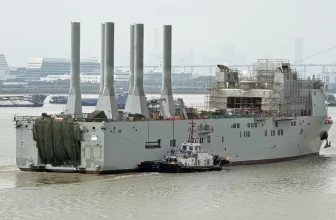
The War Zone has previously reported the construction in China of an exceptionally large replenishment ship, potentially one of the largest vessels of its type anywhere in the world.
Its emergence fits perfectly with the PLAN’s transition from operations close to the Chinese coastline toward sustained blue-water deployments.
And this may ultimately matter even more than Type 004 itself.
China is no longer simply building an aircraft carrier.
It is building the infrastructure of a carrier fleet.
From Varyag to Type 004 in Less Than 30 Years
This is why the ship under construction should not be viewed in isolation. It represents the latest stage in an unusually methodical development program.
Liaoning provided operational experience.
Shandong provided domestic construction experience.
Fujian introduced catapults and enabled an entirely new carrier air wing.
Type 004, if current assessments prove correct, will add nuclear propulsion and bring China into the physical scale of American supercarriers.
Each successive ship has not merely been somewhat better than the one before it.
Each has addressed the next major technological challenge.
And this is one of the most striking differences between China’s program and many ambitious naval projects elsewhere.
China did not attempt to build its equivalent of Gerald R. Ford immediately.
It built a ladder.
And climbed it one step at a time.
The Most Interesting Question Is No Longer Type 004 Itself
If the ship really does receive nuclear propulsion and four electromagnetic catapults, China will have mastered essentially all of the fundamental technological building blocks required for a modern supercarrier.
From that point onward, enormous generational leaps become less necessary.
The next ship can simply improve the formula.
More reliable reactors.
More efficient catapults.
Better aircraft elevators.
More capable radars.
Greater automation.
New unmanned aircraft.
That is when true serial production can begin.
The Pentagon has previously projected that the PLAN could seek a force of roughly nine aircraft carriers by 2035. This is an American assessment rather than an officially announced Chinese procurement plan, so the figure should not be treated as a confirmed target. Nevertheless, China’s shipbuilding capacity already allows it to construct major warships at a pace that few countries can currently match.
Type 004 therefore matters not because it will necessarily be better than Gerald R. Ford. There is nowhere near enough information to make such a comparison.
Its importance lies somewhere else entirely.
Less than three decades ago, China bought an unfinished Soviet carrier partly to learn how such a ship worked in the first place.
It then built a Chinese version.
Then it abandoned the Soviet-derived architecture and built its own catapult-equipped carrier.
And now, at the same Dalian shipyard where the unfinished Varyag once arrived, a roughly 320-meter ship is taking shape whose hull may contain two nuclear reactors.
The story of Type 004 is therefore not simply the story of another Chinese aircraft carrier. It is the story of the moment when China is finishing its apprenticeship in carrier construction — and beginning to build a carrier fleet of its own.