One modern warship, one manufacturer, and almost a twofold difference in price. That is how the story of Italy’s FREMM EVO frigates currently appears. In 2024, Italy ordered two of these ships for approximately €1.5 billion, or a nominal €750 million each. Portugal, meanwhile, agreed in the summer of 2026 to acquire three FREMM EVO frigates under a program valued at around €3.9 billion — €1.3 billion per ship if the total is simply divided by three.
The difference looks enormous: roughly €550 million per frigate.
And that simple arithmetic has triggered a political controversy in Portugal. The opposition demanded that Defense Minister Nuno Melo explain why Lisbon was supposedly preparing to pay almost twice as much for Italian frigates as Italy itself.
The problem, however, lies in the word “supposedly.”
Portugal’s €3.9 billion figure is not a published price for three bare ships. The program includes long-term technical support, technology transfer, at least 30 years of lifecycle support, and an industrial package that includes modernization of Portugal’s Arsenal do Alfeite shipyard. The Portuguese government has not yet disclosed exactly how much of the total is allocated to the construction of the frigates themselves.
So the figures of €750 million and €1.3 billion are both real, but they cannot be directly compared. Italy’s €1.5 billion is a domestic OCCAR contract with Orizzonte Sistemi Navali for the construction of two ships for the Italian Navy. Portugal’s €3.9 billion is an export program including infrastructure, support, and industrial commitments. Add two years of inflation and the fact that Italian industry is building ships for its own domestic customer, and the apparent scandal becomes considerably less straightforward.
The political question of transparency remains legitimate. Until the cost structure is disclosed, Lisbon cannot clearly explain to taxpayers how much the ships themselves actually cost.
But for us, the story raises a much more interesting question.
What exactly is Portugal buying for all that money?
Because the FREMM EVO is becoming one of Europe’s most interesting surface combatants of the next decade.
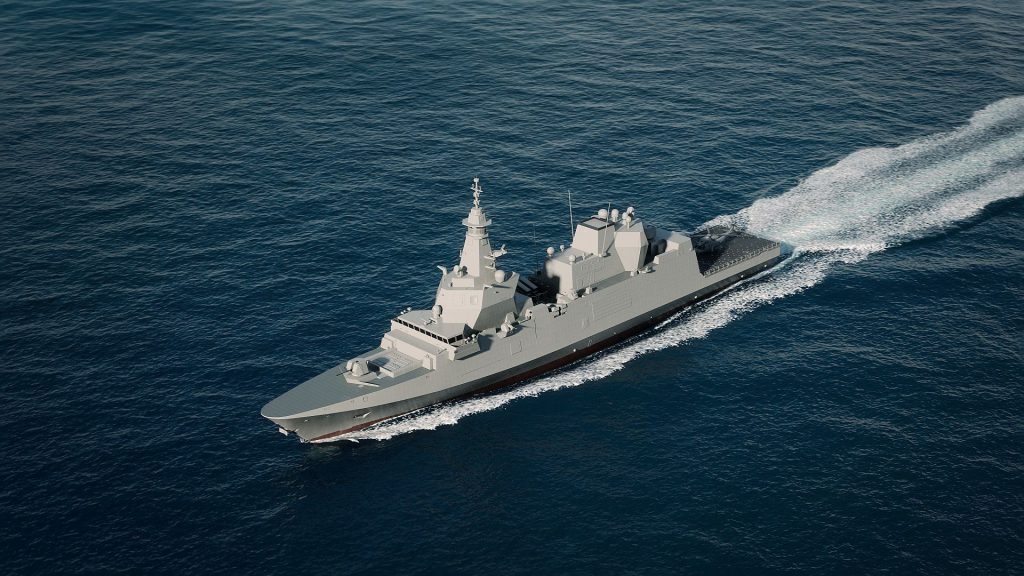
The FREMM That Gradually Stopped Being Just a Frigate
FREMM stands for Frégate Européenne Multi-Mission in French and Fregata Europea Multi-Mission in Italian — European Multi-Mission Frigate.
The program originated as a joint French-Italian project, but gradually evolved into two increasingly distinct national families.
The Italian Bergamini-class FREMMs became large ocean-going warships displacing around 6,700 tons and capable of performing anti-submarine, anti-surface, and general-purpose missions. Italy developed two principal configurations — General Purpose and ASW — with differences primarily in sensors, equipment, and weapons.
FREMM EVO represents the next evolutionary step of the Italian branch.
In July 2024, Orizzonte Sistemi Navali — a joint venture between Fincantieri, with 51%, and Leonardo, with 49% — received an OCCAR contract worth approximately €1.5 billion for two ships. Construction of the first began in April 2025. The first FREMM EVO is scheduled for delivery to the Italian Navy in 2029, with the second following in 2030.
The Italians, however, did not design an entirely new hull.
Instead, they chose what may be a much more rational approach: take the already mature FREMM platform and install a new generation of combat systems.
The result is essentially FREMM 2.0.
What Is the FREMM EVO?
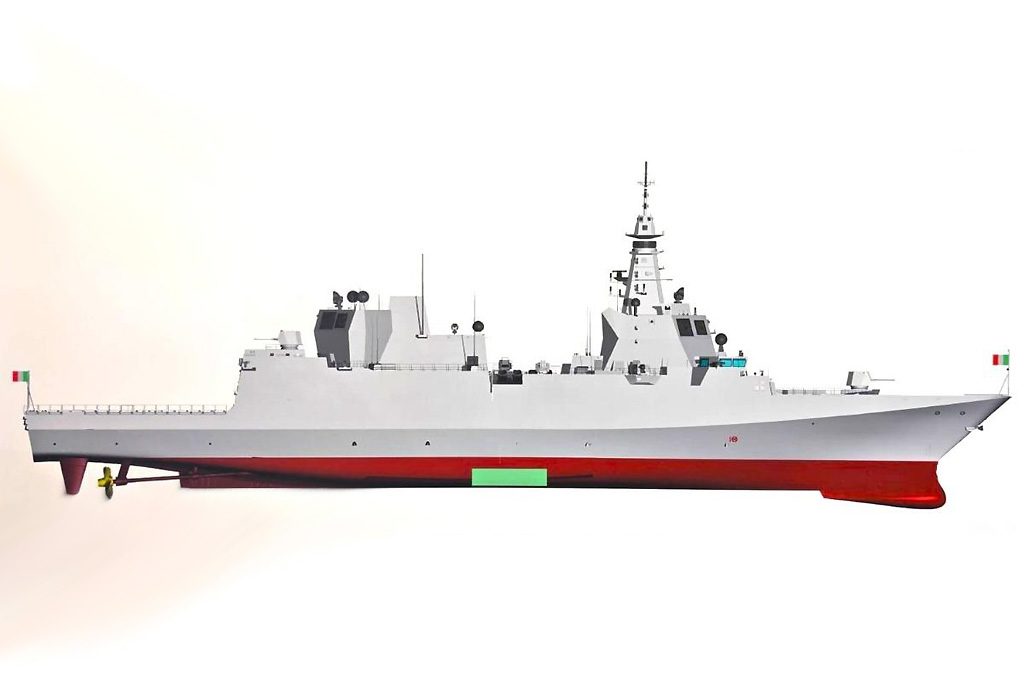
In its basic naval architecture, EVO retains the overall configuration of the Italian FREMM. It is a large ocean-going combatant approximately 144 meters long, putting it close to the upper end of what has traditionally been called a frigate.
Its approximate characteristics are as follows:
| Developer / builder | Fincantieri / Orizzonte Sistemi Navali |
| Length | approx. 144 m |
| Beam | approx. 19.7 m |
| Full-load displacement | approx. 6,700–7,000 t |
| Propulsion | CODLAG |
| Gas turbine | GE/Avio LM2500+G4 |
| Maximum speed | approx. 27 knots |
| Economic speed | approx. 15 knots |
| Range | approx. 6,000 nautical miles |
| Endurance | approx. 45 days |
| Main guns | 127mm + 76mm systems* |
| Surface-to-air missiles | Aster family |
| Anti-ship weapons | Teseo/Otomat family |
| ASW weapons | Torpedoes + helicopters |
| Aviation group | Up to 2 helicopters |
| Main EVO radar | DBR-X-C Dual Band Radar |
*The final configuration of individual export ships may differ.
But dimensions alone tell us relatively little about what makes EVO important.
The major changes are above deck — in its electronics.
The Real Revolution Is on the Mast
Modern warships have an interesting problem: the hull may remain in service for 30 or 40 years, while electronics become obsolete much faster.
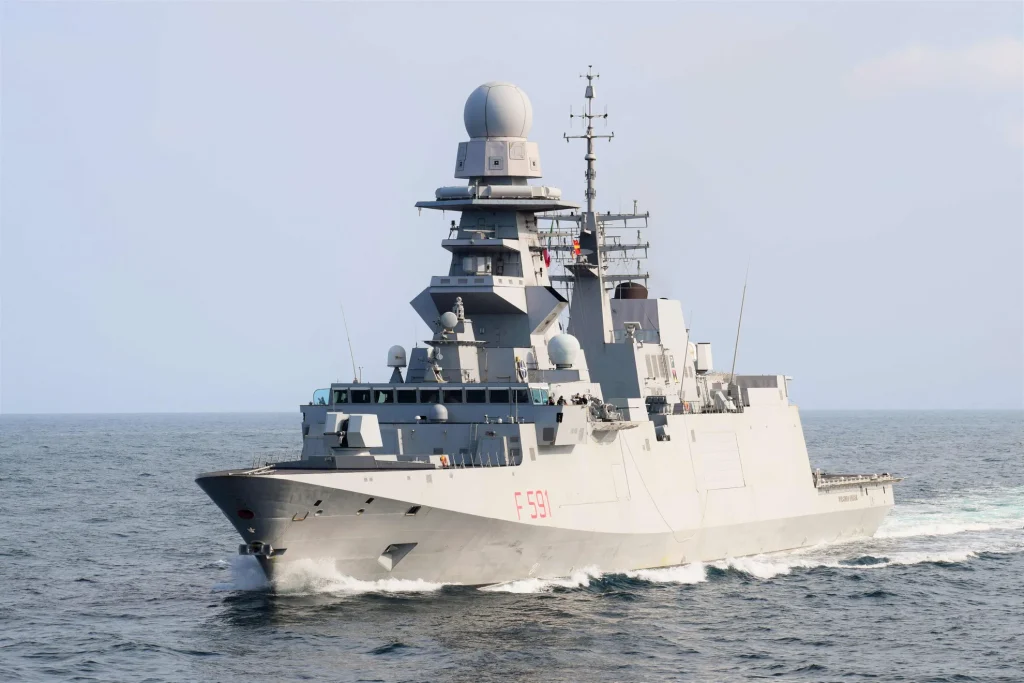
That is why FREMM EVO receives an almost entirely new radar architecture.
Fincantieri specifically identifies the DBR-X-C Dual Band Radar with fixed phased-array antennas as one of the key improvements. The system is intended to provide enhanced detection and tracking of sophisticated airborne threats and contribute to defense against tactical ballistic missiles.
The name DBR-X-C provides a clue to how the system works.
It is a dual-band radar architecture intended to exploit the advantages of different frequency bands. One can be optimized for long-range surveillance and building the overall air picture, while another can provide more precise target tracking and support weapon engagement.
Instead of a traditional mechanically rotating antenna, the system uses fixed AESA panels.
The radar does not need to physically turn toward a target. Its beams are steered electronically, allowing it to perform multiple functions almost simultaneously: searching for aircraft, tracking missiles, monitoring surface contacts, and supporting weapon engagements.
This is where FREMM EVO begins to diverge significantly from the original FREMM concept.
Why Does a Frigate Need Ballistic Missile Defense Capability?
The first FREMMs were designed in an era when the primary threats to a frigate were aircraft, anti-ship missiles, and submarines.
Over the past two decades, that list has expanded dramatically.
Modern naval forces now have to contend with mass-produced UAVs, increasingly sophisticated anti-ship missiles, ballistic threats, unmanned surface vessels, and underwater drones. At the same time, a warship may have to deal with dozens of relatively inexpensive targets appearing almost simultaneously.
Italy’s answer is not simply to add more missiles.
The entire detection and combat-management architecture is being changed.
FREMM EVO receives the new SADOC 4 combat management system, with particular emphasis on cyber resilience. Electronic warfare, communications, tactical data links, gun and missile systems, and sonar equipment are also being upgraded.
In other words, EVO differs from the original FREMM somewhat like a modern smartphone differs from a device designed a decade earlier: the physical form remains recognizable, but the sensors, processing power, and digital architecture fundamentally change what the system can do.
Aster Remains the Core of the Air-Defense System
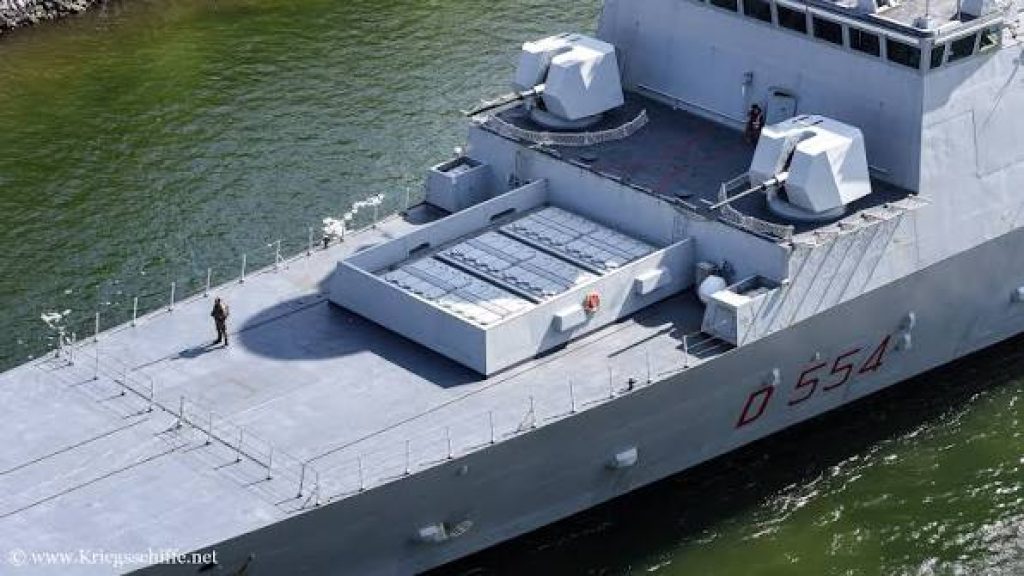
The Italian FREMM family uses European Aster missiles as the foundation of its air-defense armament.
The Aster 30 is particularly important.
Unlike compact point-defense systems intended primarily to protect the launching ship, Aster 30 provides genuine area-defense capability, allowing the frigate to contribute to the protection of an entire naval formation.
Combined with the new dual-band radar, this gradually transforms FREMM EVO from a conventional multipurpose frigate into a vessel capable of performing some missions traditionally associated with specialized air-defense destroyers.
And that helps explain why displacement has approached 7,000 tons.
Modern warships need more than missile cells. They require powerful radars, generators, cooling equipment, computing infrastructure, and electrical reserves for future modernization.
A large hull becomes a reserve for future growth.
But FREMM EVO Has Not Become a Dedicated Air-Defense Ship
This is where the Italian approach becomes particularly interesting.
Improved air defense is not supposed to come at the expense of anti-submarine capability.
Fincantieri states that the new ships will retain the ASW capabilities associated with existing Italian FREMMs while receiving upgraded sonar systems.
That is an important advantage of the platform.
An anti-submarine warship is much more than a frigate carrying torpedoes.
It requires hull-mounted and towed sonar systems, quiet propulsion, helicopters, specialized acoustic-processing equipment, and crews trained specifically for submarine hunting.
FREMM was designed from the beginning as a serious anti-submarine platform.
CODLAG Is About More Than Fuel Economy
Italian FREMMs use a CODLAG — Combined Diesel-Electric And Gas — propulsion architecture.
At high speeds, the ship can use an LM2500+G4 gas turbine. At economical speeds, propulsion can rely on the electrical portion of the power plant.
For a civilian ship, such a system would primarily be associated with efficiency.
For an anti-submarine warship, there is another important reason:
noise.
A powerful engine mechanically connected to the shafts creates vibration that propagates through the hull into the surrounding water. For a ship attempting to detect a quiet submarine tens of kilometers away, its own acoustic signature becomes a serious problem.
Electric propulsion can significantly reduce machinery noise at submarine-hunting speeds.
That means FREMM’s sophisticated hybrid propulsion architecture is effectively part of its anti-submarine warfare system, almost as much as its sonar.
Then Came the Drones
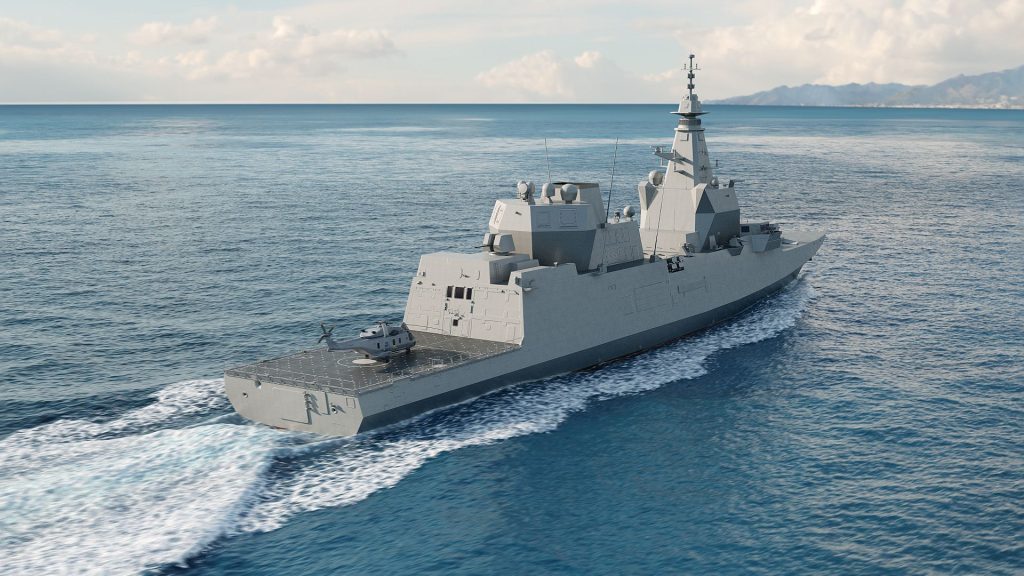
FREMM EVO is being designed from the outset to operate unmanned systems in three environments.
Fincantieri specifically mentions the ability to work with unmanned systems above the surface, on the surface, and underwater, while also emphasizing improved counter-UAV capabilities.
This represents an important shift in the philosophy of the frigate itself.
Traditionally, the reach of a warship’s sensors was determined by the height of its mast, the range of its sonar, and the capabilities of its helicopter.
A modern frigate can send an unmanned surface vessel carrying sensors ahead of the formation, launch UAVs, or deploy autonomous underwater vehicles.
The FREMM itself increasingly becomes a command and data-processing hub for a distributed network of systems.
That is why the new electronics may ultimately matter more than simply adding another missile.
Two Helicopters Are a Major Capability in Their Own Right
The large flight deck and hangar allow Italian FREMMs to operate up to two helicopters.
Depending on the mission, these can include NH90s or AW101s.
For anti-submarine warfare, helicopters fundamentally change the geometry of the search. The frigate can remain in one area while a helicopter carrying sonobuoys and dipping sonar operates tens or even hundreds of kilometers away.
The aviation group can also support reconnaissance, targeting, transport missions, and operations against surface targets.
The ability to continuously support aviation is one of the reasons modern frigates have become so large.
What About Anti-Ship Missiles?
The Italian FREMM line traditionally uses the Teseo/Otomat missile family, with future development centered on the new Teseo Mk2/E.
This is no longer simply a conventional anti-ship missile.
The new version is being developed as a multipurpose weapon capable of attacking both ships and land targets. For a modern frigate, that provides the ability to conduct strikes far beyond the horizon of its own onboard sensors, provided external targeting information is available.
Combined with Aster missiles, heavy naval artillery, anti-submarine systems, and helicopters, this produces a genuinely multipurpose combatant.
Which raises an interesting question.
Why Is This Still Called a Frigate?
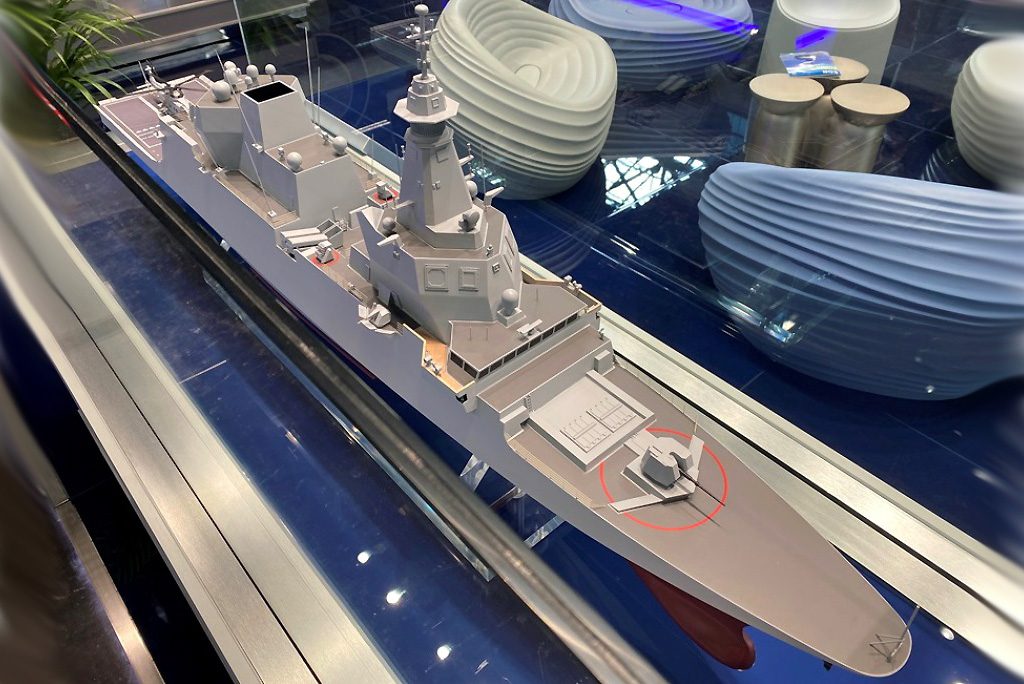
Around 7,000 tons.
Long-range air defense.
Dual-band AESA radar.
A sophisticated anti-submarine suite.
Anti-ship missiles.
A 127mm gun.
Two helicopters.
Electronic warfare systems.
The ability to control unmanned vehicles.
If we compared those characteristics with warships of the 1980s or 1990s, such a vessel could easily have been classified as a destroyer.
But modern naval classifications are no longer determined by displacement alone.
The U.S. Constellation class, itself derived from the Italian FREMM design, is also officially classified as a frigate despite its substantial size.
The explanation is simple.
The modern frigate has effectively moved into the role once occupied by destroyers, while modern destroyers themselves have grown toward the dimensions once associated with light cruisers.
FREMM EVO is a perfect example of this inflation in warship classes.
Why Didn’t Italy Simply Design an Entirely New Ship?
This may be the project’s greatest advantage.
Designing a modern surface combatant from scratch is enormously expensive and time-consuming.
The hull, propulsion plant, electrical system, cooling architecture, crew spaces, aviation facilities, weapons, and thousands of auxiliary systems all have to be designed, integrated, and tested.
Italy already has a mature and serially produced FREMM platform.
So instead of revolutionizing the hull, it has revolutionized the electronics.
A new radar.
A new combat management system.
New electronic warfare systems.
New communications.
Updated sonar equipment.
Integration of unmanned systems.
Improved electrical distribution and air-conditioning systems.
Those final two points may sound mundane.
They are not.
Modern AESA radars and computing systems consume enormous amounts of electricity and produce enormous amounts of heat.
Additional electrical capacity and cooling are effectively modernization reserves for the next several decades.
That Is the Real Meaning of EVO
FREMM EVO is not an entirely new frigate in the traditional sense.
Its hull remains an evolution of an existing family.
The basic propulsion architecture is familiar.
Many of its weapons evolve from systems already in service.
But the ship receives a fundamentally new digital nervous system.
That is why Italy calls it Evolution rather than a completely new class.
The first Italian unit is already under construction. Steel cutting began in April 2025, with delivery scheduled for 2029. The second ship is expected to follow in 2030.
Portugal is now joining the program with three additional vessels.
So Why Is Portugal Paying €1.3 Billion if Italy Pays €750 Million?
After looking at the ship itself, we can return to the controversy that started the story.
And the answer is considerably less dramatic than the headline.
We do not actually know that a Portuguese FREMM EVO costs €1.3 billion.
What we know is this:
Italy signed a contract in 2024 worth approximately €1.5 billion for two FREMM EVO frigates. Simple arithmetic gives €750 million per ship.
Portugal’s overall program is valued at approximately €3.9 billion for three ships, which gives €1.3 billion each if the total is simply divided by three.
But Portugal’s figure covers much more than the frigates themselves. It includes at least 30 years of support, technology transfer, industrial participation, and modernization of Arsenal do Alfeite. A detailed public breakdown of the costs has not yet been provided.
That lack of transparency can certainly be criticized.
If a government intends to spend almost four billion euros, taxpayers have every reason to ask how much is going to Fincantieri for ship construction, how much is allocated to weapons, how much to lifecycle support, how much to infrastructure, and how much to technology transfer.
But using the total program value to claim that “Italy is selling Portugal the same frigate for almost twice the price” is not currently justified.
That is no longer shipbuilding economics.
It is political arithmetic.
And perhaps that is why the €750 million versus €1.3 billion controversy provides such a useful reason to look more closely at FREMM EVO itself.
Behind the political scandal lies a much more interesting story. Italy is taking one of Europe’s most successful modern frigate designs and, without developing an entirely new hull, turning it into a next-generation combatant with dual-band radar, expanded air-defense capability, sophisticated anti-submarine systems, upgraded electronic warfare, and the ability to control a growing family of unmanned platforms.
If we ignore the political arithmetic surrounding the Portuguese contract and look instead at the actual capabilities, FREMM EVO is a good illustration of what the modern frigate is becoming: a roughly 7,000-ton multipurpose combatant that, only two decades ago, would have been called a destroyer without much argument.