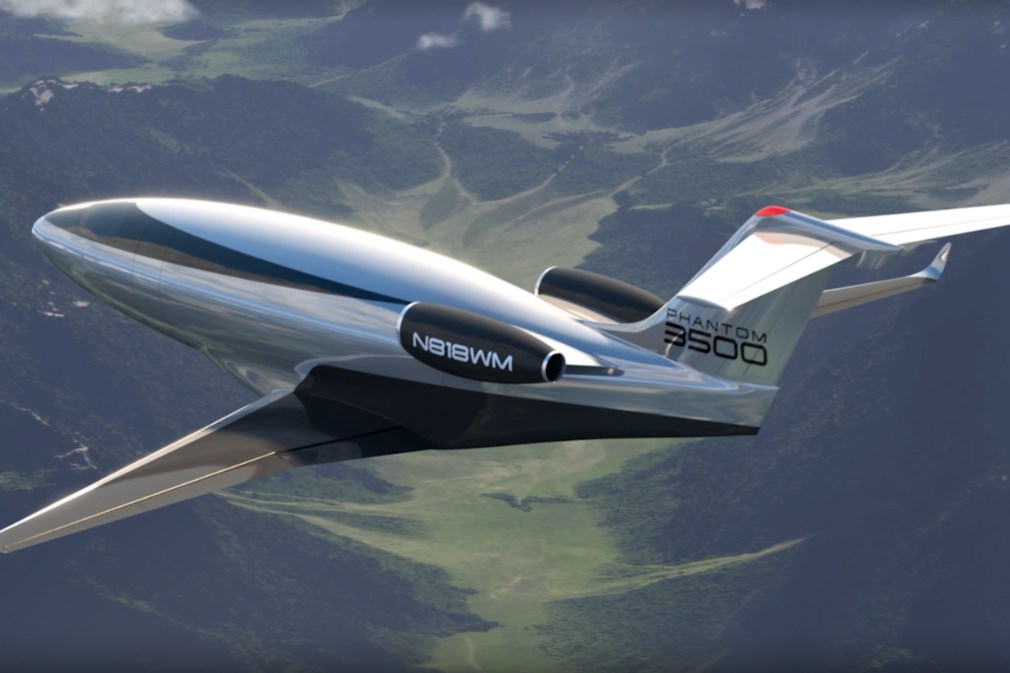
The maiden flight of Otto Aerospace’s revolutionary bullet-shaped business jet, the Phantom 3500, is drawing ever closer. Why is it called the “Holy Grail” of aviation?

The American company Otto Aerospace, formerly known as Otto Aviation, has announced a major milestone in the development of its next-generation business jet, the Phantom 3500. The project’s engineers have successfully completed the preliminary design review phase. Independent experts and in-house specialists have confirmed the validity of the aerodynamic configuration, the correct integration of onboard systems, and the accuracy of the structural strength calculations. This marks the program’s official transition to the detailed design phase, the preparation of production facilities, and the planning of flight tests.
A unique interior design concept without portholes
One of the most striking features of the Phantom 3500 is its bold engineering decision to do away with traditional windows in the fuselage. Instead of the usual windows, passengers will be able to observe what’s happening outside through ultra-high-resolution panoramic digital displays. The images displayed on these screens are streamed in real time from high-quality external cameras. This approach has made it possible to create a perfectly smooth fuselage surface without any cutouts for windows, which has a positive effect on the aircraft’s aerodynamic performance.
Aerodynamic Efficiency and Environmental Benefits
The developers are focusing primarily on achieving stable laminar flow around the fuselage. Laminar flow refers to the smoothest and most orderly flow of air over the surface of an aircraft. According to estimates by engineers at Otto Aerospace and NASA specialists, maintaining this condition consistently at cruising speeds remains one of the most challenging problems in modern aeronautical science. For the Phantom 3500, the implementation of this technology promises to reduce aerodynamic drag by approximately thirty-five percent. At the same time, harmful emissions are expected to be reduced by up to ninety percent compared to conventional business jets of the current generation.
The Legacy of Experimental Research and Development
The Phantom 3500 project is a logical continuation of the work on the Celera 500L experimental aircraft, which completed more than fifty test flights between the late 2010s and the early 2020s. However, the new aircraft is being developed as a full-fledged business jet designed to compete directly with established models on the market, such as the Bombardier Challenger 3500 and the Embraer Praetor 500.
Power Plant and Flight Range
The Phantom 3500 will be powered by a pair of Williams FJ44 dual-circuit turbofan engines. A key feature is these engines’ ability to run on environmentally friendly Sustainable Aviation Fuel (SAF). The maximum range will be approximately 6,850 kilometers, making it possible to operate intercontinental flights with four to five passengers on board. The aircraft’s service ceiling reaches 15.5 kilometers, which is higher than the standard altitudes flown by commercial airlines.
Cost-Effectiveness and Operational Flexibility
The project places particular emphasis on reducing operating costs. Thanks to the use of lightweight composite materials in the airframe and an optimized wing shape, fuel consumption can be reduced by fifty to sixty percent. The interior height reaches nearly two meters, ensuring comfortable movement for passengers. Another advantage of the reduced weight and high aerodynamics is the ability to take off from shorter runways approximately one kilometer long, which expands the range of accessible airports.
Commercial Prospects and Production Cooperation
Although the aircraft is still in the development stage, the market has already shown interest in the form of large preliminary orders. Business aviation operator Flexjet has signed a memorandum for the delivery of 300 Phantom 3500 aircraft. The estimated value of the contract is $5.85 billion, with a base price of approximately $19.5 million per aircraft. Production of composite components will be organized in collaboration with the Italian conglomerate Leonardo S.p.A., and final assembly of the aircraft will take place at Cecil Airport in Jacksonville, Florida.
Tactical and Technical Specifications
- Engines: two Williams FJ44 turbofan engines
- Fuel type: jet fuel and sustainable aviation fuel (SAF)
- Maximum flight range: approximately 6,850 km
- Practical range: up to 15.5 km
- Passenger capacity: 4–5 people
- Interior height: nearly 2 meters
- Required runway length for takeoff: approximately 1,000 meters
- Reduction in aerodynamic drag: up to 35%
- Fuel consumption reduction: 50–60%
- Emissions reduction: up to 90% compared to similar models
- Base price: approximately $19.5 million.
Based on material from https://dzen.ru/a/ahL453M-KU9rtNKR