Experimental Soviet Aircraft as Seen by the West: The Tu-8 Long-Range Bomber and the Tu-2RSHR Heavy Ground-Attack Aircraft

Here is a short vintage article from *Air Trial* magazine (February 1953 issue) that I think will be of interest to readers and colleagues. The actual names of Soviet aircraft and equipment are given in parentheses.
The Two-Faced “Tupolev” [1]
Author: WILLIAM GREEN
Little-known facts about two Russian bombers that pose a real threat; design improvements show that the Soviet Union [2] is constantly improving its aircraft.
During World War II, Russia’s primary manufacturing efforts were focused on the full-scale production of strictly traditional aircraft. The aircraft designs were simple and adaptable to a wide variety of missions, and the emphasis was on maximum manufacturability; in some cases, ease of production took precedence over maximum combat effectiveness. The range of combat aircraft was limited to a few simple types, which proved highly effective in carrying out their specific missions. By the end of the war, however, the Soviet Air Force command realized that to achieve qualitative parity with the West, it was necessary to attain a higher degree of specialization, however unpleasant that might be.
In the early postwar years, top priority was given to the development of specialized single-seat daytime fighter-interceptors and multi-seat all-weather fighter-interceptors, while specialized attack aircraft took a back seat. As a temporary measure, a policy was adopted to modify and upgrade designs created toward the end of the war so that the new variants could perform specialized missions.
Until now, little was known about this temporary program, but the description provided on these pages of specialized variants of the highly successful Tu-2 general-purpose light bomber [Tu-2], serves as further evidence of the importance the Soviet Air Force command attached to meeting, as quickly as possible, the strict technical standards established by the U.S. Air Force.
The Tu-2, developed during the war by Lieutenant General Andrei Nikolaevich Tupolev, is still considered a front-line aircraft in the air forces of Russia, Poland, and China, and although it was replaced in Europe by the twin-engine Il-28 [Il-28],
“It remains the standard aircraft of the Soviet light bomber regiments deployed in the Asian part of the Soviet Union.”
The Tu-2, the only Tupolev aircraft to enter service during the war—and for which he received the Stalin Prize in 1943—began to appear on the Eastern Front in 1944–45 during the final stage of the war. Raids by Tu-2 formations preceded ground-attack aircraft strikes and were intended to deliver preliminary bombing strikes (so-called operations to “soften up” enemy defenses). The Tu-2, originally equipped with two 14-cylinder ASh-82F [M-82F] engines, each rated at 1,640 l.s., quickly proved itself to be an effective weapon by wartime standards and, by Russian standards, one of the best-equipped aircraft.
Serial production of the Tu-2 continued into the early postwar years; this aircraft remained in service exclusively with the Soviet Air Force until the end of 1950, when several Polish squadrons were re-equipped with this type of aircraft. The fact that it has since been supplied to the Chinese Communist Air Force is evidenced by the Chinese’s unsuccessful attempts to attack UN positions in Korea, undertaken early last year using these aircraft.
Over the course of its service, the Tu-2 underwent numerous phased design improvements; aircraft from later production batches were equipped with 1,850-force ASh-82FNV [ASH-82FN] engines with four-bladed propellers, which replaced the three-bladed propellers installed on the first production models, and the maximum speed increased to 357 miles per hour (574 km/h) at an altitude of 19,000 feet (5,791 m). A specialized variant [Tu-2RSHR] was developed for striking ground targets with a 40–47 mm cannon [3], offset to the left in the shortened forward section of the fuselage. The cockpit of this model was slightly redesigned, and the engine nacelles were lengthened to compensate for the shortened forward section of the fuselage.
![штурмовой вариант тактического бомбардировщика Tu-2 [Ту-2РШР]](https://alternathistory.net/wp-content/uploads/2026/09/tu-faced-reds-03-1.jpg)
Assault variant of the Tu-2 tactical bomber [Tu-2RSHR]
В дополнение к крупнокалиберной пушке, эта версия Tu-2 несла две 20-мм пушки в корневых частях крыла и пять 12,7-мм пулеметов Березина в верхней и нижней частях фюзеляжа. Стандартный фюзеляжный бомбоотсек вмещал 3300 фунтов (1500 кг) бомб, а на меньших дальностях полета дополнительные крыльевые отсеки в корневых частях крыла могли вместить до 1700 фунтов (771 кг) противопехотных бомб. Эти крыльевые бомбоотсеки могут быть заменены ракетами, установленными между мотогондолами и бортами фюзеляжа.
![схема штурмового варианта тактического бомбардировщика Tu-2 [Ту-2РШР]. Максимальная скорость 345 миль в час (555 км/ч) на высоте 19000 футов (5791 м), время набора высоты 18000 футов (5486 м) 9,5 минут, практический потолок 28000 футов (8534 м), масса с нормальной нагрузкой 25000 фунтов (11340 м), дальность полета с нормальной нагрузкой 1100 миль (1770 км). Литерами отмечены: A) крупнокалиберное орудие в короткой носовой части фюзеляжа, отсек для другого вооружения; B) удлиненные моторные гондолы, компенсирующие более короткий нос фюзеляжа. В гондолах установлены радиальные двигатели ASh-82FNV мощностью по 1850 л.с. каждый; C) две 20-мм пушки в корневых частях крыла; D) фюзеляжный отсек для 3300 фунтов (1500 кг) бомб; E) дополнительные крыльевые от секи на 1700 фунтов (771 кг) бомб; F) специальные четырехлопастные воздушные винты; G) уменьшенная кабина экипажа; H) спаренные 12,7-мм пулеметы Березина; I) один 12,7-мм пулемет Березина; J) разрезные закрылки; K) первоначальное крыло с размахом 61 фут (18,6 м)](https://alternathistory.net/wp-content/uploads/2026/09/tu-faced-reds-04.jpg)
Diagram of the assault variant of the Tu-2 tactical bomber [Tu-2RSHR]. Maximum speed: 345 mph (555 km/h) at an altitude of 19,000 feet (5,791 m); time to climb to 18,000 feet (5,486 m) 9.5 minutes, service ceiling 28,000 feet (8,534 m), weight with standard load 25,000 pounds (11,340 m), range with standard load 1,100 miles (1,770 km). The letters denote: A) a large-caliber cannon in the short nose section of the fuselage, a compartment for other armament; B) elongated engine nacelles, compensating for the shorter fuselage nose. The nacelles house ASh-82FNV radial engines, each rated at 1,850 l.s.; C) two 20-mm cannons at the wing roots; D) a fuselage compartment for 3,300 pounds (1,500 kg) of bombs; E) additional wing pylons for 1,700 pounds (771 kg) of bombs; F) special four-bladed propellers; G) a reduced-size cockpit; H) twin 12.7-mm Berezin machine guns; I) one 12.7-mm Berezin machine gun; J) split flaps; K) original wing with a wingspan of 61 feet (18.6 m)
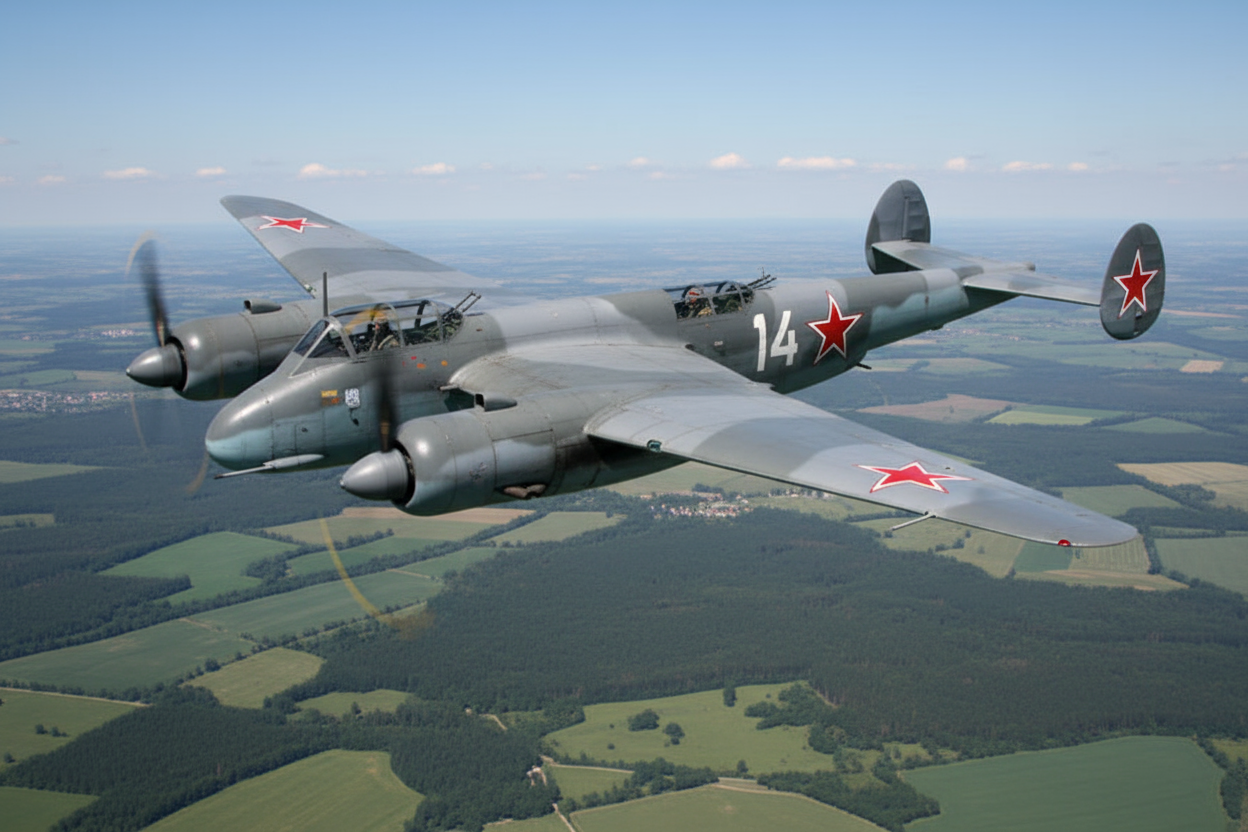
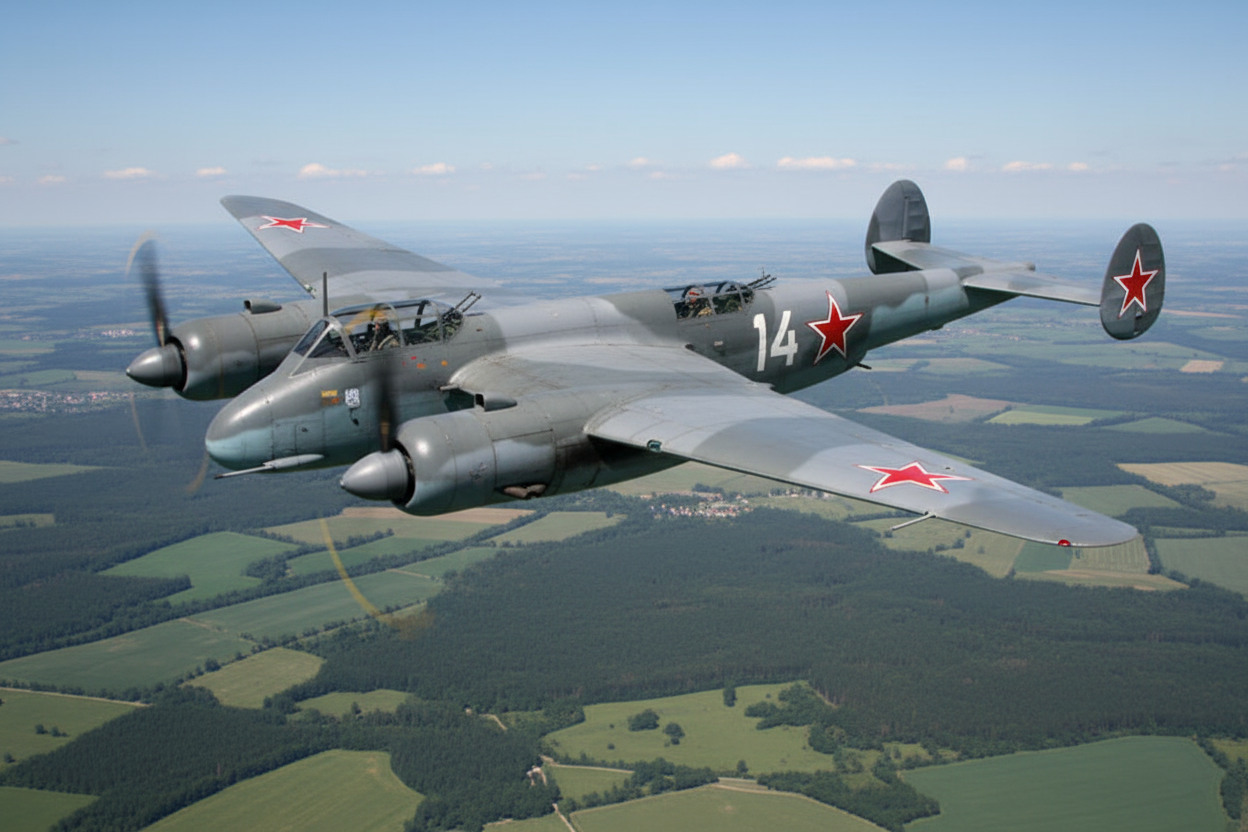
An assault variant of the Tu-2 tactical bomber in flight. Image generated by lmarena.ai
On the latest production models of the standard Tu-2, the wingspan was increased from 61 to 62 feet (from 18.6 to 18.9 m), and the tips of the stabilizers and rudders were also lengthened, the transverse V-angle of the stabilizer cantilevers, and the aircraft was equipped with a fully retractable tail landing gear. However, an even greater amount of work to modernize the basic Tu-2 design was carried out on its next variant—a high-altitude bomber-reconnaissance aircraft—which was designated the Tu-6 [Tu-8].
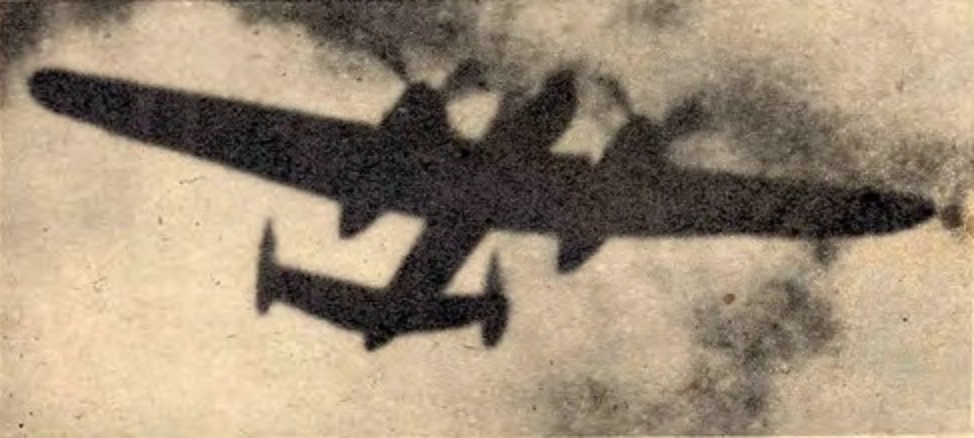
Tu-6 high-altitude bomber and reconnaissance bomber
The Tu-6 comes in two variants: a basic high-altitude bomber-reconnaissance aircraft with a modified nose section, which appears more angular than that of its predecessor, and a lead aircraft with a nose section protruding below the fuselage line, housing a radar system for blind bombing. The Tu-6’s wingspan has been increased from 62 feet (18.9 m) to over 70 feet (21.3 m); the wing has a slight taper at the leading edge and wide, rounded wingtips. The aerodynamics of the engine nacelles were refined, and the fuselage bomb bay and horizontal stabilizer span were increased.
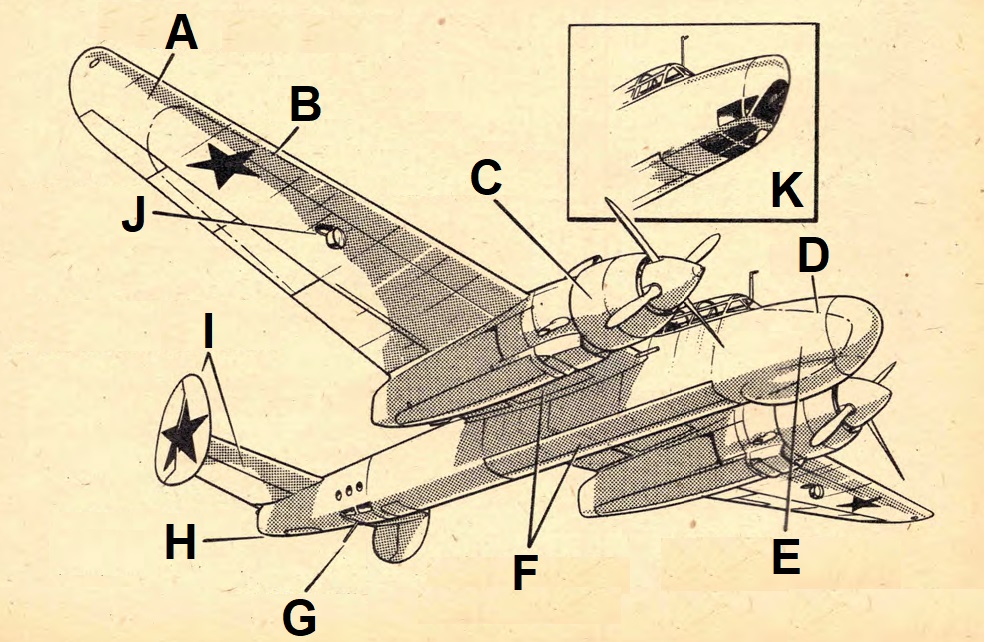
Diagram of the Tu-6 high-altitude bomber and reconnaissance bomber; the following are labeled: A) new high-altitude wing with a wingspan increased to 70 feet (21.3 m); B) the old wing configuration (shown in dashed lines); C) the modified engine nacelle and four-bladed propeller; D) the old fuselage nose configuration (shown in dashed lines); E) an elongated forward fuselage section housing a blind-bombing radar system; F) an enlarged fuselage bomb bay and additional wing bomb bays; G) a more spacious defensive position; H) fully retractable tail landing gear; I) new tail assembly with enlarged keels and rudders, increased horizontal stabilizer span, and a larger transverse V-angle; J) landing lights for night flights; K) a new nose section for the bomber-reconnaissance aircraft
[1]
The author’s play on words in the article’s title (Tu-faced and two-faced) – byakin
[2]
Here and throughout, references to the Soviet Union and the Soviet Air Force are presented in a neutral context, without terms such as “Reds,” “Soviets,” etc.—byakin
[3]
The Tu-2RSHR was armed with a 57-mm RSHR cannon—byakin
источник: By William Green «Tu-faced Reds» «Air Trails» February, 1953 • Vol. 39, No. 5, pages 20,21
Translation first published at – https://vk.com/@710541705-tu-faced-reds