Work is underway in the U.S. on a vertical takeoff and landing (VTOL) transport aircraft. The "Aurora X-Plane" program—first details

When I first came across this news, I initially thought it was all part of the alternative aviation scene. This plane looks so fantastical. However, as it turns out, this is a very real project currently under development in the United States. Below, we’ll take a look at what it is and what stage of development it’s at.
Yet Another American-Style Innovation
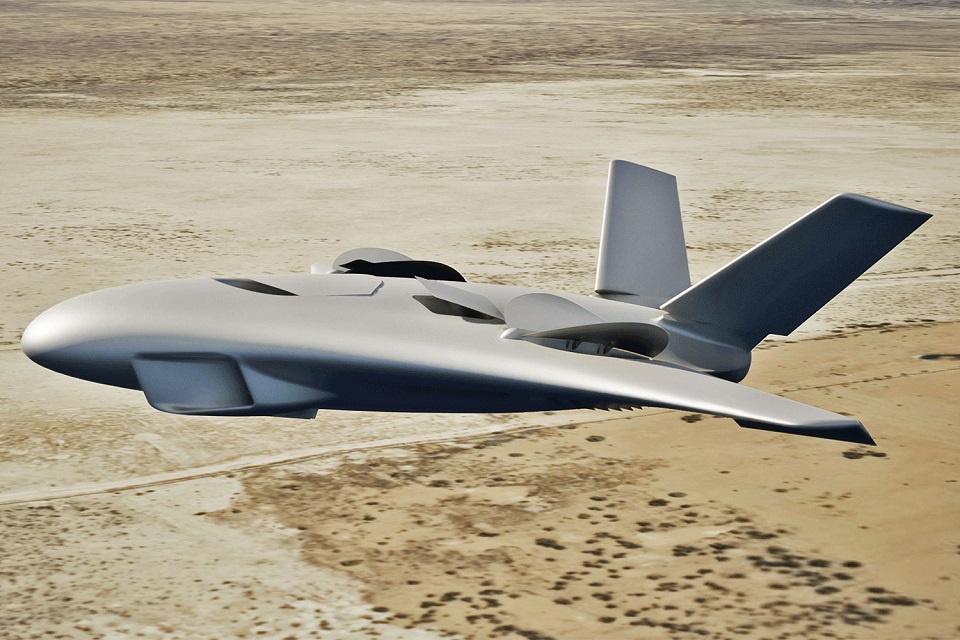
At first glance at the images presented of this concept, it is clear that its appearance bears a strong resemblance to the real-life American B-2 Spirit stealth bomber. However, in the case of the “Aurora,” the aircraft will not drop its payload on enemy positions, but will instead deploy special forces undetected by a potential adversary, and then take off vertically and depart just as stealthily, without being detected by radar. This is precisely the concept presented by Aurora Flight Sciences, a subsidiary of Boeing. Without a hint of modesty, Aurora representatives call their concept a “revolutionary solution for air transport in contested territory.”
The SPRINT Program and Its Goals
This aircraft has been in development for at least several years and is part of a program called SPRINT (Speed and Runway Independent Technologies). This program was launched by DARPA (the Defense Advanced Research Projects Agency), a division of the Pentagon, in collaboration with the U.S. Special Operations Command. DARPA was specifically created to conduct research and development on aircraft that do not require conventional runways.
The SPRINT program was launched in November 2023, and in May 2024, two companies—Aurora Flight Sciences and Bell Textron—were awarded contracts for the preliminary design phase (Phase 1B). The program’s goal is to design, build, and fly an experimental X-Plane that will demonstrate key technologies enabling a combination of high cruise speeds and the ability to operate without dedicated runways. According to DARPA’s requirements, the aircraft must be capable of cruising at speeds between 400 and 450 knots (approximately 740–830 km/h) and hovering in challenging conditions on unprepared surfaces.
The “Fan-in-Wing” Concept
At present, the U.S. cannot boast of having either stealth aircraft or even relatively large drones capable of transporting cargo or people using a vertical takeoff and landing system. They do have the Bell Boeing V-22 Osprey tiltrotor, but it certainly cannot be called stealthy. And precisely to achieve a combination of stealth and a vertical takeoff and landing system, the team at “Aurora” decided to create a wing into which powerful lift fans would be mounted.
The technology is called Fan-in-Wing (FIW)—“fan in the wing.” It combines built-in lift fans with a “blended wing body” (blended wing body), which ensures vertical maneuverability without compromising the payload capacity and aerodynamic efficiency characteristic of modern fixed-wing aircraft. According to Aurora’s experts, it is precisely this approach that leaves the aircraft’s fuselage free for carrying cargo or passengers. Moreover, this approach provides good aerodynamic performance and fuel efficiency compared to traditional solutions, such as tiltrotors or helicopters.
For the SPRINT program demonstrator, the team is designing an unmanned aircraft with a wingspan of 45 feet (about 13.7 meters) and a payload capacity of 1,000 pounds (about 454 kg). New renderings of the FIW demonstrator show three lift fans, a more refined composite exterior, and an unmanned cockpit. The choice of three fans reflects the team’s strategy to simplify the demonstrator and accelerate its transition to flight testing. FIW technology can be scaled up to four or more fans to meet future requirements, opening the door to a whole family of systems.
The power plant includes production turbofan and turboshaft engines, which are designed to accelerate the aircraft to a maximum speed of 450 knots true airspeed (approximately 833 km/h). According to preliminary calculations by Aurora engineers, their X-Plane will have a cruising speed of over 830 km/h. According to Aviation Week, an operational version of the concept would have nearly the same wingspan and payload capacity as the Lockheed Martin C-130J, but would fly 90 knots faster while retaining the ability to take off and land vertically, like a helicopter.
The History of the X-Plane VTOL Program and the XV-24A LightningStrike
It’s worth noting that this isn’t Aurora’s first attempt to build such an aircraft. The company previously developed the XV-24A LightningStrike concept as part of an earlier DARPA VTOL X-Plane program, which began in 2013. At that time, Aurora Flight Sciences, in collaboration with Rolls-Royce and Honeywell, created a hybrid-electric aircraft with 24 distributed ducted fans — 18 on the main wing and 6 on the forward wing. The aircraft was powered by a Rolls-Royce AE1107C turboshaft engine (the same one used on the V-22 Osprey), which, through three Honeywell generators, produced 3 megawatts of electrical power to drive the individual electric motors for the fans.
In March 2016, DARPA awarded Aurora an $89.4 million contract to build and demonstrate the LightningStrike concept, which beat out three competitors—Sikorsky, Boeing, and Karem Aircraft. A 20 percent-scale demonstrator weighing 325 pounds (147 kg) was built from carbon composites and 3D-printed plastics and made its first flight on March 29, 2016. However, in April 2018, DARPA canceled the program before flight tests of the full-scale aircraft could begin, citing the lack of a successor military customer and growing commercial interest in distributed electric propulsion.
Current Status and Future Prospects
The company’s experts have described the advantages of their future stealth transport aircraft in considerable detail. According to them, it will be capable of quickly and, most importantly, covertly transporting not only the cargo necessary to ensure the combat readiness and survival of ground units, but also of rapidly delivering equipment and carrying out evacuation missions.
As for the current phase of the SPRINT program, there have been significant developments. Aurora Flight Sciences successfully completed a conceptual design review in May 2024 and has moved on to the preliminary design phase. The team conducted a series of wind tunnel tests, including stability and controllability tests using a model with a full wingspan of 9 feet, as well as low-speed controllability tests. The Preliminary Design Review was scheduled for April 2025.
However, in July 2025, DARPA announced that, following a competitive selection process to move on to Phases 2 and 3 (detailed design, construction, and flight testing), Bell Textron—rather than Aurora Flight Sciences—had been selected. In March 2026, Bell’s prototype was officially designated the X-76, a nod to the 250th anniversary of the United States and the revolutionary spirit of 1776. By this point, Bell had successfully passed the Critical Design Review, and the program had moved on to the production, assembly, and ground testing of the X-76 demonstrator. Flight tests of the X-76 are scheduled for early 2028.
Thus, despite successfully completing a number of phases, the “Aurora” concept—which incorporates Fan-in-Wing technology—has not yet been carried forward as a flight demonstrator within the SPRINT program. Nevertheless, the technology itself remains promising and may be used in future programs.
Historical Parallels
I’d like to remind you that in the U.S., the concept of a vertical takeoff transport aircraft was developed as early as the 1980s by Lockheed, and at that time the project was called SOFA. Visually, it was similar to the modern X-Plane from Aurora. And now, nearly half a century later, they’ve revisited this concept. We’ll continue to follow this project closely.
Technical Specifications (Preliminary Data for the Aurora Demonstrator for the SPRINT Program)
- Wingspan: 45 feet (about 13.7 m)
- Demonstrator load capacity: 1,000 pounds (about 454 kg)
- Maximum speed: 450 knots true airspeed (about 833 km/h)
- Powerplant type: production turbofan and turboshaft engines
- Number of lift fans (demonstration unit): 3
- Crew: unmanned version (with the option to scale up to a manned version)
- Takeoff and landing: vertical (VTOL), without the need for a prepared runway
Sources:
- The “Energofixik” Zen Channel — “Yet another American-style innovation. The ‘Aurora X-Plane’ stealth aircraft will take off and land vertically” (https://dzen.ru/a/Zw_kgQBFegbv5S1Q)
- Aurora Flight Sciences — «A Revolutionary Solution for Contested Air Transport» (https://www.aurora.aero/2024/10/08/a-revolutionary-solution-for-contested-air-transport/)
- Aurora Flight Sciences — «Aurora’s Latest X-Plane Design Speeds Ahead» (https://www.aurora.aero/2024/05/20/auroras-latest-x-plane-design-speeds-ahead/)
- AIAA — «Aurora Unveils High-Speed VTOL X-Plane Concept Design» (https://aiaa.org/2024/10/09/aurora-unveils-high-speed-vtol-x-plane-concept-design/)
- DARPA — «SPRINT: Speed and Runway Independent Technologies» (https://www.darpa.mil/research/programs/speed-runway-independent-technologies)
- DARPA — «DARPA’s new X-76: the speed of a jet, the freedom of a helicopter» (https://www.darpa.mil/news/2026/darpa-new-x-76-speed-of-jet-freedom-of-helicopter)
- Wikipedia — “VTOL X-Plane” (https://en.wikipedia.org/wiki/VTOL_X-Plane)
- Wikipedia — “Aurora XV-24 LightningStrike” (https://en.wikipedia.org/wiki/Aurora_XV-24_LightningStrike)
- FlightGlobal — «Aurora completes wind-tunnel testing on experimental fan-in-wing design» (https://www.flightglobal.com/fixed-wing/2025/04/aurora-completes-wind-tunnel-testing-on-experimental-fan-in-wing-design/)
- AeroTime — «DARPA designates Bell’s SPRINT demonstrator as X-76» (https://www.aerotime.aero/articles/darpa-bell-sprint-x76-designation-critical-design-review)
- The Defense Post — «Bell Textron Beats Aurora in DARPA X-Plane Program» (https://thedefensepost.com/2025/07/10/bell-textron-darpa-x-plane/)