It looks like a prop from a sci-fi action movie. It holds 50 rounds in a single magazine. And it fires a cartridge NATO ordered to defeat body armor. But to understand the Kel-Tec P50, you have to separate two stories: the story of a cartridge born of the Cold War, and the story of a pistol born of the American market.

The late 1980s: the 9mm problem
The Cold War was winding down, but NATO planners were thinking ahead. One of their concerns seemed minor: how to arm the people who aren’t on the front line. Tank crews, gunners, signalers, drivers. A rifle gets in their way, and a pistol or submachine gun in 9×19mm was doing less and less against the big innovation of the era: body armor.
A heavy, slow pistol bullet flattened against layers of Kevlar. NATO set out a requirement for a new cartridge: greater range, accuracy and terminal performance than the 9×19, and, crucially, the ability to penetrate personal body armor. In those years, the “protected enemy” NATO had in mind was inevitably a soldier of the Eastern Bloc.
A bullet as fast as an arrow

Belgium’s FN Herstal was the first to answer. Its engineers went against tradition. Instead of making the bullet heavier, they made it lighter and much faster. The result was the 5.7×28mm: a bottlenecked case like a miniature rifle cartridge, and a bullet just over five millimeters in caliber.
The first version, the SS90, appeared in 1990. Its bullet weighed just 1.5 g, had a plastic core and reached about 850 m/s. In 1993 it was replaced by the SS190, with a slightly heavier and shorter 2 g bullet with a steel and aluminum core. From the barrel of the FN P90 personal defense weapon, it leaves the muzzle at about 716 m/s, roughly twice the speed of sound.
The physics here is simple. A wide, soft bullet spreads its impact over a large area, and the Kevlar fibers catch it. A narrow, hard and very fast bullet works like a needle: all its energy is focused on a tiny point, and it pushes through the fabric where a 9mm round gets stuck. In testing, the SS190 fired from a P90 penetrated NATO’s CRISAT reference target, or a Level IIIA Kevlar vest, at 200 m.
FN built two weapons around the cartridge. The first, the futuristic P90, carried a translucent 50-round magazine lying on top, parallel to the barrel. The second was the Five-seveN pistol.
The long road to a standard

In 2002–2003, NATO ran comparative trials between the Belgian cartridge and its main rival, Heckler & Koch’s German 4.6×30mm. An expert group from Canada, France, the United Kingdom and the United States recommended the 5.7×28. But the German delegation objected, and standardization was frozen indefinitely.
The cartridge carried on regardless: by 2006, the P90 and Five-seveN were in service with military and police forces in more than forty countries. Official recognition came only on 25 February 2021, when FN announced that the 5.7×28 had become a NATO standard caliber under STANAG 4509. Remember that date: a few weeks later, the hero of our story would make its debut.
Florida, 2020: the leak

In December 2020, a leaked magazine cover appeared on a forum for Kel-Tec fans. It showed a strange pistol with a 50-round 5.7×28 magazine and the caption “most unique Kel-Tec yet.” For a company from the Florida town of Cocoa, that’s a bold claim. Its founder, Swedish engineer George Kellgren, has long been known for weapons that break the usual rules of layout.
In January 2021, Kel-Tec confirmed it: P50 sales would begin in March, at a suggested price of $995. As it happened, the cartridge became a NATO standard and gained its most outlandish civilian pistol at almost the same time.
Anatomy of a strange pistol
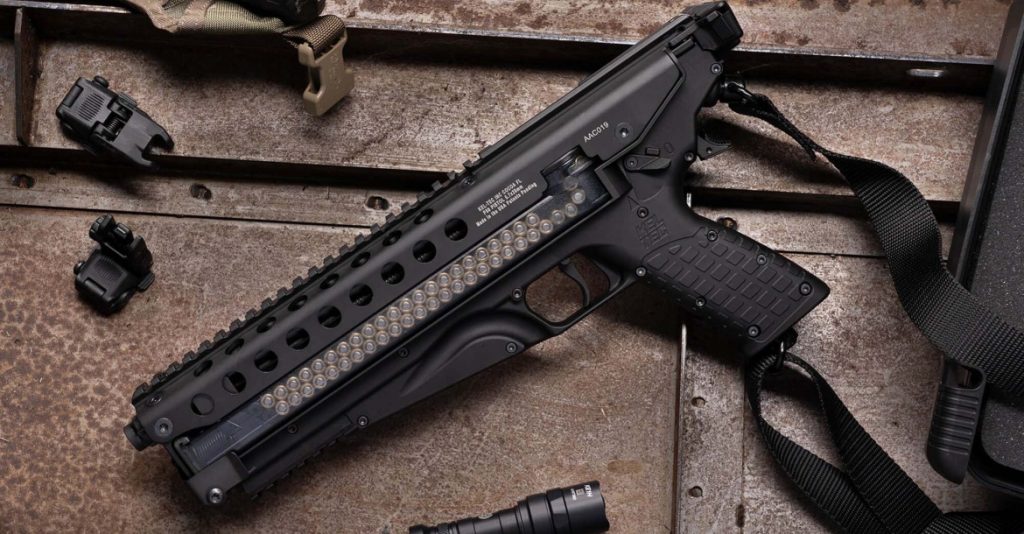
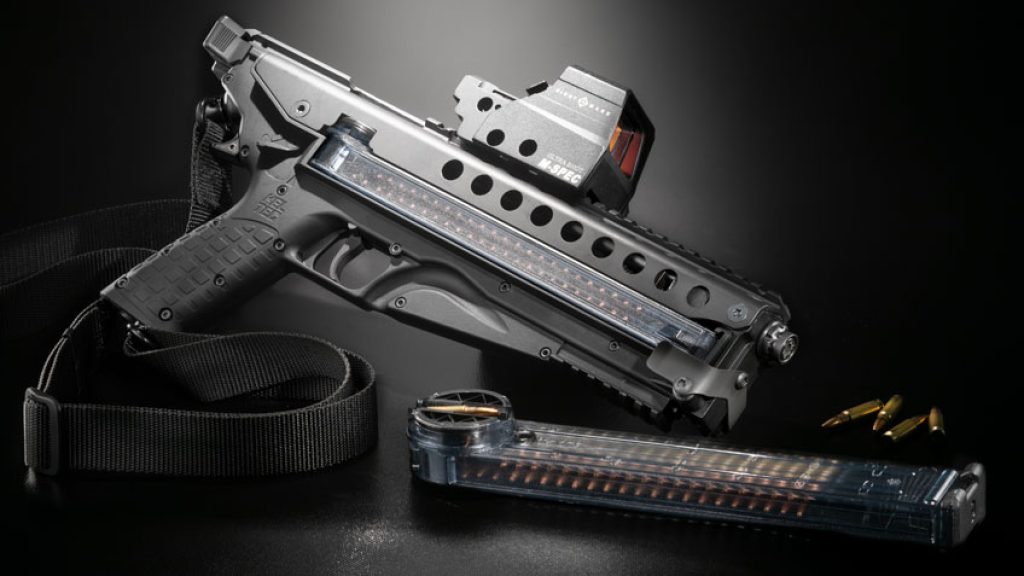
The P50’s key part is borrowed. Kel-Tec built the pistol around the very same 50-round P90 magazine, and each pistol ships with two of them. The magazine lies horizontally between the grip and the barrel, with the cartridges sitting crosswise to the gun. The trick is that as each round leaves the magazine, it rotates 90 degrees to line up with the barrel.
Reloading is unusual too. The magazine doesn’t go into the grip: the pistol opens like a clamshell. The upper half swings up on a hinge, the shooter drops in the magazine and snaps the cover shut. The barrel is rigidly attached to that upper part, so the zero doesn’t shift. The action is as simple as it gets: straight blowback. Spent cases are ejected upward.
The result is a big gun: 38 cm long, 1.43 kg unloaded, with a 24.4 cm barrel. That’s a lot for a pistol: the barrel is more than twice as long as the Five-seveN’s and only an inch shorter than the P90’s. It’s the barrel length that gives the P50 its speed. Reviewers report the bullet reaching about 2,100 feet per second, roughly 640 m/s. That’s no longer pistol speed; it’s light-carbine speed.
The central paradox: an armor-piercer without armor-piercing rounds
And here’s what most accounts of the P50 leave out.
The popular line “built to penetrate body armor” applies to the cartridge, not the pistol. And not even to the cartridge as a whole, but to one specific military load, the steel-cored SS190. The Kel-Tec pistol was made for the American civilian market. And on that market, since 2004, 5.7×28 ammunition has been sold without the steel penetrator. Sporting loads such as the SS195LF and SS197SR are meant for the range, not for armor. FN sells certain specialized versions only to military and law enforcement.
That makes for a curious picture. The P50 has everything FN’s engineers built into an armor-defeating system: the caliber, a long barrel, high bullet velocity, even the P90’s own magazine. It lacks just one thing: the very military core the whole idea was built around. It’s a complete mechanism sold with only a blank key. A weapon with a Cold War soul has become a toy for the shooting range.
What came next
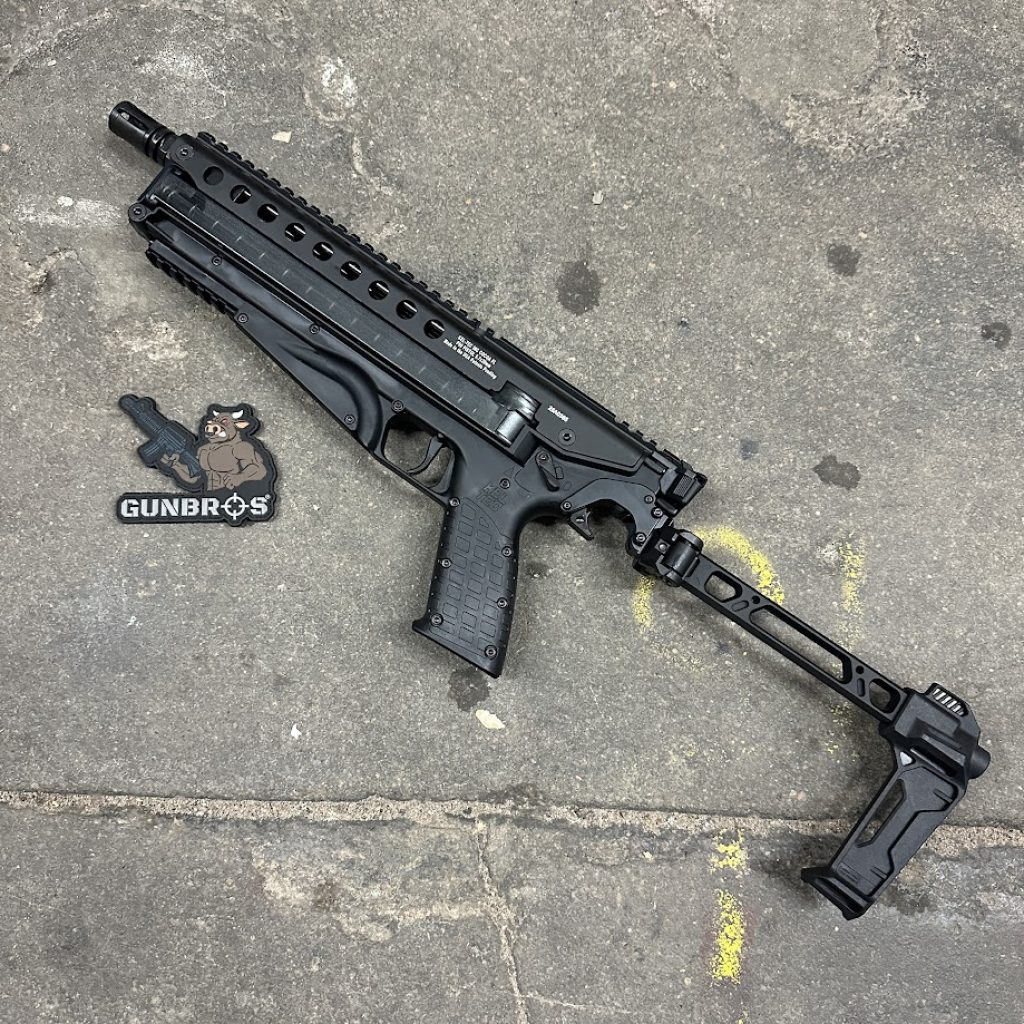
The P50 wasn’t a one-off curiosity. In 2023 Kel-Tec showed the R50 carbine on the same platform, with a stock and a longer barrel, about 77 cm overall. And the 5.7×28 itself, once an exotic round for special units, is now enjoying a real renaissance. Pistols chambered for it are made by Ruger, Smith & Wesson, Turkey’s TISAŞ and many others.
The Kel-Tec P50 is a good example of how military technology flows into the civilian world. A cartridge born of fear of a potential enemy’s body armor became, thirty years later, the basis for the most sci-fi-looking pistol on the market. And if anyone ever tells you this pistol “goes through any vest,” you now know what to ask: “With which ammo?”
Weapon profile: Kel-Tec P50
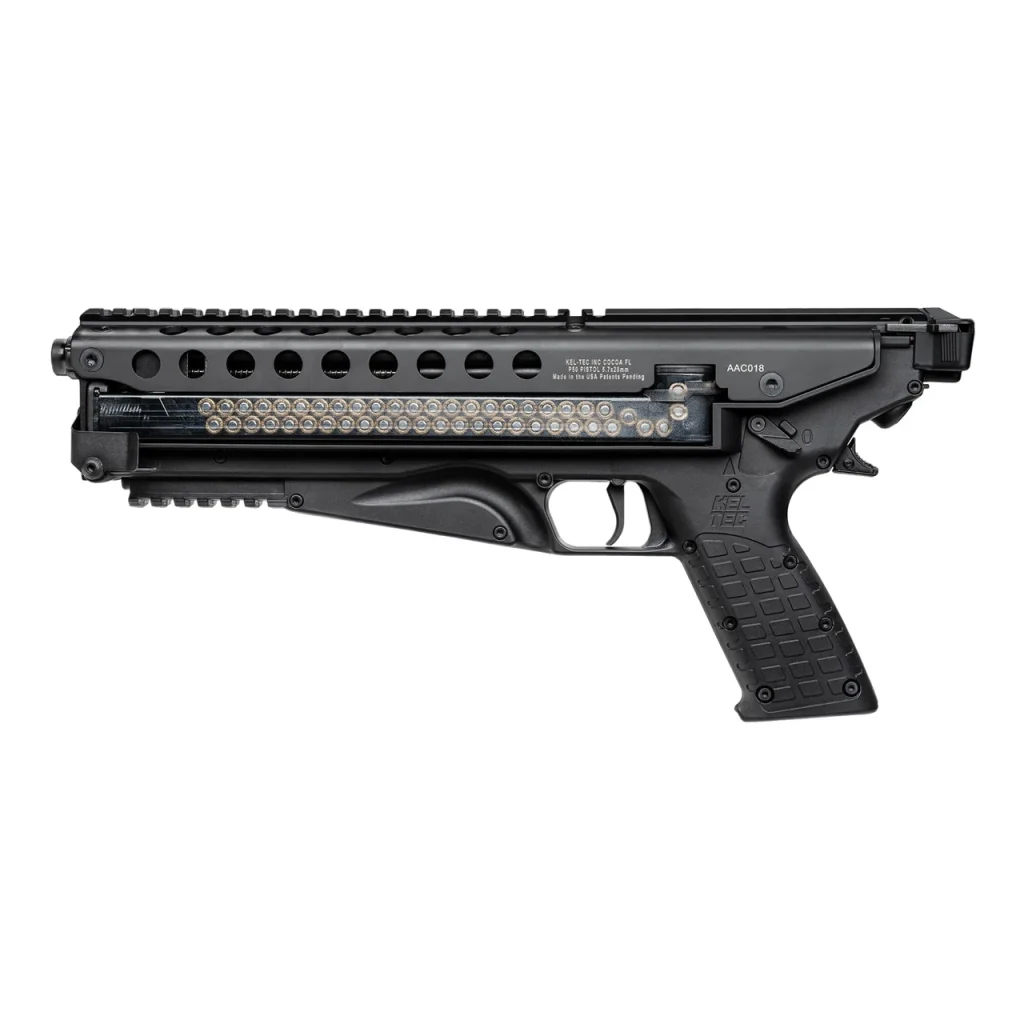
- Manufacturer: Kel-Tec CNC Industries (Cocoa, Florida, USA)
- Introduced: January 2021, on sale from March 2021
- Type: semi-automatic pistol, straight blowback
- Cartridge: FN 5.7×28mm
- Magazine: 50 rounds (FN P90), two included
- Weight: 1.43 kg unloaded
- Length: 380 mm, barrel 244 mm with threaded muzzle
- Muzzle velocity: about 640 m/s (depends on ammunition)
- Launch MSRP: $995