A Revolution in Hypersonic Technology or a Dead-End Invention? Russia Has Patented a New Principle for Accelerating Missiles

In April 2026, documentation appeared in the public database of the Federal Institute of Industrial Property (FIPS) that could change our understanding of maneuvering hypersonic systems. The Novator Design Bureau—one of Russia’s leading rocket manufacturers—filed a patent for a hypersonic missile featuring a fundamentally new acceleration scheme. This development has sparked keen interest among both experts and the general public: Is this truly a technological breakthrough, or just another conceptual design destined to remain on the drawing board?
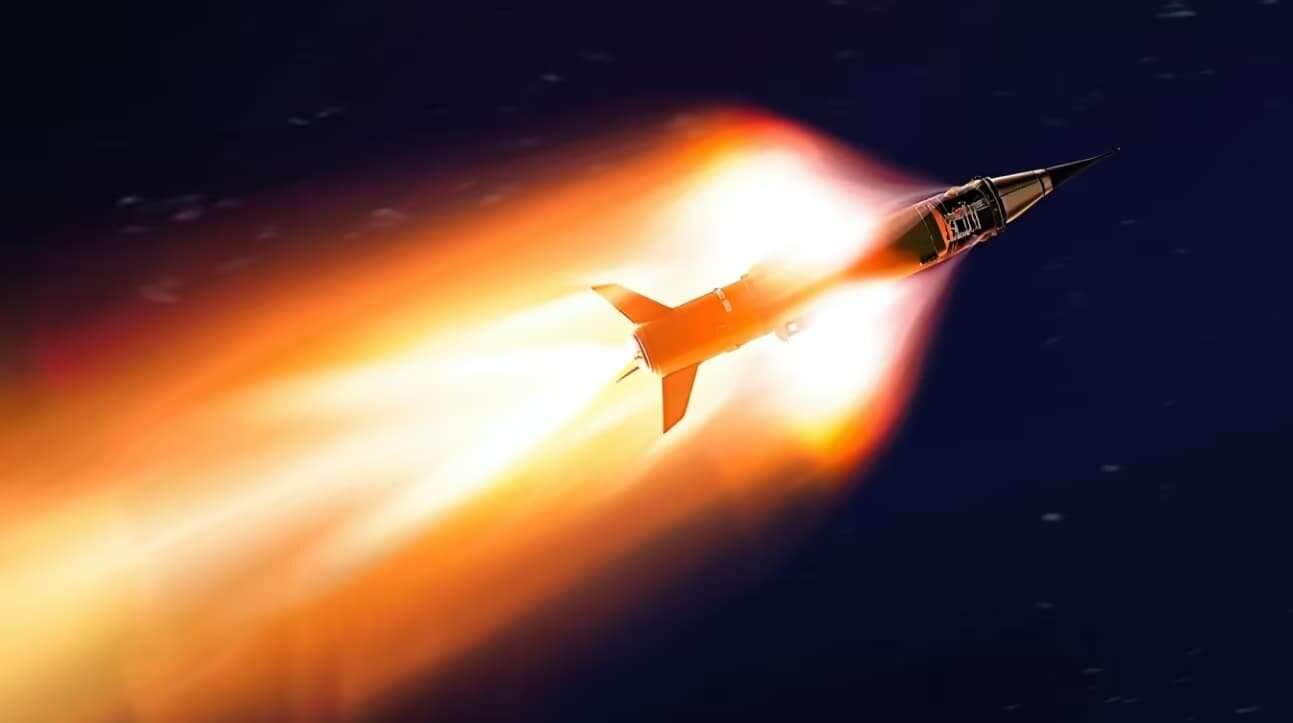
Concept: Two-stage system with intelligent weight redistribution
The key feature of this patented design is its departure from traditional approaches to acceleration in dense layers of the atmosphere. The design features a two-stage configuration with a detachable nose section, with all elements of the rocket formed within a single aerodynamic contour. This design is intended to minimize aerodynamic drag, which is particularly critical when breaking the sound barrier and reaching hypersonic speeds.
The lower stage of the rocket features a two-tiered arrangement of propellant charges with a directional geometry. According to the design by Novator engineers, this allows for more efficient use of the energy from fuel combustion during the initial phase of flight, when air resistance is at its highest. This configuration is theoretically capable of providing a smoother and more controlled acceleration without compromising trajectory stability.
An Innovative Solution: Dynamic Inertia Control
The most interesting aspect of the patent is the in-flight mass redistribution system. Additional ballast is placed in the nose section of the rocket, which acts as stabilizers during the launch phase: the increased inertia helps the vehicle maintain its intended course by compensating for turbulent disturbances and aerodynamic fluctuations.
In the final stage of the flight path, when the rocket enters a maneuvering hypersonic flight mode, these payloads can be jettisoned. Reducing the vehicle’s mass allows for a significant increase in its maneuverability by increasing the available g-forces. The patent description emphasizes that this design is intended to increase average speed without exiting the atmosphere, as well as to improve controllability during the final stage—precisely where modern air defense systems are most vulnerable to evasion.
Practical advantages: compactness and adaptability
In addition to aerodynamic and ballistic advantages, the developers at “Novator” note that the design is more compact. Reducing the missile’s overall dimensions while maintaining or even improving its combat performance simplifies its transportation and deployment in existing launchers. This is particularly important in light of the mobility of modern missile systems and the requirements for covert launch preparations.
The unified aerodynamic profile also reduces the missile’s radar signature, which, combined with its high speed and maneuverability, makes it a difficult target to intercept. At a time when foreign countries are actively developing missile defense systems, such solutions could serve as a factor in strategic deterrence.
Technical Specifications (Projected, Based on Patent Documentation)
- Type: atmospheric-based hypersonic maneuvering missile
- Design: two-stage, with a detachable head section
- Aerodynamics: a unified aerodynamic profile
- Propulsion system: solid-fuel propellant charges arranged in two tiers with a directed geometry
- Mass Control System: Dumpable ballast weights in the nose section
- Estimated speed: hypersonic (over Mach 5)
- Trajectory: maneuvering within the atmosphere, without entering outer space
- Advantages: increased acceleration efficiency in dense layers of the atmosphere, improved maneuverability during the final phase, compact design
Expert Assessment: Breakthrough or Evolution?
Experts note that the patented design does not represent a revolution in terms of fundamental understanding—many of its elements (multi-stage design, ballast jettisoning, aerodynamic optimization) have been known and applied in rocket engineering for decades. However, the innovative aspect of the approach lies in the comprehensive integration of these solutions for a specific task: ensuring stable hypersonic maneuvering in the atmosphere with minimal energy expenditure during acceleration.
On the other hand, critics point out that a patent is merely a design concept set down on paper. Implementing such systems requires solving a whole range of complex engineering challenges: the thermal resistance of materials under hypersonic airflow, the precision of control systems during mass jettisoning, and the reliability of mechanisms under extreme conditions. Until prototypes are developed and flight tests are conducted, it is premature to speak of the system’s operational readiness.
Geopolitical Context: Why It Matters Now
The development of the “Novator” comes at a time of intensifying global competition in the field of hypersonic technologies. Russia already has operational systems, such as the “Kinzhal” and “Zircon,” which are being used in a special military operation. The United States, China, and a number of other countries are actively investing in similar areas, striving to keep pace in the technological race.
In this context, a patent for a new propulsion system can be viewed as an element of strategic planning: even if this particular missile does not go into production, the solutions documented in the patent can be used in future projects. Furthermore, the very fact that the patent is publicly available serves as a form of technological signaling, demonstrating the potential of the Russian defense industry.
Conclusion: The Path from Patent to Practice
The hypersonic missile acceleration scheme patented by the “Novator” Design Bureau is an interesting example of an evolutionary approach to solving complex engineering problems. In-flight mass redistribution, optimization of the aerodynamic configuration, and a compact design—all these elements combined can provide a significant advantage during the final phase of the attack.
However, only practical application—testing, refinement, and deployment—will reveal the true value of the invention. If the development succeeds in this process, it could become an important element in the arsenal of means to counter advanced air defense systems. Even if it remains at the conceptual stage, it will still contribute to the body of engineering knowledge, which will find application sooner or later. In the hypersonic race, where every percentage point of speed and every degree of maneuverability matters, even ideas that seem like “dead ends” at first glance may turn out to be the key to the next technological breakthrough.