October 1941 was drawing to a close. The enemy was advancing on Moscow from three directions.
The 3rd Tank Group and the 9th Field Army were advancing on Moscow from the northwest. From the west and southwest came the 4th Field Army and the 4th Tank Group. Meanwhile, from the south, Colonel General Heinz Guderian’s 2nd Tank Army was attempting to break through toward Moscow.
Facing her was Lieutenant General Boldin’s 50th Army, which had been battered in previous battles near Bryansk.
To assist the regular units in defending the city, on October 23, 1941, the City Defense Committee decided to form the Tula Workers’ Regiment, consisting of 1,500 men, by combining five fighter battalions into a single unit. The regiment was led by Captain of State Security Anatoly Gorshkov, head of the 4th Department of the NKVD Directorate for the Tula Region.
The regiment was not a regular military unit; it was supplied by the Tula Party organization and the city defense committee. But while civilian organizations could provide it with clothing and food, they did not have access to weapons.
There was nowhere to get a weapon. The only option was to make one, since Tula is a city of gunsmiths. But it takes quite a while to make one. If only there were a model like the British Sten gun, which could be cobbled together in a couple of machine-tool hours…
It turned out that such a prototype did exist. It had been developed back in 1930 by a local engineer, Sergei Alexandrovich Korovin.
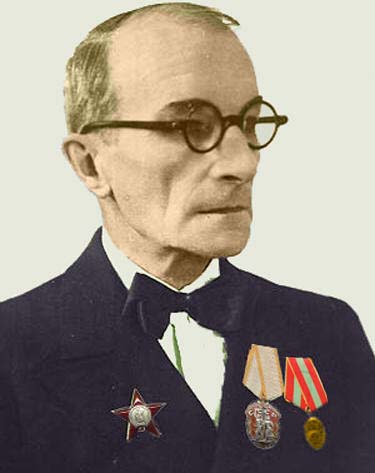
Sergey Alexandrovich Korovin
Korovin was not among the top tier of firearms designers, and although he participated in every firearms competition, it was Degtyarev, Tokarev, Shpagin, and Simonov who won them. This is understandable—Tokarev, Simonov, and Degtyarev were Fyodorov’s students, while Shpagin was Degtyarev’s student. They were all bound together by professional solidarity and the patronage of Fyodorov, who served as the permanent chairman of all competition committees.
Korovin, however, did not study under Fedorov—he studied in Belgium under John Moses Browning, and so he was not one of Fedorov’s own. Only once, back in 1926, did Korovin’s design go into production, but it was a 6.35-millimeter civilian pistol, which, incidentally, was freely sold to the public without any permits until as late as 1936.
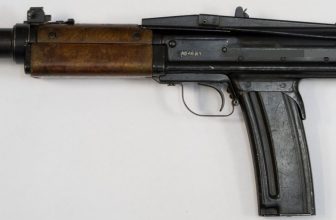
While remaining in supporting roles, Korovin created prototypes that later ended up simply gathering dust in the factory museum. It was there that the prototype built to compete in that very contest—the one that PPD had won back in the day—was gathering dust.
It took Korovin two days to prepare production, and by October 25, the Tula factories had already begun manufacturing the simple submachine gun. As early as October 30, soldiers dressed in civilian sheepskin coats engaged in battle near the village of Rogozhinsky with Guderian’s units.
Early in the morning, 40 enemy tanks appeared near the brick factory located south of the village. Columns of machine-gunners followed behind them. Firing as they advanced, the tanks approached the regiment’s trenches in two groups—from the left and the right. The Tula soldiers let the enemy get closer, then opened fire on the riflemen with rifle and machine-gun fire, while pelting the tanks with grenades and bottles filled with incendiary mixture.
The battle lasted more than four hours. The Nazis attacked the regiment’s positions several times. But they were never able to cross the anti-tank trench, and the infantrymen, without tanks, were unable to break through, as they were mowed down at close range by fire from Korovin submachine guns.
The main feature of the Korovin submachine gun was its simplicity of design and manufacturing. Unlike the earlier Korovin model, which had been submitted to a competition at the time, the 1941 Korovin submachine gun had neither a wooden stock—which required lengthy and labor-intensive carving—nor a barrel shroud, which was difficult to stamp due to its round shape. All parts, with the exception of the barrel and the bolt, were manufactured by stamping followed by welding; the receiver was made from a single-piece drawn tube. Thus, in just two days, Korovin developed what was effectively a new submachine gun. Under wartime conditions, this Korovin submachine gun could be produced at any factory equipped with standard pressing machinery.
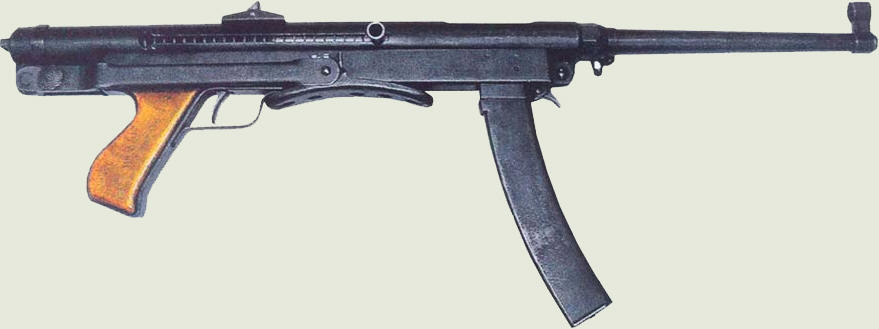
The Korovin submachine gun measured 682 millimeters in length with the stock folded. With the stock extended, it reached 13 mm. The bullet from a TT pistol cartridge was propelled by a 0.59-gram powder charge from a 270-millimeter-long barrel at a velocity of 480 meters per second.
The Korovin submachine gun’s firing mechanism operated on the principle of a free-floating bolt. The barrel was locked by a weighted bolt and a recoil spring. There was no safety catch—its function was performed by a notch at the rear of the receiver groove, into which the loading handle could be inserted. In this position, firing was impossible.
The firing mechanism of the Korovin submachine gun allowed only automatic fire. The sear was shifted forward, which helped improve the accuracy of the first shot by reducing the travel of the moving parts. The trigger travel was 4 mm. The trigger pull did not exceed 2.9 kg.
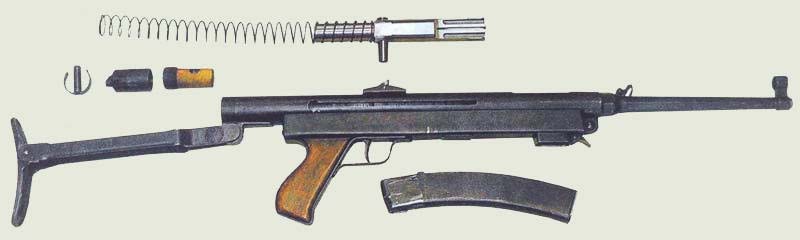
The open-type sighting device included a flip-up rear sight calibrated for 100 and 200 meters and a front sight with a closed sight cover that could be adjusted horizontally. The spent cartridge case was extracted and ejected by a spring-loaded ejector. The ejector was rigidly mounted to the bottom of the receiver.
Due to the 700-gram mass of its moving parts and a 143-millimeter bolt travel, the Korovin submachine gun had a low rate of fire of only 470 rounds per minute. This prevented inexperienced shooters from quickly exhausting their ammunition, while allowing experienced shooters to fire short bursts and even single shots.
The folding metal stock of the Korovin submachine gun had a swiveling butt plate. The pistol grip was also made of metal, but had wooden cheek pieces. A 35-round box magazine with a double-row, staggered cartridge arrangement served as an auxiliary grip.
After that, Korovin continued to work at TOZ and participate in all competitions, but still without success. He did not deserve either the title of Hero of Labor or the Stalin Prize. Of all his awards, he had only the Order of the Badge of Honor and the Order of the Red Star, which he received specifically for his contribution to the defense of Tula. Shortly before his death—he died in 1946—Korovin received the medal “For Valiant Labor in the Great Patriotic War.”
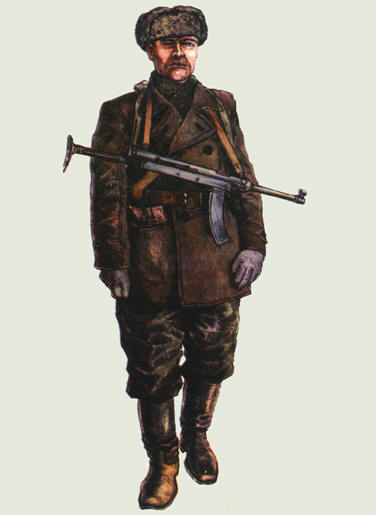
A soldier from the Tula Workers’ Regiment carrying a Korovin submachine gun.
Source – http://www.opoccuu.com/pistolet-pulemyot-korovina.htm