The Cold War gave rise to many remarkable weapons. Some became symbols of their era, others turned into dead-end branches of technological development, and some looked so incredible that today they seem like the product of a science fiction writer’s imagination. One such project was the M28/M29 Davy Crockett system—the smallest tactical nuclear weapon ever adopted by the U.S. Army.
It was named after Davy Crockett—the legendary American frontiersman, hunter, and hero of the Battle of the Alamo. However, while Crockett himself was famous for his marksmanship and personal bravery, the weapon bearing his name was intended for a completely different purpose. In the event of war in Europe, it was designed to halt the advance of Soviet tank armies with a nuclear explosion.
It sounds like the plot of an alternate history story, but in the early 1960s, it was a very real part of American military doctrine.
An Atomic Bomb for the Infantry
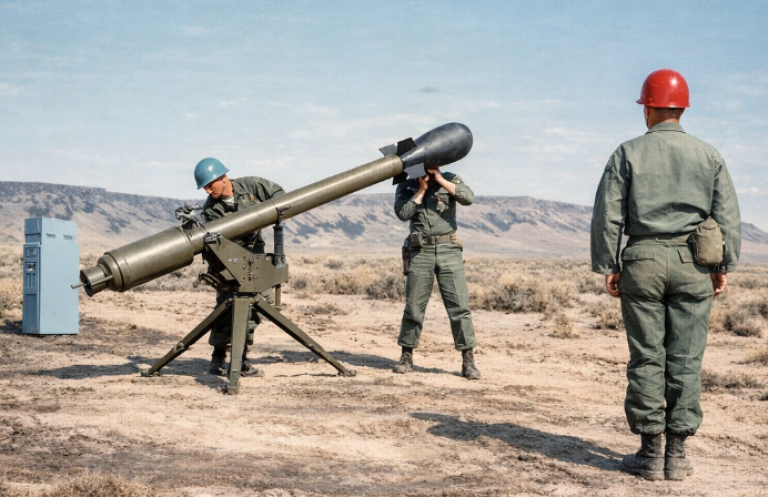
After the advent of nuclear weapons, the military quickly realized that a nuclear warhead did not necessarily have to be delivered by a strategic bomber. As early as the 1950s, the United States began actively developing tactical nuclear systems to provide direct support to ground forces.
Nuclear artillery shells, short-range missiles, and even special nuclear mines were developed. But the army command wanted something even more mobile—a weapon that could accompany forward units and be deployed literally just a few kilometers from the front lines.
That’s how the Davy Crockett project came to be.
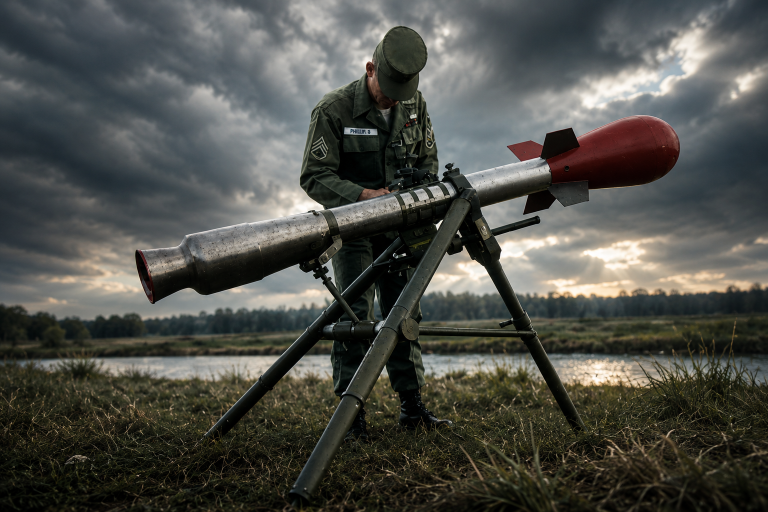
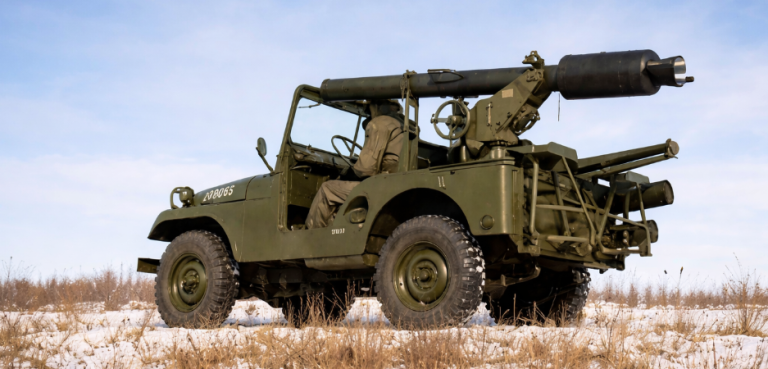
Externally, the system resembled a large-caliber recoilless rifle. It could be mounted on army jeeps or armored personnel carriers, or transported by a separate crew. However, the main component of the system was not the barrel at all, but the ammunition.
It was the W54 nuclear warhead.
The smallest nuclear warhead in history
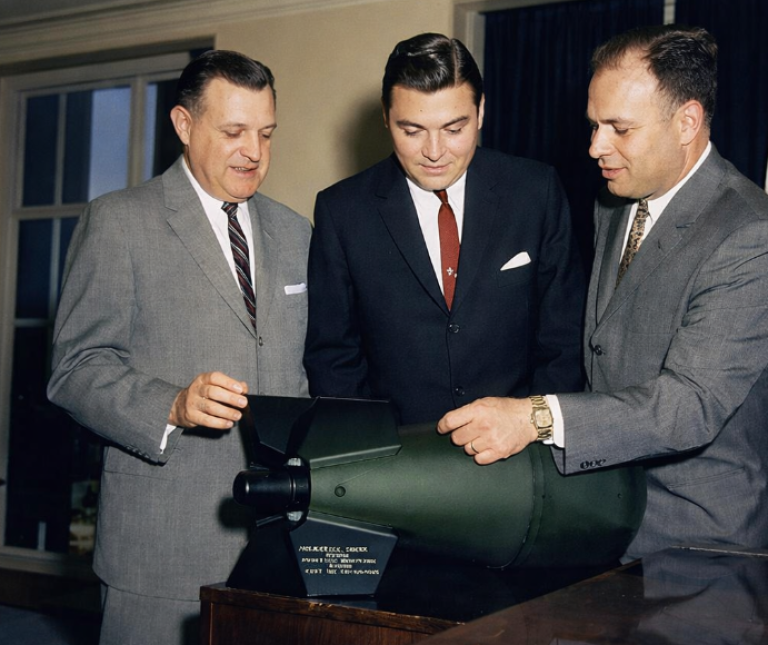
The W54 remains one of the most unusual nuclear weapons ever created by humans.
Its yield ranged from 10 to 20 metric tons in TNT equivalent. Compared to the strategic bombs of that era, it seemed almost laughable. By comparison, the bomb that destroyed Hiroshima had a yield of about 15,000 metric tons of TNT equivalent.
But it is important to understand the difference between the scale of the destruction and its direct impact on the battlefield.
Even an explosion with a yield of several dozen metric tons created a lethal blast zone with a radius of hundreds of meters. And considering that radiation was the primary factor causing casualties, the consequences for personnel could have been catastrophic.
At the same time, the warhead itself weighed only about 23 kilograms and was housed in a compact casing that could be fired from a recoilless rifle.
In fact, the U.S. military now has the capability to fire a nuclear bomb almost as easily as a conventional artillery shell.
The M28 and M29 are two versions of the same weapon
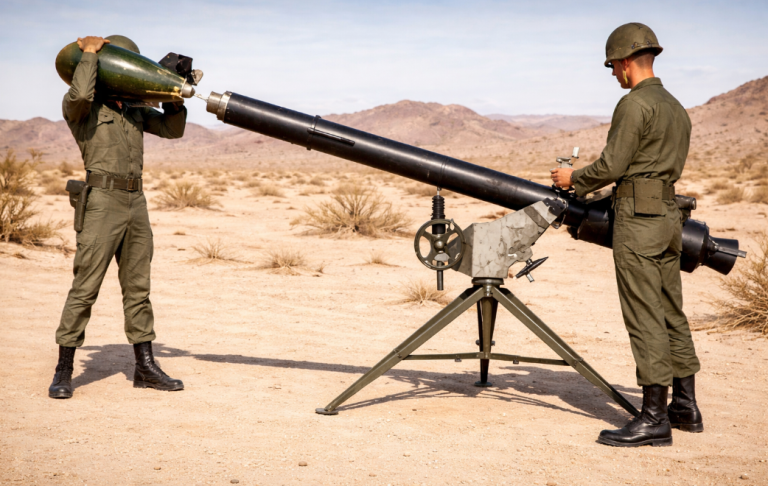
The system was produced in two versions.
The first was the 120-millimeter M28. It weighed about 49 kilograms and could hit targets at ranges of up to two kilometers.
The second version—the M29—had a caliber of 155 millimeters and a firing range of up to four kilometers. However, the increased range came at the cost of greater weight: the system now weighed about 140 kilograms.
Both systems were recoilless ramrod-type guns. The projectile was literally slid onto a long guide rod and then fired by a special propellant charge.
The design looked unusual even by the standards of its time. However, it made it possible to launch a nuclear warhead without the massive recoil that would inevitably accompany a conventional artillery system.
From an engineering standpoint, the solution was quite elegant. From a military standpoint, it was far less convincing.
The main problem is accuracy
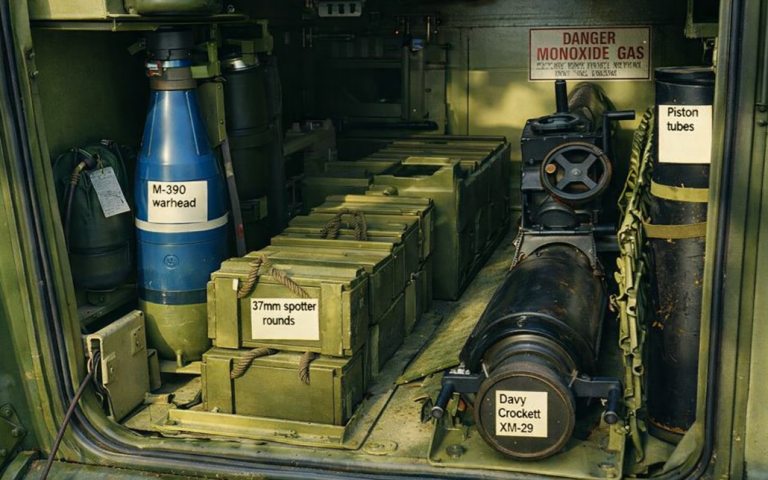
One of Davy Crockett’s main problems was his extremely poor accuracy.
The projectile’s initial velocity was only about 100–120 meters per second. For artillery, that is very low. The shell flew along a steep trajectory, was highly dependent on weather conditions, and exhibited a wide dispersion.
At maximum range, the circular probability of error reached hundreds of meters.
For a conventional artillery shell, this would be a nuisance. For a nuclear warhead, however, such an error became a serious problem.
The commander might have expected to destroy the advancing tank column, but in reality, the charge could have exploded well off target.
Weapons That Are Dangerous to Their Own People
But what caused even greater concern was not the accuracy of the calculation, but its reliability.
The W54 warhead was designed to maximize the effectiveness of its radiation effects. Its primary destructive factor was a powerful burst of neutron and gamma radiation.
The guaranteed radius of effect on living organisms reached several hundred meters. However, dangerous doses of radiation could spread much farther.
The problem was that the system’s effective range was only a few kilometers.
This created a paradoxical situation: the soldiers who fired the shot were themselves not that far from the epicenter of the impending nuclear explosion.
Therefore, after launch, the crew was supposed to take immediate cover in the natural terrain, trenches, or special shelters. Otherwise, the risk of receiving a serious dose of radiation was very real.
It is not surprising that many American service members viewed the system with a certain degree of skepticism.
The Only Nuclear Shot
The story of Davy Crockett also went down in military history because the system marked the only instance in which a nuclear warhead was launched from a recoilless rifle during actual testing.
This took place in the summer of 1962 as part of Operation Sunbeam at the Nevada Test Site.
The test was named Little Feller I.
After the shot was fired, the warhead detonated at a low altitude above the ground. The flash illuminated the desert, confirming that the entire concept was viable.
From a technical standpoint, the experiment was a success. But at the same time, it clearly demonstrated all the limitations of such weapons.
The Final Argument for the Fulda Corridor
Despite its many shortcomings, the Davy Crockett was adopted by the U.S. Army.
West Germany became the main location for its deployment. It was there that the American command anticipated a possible offensive by Warsaw Pact forces through the famous Fulda Gap—one of the most likely routes for Soviet tank armies to advance toward the Rhine.
The systems were transported in M151 jeeps and M113 armored personnel carriers, and their crews were kept on constant standby.
In fact, young army officers were given command of tactical nuclear weapons that could be deployed in a matter of minutes.
It seems unbelievable today, but at the height of the Cold War, such decisions were considered entirely rational.
Why was he rejected?
By the late 1960s, attitudes toward tactical nuclear weapons had begun to change.
Military officials increasingly came to the conclusion that the Davy Crockett had too many shortcomings. Its poor accuracy, limited firing range, and the risk to its own crew significantly reduced its practical value.
At the same time, more advanced systems were being developed.
Nuclear artillery shells for conventional howitzers, operational-tactical missiles, and new delivery systems capable of striking targets tens of kilometers away were being introduced into service.
Compared to them, the nuclear recoilless rifle looked like a relic of the early nuclear age.
As a result, the system was decommissioned as early as the early 1970s.
A Symbol of the Age of Fear
Today, Davy Crockett holds a special place in the history of weaponry.
On the one hand, it was one of the most unusual and technically daring projects of the Cold War. On the other hand, it was clear evidence of just how far the superpowers were willing to go in their search for ways to deter one another.
It is hard to imagine a more striking symbol of that era than a small army jeep carrying a nuclear warhead with a yield of tens of metric tons of TNT equivalent. In a world where strategists were seriously preparing for a nuclear war in the heart of Europe, such a weapon seemed like a logical solution.
Fortunately, the Davy Crockett remained a weapon that was never used in combat. Today, it can only be seen in museums, where it serves as a reminder of a time when the line between tactical success and global catastrophe was dangerously thin.
Tactical and Technical Specifications of the M29 Davy Crockett
- Type: recoilless nuclear cannon
- Caliber: 155 mm
- Ammo: W54 nuclear warhead
- Warhead yield: 10–20 metric tons of TNT equivalent
- Firing range: up to 4 km
- Weight of the unit: approximately 143 kg
- Serves: 3–5 people
- Year of entry into service: 1961
- Year of decommissioning: 1971