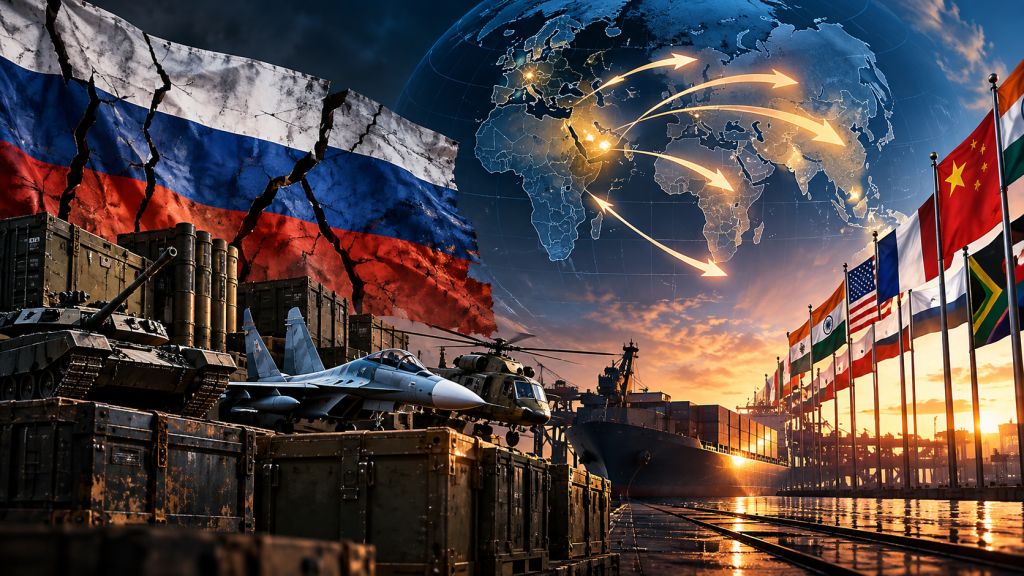
Not so long ago, Russia’s position in the global arms market seemed almost unshakable. For years, it ranked second only to the United States, while Russian aircraft, helicopters, air defense systems, armored vehicles, and missiles were sold to customers ranging from India and China to Algeria, Egypt, and Southeast Asia. Even when individual contracts fell through, the system itself appeared resilient: a huge Soviet-era customer base, relatively attractive prices, the ability to supply weapons to countries that had limited access to Western equipment, and commercial relationships built up over decades.
In 2016–2020, Russia accounted for roughly 21% of global exports of major arms. In 2021–2025, its share fell to just 6.8%. According to the Stockholm International Peace Research Institute (SIPRI), the volume of Russian arms exports declined by 64% between those two five-year periods. Moreover, Russia was the only country among the world’s ten largest arms exporters whose exports decreased during this period. Its share has never been this low over a comparable five-year period in the history of the Russian Federation — or even in SIPRI’s available data covering the Soviet Union since 1950.
Yet almost simultaneously, Moscow has been presenting a very different set of figures. Russian officials stated that military exports generated more than $15 billion in 2025, while Rosoboronexport says its order portfolio exceeds $60 billion. Moreover, in September 2026, the company announced that it had signed more than $13 billion worth of new export contracts in the first half of the year alone. At first glance, these appear to be two completely incompatible pictures: either Russian arms exports are experiencing a historic collapse, or the country is once again signing weapons contracts worth tens of billions of dollars.
In reality, the contradiction is not so simple. Once the figures are examined more closely, they reveal not only what has happened to Russian arms exports, but also why the problems began well before 2022.
Russia Really Was an Arms Export Superpower
Russia’s arms export industry did not emerge from nowhere. After the extremely difficult 1990s, foreign orders effectively became one of the mechanisms that allowed entire design bureaus and defense enterprises to survive. India and China were particularly important. They purchased Su-27 and Su-30 family fighters, aircraft engines, air defense systems, warships, helicopters, and many other systems, while simultaneously helping finance the continued development of Russia’s defense industry.
By the 2000s and 2010s, a remarkably stable model had emerged. The United States occupied the enormous upper segment of the global market, Russia held a comfortable second place, and other exporters remained well behind. As recently as 2016–2020, the United States accounted for approximately 37% of international transfers of major arms, Russia for around 20–21%, France for only 8.2%, Germany for 5.5%, and China for 5.2%. In other words, Russian exports were roughly two and a half times larger than France’s.
But even then, there was already a problem hidden beneath the apparently healthy numbers.
Russian arms exports in 2016–2020 were 22% lower than during the previous five-year period. SIPRI estimated that approximately 90% of that decline could be explained by reduced Russian deliveries to a single country — India. At the same time, Moscow increased exports to China, Algeria, and Egypt, but these customers could no longer fully compensate for the loss of Indian orders.
This is a crucial point in the entire story.
Russian arms exports did not begin losing ground in 2022. They had started losing ground earlier.
India Began to Move Away
For decades, India was almost the ideal customer for the Soviet and later Russian defense industry. The Indian armed forces operated huge quantities of Soviet equipment, so purchasing new Russian systems allowed the country to preserve existing infrastructure, training procedures, maintenance networks, and logistics.
Gradually, however, New Delhi began deliberately diversifying its suppliers.
The shift is remarkably clear. In 2011–2015, Russia accounted for approximately 70% of India’s imports of major arms. In 2016–2020, the figure fell to 51%. By 2021–2025, it had dropped again to 40%. Russia remains India’s largest arms supplier, but its former near-monopoly has disappeared. France now ranks second with 29%, while Israel accounts for 15%.
And it is particularly revealing to see who has benefited most from this change.
France.
India has purchased French Rafale fighters, Scorpène-family submarines, and other weapons. As a result, India simultaneously remains Russia’s largest customer and has become the largest customer of the French defense industry, accounting for 24% of French arms exports in 2021–2025.
In other words, France did not merely overtake Russia in the global rankings. It moved aggressively into a market that had been one of the foundations of Russia’s second-place position for decades.
China No Longer Needs Russian Weapons the Way It Once Did
China presents a different story.
In the 1990s and early 2000s, Russia possessed technologies that China’s rapidly expanding defense industry could not yet produce independently. Beijing bought Russian fighters, aircraft engines, air defense systems, naval technologies, and other sophisticated equipment.
Over time, however, the purpose of these purchases changed. China’s defense industry became capable of manufacturing more and more advanced systems domestically.
As a result, Chinese imports of major arms fell by 72% between 2016–2020 and 2021–2025. SIPRI directly links this decline to the growing capabilities of China’s domestic defense industry.
For Russia, this represents an unpleasant structural problem. China is not necessarily replacing Russian suppliers with American or French ones. It is replacing Russian weapons with Chinese weapons.
This creates an interesting situation. The two customers that had supported much of Russia’s export success began reducing their dependence on Moscow in completely different ways. India diversified its imports and increasingly turned to Western suppliers while developing its own industry. China increasingly became capable of supplying itself.
That is why the decline had already begun before 2022.
Then Came the Real Collapse
Looking at individual years makes the trend even clearer. SIPRI notes that 2020 and 2021 were already unusually weak years for Russian exports: deliveries were 22–73% below every annual level recorded between 2000 and 2019.
After 2022, the old problems were joined by new ones.
SIPRI identifies several factors: priority being given to weapons production for Russia’s own armed forces, sanctions that complicate manufacturing and international financial transactions, and political pressure by the United States and its allies on potential buyers of Russian weapons. In 2024, Russian export volumes remained roughly at the 2023 level and were 47% lower than in 2022.
Even the number of customers changed dramatically.
In 2019, Russia delivered major weapons to 31 countries. In 2023, it supplied only 12. Looking at the longer 2021–2025 period, Russian weapons were delivered to 30 states and one non-state actor, but this figure obscures another problem: exports have become extraordinarily concentrated.
Just three countries accounted for 74% of all Russian deliveries.
India — 48%.
China — 13%.
Belarus — 13%.
In other words, almost three quarters of Russian exports depend on just three destinations, while its two largest commercial customers are simultaneously reducing their dependence on Russian weapons.
That may be even more significant than the fall from 21% to 6.8%.
The Vacated Market Did Not Remain Empty
One might assume that the global arms market as a whole contracted and that Russia simply became a victim of the broader trend. In fact, the opposite happened.
The volume of international transfers of major arms in 2021–2025 increased by 9.2% compared with the previous five-year period, reaching its highest level since the end of the Cold War.
The pie grew larger while Russia’s slice became dramatically smaller.
The United States increased its exports by 27% and now accounts for around 42% of global deliveries. France increased exports by another 21% and reached 9.8% of the global market. Germany grew by 15%, reaching 5.7%. Italy’s performance was particularly striking: its exports increased by 157% between the two five-year periods, lifting the country to sixth place.
The broader picture is even more revealing. European Union countries increased their arms exports by 36% and accounted for approximately 28% of global transfers of major arms in 2021–2025 — four times Russia’s share.
So it is not enough to speak simply of a “decline in Russian exports.” A redistribution of the global market is taking place at the same time.
Russia lost second place, which is now held by France. The United States widened its lead over every other supplier. European manufacturers expanded their exports. South Korea emerged as an increasingly significant player. And India, which had been the foundation of Russian arms exports for decades, gradually opened its market to competitors.
It is especially symbolic that France overtook Russia partly through aircraft sales — a category that had once been one of Russia’s greatest export strengths.
So Where Did Russia’s $15 Billion Come From?
This is where we encounter the most dangerous statistical trap in the entire story.
In January 2026, Vladimir Putin stated that Russian exports of military products exceeded $15 billion in 2025. Rosoboronexport has also said that its order portfolio exceeds $60 billion. In September, the company announced that it had signed contracts worth more than $13 billion in the first half of 2026 alone.
Compare those numbers directly with SIPRI’s figures and something appears to be wrong.
But they cannot be compared directly.
SIPRI does not measure the financial value of the global arms market in dollars. Its Trend Indicator Value is designed to estimate the volume of transfers of major weapons and to compare flows between countries and periods. It covers aircraft, warships, armored vehicles, missiles, air defense systems, and other major weapons, including not only commercial sales but also military aid, gifts, and licensed production. SIPRI itself explicitly warns that its figures represent the volume of transferred military resources, not the financial value of the transactions.
There is another important distinction: an order portfolio is not the same thing as deliveries.
A multibillion-dollar contract signed today may be fulfilled over five, seven, or ten years. Its value may include maintenance, ammunition, spare parts, training, modernization, and other services or products that SIPRI either measures differently or does not include in its major-arms transfer indicator at all.
Therefore, Russia’s claim of $15 billion in exports and SIPRI’s figure of 6.8% of global major-arms exports can theoretically both be true at the same time.
The real problem is different. Since 2022, Russia has published considerably less detailed information about its arms exports, making it much harder to independently verify the structure of the reported financial totals. They should therefore be treated as official Russian estimates rather than as figures directly comparable with SIPRI statistics.
Russia Has Not Disappeared From the Arms Market
Turning this story into a narrative about “the end of Russian arms exports” would also be misleading.
Even after this enormous decline, Russia remains the third-largest supplier of major arms in the world according to SIPRI data for 2021–2025. Its 6.8% share is significantly below France’s 9.8%, but still slightly ahead of Germany and China. Russian weapons continued to reach dozens of countries during the five-year period.
There is also enormous inertia from previously exported equipment. Hundreds of Russian aircraft and helicopters, thousands of armored vehicles, air defense systems, and warships will remain in service for decades. They require spare parts, maintenance, ammunition, and modernization. Even a country that no longer intends to purchase Russian combat aircraft cannot instantly abandon an existing fleet of Su-30s.
There are also markets where Russia can still compete through pricing, political conditions, or its willingness to supply weapons that other exporters may be unwilling to sell. Moscow is actively attempting to expand military-technical cooperation with African countries, and Russian officials claim that Africa is becoming an important source of new contracts.
Finally, Rosoboronexport’s September announcement of more than $13 billion in new contracts during the first half of 2026 deserves attention. If those agreements turn into actual deliveries of major systems over the coming years, the decline could at least partially stabilize. For now, however, these are contracts, while SIPRI records the actual transfer of major weapons.
And that leads to perhaps the most important question for the next several years: whether Russia can convert its new order portfolio into deliveries.
The Problem Goes Much Deeper Than 2022
If we look only at two figures — 21% and 6.8% — the story appears straightforward. Russia launched its full-scale invasion of Ukraine, encountered sanctions and soaring domestic demand for weapons, and exports subsequently collapsed.
The data reveals a more complicated picture.
The first major blow to Russia’s export model did not come from the West. It came from changes among its two most important customers. India decided to reduce its dependence on a single supplier, while China gradually stopped needing a large proportion of imported weapons. Russian exports therefore began declining before 2022. After that, Russia’s own military requirements, sanctions, difficulties with international cooperation, and political pressure on potential customers dramatically accelerated an already existing trend.
At the same time, competitors did not stand still.
France took second place. The United States increased its share to 42%. European manufacturers expanded their exports. India bought more French and Israeli weapons. China increasingly produced what it needed domestically. The global arms market now has more capable suppliers, while Russia’s traditional advantage — the ability to offer sophisticated equipment at lower prices than many Western competitors and with fewer political restrictions — no longer automatically guarantees a contract.
What is happening, therefore, is better described not as the disappearance of Russian arms exports, but as the breakdown of the export model that kept Russia in second place globally for roughly two decades.
Russia continues to sell weapons. It remains one of the world’s largest suppliers. It has an enormous installed base of previously exported equipment and, according to official statements, a substantial portfolio of new contracts.
But the statistics reveal a shift that is difficult to ignore.
In 2016–2020, roughly one in every five notional units of major arms moving through the international export market, as measured by SIPRI, came from Russia.
In 2021–2025, the figure was closer to one in fifteen.
And perhaps the most important question is no longer simply whether Russia can increase its exports again. The more interesting question is this:
Can it win back markets that, over the past several years, have already learned to buy their weapons elsewhere?