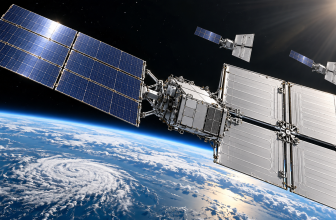
The Russian military satellite Kosmos-2612 carried out a series of maneuvers near ICEYE-X36, a commercial radar-imaging spacecraft. According to tracking company LeoLabs, the separation narrowed to approximately 500 meters during the encounter. The Russian spacecraft changed its position relative to its neighbor, remained nearby for a time, and then began moving away. What caught observers’ attention was the sequence itself: it indicated controlled shadowing of another operational satellite.
Reports of the encounter emerged in mid-October 2026. Some coverage cited a much more dramatic figure: 26 meters. That degree of precision, however, exceeds what can confidently be established from publicly available data. In its own reconstruction, KeepTrack stresses that the exact minimum separation is the least certain part of the story. The maneuvers that gradually brought the spacecraft together are much more clearly documented.
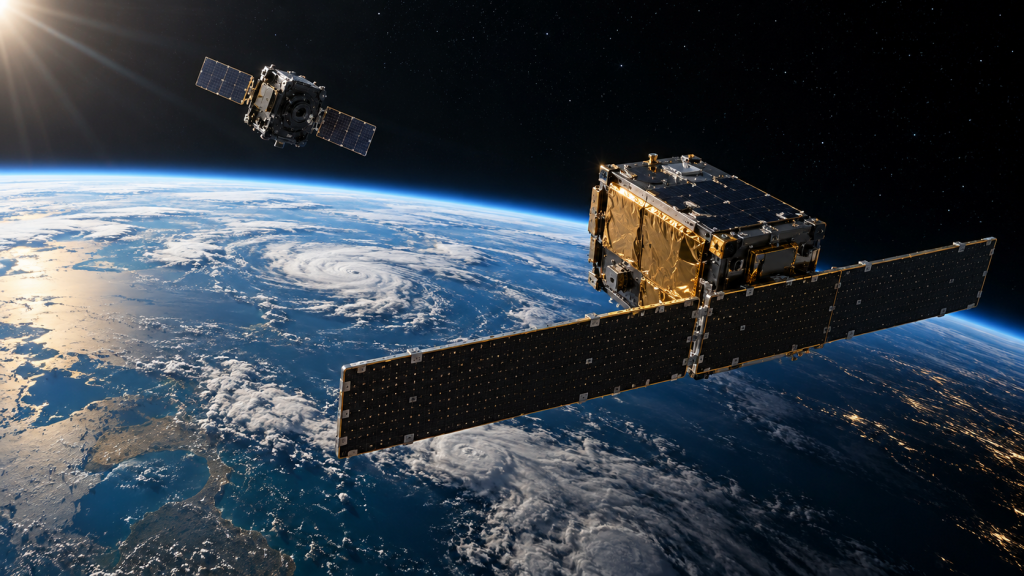
The spacecraft selected for shadowing deserves particular attention. ICEYE-X36 belongs to a commercial Earth-observation system offering capabilities that, until relatively recently, were largely the preserve of major government intelligence programs.
ICEYE-X36 carries a synthetic aperture radar, or SAR. This equipment transmits radio signals toward the surface and receives their reflections. By processing successive measurements collected as the satellite moves, the system produces detailed images of the terrain. It can operate at night and through cloud cover that blocks optical cameras. That is particularly valuable when an area must be observed on schedule, without waiting for clear skies. Radar imagery can reveal changes at airfields, ports, and industrial sites. A commercial service can therefore support military missions as well. ICEYE officially announced that it was providing Ukraine with access to its satellite imaging capabilities in 2022. The involvement of X36 specifically in that work has not been publicly confirmed.
The background to October’s encounter stretches back several months. In April, Russia launched six Kosmos-series spacecraft. According to analysis by the Center for Strategic and International Studies, or CSIS, some subsequently shifted into orbital planes closely aligned with ICEYE-X36’s. Initially, this produced individual close passes, after which the orbits diverged again. Kosmos-2612’s behavior changed in late September, when a new sequence of orbital corrections began.
Satellite-tracking specialist Marco Langbroek initially considered the possibility that the orbital similarities were coincidental. Later maneuvers changed his assessment. He identified corrections on September 30 and October 12, 15, and 16 that brought the spacecraft’s orbital altitude, shape, and period into closer alignment. By October 17, the estimated separation had fallen to just a few kilometers.
This illustrates the central distinction between orbital pursuit and a chance encounter. Two trajectories can intersect, with the spacecraft passing one another rapidly. Remaining close requires their motion to be matched much more precisely. A small altitude difference changes the orbital period: one satellite gradually gains on the other or falls behind. Orbital adjustments can first close the distance, then reduce relative motion and keep the spacecraft nearby.
KeepTrack’s reconstruction shows precisely that sequence. After changing altitude, Kosmos-2612 closed the gap; subsequent maneuvers reduced its rate of approach. The spacecraft consequently spent time in closely matched orbits. Technically, this demonstrates considerably more than a brief flyby: the operator showed an ability to time the approach and control one satellite’s position relative to another.
Such operations are used for docking, inspection, and spacecraft servicing. They require navigation, relative-motion calculations, and precise control. During a normal cooperative mission, the participants coordinate their actions beforehand. Observers describe the ICEYE-X36 encounter as uncoordinated. The commercial operator must assess a spacecraft whose mission and capabilities it does not know.
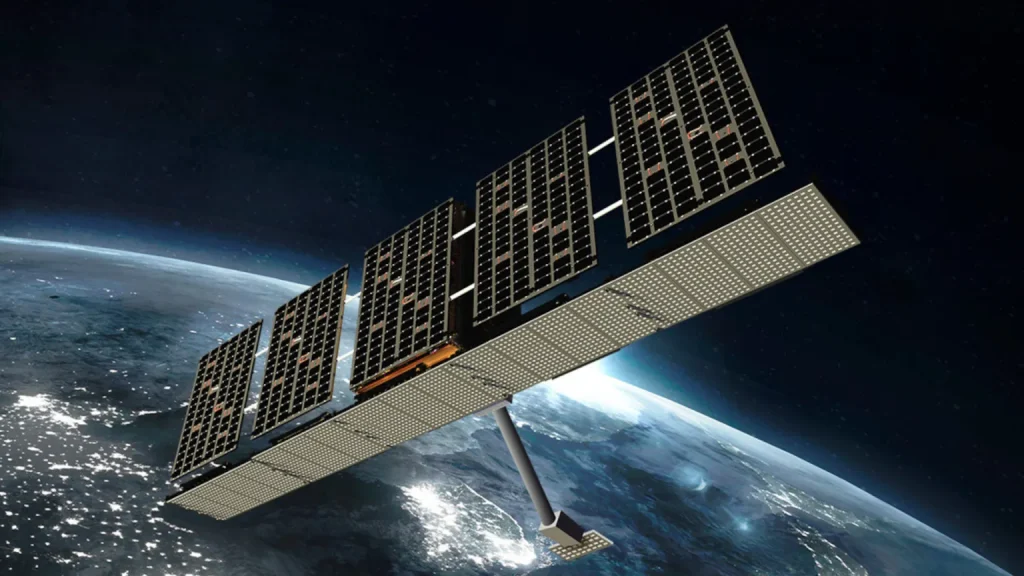
Close shadowing opens several possibilities. It could allow images of a spacecraft to be collected from unusual angles, its construction and radio emissions to be studied, and its operator’s reaction to the approach to be observed. All of this could reveal information about the satellite without damaging it. Which of these tasks Kosmos-2612 might have performed depends on its undisclosed onboard equipment.
The military significance of these skills stems from the dual-use nature of rendezvous technology. A spacecraft capable of approaching another for servicing could, with suitable equipment, also threaten it. Studies of counterspace capabilities examine both physical effects and electronic interference. Such capabilities have not been publicly established for Kosmos-2612 specifically. What it demonstrated above all was a prerequisite for many scenarios: a controlled approach to another object.
Previous incidents give military observers reason to scrutinize such maneuvers. In July 2020, U.S. Space Command reported the release of a new object from Russia’s Kosmos-2543 and characterized the event as a test of a space-based anti-satellite weapon. Episodes like that have encouraged military planners to associate the term “inspector” with a range of potential functions, from observation to interference with a neighboring spacecraft.
A satellite’s operations can also be affected simply by creating a threat that forces its operator to change plans. Avoidance requires calculations and, if a maneuver is executed, consumes a finite propellant supply. An orbital change may also disrupt the planned imaging geometry. Repeated close approaches could turn this response into an additional operational burden, even without a collision or physical damage.
ICEYE chief executive Rafal Modrzewski previously told Reuters that the company had moved its satellite following earlier activity, prompting further Russian maneuvers. His account shows that the operator was already factoring the situation into its spacecraft management.
As of October 19, LeoLabs reported that the spacecraft were moving apart and the close-proximity phase had ended. No collision or damage to ICEYE-X36 had been confirmed. Langbroek’s analysis likewise found no indication that an impact had disturbed the commercial satellite’s orbit.
For commercial space-based intelligence, the episode highlights a practical problem. A satellite may be imaging Earth, maintaining communications, and following its flight plan normally while a foreign maneuvering spacecraft operates nearby. Its owner must decide whether to continue working, change orbit, and expend resources on precautionary measures. During the next such encounter, an avoidance decision may have to be made before anyone knows why the neighboring spacecraft approached in the first place.