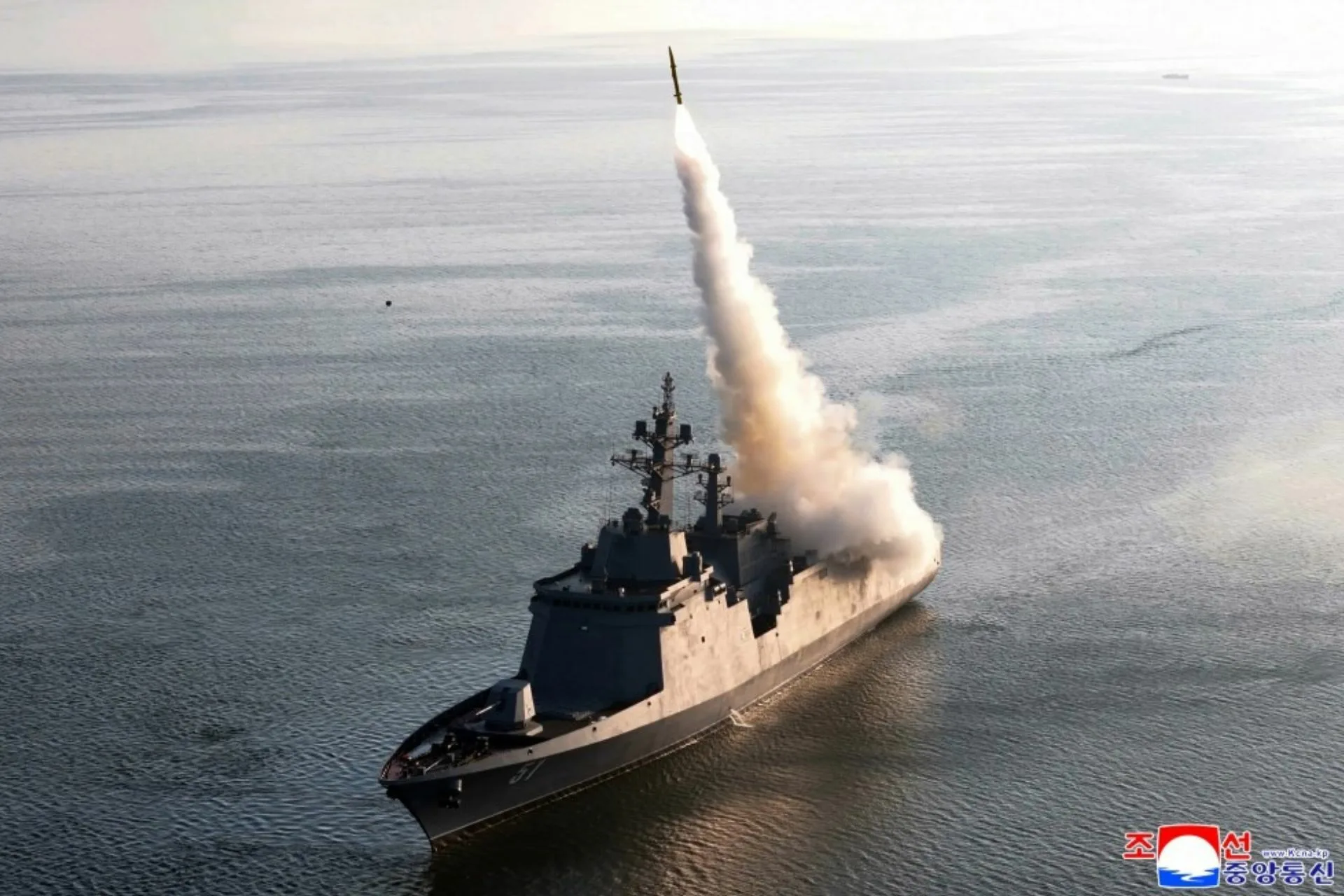
The DPRK Navy’s newest destroyer, the “Chwŏ Hŭng” — which I have previously written about in several articles — recently set sail for another round of trials, during which it demonstrated a highly impressive salvo of cruise missiles:
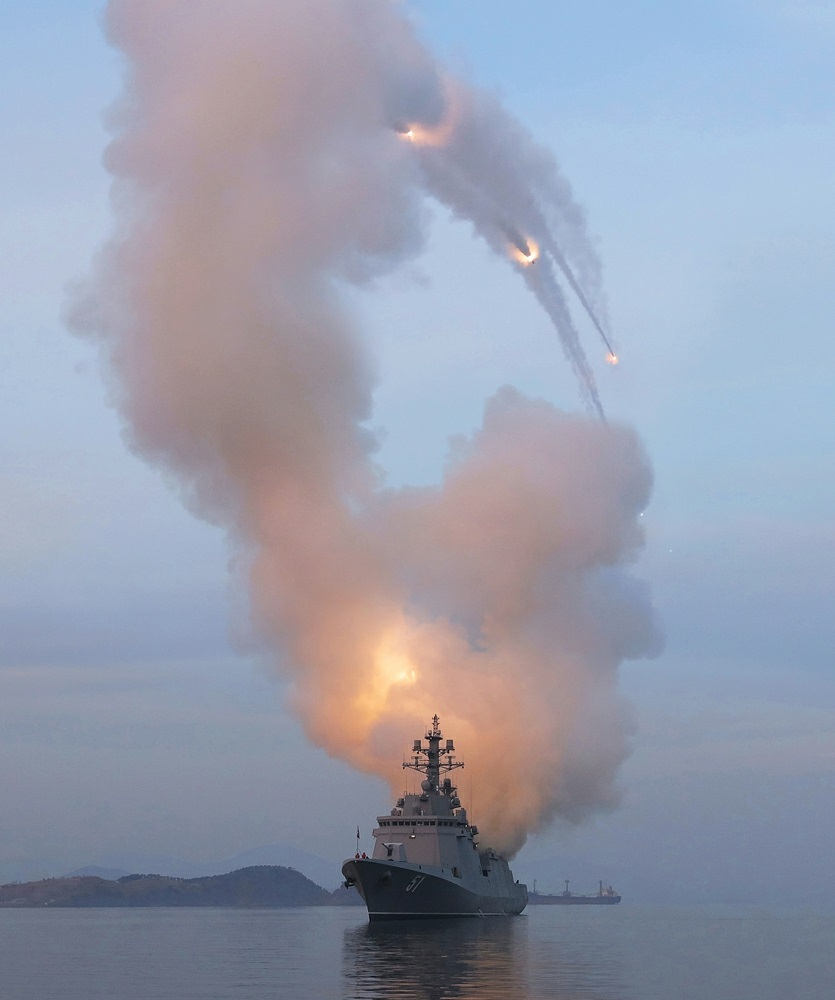
I must say, the salvo fired by North Korea’s “Tomahawk”-like missiles from vertical launchers looks very impressive. The destroyer fired at least 7–8 missiles in a single salvo, without the slightest delay. Whatever anyone may say, the DPRK certainly doesn’t skimp on ammunition for its exercises.
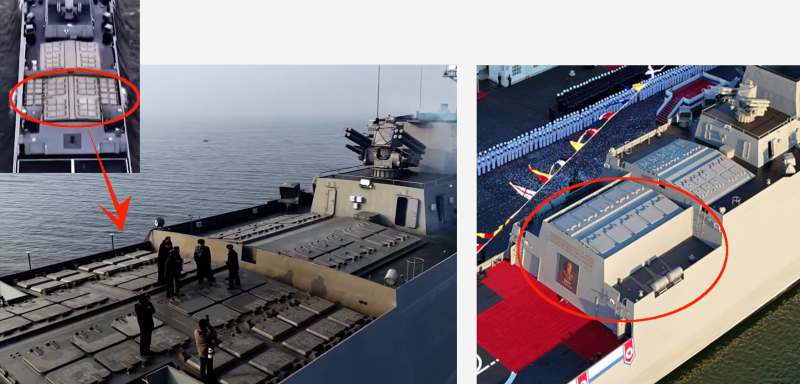
But what really caught our attention were the latest modifications to the destroyer—primarily, the configuration and arrangement of its vertical launch systems:
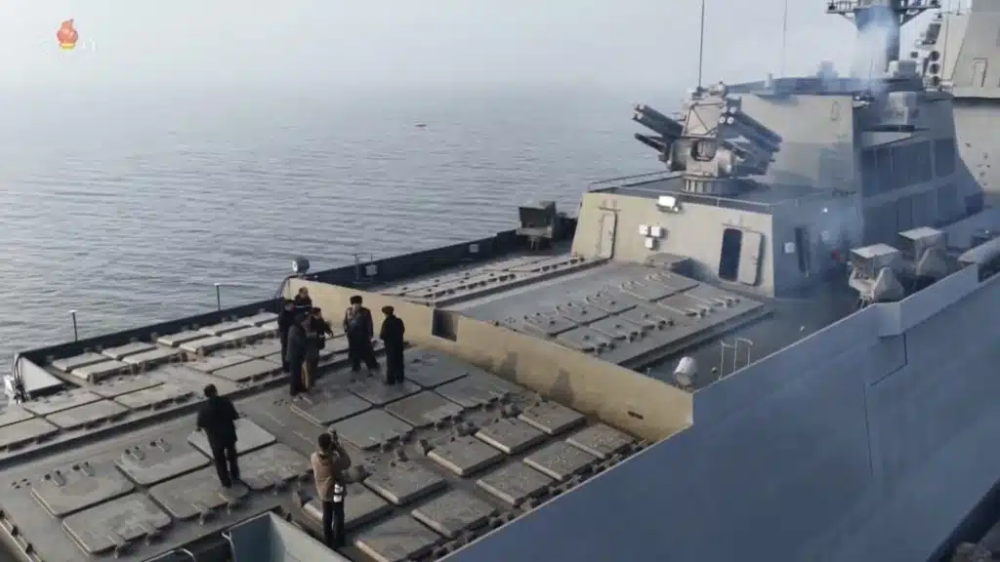
Judging by the photographs, the massive stern complex—consisting of ten very large launch tubes (presumably intended for launching ship-based ballistic missiles)—has been completely removed from the stern of the ship, and four blocks, each containing six smaller launch tubes, have been installed in its place. On either side of these, in turn, ten medium-sized launch tubes were added. To accommodate them, the sides of the superstructure in the stern section were raised by the height of one deck.
Taking into account the previously noted changes to the destroyer’s forward launch system, the ship’s missile armament is as follows (from bow to stern):
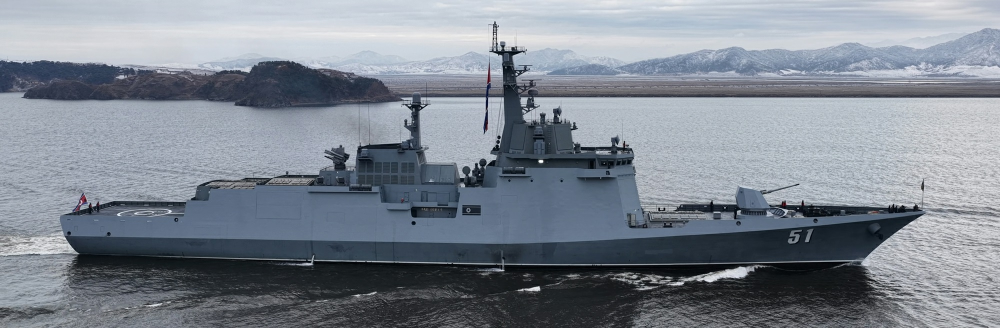
* The first launch system module (in the bow) consists of 24 identical large launch cells;
* The second launch system block (at the stern, immediately behind the “Pantsir-ME” anti-aircraft system) — 8 large and 12 medium launch systems;
* The third launch pad complex (behind the previous one, in front of the helipad) — 24 large launch pads and 20 small launch pads;
The total arsenal thus consists of 88 vertical launchers of three different types. All vertical launchers share the same basic configuration—they are “cold” launch systems (i.e., the missile is ejected from the silo by gas pressure from a gas generator, and the engine ignites while in flight), slightly angled toward the sides from the center of the ship (so that if the rocket’s engine fails to ignite, it would not fall back onto the ship). We are not taking into account the central inclined launchers (in front of the tube, likely intended for the “Hwasal-2” strategic cruise missiles) or the missiles in the “Pantsir” launch tubes.
Based on the available photographs, it became clear that so-called “medium” launch tubes from the second block of launchers are used to launch strategic cruise missiles—they are easily identifiable by the distinctive “knob” in the center of the cover:
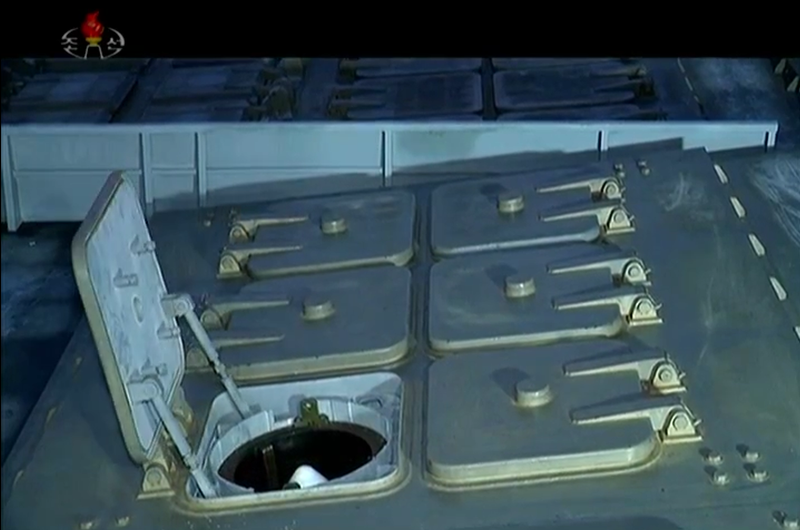
Based on this, it can be assumed that the large launch cells are likely used to house long-range anti-aircraft missiles of the “Pyoljji-1-2” family (previously designated as “Pongae-6”). These anti-aircraft missiles—presumably based on export versions of the S-300 air defense system—appear, judging by photographs, to have a fairly large booster with non-folding fins of considerable span. This is apparently why they occupy the largest of the available launch cells.
The purpose of the small launch cells installed along the sides of the third VPU module remains unclear. They could be launchers for short-range anti-aircraft missiles, lighter cruise/anti-ship missiles, or even anti-submarine missile-torpedoes.
In general, the most interesting aspect of the modifications to the North Korean destroyer is how easily the launch system configuration can be changed. I suspect that North Korean engineers deliberately designed the ship to be modular—with the intention that a launcher module of one type could be removed and replaced with a launcher module of another type as quickly as possible. It’s likely that creating fully universal launch systems (such as the American Mk-41) seemed too daunting a task to DPRK engineers; after all, they would have had to adapt the launcher for a wide variety of missile families of completely different (and, moreover, primarily “land-based”) origins.
All in all… the *Chwe Haeng* is up and running, its weapon systems are operational, and I, for one, am eagerly awaiting the tests of the ship’s anti-aircraft missile systems.)
P.S. There are reports that the third ship in the series—which is currently unnamed and under construction in Nampo—is set to be completed according to a revised design, because Comrade Kim III “expressed the opinion” that large-caliber automatic artillery systems are more suitable for ships with a displacement of no more than 3,000 metric tons (frigates and corvettes), while large destroyers and cruisers should instead carry supersonic anti-ship missiles.
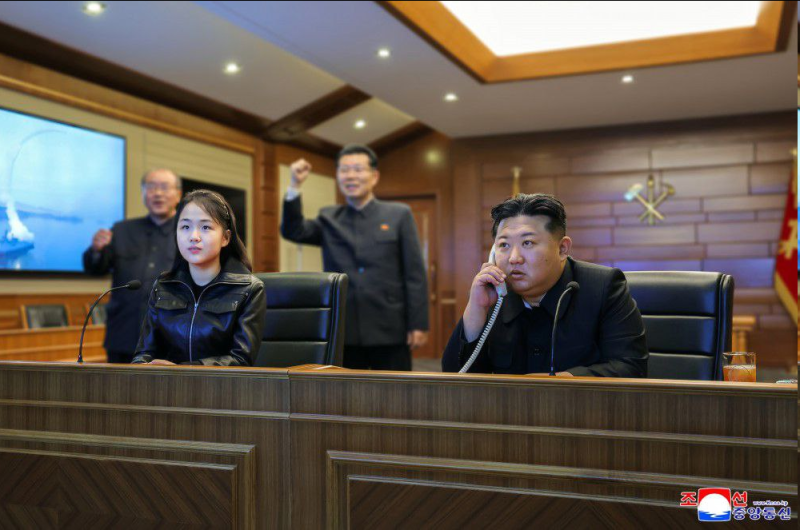
I have to say, the heir to the throne looks absolutely stunning in that black leather jacket. A real badass evil lady.
Such an “expression of opinion”—which, in the North Korean context, usually means that experts in the field have reached a consensus and the leader has “voiced” their viewpoint as his own revelation—suggests two things:
* Currently, North Korean destroyers do not carry anti-ship weapons;
* North Korea adheres to the “Italian” view that it is better to have several small-caliber (57–75 mm) self-propelled guns than a single heavy one;