An article from the “Historical Weapons Studies” channel on Yandex Zen.
Contents:
The “Historical Weapons” channel has already covered the creation of a gloomy English genius, the “Mars” pistol, one of whose dark “highlights” was its long barrel travel. Well, today we’ll talk about another pistol whose automatic mechanism used the same design—the Austrian automatic (now called self-loading) pistol, created by Georg Roth in 1900.
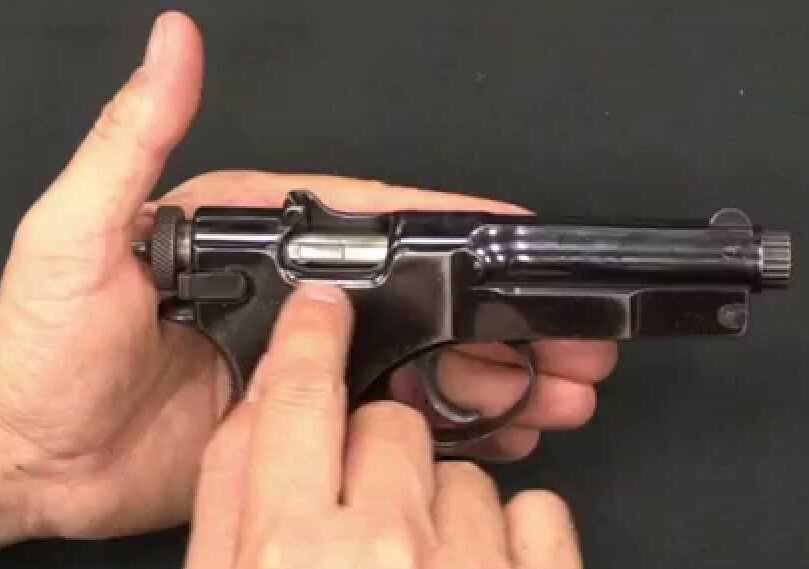
Roth-Sauer Pistol, Model 1900
General Information
This pistol, better known as the Roth-Sauer, traced its origins to the pistol designed by Georg Roth, which he patented in 1894 and submitted to a pistol competition organized by the Swiss Army in 1898. The Borchardt-Luger pistol won the competition, but the resourceful Austrian did not give up and began refining his pistol, patenting a significantly modernized version in 1900.
As I mentioned at the very beginning, Georg Roth’s pistol featured a design that was quite unusual for pistols of that period (the turn of the 19th and 20th centuries) and which enabled its automatic mechanism to function—a long barrel stroke:
“In Rota’s automatic pistol, when a shot is fired, the barrel—together with the slide—is pushed backward by the pressure of the powder gases against the bottom of the chamber for the entire length of the slide’s travel, then the bolt stops, and the barrel, having disengaged from the bolt, moves forward and opens the firearm. Thus, in the Rota model, the firearm is opened by the forward movement of the barrel.”
Georg Roth was innovative not only in ensuring the smooth operation of his pistol’s automatic mechanism, but also in loading its magazine with cartridges.
The pistol’s magazine was non-removable, and rounds were fed in two ways: one at a time (through the spent casing ejection port on the right) and using a special motorized magazine, which Georg Roth patented in 1895 (loading was performed through the loading port on top). Thanks to the mechanism, this magazine fed cartridges faster and more accurately, but it also required greater care on the part of the person loading the pistol to ensure that, in a hurry, they did not insert it into the pistol the wrong way around.
The pistol owed its distinctive appearance to two nuts that were screwed onto the rear end of the slide. The first (larger) one was called the safety nut; the second (smaller, visible in the first photo) was called the bolt nut—it formed the bottom of the bolt, against which the rear end of the main spring rested.
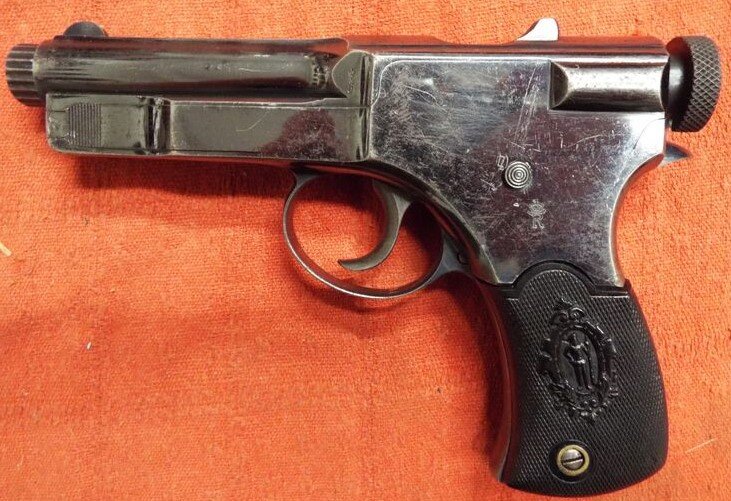
Roth-Sauer Pistol, Model 1900
Tactical and Technical Specifications
Technical Specifications of the Weapon (Data from 1907)
7.65 mm caliber
The pistol is 168 mm long
The pistol is 116 mm tall
The pistol weighs 650 g
Magazine capacity: 7 rounds
Cartridge Specifications
Cartridge length: 21.5 mm
The bullet is 12 mm long
The bullet has a diameter of 7.8 mm
The bullet weighs 4.7 g
Charge weight: 0.18 g
The bullet’s initial velocity is 320 m/s
Energy: 144 J
Tactical Specifications of the Pistol
The pistol’s tactical capabilities were limited by its weak cartridge (7.65×13 mm).
From a distance of 25 meters, the bullet penetrated a dry pine tree by 17 cm, but the maximum effective range for firing at a living person was considered to be no more than 35 meters.
By comparison, the Browning Model 1900 pistol, which had technical specifications similar to those of the Roth-Sauer pistol but fired a 7.65×17 mm cartridge with a 4 g bullet, had a similar muzzle velocity (335 m/s versus 320 m/s) but delivered much greater energy (218 J versus 144 J).
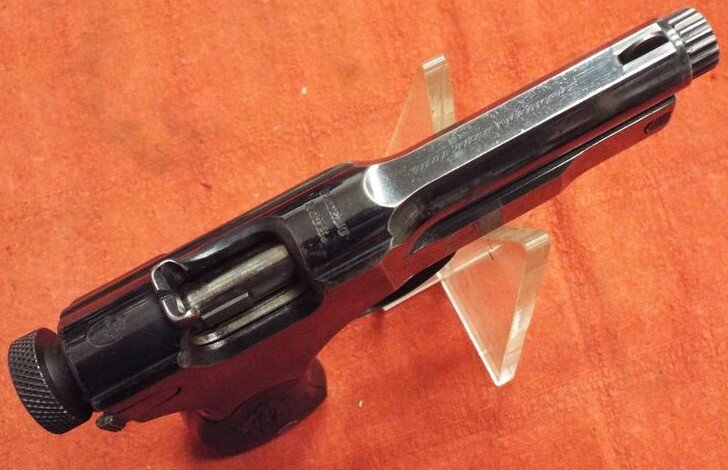
Roth-Sauer Pistol, Model 1900
But Browning is cooler…
Although this pistol was designed specifically for the civilian firearms market, its compact size could not compensate for either the weak cartridge or, even less so, the complexity of its design, which made both disassembly and maintenance difficult. As noted in 1907,
“Although all but a very few parts of the Roth-Sauer pistol can be separated from one another without the use of any tools and can also be reassembled into a single unit, it is nevertheless recommended that, when cleaning the pistol, you limit yourself to removing only the most essential parts.”
Given the success and advantages of the “classmate”—the Browning Model 1900 pistol—the commercial failure of the Roth-Sauer pistol can be considered inevitable. According to available information, no more than 7,000 were produced.
However, Georg Roth did not give up this time either and ultimately succeeded—his Model 1907 pistol was, after all, adopted by the Austrian Army. But more on that weapon next time.
Source: https://dzen.ru/a/Ym1pHF3TiwuPiRfL