Two Victories of the Kaiserreich. Part 1. The Victory That Destroyed Austria-Hungary

One of the most surprising consequences of Germany’s triumph was the collapse of Austria-Hungary. Despite being on the winning side of the world war, the multinational Habsburg monarchy could not withstand its internal contradictions and descended into a bloody civil war. As a result, Austria disappeared from the political map, an enlarged Hungary became one of the strongest powers in Central Europe, and Germany annexed Vienna and the other German-speaking territories of the former empire. These events marked the beginning of an entirely different twentieth-century Europe.
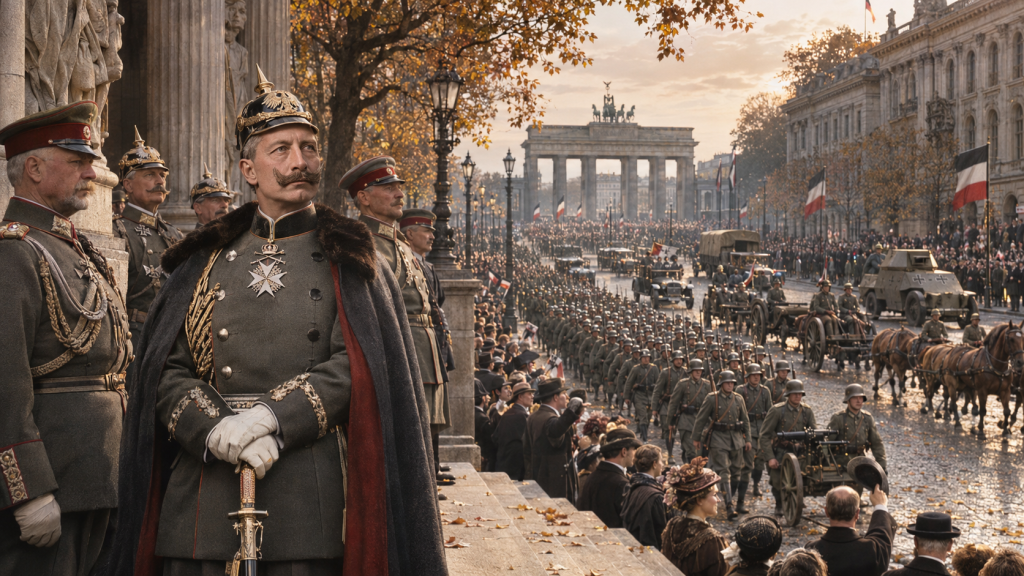
The Point of Divergence in 1917: Why America Stayed Out of the War
One of the main reasons for Germany’s defeat in the actual First World War was the entry of the United States into the conflict on the side of the Entente. American loans, war production, and the divisions arriving in France gradually shifted the balance of power. But let us imagine that, in early 1917, the German leadership made an entirely different decision. Kaiser Wilhelm II, fully aware of the danger posed by the emergence of another powerful enemy, decided against resuming unrestricted submarine warfare. German submarines continued their campaign against British maritime trade but received strict orders to avoid attacks on American and other neutral vessels.
The decision caused considerable dissatisfaction among the commanders of the German navy. The admirals were convinced that only unrestricted submarine warfare could bring Great Britain to its knees. However, the Kaiser listened to advocates of a more cautious policy, who argued that the arrival of several million American soldiers in France would eliminate Germany’s remaining chances of victory. In Washington, German actions continued to cause irritation, but President Woodrow Wilson failed to secure sufficient political support for entering the war. The United States remained neutral, although it continued to provide the Entente with loans and sell it weapons.
This did not mean that Germany’s situation immediately improved. The British naval blockade continued to strangle the German economy, the population suffered from food shortages, and industry operated under enormous strain. Bloody battles continued on the Western Front, while the French and British commands hoped to gradually exhaust their opponent. Nevertheless, the German General Staff gained the most valuable thing Germany still had left: time. Berlin understood that a decisive result had to be achieved in 1918, because the German economy could not sustain a world war indefinitely.
Meanwhile, events in Russia unfolded almost exactly as they did in our reality. The February Revolution brought down the monarchy, the Provisional Government proved unable to halt the disintegration of the army, and the Bolsheviks seized power in the autumn of 1917. Lenin declared the need for an immediate peace and opened negotiations with the Central Powers. In March 1918, the Treaty of Brest-Litovsk was signed, under which Russia withdrew from the war and acknowledged the loss of vast territories. For Germany, this was a gift of fate. The Eastern Front effectively ceased to exist, allowing the German command to transfer dozens of divisions westward.
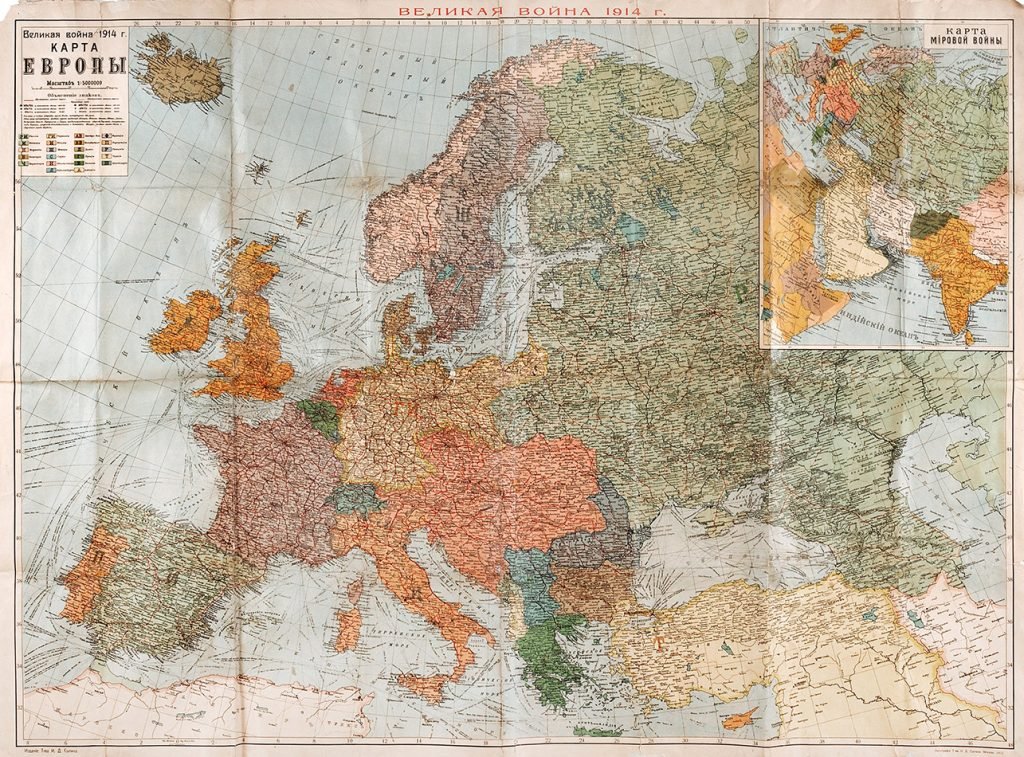
Political map of Europe in 1914
Operation Michael: This Time the Germans Win
On March 21, 1918, the largest German offensive of the final phase of the First World War began: Operation Michael. In our history, the Germans achieved impressive initial successes but failed to accomplish their main objective: separating the British and French armies and defeating the enemy before American reinforcements arrived. In this alternative reality, the German command acted more consistently. Instead of launching several offensives in different directions, it concentrated its main reserves for a strike against Amiens, through which the Allies’ most important railway communications passed.
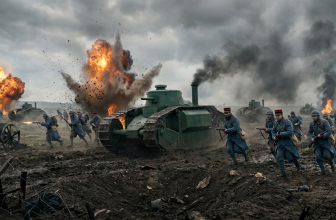
At the beginning of the operation, German stormtrooper units broke through British fortifications. Specially trained groups bypassed strongpoints, destroyed headquarters, and disrupted communications, leaving surrounded positions to the following waves of infantry. German artillery shifted its fire deeper into the defenses, preventing the arrival of reserves. At the same time, the advancing troops benefited from much better-organized supply lines, while German railway engineers immediately began repairing the destroyed tracks. In the first half of April, Amiens fell into German hands, and the British front began to collapse.
The fall of Amiens became a genuine catastrophe for the Entente. The British Expeditionary Force faced the danger of being split into several isolated groups, while the German army gained an opportunity to advance toward the English Channel ports. The French command had to transfer its last strategic reserves northward, weakening its defenses in other sectors. The German General Staff immediately exploited the situation. In May, another offensive began, this time toward Compiègne and Paris.
The Germans did not attempt to capture the French capital in a single rush. Instead, they sought to encircle and destroy the French armies defending the approaches to Paris. In June, German troops reached the Marne, cut several vital railway lines, and forced the French command to abandon substantial territories. The French army remained capable of fighting, but its strength was limited by the enormous losses of the preceding years. No fresh American divisions were present in Europe to change the situation.
In July 1918, Paris was engulfed by a political crisis. Some ministers demanded continued resistance, counting on British assistance. Others argued that further fighting would only lead to the destruction of the capital and the complete defeat of the French army. The British, having preserved a substantial portion of their forces, were already preparing to evacuate the continent and made no secret of their doubts about France’s ability to hold out. Under pressure from the military command, the French government decided to open negotiations.
In September 1918, an armistice was signed at Compiègne, France. This time, however, it was France that surrendered, rather than Germany, as happened in our reality. Great Britain continued fighting for several more months, but after the defeat of its principal continental ally and Russia’s withdrawal from the conflict, the prospects of a successful offensive had virtually disappeared. In early 1919, London concluded a compromise peace with the Central Powers. Britain retained its fleet and colonial empire but acknowledged Germany’s political supremacy on the European continent.
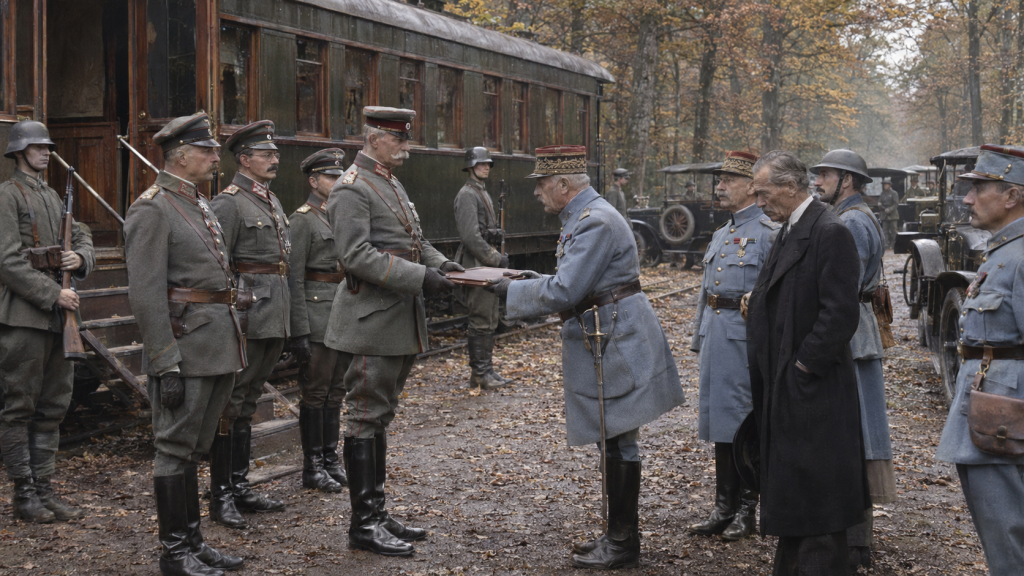
German officers and French negotiators beside a railway headquarters carriage in the Forest of Compiègne
The Victors’ Peace: What Germany Gained
The postwar peace conference of 1919 took place under Berlin’s decisive influence. France was forced to definitively recognize German sovereignty over Alsace and Lorraine, agree to reparations payments, and accept restrictions on the size of its armed forces. Belgium retained its formal independence but was obliged to facilitate German transit and maintain a neutral foreign policy. Luxembourg was fully incorporated into the German economic system.
However, Germany did not seek to repeat Napoleon’s policies by annexing vast territories in Western Europe. German industrialists understood perfectly well that having dependent states with their own governments was far more profitable than maintaining expensive occupation administrations. Consequently, the principal outcome of the peace negotiations was not so much the expansion of Germany’s borders as the recognition of its special position in Central and Eastern Europe.
The victorious empire gained enormous economic advantages. German goods flowed freely into the markets of the new Eastern European states, German banks financed the construction of railways and factories, and German industry gained access to the raw materials of Ukraine and other territories of the former Russian Empire. Meanwhile, Berlin gradually recovered the colonial possessions it had lost during the war and restored trade with the British Empire.
Kaiser Wilhelm II found himself at the height of his glory. In Germany, he was hailed as the monarch who had defeated the combined forces of his European opponents. Yet serious problems lay behind this outward triumph. Millions of people had been killed or wounded, the economy was exhausted, and the Social Democrats demanded greater political freedoms. Moreover, Germany’s allies expected to receive their own share of the postwar gains. And it was here that an unpleasant surprise awaited the victors: Austria-Hungary began to fall apart.
Austria-Hungary: The Empire That Even Victory Could Not Save
At first glance, Austria-Hungary’s position should have improved considerably. The Habsburg monarchy was among the victors, avoided the historical Treaties of Saint-Germain and Trianon, and saw its army return home with a sense of duty fulfilled. However, four years of war had finally destroyed the fragile balance among the state’s many nationalities. Austrian Germans, Hungarians, Czechs, Slovaks, Croats, Serbs, Romanians, and other national groups held completely different visions of the empire’s future.
The young Emperor Charles I, who had ascended the throne after the death of Franz Joseph in 1916, attempted to carry out long-overdue reforms. In early 1919, he announced preparations for a new federal constitution that would establish autonomous national regions. However, the attempt to save the monarchy became the very cause of its final destruction. Hungarian politicians refused to allow any revision of the borders of the lands of the Crown of Saint Stephen, Czech nationalists demanded complete independence, and South Slavic movements began forming armed units.
In the spring of 1919, mass demonstrations broke out in Vienna. The government lost control of the capital, while national councils were established in the provinces. Czech politicians proclaimed independence, the Hungarian parliament announced the restoration of the kingdom’s full sovereignty, and Croatian representatives demanded separation from Budapest. Charles I attempted to organize negotiations but no longer possessed sufficient military strength to preserve the state.
Before long, the political crisis escalated into a full-scale civil war. Hungarian troops, which had retained a relatively high level of organization, launched offensives into territories Budapest considered historically Hungarian. Their primary objective was to retain Slovakia, Transylvania, and other regions of the former kingdom. A separate army was formed in the Czech lands, while fighting erupted in the south among Serbian, Croatian, and Hungarian formations.
Germany initially attempted to act as a mediator. Berlin understood perfectly well that the emergence of several hostile states in place of a reliable Austria-Hungary could undermine the postwar security system. However, German politicians quickly concluded that restoring the Habsburg monarchy would require massive military intervention and would offer no guarantee of success. The German leadership therefore began considering an entirely different option: directly annexing Austria’s German-speaking territories to Germany and recognizing Hungary as the principal successor to the former Dual Monarchy.
In 1920, German troops entered Upper Austria, Salzburg, and Tyrol, officially declaring that the purpose of the operation was to protect the German-speaking population. By then, a strong movement supporting union with Germany had already emerged in Vienna. Following the collapse of the central government, Austrian national councils held votes on joining the German Empire. The plebiscites took place amid civil war and a German military presence, so their results were disputed, but Berlin declared them sufficient grounds for changing the borders.
By 1921, Vienna and most of the German-speaking territories of the former Austria had become part of the German Empire. Certain western border regions became the subject of negotiations with Italy, while Burgenland and several other territories went to the Hungarians. An independent Austrian state no longer existed. The Habsburg dynasty lost its throne, and Charles I went into exile. For the German national movement, this represented the fulfillment of a long-standing dream of uniting the German lands. For millions of inhabitants of the former monarchy, however, an entirely new era was beginning.
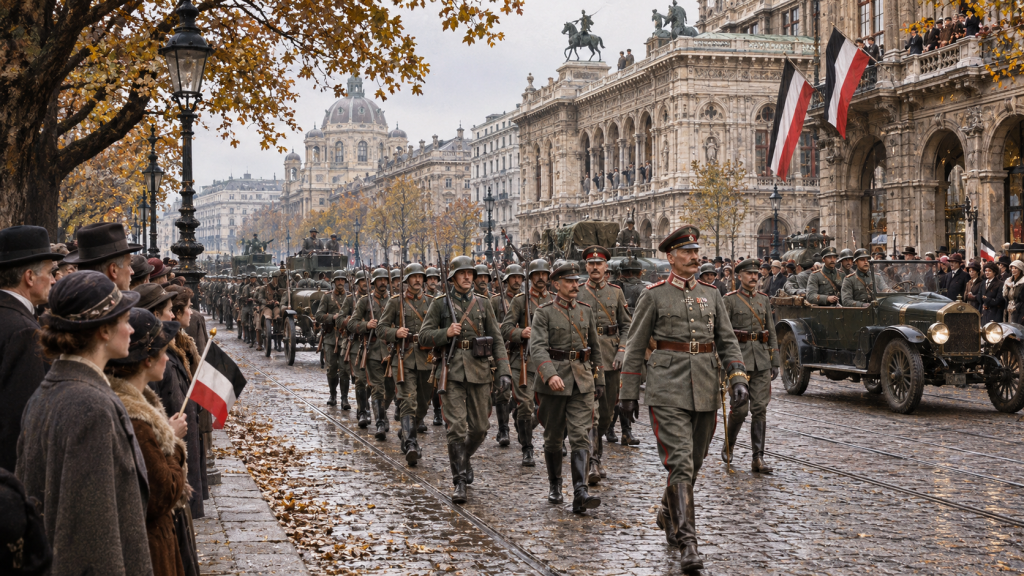
Vienna, 1920. German troops march along the Ringstrasse
Greater Hungary: The Unexpected Victor of the Civil War
After Germany, Hungary emerged as the principal victor of the Austro-Hungarian crisis. Budapest managed to preserve most of the former joint army’s most combat-capable formations and organize them under a unified command. This gave Hungarian forces an advantage over the numerous but fragmented national formations.
In 1920, the Hungarian army restored control over Slovakia. Fierce fighting continued in the east over Transylvania, where the Romanian population demanded union with Romania. However, Germany did not want Romanian influence to expand and provided Budapest with financial and material assistance. The Kingdom of Romania, deprived of support from a victorious Entente, lacked the strength to launch a full-scale offensive against Hungarian positions. After a series of heavy battles, an armistice was concluded, leaving most of Transylvania under Hungarian control.
The situation in the south proved more complicated. Croatian nationalists categorically refused to return to direct rule from Budapest. Hungarian forces attempted to hold Zagreb and the main railway communications but encountered widespread resistance. Germany intervened in the conflict, proposing a compromise: Hungary would recognize Croatia’s independence, while Zagreb would conclude a military and economic treaty with Budapest. Serbia also retained its independence but abandoned plans to unite all South Slavs into a single state.
By 1922, the civil war had ended. Several states emerged on the map in place of Austria-Hungary, the largest of which was Hungary. Its territory included a substantial portion of the historical lands of the Crown of Saint Stephen, while its population had increased through the inclusion of Slovaks, Romanians, Ruthenians, and other peoples. In size, the new Hungary far exceeded the state that existed in our reality after the Treaty of Trianon.
However, serious problems lay behind this impressive territorial expansion. Several years of warfare had devastated the transport system, national tensions had not disappeared, and a substantial portion of the population was unwilling to accept rule from Budapest. The Hungarian leadership was forced to establish a complicated system of autonomies, combining military force with local self-government. Germany became the principal guarantor of Hungary’s borders, supplying equipment, providing loans, and helping rebuild industry.
Thus, an enlarged Hungary emerged in Central Europe, gradually becoming the second most important participant in the German system after Germany itself. Its army became one of the strongest on the continent, while its political ambitions increasingly came into conflict with Berlin’s interests. Nevertheless, the Hungarian leadership understood perfectly well that maintaining such extensive possessions would be extremely difficult without German protection.
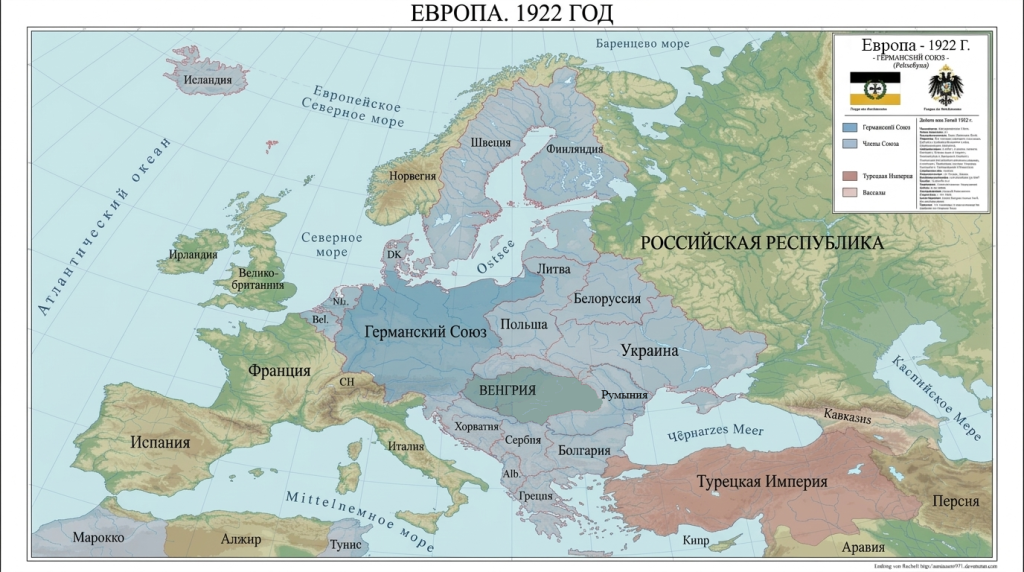
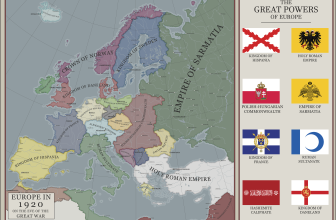
Europe in 1922
Germany Reforms Its Political System
The German Empire emerged from all these events considerably more powerful than it had been in 1914. The Austrian lands had been annexed, a network of dependent states was forming around it, and German industry had gained access to vast new markets. But as the empire grew stronger, the need for political reform also increased.
Victory in the First World War saved Wilhelm II from abdication, but it did not eliminate the internal contradictions of German society. The Social Democrats demanded that the government be made accountable to parliament, business leaders wanted predictable policies, and a substantial portion of the army was exhausted by years of conflict. The Kaiser understood that preserving the old system of government could lead to revolution even after a victorious war.
Constitutional reforms therefore began as early as 1919. The Reichstag received expanded budgetary powers, the Chancellor became accountable to the parliamentary majority, and the formation of the government increasingly depended on election results. The Emperor retained his position as head of state and supreme symbol of the armed forces, but his ability to determine domestic and foreign policy independently was significantly restricted.
By the early 1920s, Germany was gradually becoming a constitutional monarchy resembling the British system, although the Emperor retained somewhat broader powers. Wilhelm II remained extremely popular thanks to the victory of 1918, but real power was increasingly concentrated in the hands of the parliamentary government and the professional state administration.
This development would later play a crucial role. Unlike our reality, where defeat in the First World War contributed to the fall of the monarchy and the establishment of the Weimar Republic, the German Empire in this world preserved dynastic continuity. Moreover, it gradually developed a system of political government capable of uniting numerous nation-states without directly annexing them.
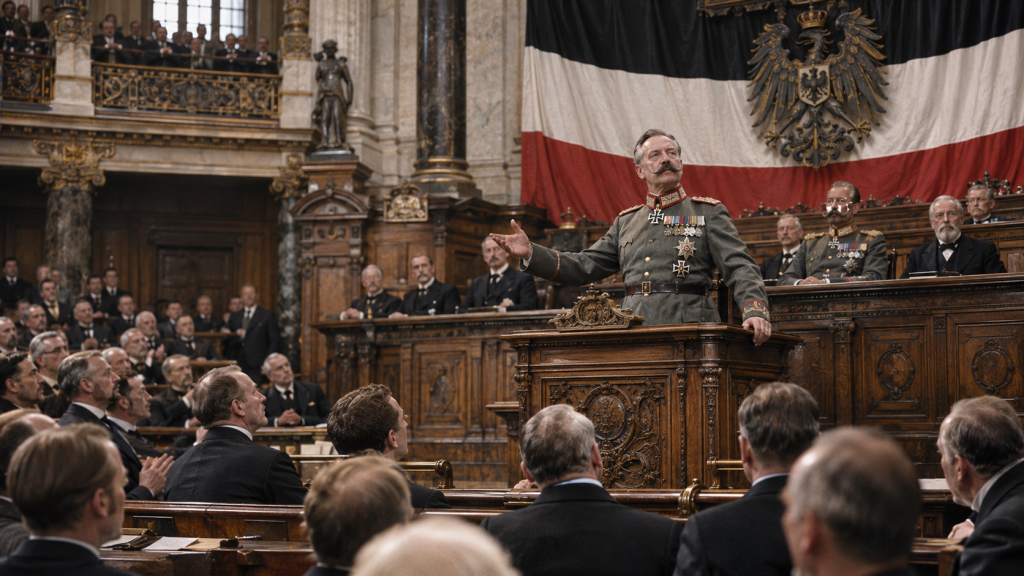
Emperor Wilhelm II addresses the deputies following the adoption of constitutional reforms
In Conclusion
By 1922, Europe had already become almost unrecognizable compared with the continent familiar to us. Germany had won the First World War, preserved the Hohenzollern dynasty, and annexed German-speaking Austria. The Habsburg monarchy had disappeared, an enlarged Hungary had become a new great power in Central Europe, and Croatia and Serbia had gained independence. Instead of a united Austria-Hungary, an entire system of states had emerged, linked to Berlin by common political and economic interests.
But no less remarkable events were unfolding in Eastern Europe. German troops continued to hold positions in the territories of the former Russian Empire, Ukraine sought to consolidate its independence, Poland was preparing for a war over Galicia, and a brutal Civil War was raging in Russia itself. Berlin was gradually coming to the conclusion that preserving its eastern gains would require not only supporting the new states but also definitively resolving the problem of Bolshevik rule.
That is why the next chapter of this story will focus on events that ended in a Red victory in our reality but produced an entirely different outcome here. Germany backed Yudenich and Krasnov — and that decision changed Russia’s fate for decades to come.