Italy Built One of the Most Advanced Tanks of World War I. Why Did the Fiat 2000 Lose to the Tiny Renault FT?

In 1916, Italy found itself in a rather strange position. The country had already been at war with Austria-Hungary for more than a year, British tanks were beginning to appear on the Western Front, the French were developing their own armored vehicles, yet the Italian Army had virtually nothing comparable. Even worse, the Italian theater of operations seemed almost designed to frustrate the new technology: much of the Austro-Italian front ran through the Alps, where enormous tracked armored vehicles had far fewer opportunities than on the trench-covered plains of France and Belgium.
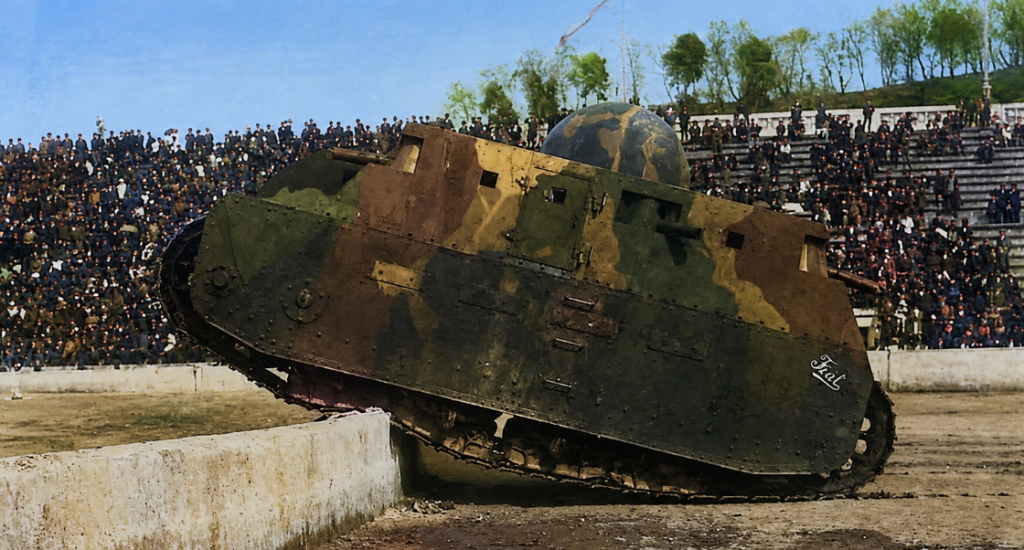
That makes the machine Fiat began developing all the more remarkable. The Italians did not simply copy the British rhomboid tanks. Instead, they designed their own heavy tank weighing around 40 tons, armed it with a 65 mm gun and seven machine guns, installed an aircraft engine producing roughly 240–250 hp, and, most importantly, placed its main gun in a fully rotating 360-degree turret. The first running prototype appeared in 1917, while the second vehicle was completed in 1918.
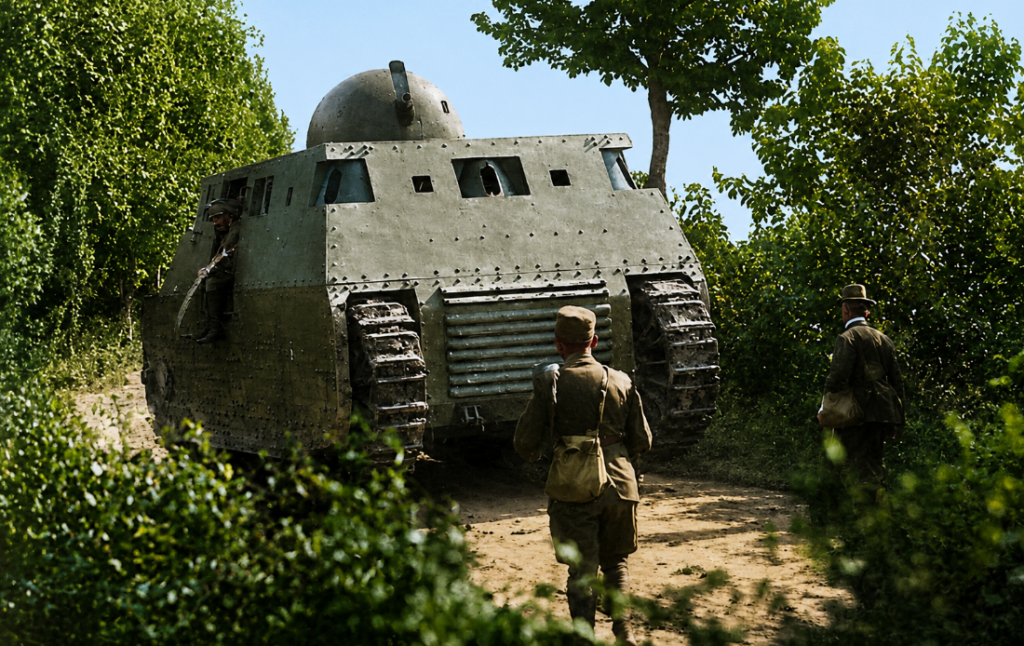
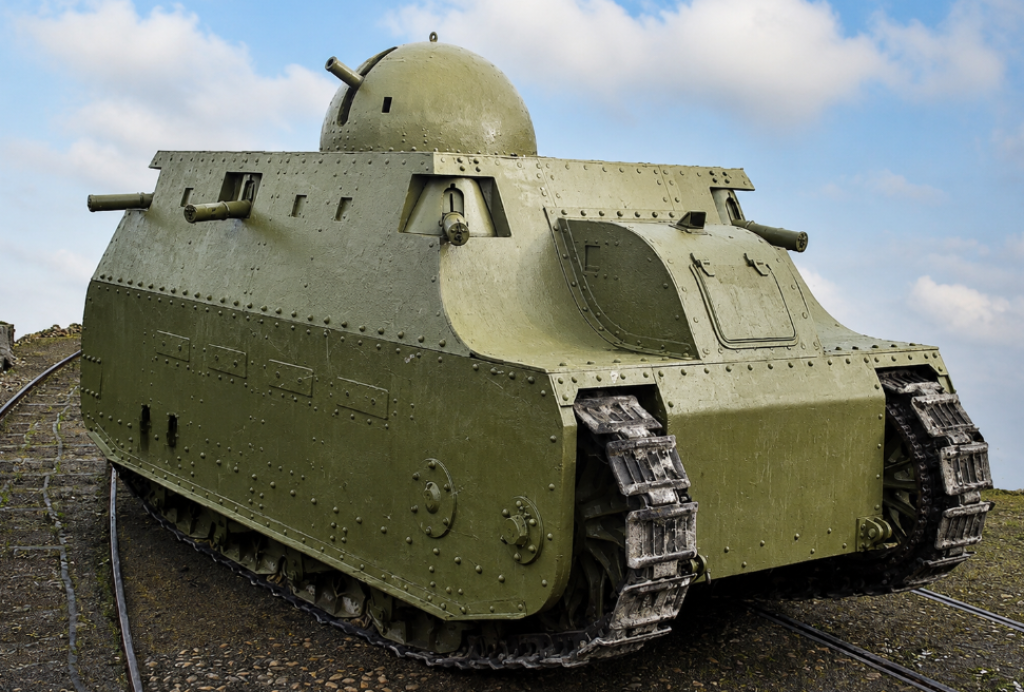
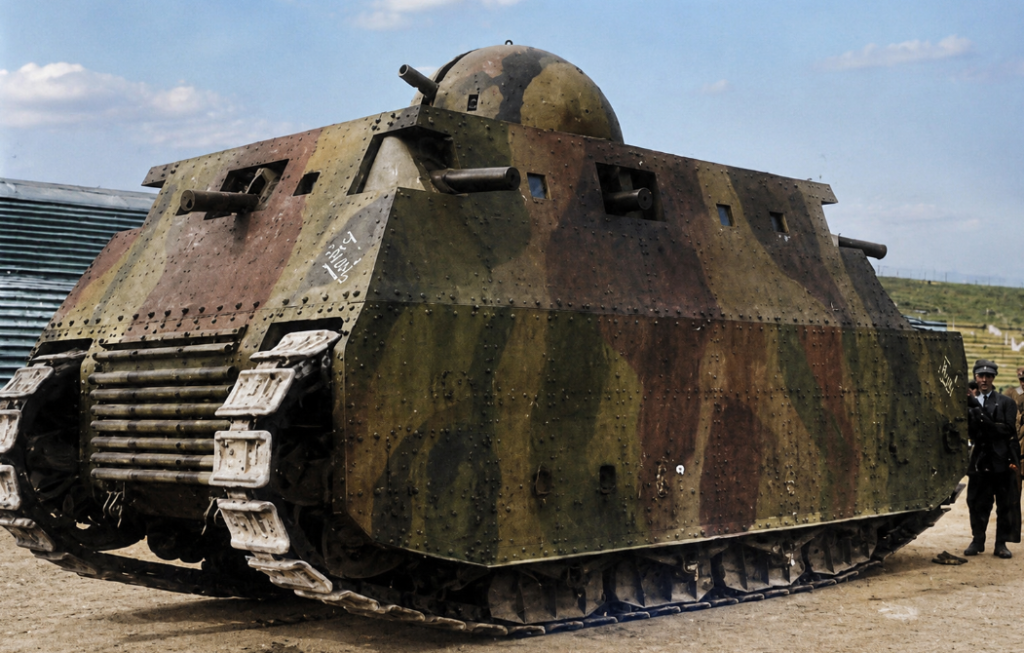
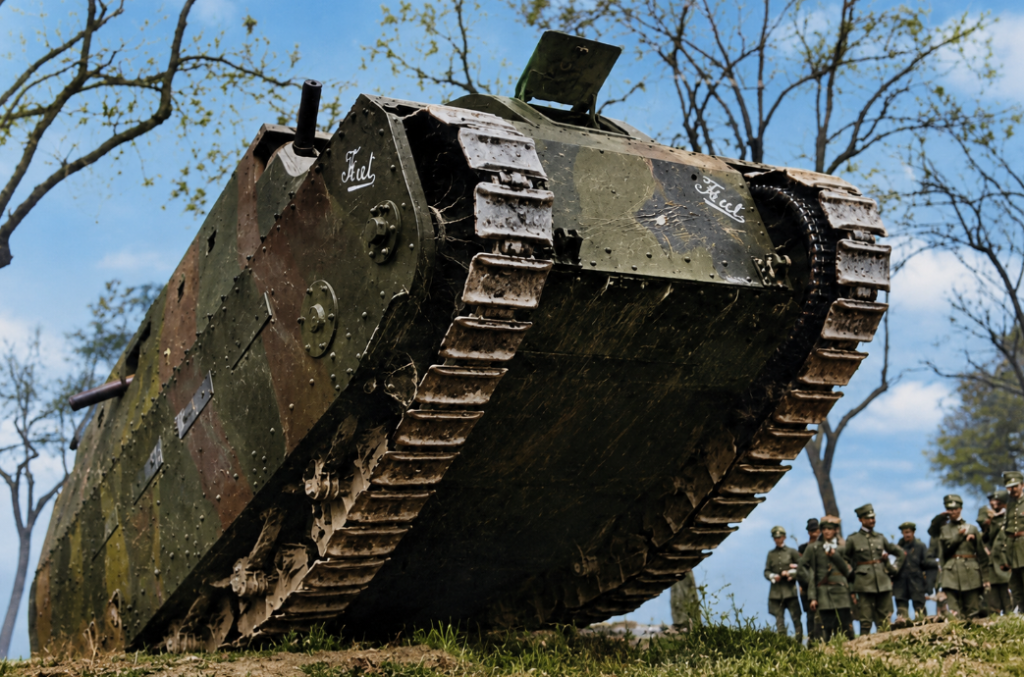
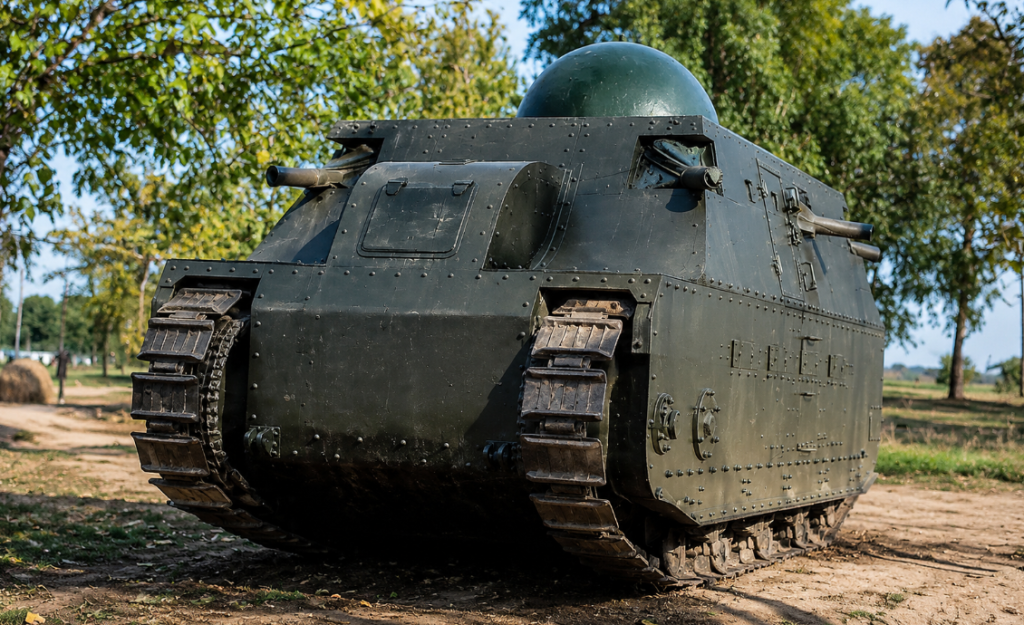
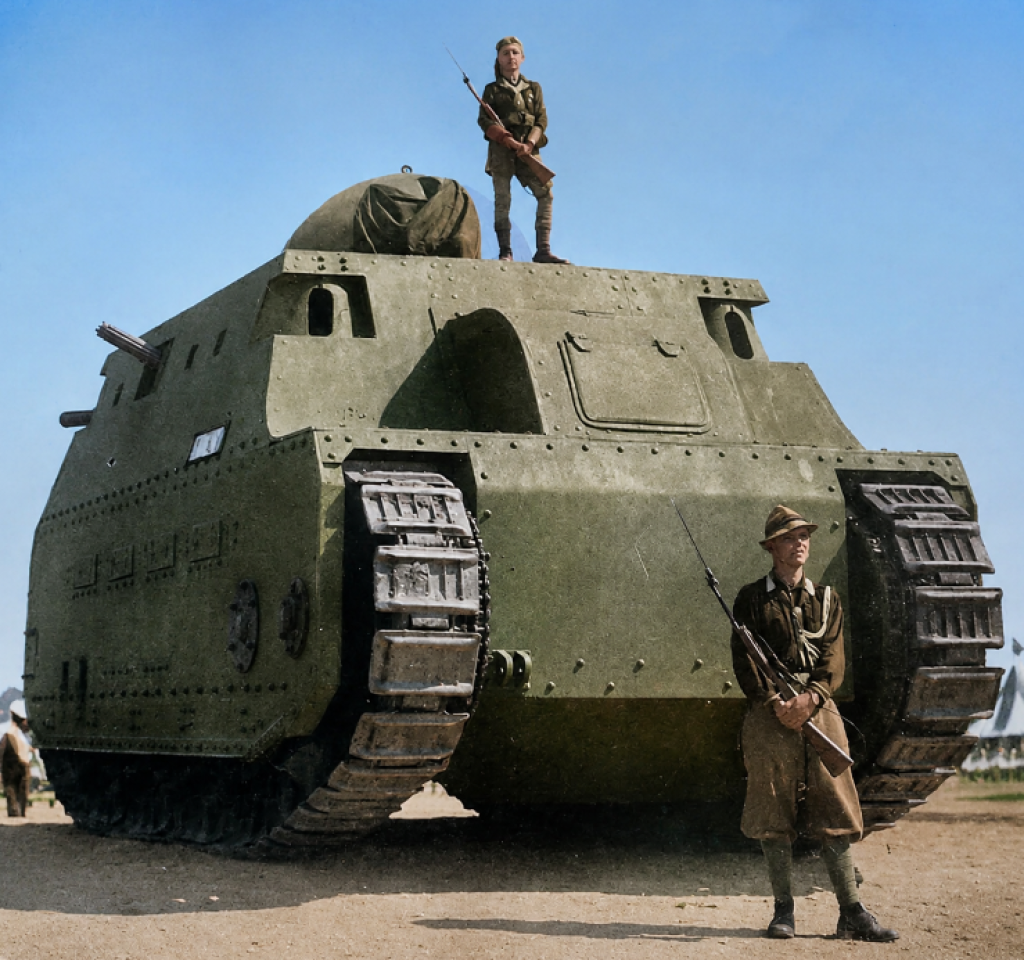
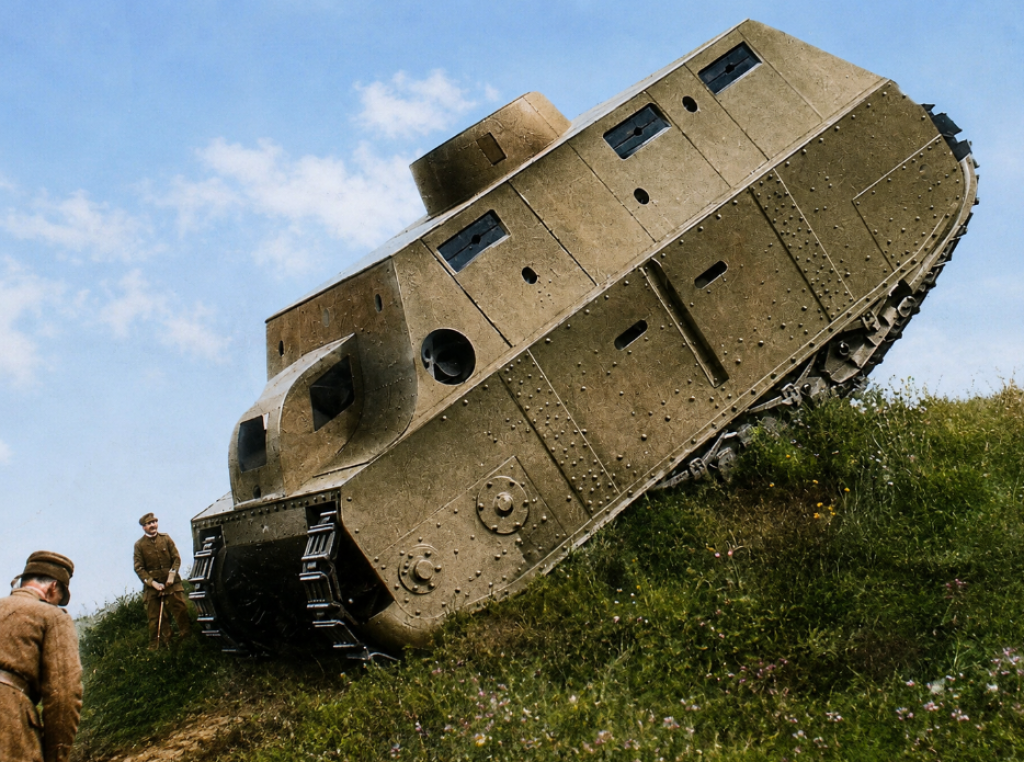
In photographs, the Fiat 2000 looks almost comical. It stood roughly 3.8 meters tall, measured about 7.4 meters long and just over three meters wide, with an enormous box-shaped hull sitting above comparatively narrow tracks. It was a genuine land dreadnought of the First World War.
But once you look past its appearance, a paradox emerges.
Inside this monster were several ideas that looked considerably more modern than the tank itself.
While the British Built Rhomboids, the Italians Put the Gun in a Turret
The first British Mark I tanks entered combat in 1916 and created one of the most recognizable images of World War I: an enormous rhomboid hull, tracks running around the entire vehicle, and guns mounted in sponsons on either side. The configuration suited the original mission rather well. The tank had to cross trenches, crush barbed wire, and support advancing infantry by firing along enemy positions.
But the sponson arrangement had an obvious disadvantage. Shifting the main armament from one direction to another was difficult, and the firing arcs were dictated by where the weapons were mounted in the hull. The entire layout was also bulky.
The Fiat 2000 took a different approach. On top of the hull sat a hemispherical rotating turret carrying a 65 mm Cannone da 65/17, derived from a mountain gun. The weapon could fire in any direction, while its generous elevation range was well suited to rough terrain. It was supplemented by seven 6.5 mm Fiat-Revelli Mod. 1914 machine guns positioned around the hull, giving the vehicle extensive all-around defensive fire.
Today, this arrangement seems completely natural: tracks below, hull in the middle, and a rotating turret carrying the main armament on top. But in 1917–1918 there was still no universally accepted answer to the basic question of what a tank was actually supposed to look like.
The Italians independently arrived at one of the right answers.
But the Renault FT Went Even Further
This is where things become particularly interesting.
The Fiat 2000 is sometimes described as a precursor to the modern tank because of its rotating turret. There is some truth to that, but giving the Italians all the credit would be misleading.
At almost the same time, France introduced the Renault FT.
It also had a rotating turret, but the French designers went considerably further. The driver sat at the front, the fighting compartment and turret were in the center, while the engine and transmission were placed at the rear.
The result was a layout that would become the standard arrangement for tanks for decades.
And this is where the two vehicles become fascinating to compare.
The Fiat 2000 weighed around 40 tons, while the Renault FT weighed roughly 6.5–7 tons. The Fiat carried a 65 mm gun and seven machine guns; the Renault had either a single 37 mm cannon or a machine gun. Depending on the source, the Fiat required a crew of eight to ten men. The Renault needed just two.
On paper, the French tank looks almost like a toy beside the Italian giant.
Yet it was that “toy” that won the argument over the future of the tank.
The Fiat 2000 Was Surprisingly Comfortable — by 1917 Standards
The qualification is important.
Early tanks were extremely unpleasant places to work. Crews sat close to running engines in an environment filled with heat, noise, fuel fumes, lubricants, and propellant gases. In British heavy tanks, the engine effectively shared the crew compartment with the men operating the vehicle.
The Italians tried something different.
The Fiat 2000 had a large fighting compartment, while the engine was positioned beneath it and separated by bulkheads. The vehicle had ventilation, and the driver sat in a projecting position at the front with a large observation hatch.
Nobody would call the Fiat 2000 comfortable by modern standards. But compared with some of its contemporaries, its crew accommodations were remarkably well considered. Studies of the surviving design have repeatedly noted the relatively spacious interior and good visibility available to the driver.
And the engine was appropriately enormous.
21 Liters of Aircraft Engine
A 40-ton tank needed serious power, so Fiat turned to its own A12 aircraft engine, a huge inline six-cylinder gasoline engine producing approximately 240–250 hp.
That gave the tank roughly 6 hp per ton. The figure sounds laughable today, but for a World War I heavy tank it was respectable. British Mark IV heavy tanks, for comparison, had a noticeably worse power-to-weight ratio.
The engine could not perform miracles, however. The Fiat’s maximum speed was only around 7–7.5 km/h, while its road range was approximately 75 kilometers. The tank could cross broad trenches, climb obstacles, and smash through walls — abilities that were later demonstrated very effectively in front of large crowds.
Fiat had, in other words, built a reasonably capable mobile fortress.
The problem was that by the time it appeared, armies were beginning to realize that perhaps they did not need mobile fortresses at all.
Forty Tons Versus Seven
This is where the answer to the Fiat 2000 puzzle begins to emerge.
Consider the resources required to build one 40-ton tank: a huge armored hull, a powerful aircraft engine, a complicated transmission, seven machine guns, a 65 mm cannon, and a large crew. Then the vehicle had to be transported to the front and supplied with hundreds of liters of gasoline, ammunition, spare parts, and maintenance support.
And next to it stood the Renault FT.
It was much more lightly armed and protected. But it weighed roughly one-sixth as much, required only two crew members, and was vastly easier to transport.
Most importantly, it could be built in large numbers.
France ultimately produced thousands of FTs and related vehicles. The Fiat 2000 remained essentially an experimental machine built in tiny numbers.
World War I was beginning to teach one of the most important lessons of future mechanized warfare: sometimes having one extremely powerful tank matters less than being able to field several simpler ones.
For Italy, the Problem Was Even Worse
Look at a map of the Italian Front during World War I and another uncomfortable question appears: where exactly was a 40-ton Fiat supposed to fight?
Most of Italy’s fighting against Austria-Hungary took place in the northeast. Mountains, narrow valleys, limited road networks, bridges, and steep gradients created an exceptionally hostile environment for heavy armored vehicles.
The Italian Army eventually concluded that the enormous Fiat 2000 lacked the mobility required for this theater, while the much lighter French FT was better suited to its needs.
The result was an almost perfect historical paradox.
Fiat had created an impressive heavy tank for an army operating in one of the least convenient environments imaginable for a heavy tank.
And Then the War Ended
Timing ultimately doomed the project.
Development began in 1916. In June 1917, the running gear of the first prototype was being tested, but the vehicle did not yet have its complete armored superstructure. The second example was only completed in 1918.
By then, the war was nearly over.
There are reports of plans or an order for 50 Fiat 2000s, but large-scale production never began. Two completed vehicles are the best documented figure. Some older sources claim that four additional machines may have existed, but the evidence remains disputed. The popular statement that “six Fiat 2000s were built” should therefore be treated cautiously.
Once the armistice arrived, there was simply no longer an urgent reason to launch mass production of an enormous heavy tank.
But the Fiat’s story was not over.
Italy Then Sent a 40-Ton Tank to Libya
What could possibly be better suited to fighting a mobile opponent in North Africa than a massive tank capable of roughly 7 km/h?
The answer was predictable.
In 1919, at least one Fiat 2000 was sent to Libya along with Renault FTs, where Italian forces were using armored vehicles against local resistance. Here the heavy tank’s fundamental weakness became obvious: its opponents had no intention of sitting in trenches and waiting for a 40-ton machine to slowly reach them.
The Fiat might have had powerful all-around armament and respectable protection, but its low speed made pursuing mobile forces virtually impossible. Sources broadly agree that it was poorly suited to this kind of warfare.
The exact fate of the individual machines becomes less certain at this point. Sources disagree over whether one or both Fiat 2000s went to Libya, so colorful stories about a particular tank being permanently abandoned outside a specific town should be treated cautiously. Photographs and documentation confirm the Fiat 2000’s presence in the colony, but not every detail of its service can be reconstructed with confidence.
But It Was Magnificent in Front of a Crowd
If the Fiat 2000 was questionable as a practical weapon, it was almost perfect for public demonstrations.
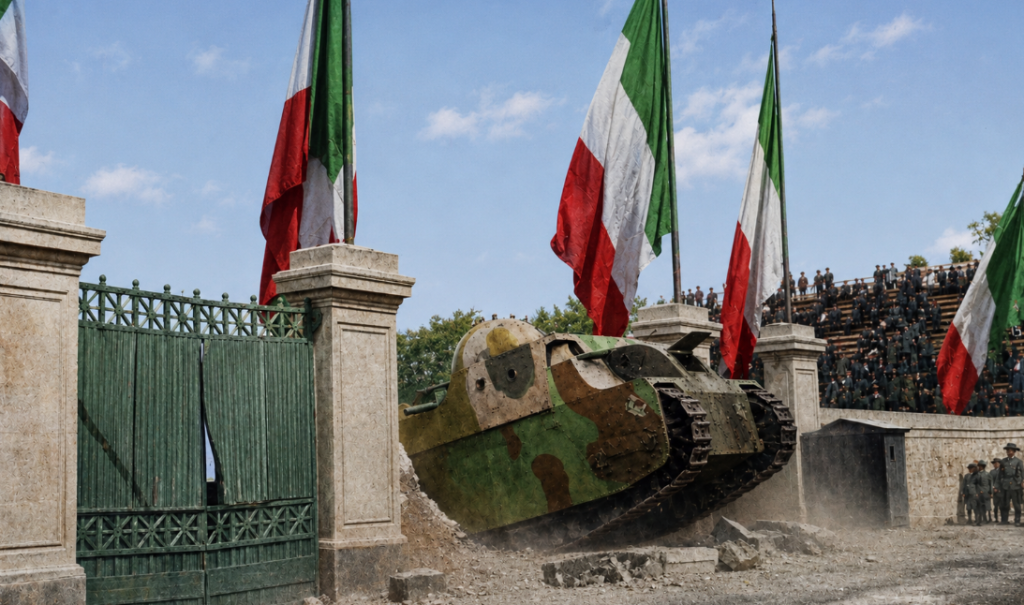
In 1919, one of the tanks participated in spectacular demonstrations in Rome before King Victor Emmanuel III and a large audience. The giant machine crossed a trench roughly three meters wide, climbed obstacles, smashed through walls, and knocked down trees.
To a spectator in 1919, the sight must have been extraordinary.
Forty tons of steel slowly moving forward, brick walls collapsing beneath its tracks, with a cannon turret rotating above.
This was surely the weapon of the future.
Military officers, however, saw something different.
They saw 40 tons of weight, walking speed, enormous fuel consumption, and complicated logistics.
And somewhere nearby stood a seven-ton Renault.
The Frustrating Part Is That Fiat Actually Predicted Much of the Future
This is why simply describing the Fiat 2000 as a failed tank misses the point.
It emerged at a time when engineers were still trying to understand what this new category of weapon should actually be. The British experimented with rhomboid hulls and sponsons. Germany’s A7V looked like an enormous armored box. The French produced the Schneider CA1 and Saint-Chamond with their main weapons mounted in the hull.
Fiat built a vehicle with a rotating cannon turret, extensive all-around machine-gun coverage, a relatively spacious fighting compartment, and a powerful engine.
In several respects, the Italian engineers really were looking ahead.
But they got the scale wrong.
The future tank really would have a turret.
It really would have a gun capable of firing in any direction.
It really would separate the engine from the crew.
But none of that required building a 40-ton fortress almost four meters tall.
Renault FT Understood the Most Important Thing
The French machine was dramatically weaker than the Fiat 2000. It had less armor, less firepower, and a far less imposing appearance.
But the Renault FT embodied an idea more important than armor thickness or gun caliber.
A tank must not only be effective. It must also be mass-producible.
It has to be transported, repaired, fueled, and manufactured by the hundreds or thousands. It needs crews, spare parts, railway wagons, bridges, and maintenance units. And if one vehicle is lost, the formation must continue to function.
That is why the little FT inspired numerous foreign designs and effectively established the basic architecture of the next generation of tanks.
The enormous Fiat became a historical curiosity.
Although History Gave It One More Appearance
The last surviving Fiat 2000 continued to appear in public long after World War I. In 1934, the vehicle was modified: two of its forward machine guns were replaced by 37 mm Vickers-Terni guns, after which the old giant once again appeared at public events.
By then, it looked like a genuine dinosaur.
The world had moved on to faster tanks with improved suspensions, compact hulls, and much more efficient layouts. Italy itself had long since adopted the Fiat 3000 — a machine heavily influenced by the French Renault FT concept.
The trail of the Fiat 2000 eventually disappears. A popular account holds that the last example was scrapped during World War II, although reliable documentation of its final fate is limited. Historical researchers studying the vehicle cautiously suggest that it was probably dismantled around the beginning of the Second World War.
No original Fiat 2000 survives today.
So Was the Fiat 2000 a Tank Ahead of Its Time?
The answer is both yes and no.
In several technical respects, absolutely. The rotating turret carrying the main armament, the organization of the internal space, the powerful engine, and the attempt to provide all-around fire demonstrate that Italian engineers understood many of the problems faced by the earliest tanks.
But the Fiat 2000 also embodied an idea that tank design was already beginning to leave behind.
It was a land dreadnought.
Large, heavy, expensive, and armed as heavily as possible.
Its designers tried to make a single vehicle capable of solving as many battlefield problems as possible.
The Renault FT represented the opposite philosophy: a small, specialized tank that could be manufactured in large numbers and deployed as part of entire formations.
And that is why the story of the Fiat 2000 is much more interesting than a simple tale of an “underrated tank.”
The Italians did not build a bad machine. In fact, they correctly anticipated several design solutions that would later become standard.
They made a different mistake.
Fiat correctly understood what a tank should look like on the inside. Renault understood what a tank army should look like.
And in a major war, the second insight proved far more important than the first.