In the autumn of 1942, the U.S. Office of Strategic Services presented engineers with an almost impossible task. An agent operating in occupied territory needed a compact weapon capable of silently eliminating a sentry or guard dog. It was not supposed to reveal the shooter with a muzzle flash, cloud of powder smoke, or loud report. Ideally, it also had to be concealable under clothing and quickly prepared for use.
The specifications were extraordinarily ambitious: the projectile was expected to reach a muzzle velocity of 1,000 feet per second, or approximately 305 meters per second. A conventional pistol could deliver that speed, but not the required level of silence. Suppressors already existed, yet they were often bulky, lost effectiveness with use, and could not completely eliminate the distinctive sound of a gunshot. Engineers therefore turned to technology that was already several centuries old.
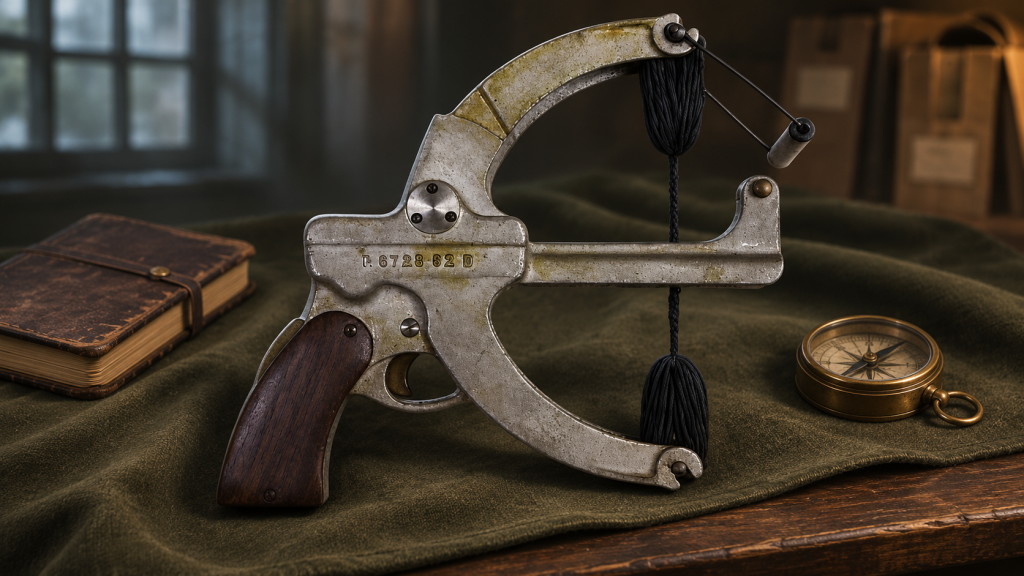
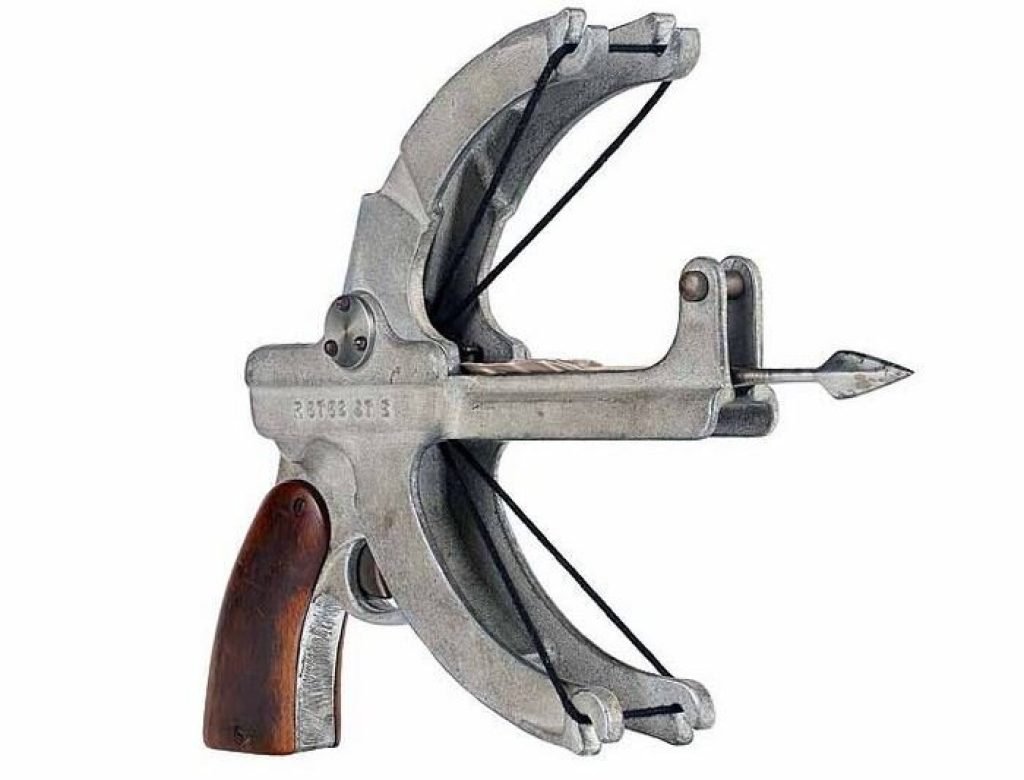
The result was Little Joe—a small crossbow disguised as an oversized pistol.
A Pistol Without Gunpowder
The weapon was developed by specialists working with the U.S. National Defense Research Committee. One of Little Joe’s creators was Paul Klopsteg, an American physicist, ballistics expert, and authority on archery. In his papers, the project appeared under the name “Penetrometer.” The term captured its central idea: a heavy dart was expected not merely to wound a target but to penetrate deeply enough to disable it.
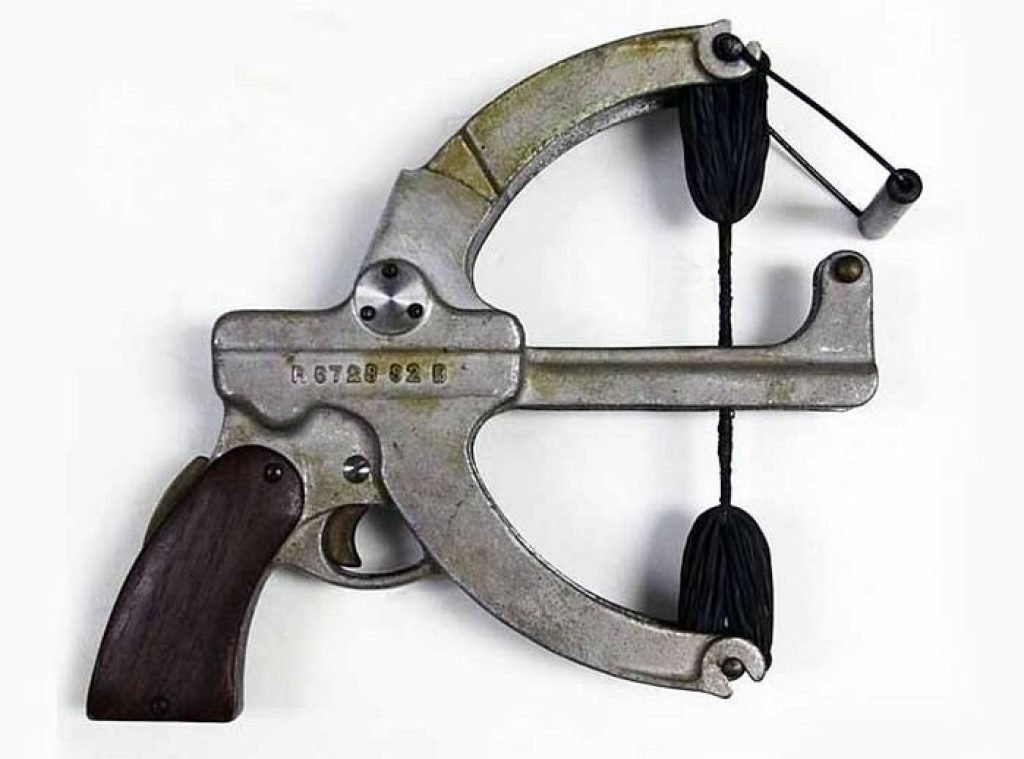
By 1943, the project had reached the working-prototype stage. Little Joe weighed about 2.25 pounds, or just over one kilogram, and measured approximately 13 inches long and eight inches high. In size and shape, it resembled an unusually large handgun. Its frame was manufactured from heat-treated aluminum alloy to combine strength with relatively low weight.
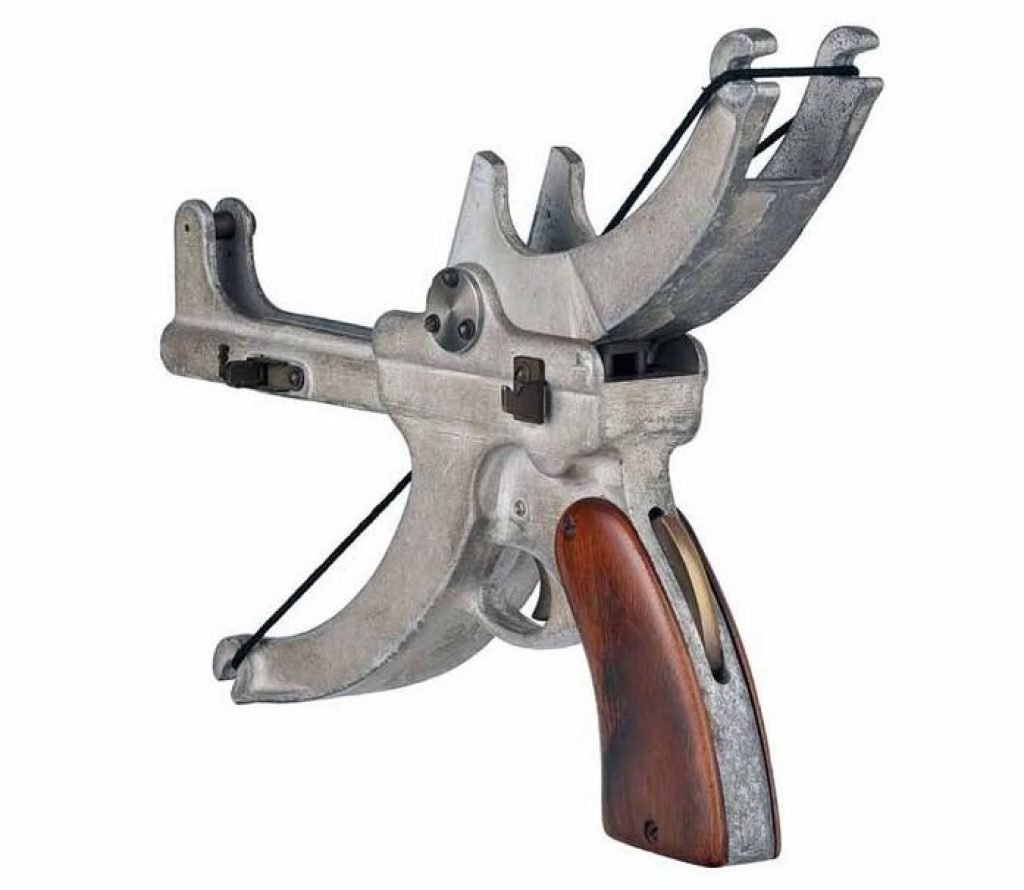
Its most distinctive feature was the vertical arrangement of the bow arms. On a conventional crossbow, the limbs extend to the left and right, making the weapon broad and difficult to conceal. On Little Joe, one arm was positioned above the barrel and the other below it. This kept the weapon comparatively flat and, at least in theory, allowed an agent to carry it beneath outer clothing.
Calling Little Joe a true crossbow requires some qualification. Its energy was stored not by flexible bow limbs but by a bundle of around 50 rubber bands. At the center was a graphite-treated section of linen string that engaged the projectile. In practice, American engineers had created a hybrid of a pistol, crossbow, and powerful mechanical slingshot.
To cock the weapon, the upper arm was pivoted backward until the string was captured by the release mechanism. The shooter then placed a long metal-shafted dart with a broad cutting head into position. The sights consisted of a front bead and an adjustable rear sight. Little Joe was not intended as a novelty or intimidation device—it was designed as a serious weapon for accurate shooting at close range.
Quiet, but Far From Fast
Little Joe never came close to the extraordinary 1,000 feet-per-second velocity demanded by the original specification. Its actual projectile speed was approximately 170 feet per second, or 52 meters per second—almost six times lower than requested.
For a heavy dart, however, that velocity was still considerable. During testing, the projectile reportedly penetrated a 1,276-page Washington, D.C., telephone directory at point-blank range. It was also claimed that at a distance of 30 yards—about 27 meters—the dart retained enough energy to penetrate a uniformed human target. At 20 yards, Little Joe reportedly produced groups measuring around six inches, or 15 centimeters.
Its sound signature was especially impressive. Historical test records mention a figure of approximately 72 decibels. That number cannot be compared directly with modern sound measurements because the microphone distance and other test conditions are unclear. Even so, Little Joe was unquestionably much quieter than a conventional pistol. There was no exploding powder charge, muzzle flash, or cycling firearm action.
It was not completely silent. The release mechanism clicked, the rubber-powered string struck the weapon, and the dart could make considerable noise if it hit a wall, metal object, or the target’s equipment. Most importantly, even a perfectly silent weapon could not guarantee that a wounded person would not scream or raise the alarm.
Little Joe’s practical rate of fire was approximately four shots per minute. After every shot, the weapon had to be cocked again and another dart installed. That might have been respectable performance for a sporting crossbow, but during a covert operation—where the first shot could miss—15 seconds was an eternity.
Twenty-Seven Crossbows for Intelligence Agents
A total of 27 Little Joe crossbows were reportedly manufactured. The Americans shared information about the project with Britain’s Special Operations Executive, while several completed weapons were sent to the Pacific theater for field evaluation.
At that point, the documented history becomes much less certain. Neither American nor British records have produced convincing evidence that Little Joe was ever used to kill an enemy. The weapon was tested and demonstrated to representatives of special-operations units, but it was never formally adopted for large-scale operational service.
That distinction is important. Little Joe was not a standard “special forces crossbow” regularly carried behind enemy lines. It remained a limited experimental series—one of many devices created by the OSS during its search for the ideal weapon for clandestine warfare.
The Americans experimented with several other crossbow designs. The larger Big Joe 5 was fired from the shoulder and could launch heavy darts or incendiary projectiles. Other prototypes included the Joe Louis, William Tell, and Little Joe Pedal. Engineers even developed the Flying Dragon, which used compressed carbon dioxide to propel a dart. All were attempts to solve the same problem in different ways, but none progressed beyond testing and limited production.
Why the Medieval Idea Lost
Little Joe became a victim of the rapid development of suppressed firearms. At almost the same time that the American crossbow was taking shape, British engineers were developing the Welrod—a magazine-fed, manually operated pistol with an integral suppressor. Its first prototypes appeared in 1942, and by 1943 the weapon existed in an operationally useful form.
The Welrod was not completely silent, but it allowed the shooter to chamber another round quickly. It used conventional pistol ammunition and remained effective at the short distances for which Little Joe had been designed. The British also introduced the suppressed STEN submachine gun, while the OSS obtained the High Standard HD, a semiautomatic .22-caliber pistol with an integral suppressor and a ten-round magazine.
Against these weapons, the crossbow’s advantages rapidly disappeared. Suppressed firearms were more compact when ready to fire, quicker to reload, and allowed the shooter to correct a miss immediately. Pistol bullets followed a flatter trajectory, while cartridges occupied far less space than long, specialized darts.
Predictability was particularly important. A heavy crossbow dart could inflict a terrible wound, but it could not reliably incapacitate a person instantly. During a covert operation, that was a critical weakness: a wounded sentry might scream, fire his own weapon, or activate an alarm. The ability to launch another silent dart offered little comfort if preparing the second shot took several seconds.
A suppressor did not make a pistol completely silent, but intelligence agents did not actually require absolute silence. They needed a weapon that was quiet enough, compact, reliable, and capable of firing several shots in quick succession. Little Joe had no convincing answer to that combination.
Not a Failure, but an Honest Experiment
Today, Little Joe can easily be dismissed as an amusing weapons curiosity—an attempt to return the crossbow to the battlefields of the 20th century. Its development, however, was not irrational. In 1942, no one yet knew which weapon would be best suited to an agent parachuted into occupied Europe or the jungles of Southeast Asia. Many ideas had to be tested before their limitations became obvious.
The engineers really did create a weapon weighing little more than one kilogram that could accurately launch a heavy dart across nearly 30 meters without using gunpowder. Little Joe functioned broadly as intended. It was quiet, reasonably accurate, and potentially lethal—but not practical enough to replace a pistol.
That is what makes its real history more interesting than the legend of a “secret special forces crossbow.” Little Joe demonstrates that technological development does not always move in a straight line. Engineers sometimes return to long-abandoned designs, combine them with modern materials, and test them under new conditions. Most such ideas fail, but only through those experiments does it become clear why the more conventional solution is better.
American intelligence wanted a weapon that would eliminate the sound of a gunshot. Engineers built a crossbow. It was quieter than a pistol—and it still lost to the pistol.