To begin with, we have the 12-shot “Welch Navy” revolver, developed in the United States by a certain John Welch and patented in 1859. It is a traditional percussion-cap revolver with an open frame, similar to Colt or Remington revolvers.
Its unique feature is an elongated cylinder, and each chamber of the cylinder held not one round, but two—one after the other—meaning that two shots could be fired sequentially from a single chamber. Each round had its own firing tube, and each firing tube on this revolver had its own separate hammer, activated by a separate trigger.
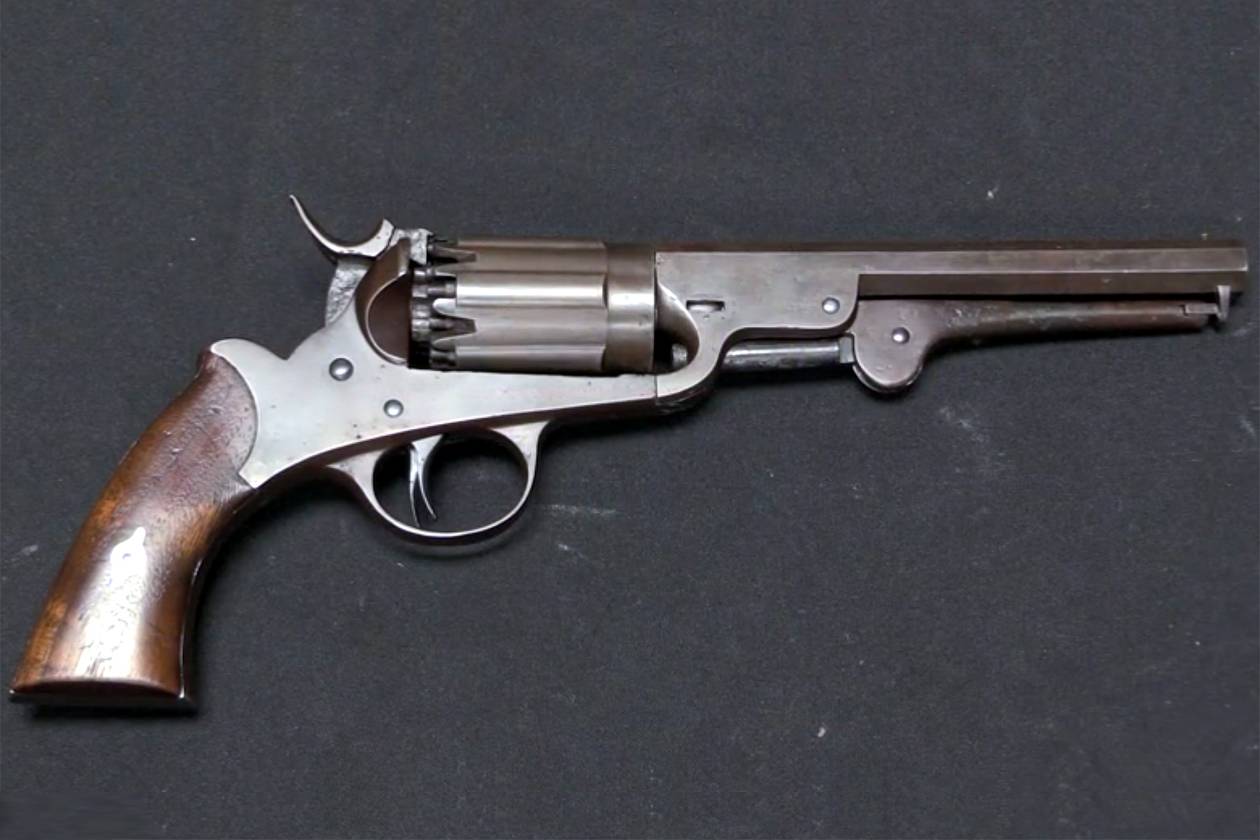
The revolver’s firing mechanism consisted of a combination of two mechanisms, each operating a separate row of firing tubes. What made it unique was that the revolver could fire either singly (one shot per trigger pull) or practically in rapid succession: after pulling the trigger the first time, the second shot could be fired with the same motion. But shooters still often confused the hammers, which is why the cylinder would get completely messed up…
Let’s say that around 1861, a clever gunsmith—a Frenchman (the French were renowned for their creativity
)—Jean Martin (the most common last name in France. Let’s say that in our world he died before that from pneumonia or sepsis, or was stabbed with a bayonet by a fearsome bearded Cossack
on Malakhov Hill—or perhaps he was slain with a yatagan by an Algerian fedayeen of Abdul-Kadir. But here he survived and perfected this glitchy system.
First, he eliminated the second trigger, using the same design as on the Le Ma revolver—a rotating firing pin to strike the second primer, igniting the rear chamber. This alone dramatically increased the reliability and safety of the design.
Second, he manufactured a Roman candle-style cartridge for this weapon—a tin tube casing with windows opposite the top charge, a wadding, and a second sealing bullet filled with rosin… This improved safety and made reloading
simpler and faster. The design wasn’t a “wunderwaffe,” but it nevertheless significantly improved effectiveness and marketability—not just a few hundred were produced, but up to ten thousand. And toward the end of the 19th century, a revolver of this type appeared chambered for a standard cartridge—a special cartridge case with a steel, um
, steel base designed for two primers, with a primer channel in the side wall—but the age of automatic firearms was already upon us.