An article by Evgeny Belash from the WARSPOT website, dated November 23, 2014.
“To the tank. They call it ‘Toteninsel’—‘Death Island.’ Only those who’ve been punished are sent there. Whoever spends a day there is excused; whoever spends two gets the Iron Cross; whoever spends three gets it with oak leaves. But there haven’t been any like that yet…”
Viktor Nekrasov, “In the Trenches of Stalingrad.”
“Tanks don’t fight in cities” is a very popular view, but… it’s incorrect. Throughout virtually their entire history—from the earliest battles to modern-day conflicts—tanks have been used in cities with varying degrees of success. From Amiens in 1918 to Baghdad in 2003 and Syria today, tanks have regularly served—and continue to serve—as the main offensive or defensive force of the opposing armies. One of the most notable examples of armored warfare in urban environments is the Battle of Stalingrad.
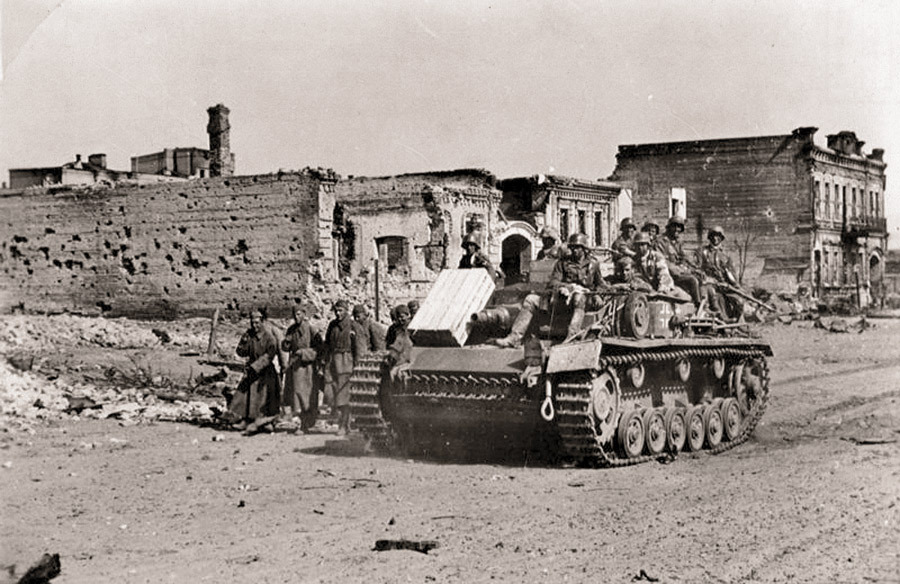
German infantrymen ride in a StuG III self-propelled gun. Stalingrad, October 1942 (Bundesarchiv)
The overall layout of Stalingrad, as Soviet officers noted after the fighting, consisted of rectangular blocks with long, straight streets. On the one hand, this layout facilitated the construction of barricades and the organization of fire support; on the other hand, given Stalingrad’s extensive stretch along the Volga and the city’s relatively narrow width, the enemy was able to fire across the entire length of the streets on a number of attack fronts.
For the assault on Stalingrad, the Germans concentrated the XIV and XXXXVIII Panzer Corps—three tank divisions. Following a meeting with Hitler on September 11, 1942, Halder wrote in his diary:
“The assault on the urban part of Stalingrad—September 14 or 15, provided adequate preparation. Time estimate: 10 days for the assault on Stalingrad. Then 14 days for regrouping. Completion—no earlier than October 1.”
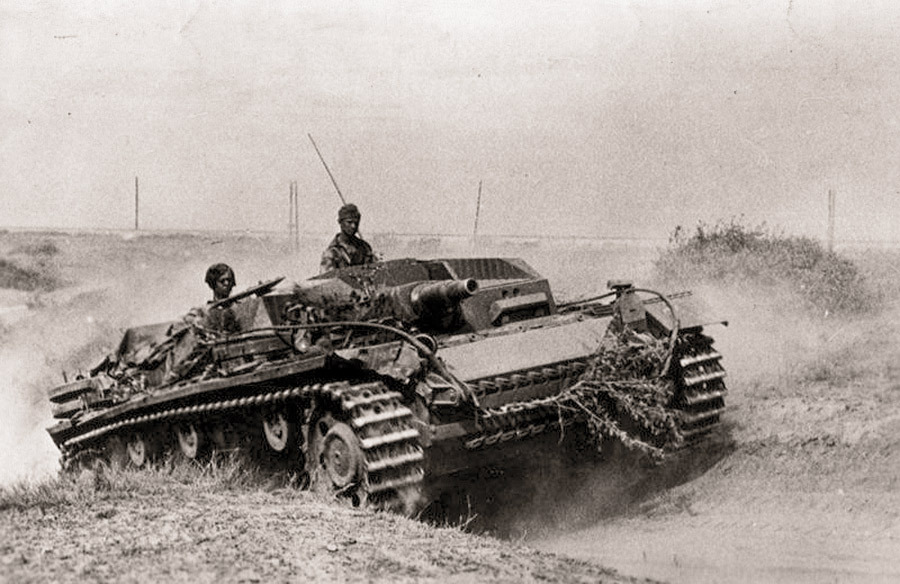
A StuG III self-propelled gun in Stalingrad, October 1942 (Bundesarchiv)
However, resistance from Soviet forces “adjusted” these plans. As of September 10, Soviet tank brigades in the Stalingrad area had 22 heavy tanks, 51 medium tanks, and 42 light and small tanks at their disposal. They were to act as “fire brigades,” compensating for the small numbers of infantry units, which had been exhausted by previous battles and constant ongoing losses.
On September 14, a KV battalion (11 vehicles), as it approached the Stalingrad train station, encountered enemy tanks (as stated in the reports, but most likely these were StuG III “Sturmgeschütz”) and immediately knocked out three vehicles. However, while attempting to capitalize on their success, the Soviet tankers lost one KV to enemy fire from artillery and “heavy tanks,” and another was burned out, forcing them to retreat. On September 17 alone, the Stalingrad train station changed hands four times, and on the battlefield (according to Soviet reports) there were 8 “destroyed and burned” German tanks and up to 100 corpses of soldiers and officers. On September 27, 12 T-34 tanks, counterattacking the enemy as it broke through toward the village of Krasny Oktyabr, managed to stabilize the latest defensive crisis for a time.
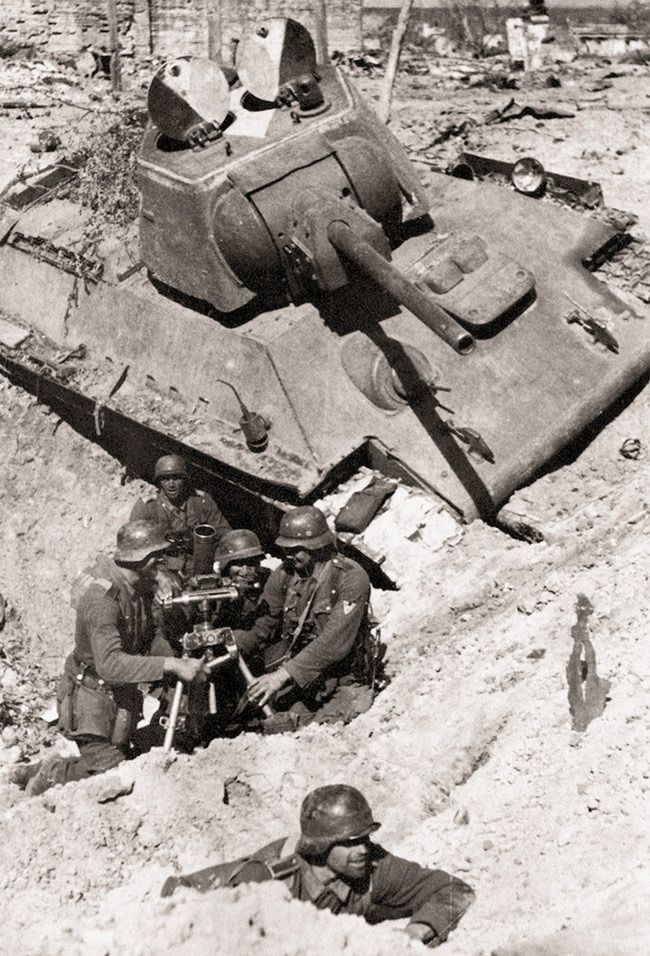
A German mortar crew prepares to open fire during the Battle of Stalingrad. Their position is set up in a crater in front of a disabled Soviet T-34 tank (http://worldwartwo.filminspector.com)
According to Dr. Luis DiMarco, Ph.D. in History, the three tank divisions were a key factor in the tactical successes of the German 6th Army. Soviet reports often cite situations such as “…four enemy heavy tanks setting houses on fire with thermite shells” as the reason for German successes. However, in urban conditions, the tank divisions were forced to split into small groups working in close coordination with the infantry—up to 20–30 tanks per infantry regiment. On streets blocked by barricades, littered with building debris, and pockmarked with craters, the Germans were unable to carry out their usual deep tank breakthroughs; therefore, their attacks consistently focused on individual strongpoints.
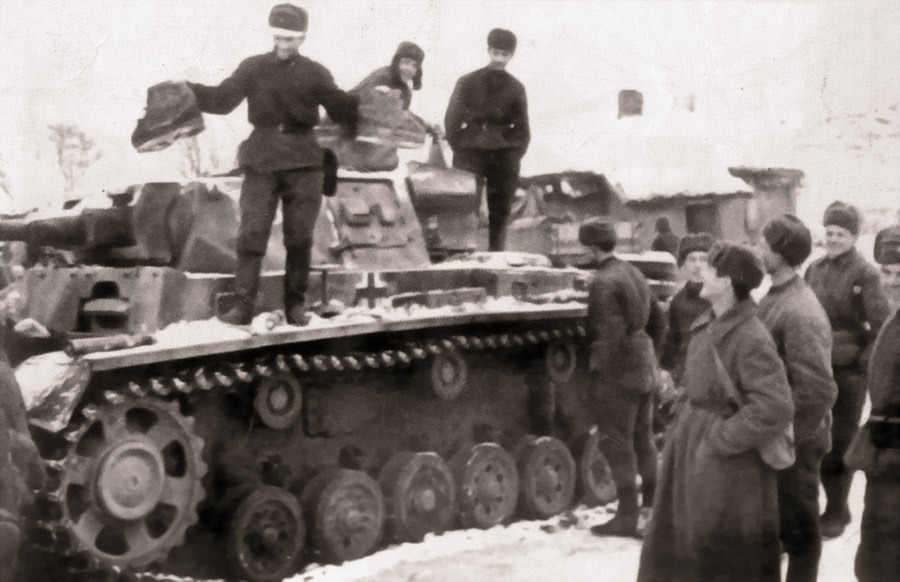
Soviet soldiers retrieve homemade German shoes from a damaged German Pz.Kpfw. III tank. Stalingrad, November 1942 (http://waralbum.ru)
According to Soviet accounts, typical German attacks at Stalingrad followed this pattern: First, based on intelligence reports, thorough aerial and artillery preparation was carried out, and then tanks appeared on a narrow section of the front. The first group of tanks, emerging from cover, fired on the move and attempted to draw anti-tank fire upon themselves. Artillery, mortars, and airstrikes concentrated their fire on the guns and anti-tank weapons that had revealed their positions. After the second barrage, the main body of tanks, staggered in depth, advanced with infantry support. Some of the tanks used fences or building ruins for cover. “Heavy tanks” (according to Soviet assessments) often approached cover to within 30–40 meters and opened fire at point-blank range. “Light and medium tanks” fired from a greater distance—150–200 m. Separate infantry groups, reinforced by tanks and close-combat weapons, blocked strongpoints that had not yet been occupied. Basements were often filled with smoke grenades and sometimes blown up.
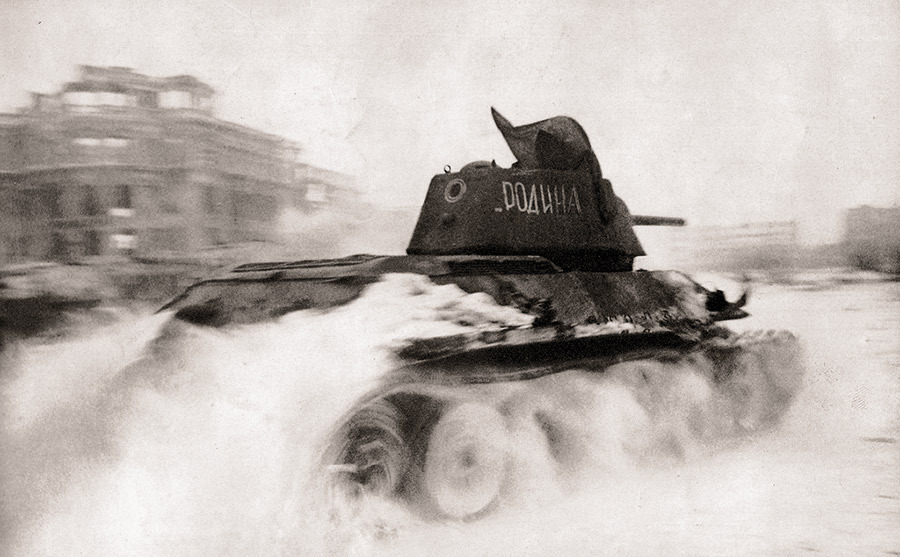
A T-34 tank named “Rodina” on the Square of the Fallen Fighters in Stalingrad. January 1943 (http://mediananny.com)
For their part, Soviet troops usually tried to take up defensive positions in sturdy stone buildings. During air raids and artillery barrages, our garrisons (ranging in size from a squad to a company) took shelter in covered crevices. Tank destroyers set up ambushes along likely routes of armored vehicle movement. All approaches were covered by anti-tank and anti-infantry obstacles. The gaps between buildings were covered by layered fire. Artillery and machine guns often operated in a “dagger-like” manner, firing at point-blank range and quickly changing positions. The guns would roll out of cover, fire several rounds, and then hide again. The crew of a single regimental gun alone reported destroying three German tanks in half a month. Flamethrowers, ampule launchers, company mortars, and snipers were widely used.
Soviet tanks were typically used in defensive operations as stationary armored firing positions. Foxholes were dug around and near the tanks, and infantry fire units were concentrated in the area. To ensure a circular field of fire, the tanks were positioned either at street intersections or in squares. Separate tank units waited deep within the defensive line—as an anti-tank reserve. According to the notes of V.I. Koroteev, an eyewitness to the defense,
“…at headquarters, particular attention was paid to coordinating the interaction between infantry, tanks, and engineer units, as well as between ground forces and the air force.”
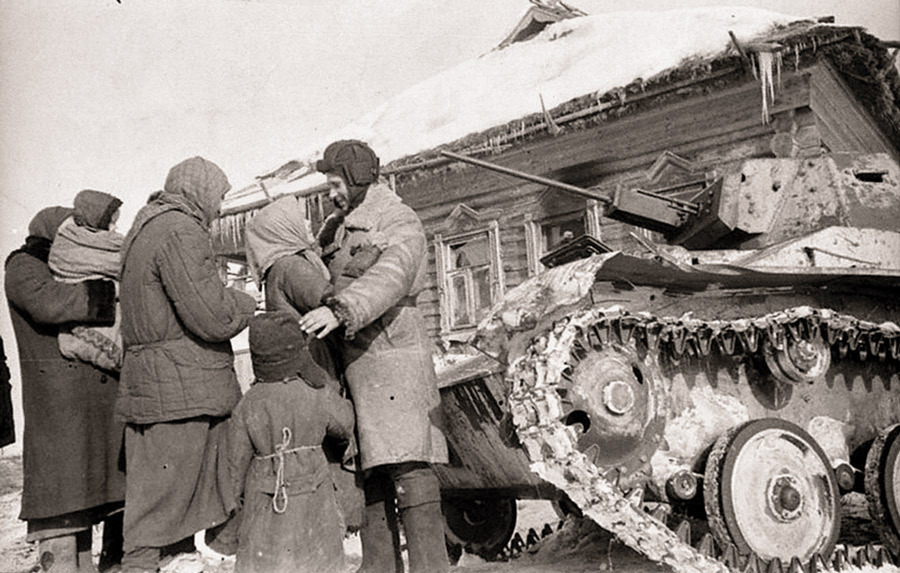
Soviet T-60 light tank, near Stalingrad, 1943 (http://nevsepic.com.ua)
Examples of successful urban defense tactics against tanks include the battles for the stronghold near the “Barrikady” factory and Aeroportovsky Park.
In early October, a platoon of the 347th Rifle Regiment was defending a stone building. Trenches and bunkers had been dug 70–100 meters from the building and were connected to it by covered passageways. When the Germans began bombing and shelling the strongpoint, the garrison, responding to a prearranged signal, quietly and quickly moved into the embrasures, trenches, and bunkers. Only the lookouts remained at their posts. Two German “heavy tanks” appeared and opened fire at point-blank range at the building’s windows, doors, and embrasures. The defenders did not fire, biding their time. At a signal from the lookouts, assault teams rushed toward the tanks along the communication trenches and pelted the vehicles with bottles containing an incendiary mixture. One tank was destroyed, and the second withdrew from the battlefield. At that moment, other enemy tanks accompanied by infantry approached and opened fire from a distance of 400–500 meters. But the garrison did not respond to the fire, and the Germans concluded that resistance had been suppressed, so they launched an attack. However, the defenders had left a small screen in front of their lines, while their main forces moved along the communication lines to flank the attackers and launched a counterattack. In the brief battle, according to Soviet reports, the Germans lost one heavy and two medium tanks (destroyed), with 27 killed and wounded. Over the course of the day, four attacks were repelled in the same manner; the garrison suffered two killed and five wounded. Over five days of continuous fighting, the building sustained 12 direct hits from aerial bombs and up to 30 hits from shells and mines. In total, the garrison repelled 17 attacks.
Aeroportovsky Park was defended by units of the 339th Rifle Regiment. On October 5, the Germans attacked three times, but each time two machine guns cut off the German infantry with crossfire. Tanks that had pushed ahead, left without infantry support, quickly turned back, with some of them hitting landmines or coming under fire from anti-tank gunners.
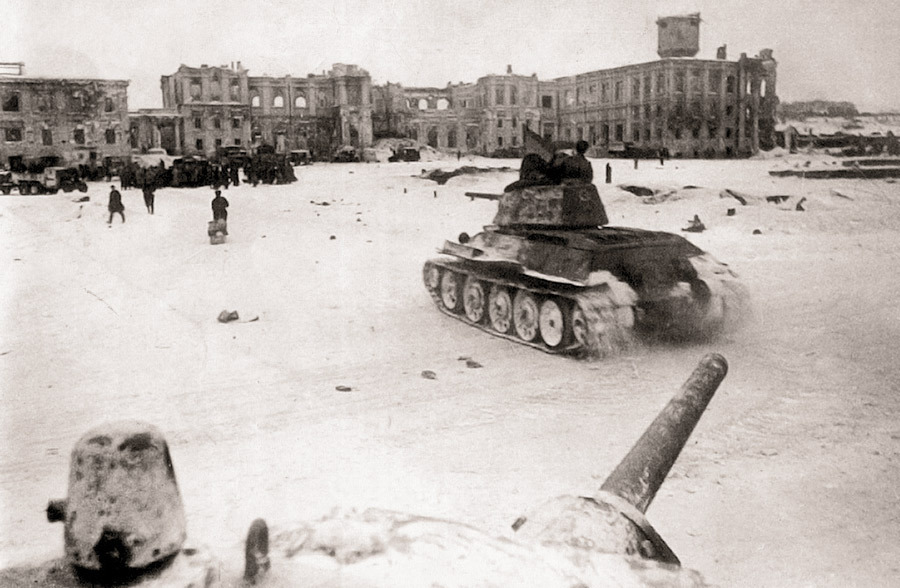
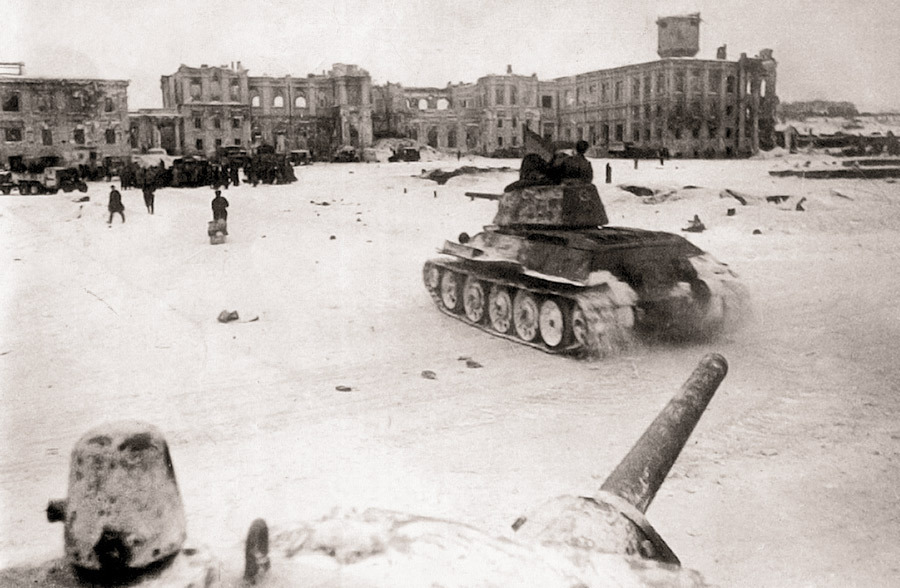
The central square of Stalingrad on the day of the German forces’ surrender in the Battle of Stalingrad. January 31, 1943 (http://waralbum.ru)
Having deduced the direction of the Germans’ next attack based on intelligence reports, Soviet troops arranged 450 bottles filled with a flammable mixture in a staggered pattern at the northwest corner of the park, camouflaging them to “blend in with the general appearance of the street.” Several bottles were placed upright so that firing at them would set the entire field of bottles ablaze.
In the afternoon of October 8, five German tanks and up to two infantry companies launched an attack. The lead tank drove at full speed into the bottle field and, after crushing several bottles, showered its engine crew and the tank following behind with clumps of earth and debris soaked in flammable liquid. Both tanks burst into flames. The infantrymen riding on the tanks jumped to the ground but landed in the burning liquid. The remaining bottles burst from the heat, creating a “powerful wall of fire” several meters high. Fire was opened on the Germans, who had huddled together in a heap. As a result of the battle, the Germans lost three tanks, with more than 25 soldiers killed or wounded and about 35 burned to death or severely scorched.
The Germans continued to capture territory in the city, but each advance took far more time and claimed far more casualties than they had planned. While at the start of the Battle of Stalingrad the Germans were advancing up to two kilometers a day, their progress later slowed to tens of meters, and eventually came to a complete halt.
On the defensive, the Germans also used tanks as stationary firing positions, placing them in houses or earthen shelters. Vasily Grossman’s frontline notes state:
“When the Germans captured one of the workshops [at the tractor factory—ed.], they managed to hoist a malfunctioning tank to a certain height and fired from a window in the workshop.”
However, there is no such passage in the supporting documents.
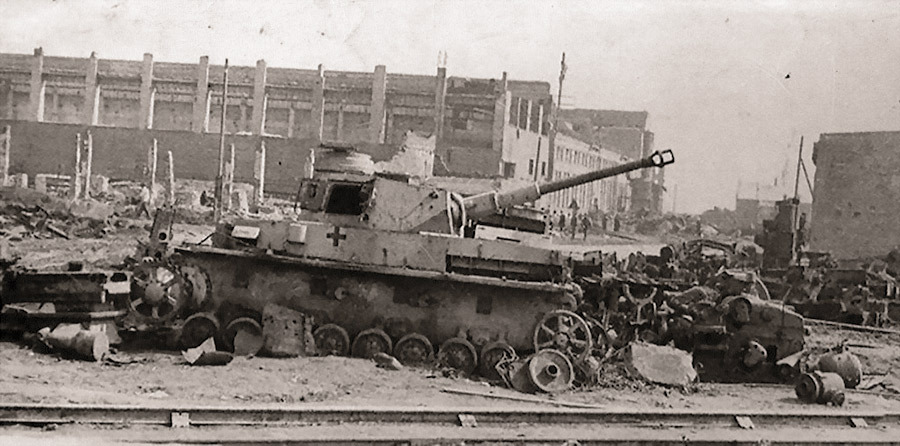
Destroyed German military vehicles near the tractor factory (http://fotowarmotors.ru)
While fierce fighting raged in the city itself for every single house, new Soviet units were secretly concentrating on the flanks of the German force. The counteroffensive at Stalingrad, which culminated in a closed ring encircling the German 6th Army and the forces of Nazi Germany’s allies, became a classic example of maneuver warfare.
In the final battles at the end of January 1943 against the encircled German units, tanks once again played a very active role. Here is an eyewitness account from the German side:
“At night, everything shakes from the rumble. Around midnight, Russian tanks storm into our area. Their tracks rattle incessantly on the pavement. Not a single anti-tank gun, not a single German artillery piece, prevents the T-34s from roaming freely in every direction. Machine-gunners mounted on the armor jump down, engage in combat within our positions, and drive our soldiers out of individual houses; in a matter of minutes, they destroy command posts and entire headquarters that, just a short while ago, felt completely safe… Up ahead, in front of the building, tanks are once again positioned and firing in a fan pattern across the terrain. Shots of shells are flying down the street; all exits are under fire.”
These were the last events that took place before the author was taken prisoner.
Sources:
-
-
- Dimarco, Louis. *Concrete Hell: Urban Warfare From Stalingrad to Iraq*. Osprey Publishing, 2012.
- The Battles of Stalingrad: Lessons from the Great Patriotic War. Colonel M.V. Savin and Lieutenant Colonel V.M. Kravtsov. – Moscow: Voenizdat, 1944.
- Welz, G. The Soldiers Who Were Betrayed. – Smolensk: Rusich, 1999.
- Grossman, V.S. The War Years. – Moscow: Pravda, 1989.
- Isaev, A.V. Stalingrad: Beyond the Volga, There Is No Land for Us. – Moscow: Yauza, Eksmo, 2008.
- Koroteev, V.I. Essays on Stalingrad. – Moscow: Voenizdat, 1954.
- Nekrasov, V.P. In the Trenches of Stalingrad. – Moscow: Russkaya Kniga, 1995.
-