57 Millimeters Against a Small Drone: Why Russia Built the Derivatsiya-PVO — and Why a Big Gun Alone Is Not Enough

After nine years on the exhibition circuit, Russia’s 2S38 has resurfaced in a photograph reportedly taken during a major military exercise. On paper, it can destroy drones at ranges of up to six kilometers, but the vehicle’s real value depends less on the size of its gun than on whether Russian industry can mass-produce the “smart” ammunition it requires.
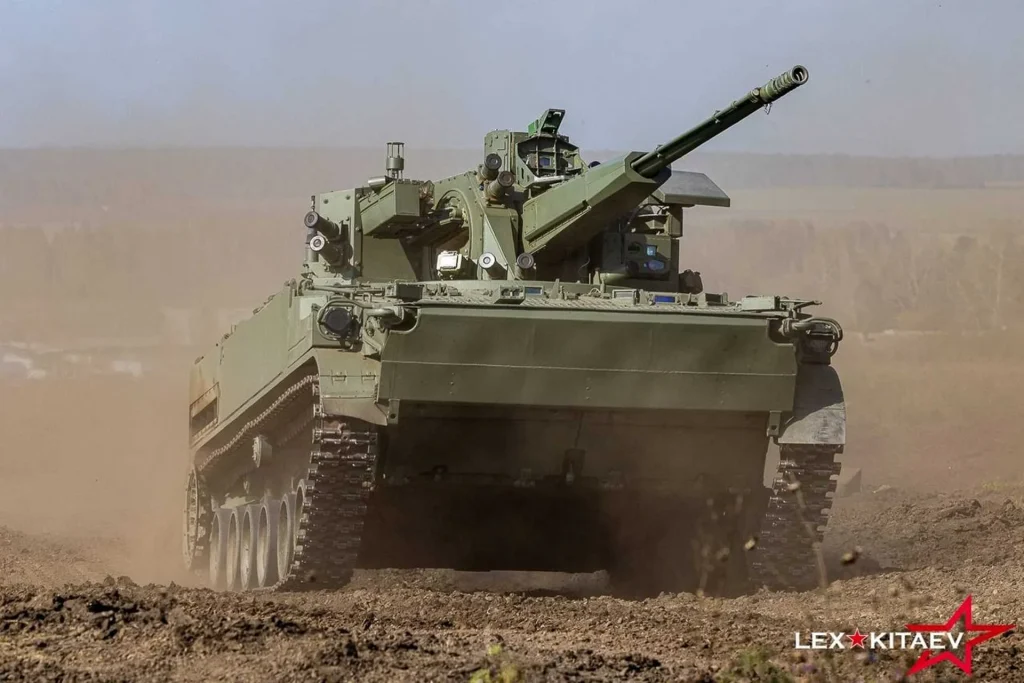
A photograph recently appeared online showing an unusual BMP-3-based vehicle with a long 57 mm gun, reportedly taken during the Center-2026 exercises in early October. The vehicle was the 2S38 Derivatsiya-PVO, a self-propelled anti-aircraft system first unveiled in 2017, then repeatedly displayed at exhibitions and parades, subjected to trials and declared almost ready on several occasions. The new image suggests that the project has not been abandoned, but it does not answer the two most important questions: is the Derivatsiya actually being mass-produced, and can it reliably shoot down small drones? There is still no confirmed information about live firing during the exercise or deliveries to operational units.
The renewed interest in the vehicle is easy to understand. Small drones have forced armies to rediscover anti-aircraft guns. A missile can destroy an unmanned aircraft, but using an expensive guided weapon against every inexpensive drone is economically unsustainable. Machine guns and smaller automatic cannon are cheaper, but they require a direct hit or an extremely dense burst. Derivatsiya-PVO proposes a third approach: fire fewer, larger projectiles designed to explode near the target and envelop it in a cloud of fragments.
Why Does an Anti-Aircraft Gun Need a 57 mm Caliber?
At first glance, the choice appears excessive. Most modern self-propelled anti-aircraft guns use 30–35 mm weapons. They fire faster, carry more ammunition and already employ programmable rounds. A 57 mm projectile, however, offers an advantage that becomes especially valuable against small aerial targets: its larger body can accommodate more explosive, more preformed fragments and a fully programmable fuze.
A conventional shell has to strike a drone directly, which is no easy task. Even a relatively large reconnaissance UAV occupies only a tiny patch of sky when seen from several kilometers away. It changes altitude, encounters gusting winds and may maneuver suddenly. A programmable airburst projectile does not require a direct hit. The fire-control system measures the range, calculates an intercept point and programs the fuze before the round leaves the barrel. The shell detonates near the target, creating a cone or cloud of fragments. A handful of hits may be enough to destroy a lightweight airframe, exposed propellers, an engine, optics or antennas.
This type of ammunition is central to the logic behind Derivatsiya. Its 2A90 cannon traces its lineage to the Soviet S-60 57 mm anti-aircraft gun, but is installed in an unmanned, remotely operated turret. The advertised rate of fire is up to 120 rounds per minute, with 148 rounds carried aboard. That is far less than the torrent produced by older small-caliber anti-aircraft guns. In theory, however, each explosion covers a substantial volume of air, allowing a battery to engage a target with a short series of rounds rather than a prolonged burst.
Published specifications claim a maximum range of six kilometers against aerial targets, an engagement altitude of 4.5 kilometers and a maximum target speed of 500 meters per second. These figures describe the system’s theoretical limits, not a guaranteed kill range against every type of drone. A small quadcopter is far harder to detect and track than an aircraft or helicopter. Before the large gun can demonstrate its range, the vehicle must first find a small target and determine its position with sufficient accuracy.
An Anti-Aircraft Vehicle That Does Not Switch On a Radar
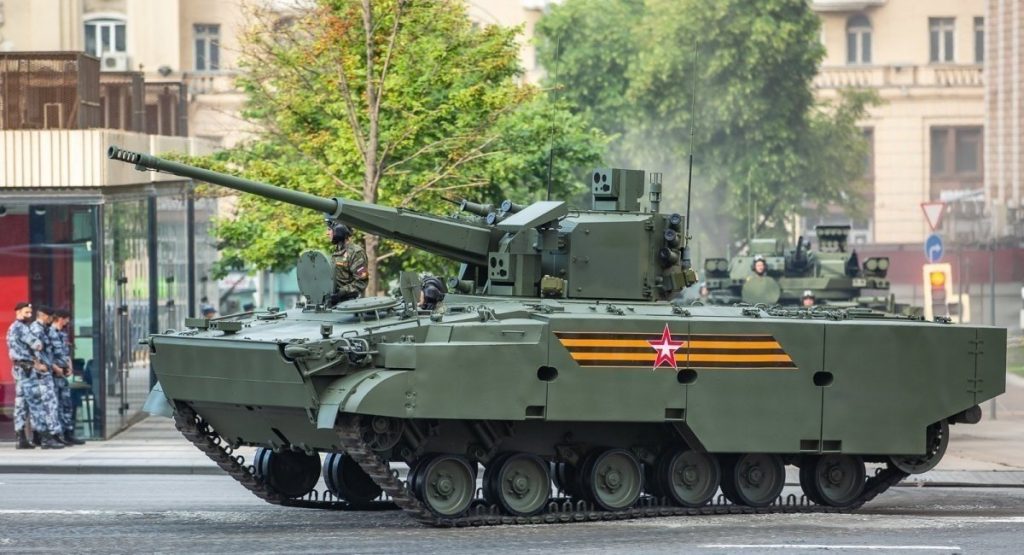
The most unusual feature of the 2S38 is not its gun. The vehicle has no onboard surveillance radar constantly scanning the sky. Targets are supposed to be detected and tracked by a passive electro-optical system incorporating television and thermal-imaging channels, a laser rangefinder and automatic target tracking.
This arrangement has an obvious advantage. A radar reveals the vehicle’s presence through its emissions, while optical sensors can observe without broadcasting radio signals. Derivatsiya can remain invisible to electronic intelligence systems until it opens fire, and its sight is not affected by conventional radio-frequency jamming in the same way as radar. Removing a large radar also simplifies the combat vehicle and reduces its cost.
The price of that concealment is restricted awareness. Rain, fog, smoke, dust, vegetation and a hot background all reduce the effectiveness of television and thermal sensors. A narrow field of view helps identify a distant target, but the target must first be found somewhere in the vast sky. Optics alone may be insufficient for independent protection of a site. An effective Derivatsiya unit would need warning from external radars, observation posts or the wider air-defense network, allowing its sensors to be pointed toward the correct sector before attempting to acquire and track the target.
The absence of radar is therefore neither an unqualified advantage nor an automatic flaw. As part of a network, a passive vehicle could set a highly effective ambush. Operating alone, it might detect a low-flying drone too late, particularly if the target approaches behind trees, buildings or folds in the terrain.
The Projectile Matters More Than the Vehicle
The BMP-3 chassis, automatic cannon and optical sight are not the project’s principal technological challenge. The most difficult element is a mass-produced 57 mm round with a reliable programmable fuze. The fuze must survive the enormous acceleration of firing, receive data from the programmer, count down fractions of a second and function precisely where its fragmentation pattern will intersect the target. An error of only a few dozen meters turns an expensive “smart” shell into an ordinary explosion in empty sky.
For years, Russian developers have discussed two types of advanced ammunition: a multipurpose round with a programmable fuze and a guided projectile corrected in flight along a laser beam. The first appears more practical for defeating drones in large numbers. The second promises greater accuracy but makes the round significantly more complicated and expensive. In 2020, Rostec said that a family of ammunition had been developed for Derivatsiya, including an airburst round. In April 2024, however, the corporation was still discussing work on 57 mm fragmentation rounds with controlled detonation. The difference in wording does not prove that the technology failed, but it highlights the gap between producing an experimental projectile and sustaining mass production.
Without such ammunition, much of the rationale for the 57 mm caliber disappears. The vehicle remains a powerful gun platform capable of engaging light armored vehicles, ground positions and larger aerial targets, but against small drones it must once again achieve an almost direct hit. The large shell becomes expensive, ammunition is rapidly consumed and the comparatively low rate of fire begins to work against the system.
Why Derivatsiya Cannot Simply Replace Shilka and Tunguska
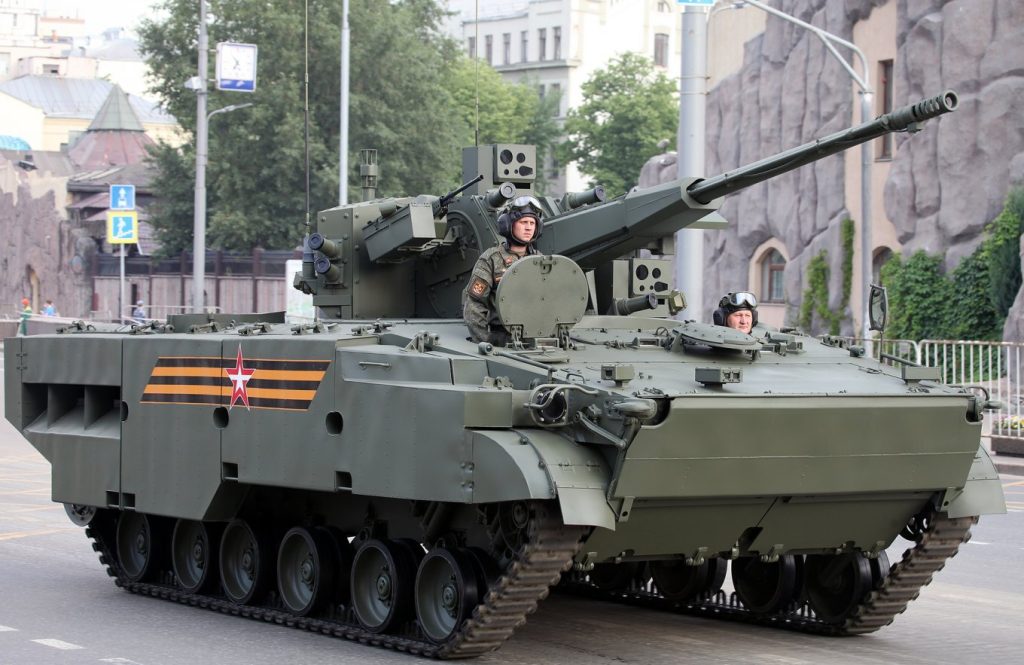
Early presentations described the 2S38 as a future replacement for the Soviet ZSU-23-4 Shilka and 2S6 Tunguska. That comparison works well in advertising but conceals major differences between the vehicles. Shilka produces an extremely dense stream of 23 mm fire at close range. Tunguska combines cannon with missiles and carries its own radar equipment, enabling it to detect targets and select a weapon according to range. Derivatsiya relies on a single 57 mm gun, passive sensors and external target designation.
It could occupy a useful position between machine guns, small-caliber cannon and surface-to-air missiles, but only as part of a layered defense. Radar posts detect approaching aircraft, electronic-warfare systems attempt to disrupt their control links, guns destroy targets within their engagement zone, and missiles remain available for faster or more distant threats. A single 2S38 cannot perform all these tasks, regardless of how impressive its gun may appear.
In this respect, the Russian project follows a global trend. Germany’s Skyranger and American mobile short-range air-defense systems are also returning automatic cannon to battlefield air defense, combining them with programmable ammunition, radar, optical sensors and, in some cases, missiles. The difference is that Western systems already have confirmed orders, deliveries or documented troop-level firing exercises, while Derivatsiya’s status remains unclear.
Nine Years Between the Exhibition and the Exercise
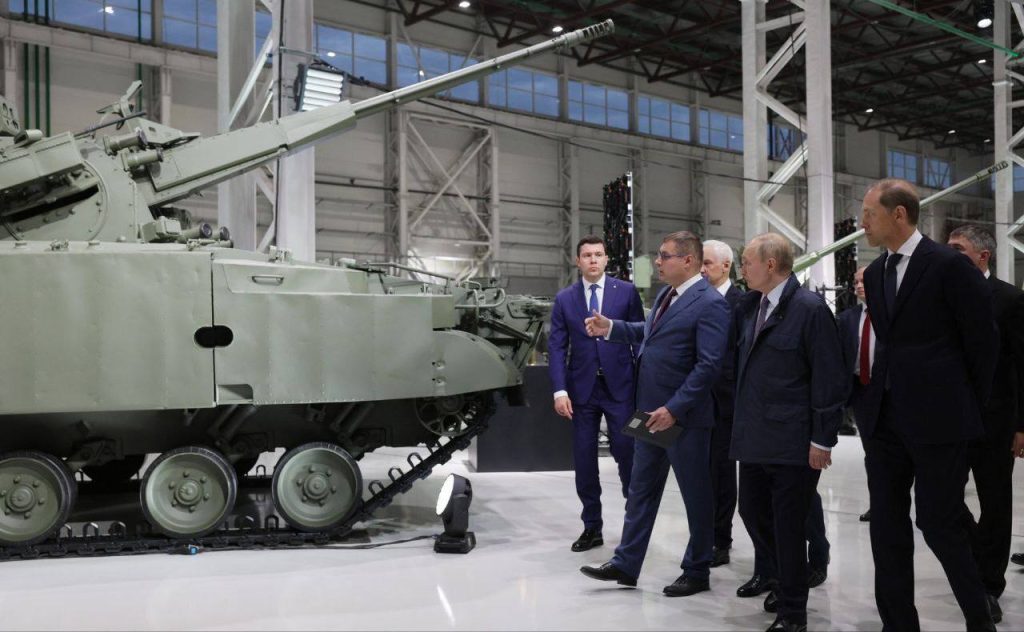
A Derivatsiya-PVO model was shown in 2017, followed by a full prototype in 2018. The system was still undergoing state trials in 2020. Rostec announced the completion of development in 2023 and said in 2024 that it wanted to accelerate deliveries. The vehicle nevertheless continued to appear at exhibitions and parades without any public information about the size of a production run. The photograph reportedly taken at Center-2026 adds another episode to that history, but it does not by itself transform a prototype into an operational system.
The 2S38 has genuine potential. A large programmable projectile could create a lethal fragmentation pattern around a drone, passive optics permit operation without radar emissions, and the BMP-3 chassis gives the vehicle mobility comparable to the armored formations it is meant to accompany. Yet a long chain separates a promising concept from an effective battlefield system: mass-produced fuzes, an accurate fire-control system, external target designation, trained crews, ammunition-resupply vehicles and enough combat vehicles to provide continuous coverage.
Derivatsiya-PVO attempts to solve a modern problem with a gun whose lineage reaches back to the middle of the last century. That does not make the project obsolete: modern electronics and programmable ammunition can completely transform the capabilities of an old caliber. After nine years in public view, however, the real proof of success would no longer be another photograph from a training ground. It would be a production vehicle detecting a small target, firing a handful of rounds and leaving nothing in the sky but a cloud of fragments.