It has the hull of an infantry fighting vehicle, but instead of the familiar turret, it carries a bank of launch tubes for 220 mm rockets. An unusual conversion has appeared in Afghanistan: the launcher assembly from an Uragan multiple launch rocket system has been mounted on a tracked BMP chassis. The result combines two Soviet vehicles originally designed for very different jobs.
Defense Express identifies the chassis as a BMP-2D. An earlier report by Militarnyi is more cautious, describing it as a BMP-1 or BMP-2 chassis. The exact variant should therefore be treated as provisionally identified.
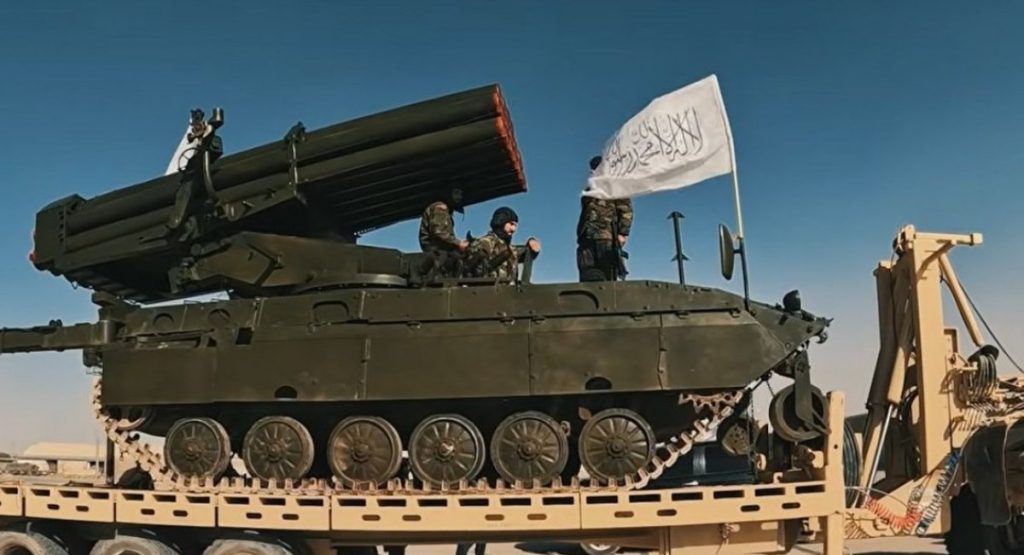
What is known about the vehicle:
- Type: improvised tracked multiple launch rocket system.
- Chassis: reportedly a BMP-2D; the exact variant has not been independently confirmed.
- Armament: launcher assembly from the BM-27 Uragan MLRS.
- Calibre: 220 mm.
- Weapon installation: in place of the BMP’s original turret.
- Weight, speed, operational range, and crew size following conversion: not published.
- Fire-control system: no information indicating an upgrade has been released.
Why Uragan Needed Tracks
The logic behind such a transplant is easy to understand. A serviceable launcher is useless if the vehicle beneath it can no longer reach a firing position. When spare parts are scarce, replacing the carrier may be more practical than restoring the original chassis.
Defense Express links the hybrid’s appearance to the difficulty of maintaining Uragan’s standard wheeled chassis. A tracked armoured vehicle offers a potential way to preserve the launcher’s mobility away from good roads.
Tracks do not guarantee success on every type of terrain, however. The converted vehicle’s weight, the condition of its engine and running gear, and its weight distribution all matter. A chassis that performed reliably as an IFV may behave differently after receiving new armament. The original armoured vehicle’s published specifications therefore cannot simply be applied to this hybrid.
The conversion appears intended to solve a specific problem: provide an available self-propelled platform for an existing artillery assembly. How successfully it does so is difficult to judge from a single public appearance.
A New Chassis Does Not Make the Rockets More Accurate
The most visible change concerns the carrier. No information has been published about new ammunition, a modern fire-control system, or improved accuracy for this vehicle.
This is primarily an attempt to keep existing weapons operational or adapt them to local conditions. A chassis change can affect mobility and ease of operation, but does not inherently increase firing range or accuracy.
The crew’s day-to-day work remains another unanswered question. The launcher must be maintained, reloaded, and repaired. Displaying an unusual vehicle does not reveal how much time it remains serviceable or how convenient it is to operate.
Combining What Is Available
The tracked Uragan did not appear alone. The published material also showed Grad launchers transferred onto American Navistar trucks. That is another approach to a similar problem: retaining the launcher while replacing its automotive platform.
Such hybrids illustrate the challenges of operating a mixed inheritance of military equipment. Workshops have vehicles from different generations and countries of origin. Some still run, others retain usable weapons, and others can provide spare parts.
Under those conditions, value lies in a combination that can be assembled and kept working. But a one-off conversion creates a problem of its own: its non-standard components will have to be maintained by the same workshops that built it. The fewer similar vehicles there are, the harder it becomes to standardise repairs.
Did Russia Help?
Defense Express raises the question but provides no confirmation of Russian involvement in the conversion. Combining two Soviet vehicles does not, by itself, establish who carried out the work.
The publication also acknowledges that the hybrid could have been produced locally, pointing to other Afghan equipment conversions. Foreign assistance remains a possibility rather than an established fact.
For now, the vehicle is most interesting as an example of technical improvisation. An Uragan launcher has been fitted to a tracked carrier. The next question is more practical than its appearance: can this hybrid regularly deploy, perform its mission, and return to service after maintenance?