Glukharev's Jet Engine for Backpack Helicopters. Why Didn't It Become Widely Used?

As is well known, the more moving parts an engine has, the higher the likelihood that any one of them will fail—not to mention the wear and tear caused by friction. Following this logic, we conclude that an engine with no moving parts at all has much greater potential—that is, it can run longer without breaking down, since there is nothing to break.
That is precisely what makes Glukharev’s jet ENGINE—or “converter engine”—so appealing. It was invented in 1952 by Eugene Michael Glukharev, an American engineer and the son of a Russian émigré.
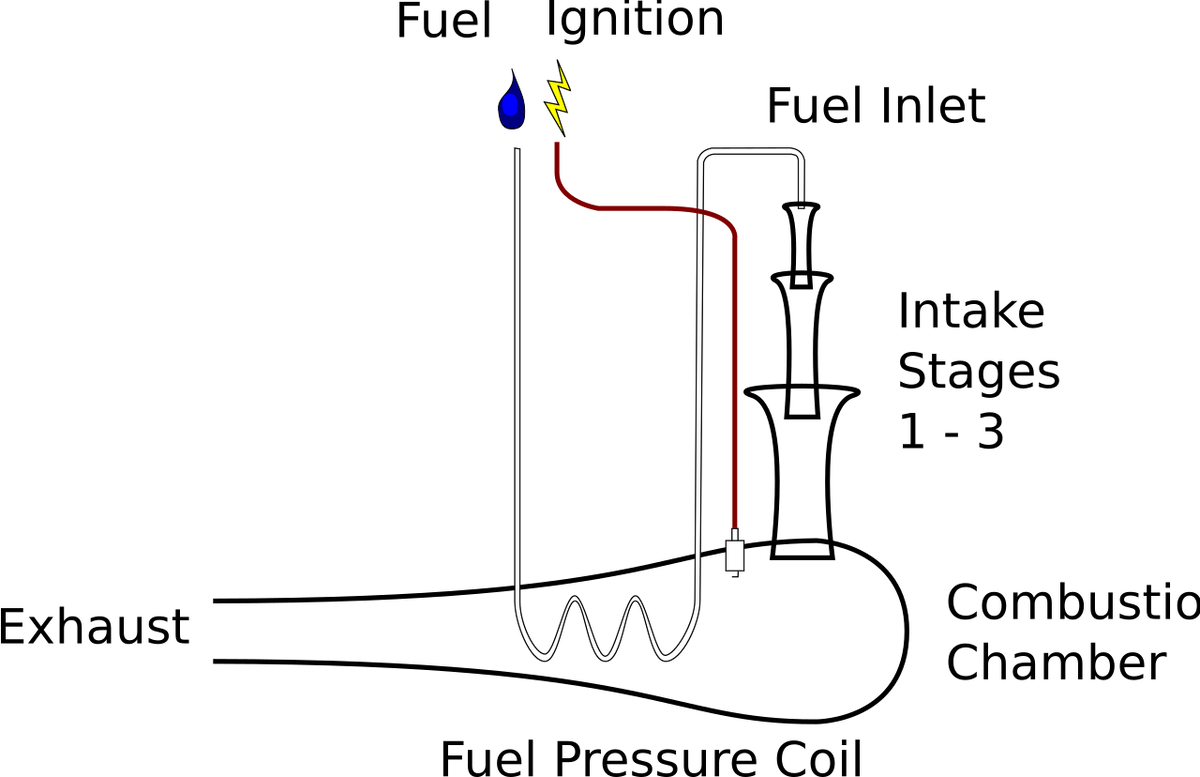
The engine works as follows: there is a spiral tube in the combustion chamber that heats the fuel (propane) before it is fed into the air-fuel chamber. In the combustion chamber, the fuel-air mixture ignites and burns, creating thrust as it exits through the exhaust pipe. The fuel-air mixture is fed and compressed by the pressure of the propane as it is supplied, as well as by the sound waves generated during combustion that act on the intake pipes.
Similar systems were described as early as the 1940s, though they were based on the direct-flow air-jet principle and were not very efficient. Gluharev, however, introduced several innovations—in particular, his engine had three intake stages that were controlled by the intensity of the sound waves generated during fuel combustion. The intake and exhaust ports are configured so that the location of the pressure antinodes of the MAH RINGS in the propane flow corresponds to the location of the intake ports. Thus, atmospheric pressure maximizes the air inflow.
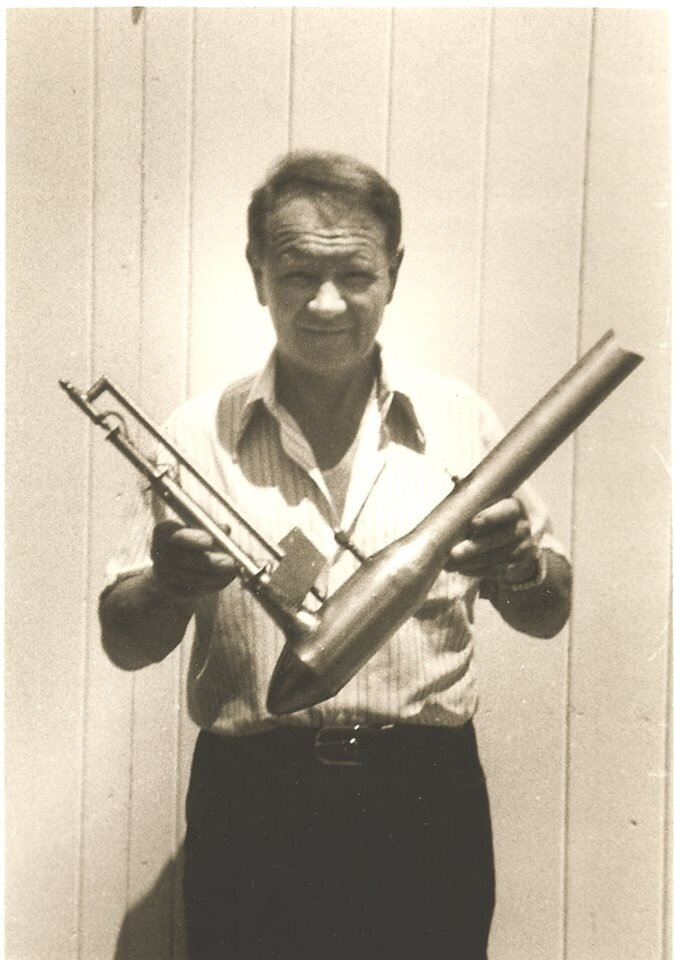
Eugene Michael Glukharev
There are a number of obvious advantages to this type of engine—in addition to having no moving parts, it can be easily adjusted using a valve in the fuel line. Since it runs on pure propane, there is no carbon buildup and very low levels of harmful combustion byproducts. The engine is simple; you can assemble it yourself, even on the fly, using ready-made blueprints or kits. And its compact size makes it suitable for installation on helicopter rotors or aircraft tail stabilizers.
But there are also obvious drawbacks—for maximum efficiency, the engines must be tuned using audio signals. And yes, it is indeed very noisy. Furthermore, since the engine’s moving parts heat up to a bright orange glow as a result of propane combustion, this creates a number of problems related to both wear and tear (alas!) and fire hazard.
Gluharev himself used his invention to create the MEG-1X backpack helicopter. Later, attempts were made to install them on helicopters, which were given the name “Tip Jet.”
Several articles note that Glukharev’s backpack weighed 104 kilograms (I think this is a mistake, or a comma is missing somewhere).
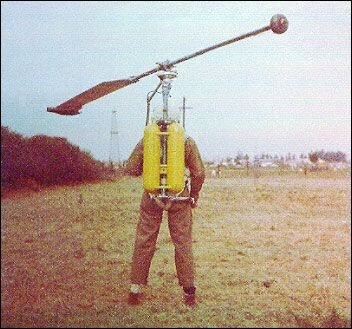
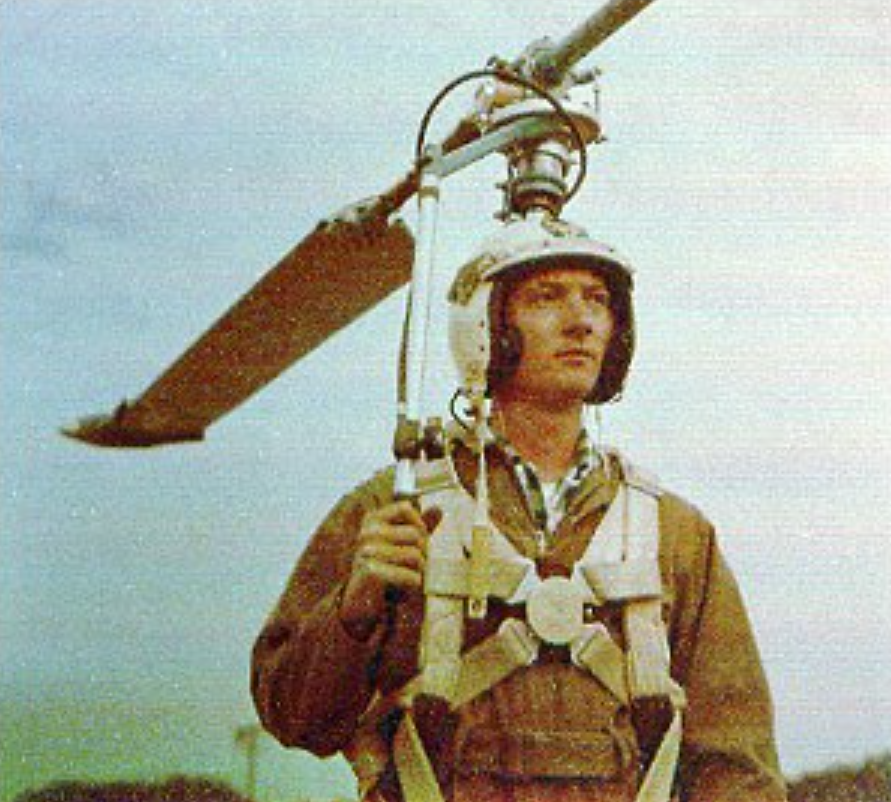
A distinctive feature of the design was that the helicopter had only one rotor blade with a single engine at one end, while a counterweight was positioned at the other end to maintain balance. Behind the pilot were propane tanks.
This aircraft reached a speed of nearly 90 kilometers per hour, flew at an altitude of 1.5 kilometers (though this figure is not exact), and remained airborne for 18 minutes.
Eugene Michael Glukharev (April 5, 1916 – July 15, 1994) was an American engineer and inventor.
He was born in Petrograd to a family of aviation engineers. After the revolution, he moved to the United States with his parents. There, his father found a job at the United Aircraft Corporation, working for another émigré, Igor Ivanovich Sikorsky.
His son, after graduating from Rensselaer Polytechnic Institute with a Bachelor of Science degree in aeronautical engineering, also joined Sikorsky Aircraft. There, he designed helicopters and later began working on a pulsejet engine.
Gluhareff Jr. then went to work for American Helicopter in California. There, he continued building helicopters, after which he decided to start his own company, Gluhareff Helicopters.
Beginning in 1960, he collaborated with the U.S. Navy, working on the development of unmanned aerial vehicles with rotary wings. He then joined Douglas, where he worked as a design engineer on the development of the S-4 stage of the Saturn rocket (as part of the Apollo program).
But from 1972 until his death, he worked at his own company, EMG Engineering. In the early 1990s, he created the “flying motorcycle”—the EMG-300—which he spent another four years trying to perfect, and he died while working on it.
Source — https://dzen.ru/a/aFzyMv2J7hndytyN