The plan looked almost exemplary. Instead of launching another decade-long development program, Germany decided to take the well-established Airbus H145M light helicopter, fit it with a modular weapons system, and rapidly field a relatively inexpensive combat aircraft. The H145 already serves with emergency medical services, police forces, and militaries worldwide. Its production line is active, while several countries already operate the military version.
However, problems emerged precisely in the area that was supposed to transform a reliable utility helicopter into an attack platform. According to German media reports citing a confidential Federal Court of Auditors document, the H145M cannot yet safely employ its intended 20 mm cannon, while tests of the Spike ER2 anti-tank missile had to be suspended because of technical failures.
The helicopters are already being delivered and can perform training, reconnaissance, and transport missions, but their full combat capability has been delayed.
German journalists summarized the situation rather simply: the H145M can fly, but it cannot fight yet.

How Germany tried to avoid another Tiger problem
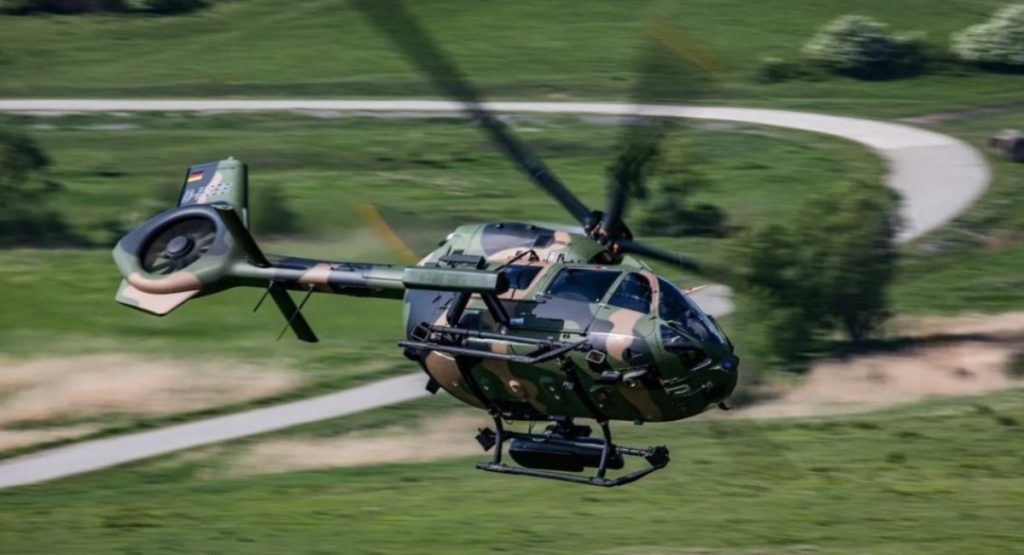
The H145M program began as an attempt to escape the familiar cycle of European defense projects in which schedules and costs grow faster than operational capabilities. Germany’s Tiger attack helicopters proved expensive to operate, difficult to maintain, and regularly suffered from poor availability. Berlin eventually rejected a major Tiger modernization and began searching for a simpler aircraft capable of performing training, reconnaissance, and light attack missions.
Instead of purchasing a specialized heavy attack helicopter such as the AH-64 Apache, Germany selected a military development of the civilian Airbus H145. The concept was not inherently unreasonable. The H145M was already serving with German special forces, while related versions were being operated by Hungary, Serbia, and Thailand. The helicopter offered high availability, comparatively straightforward maintenance, and the ability to operate from small landing sites.
In December 2023, Germany ordered 62 H145Ms in the Leichter Kampfhubschrauber, or “light combat helicopter,” configuration. The first aircraft was delivered less than a year later, in November 2024. In December 2025, Berlin exercised an option for another 20 machines, increasing the total order to 82 helicopters. The German Army is to receive 72, while another ten are intended for Luftwaffe special operations forces.
The original package, valued at approximately €2.5 billion, included not only the helicopters but also training, simulators, spare parts, infrastructure, and logistical support. This is an important qualification: the frequently repeated description of a “€50 million helicopter” does not represent the factory price of a single airframe.
A civilian helicopter with guns and missiles
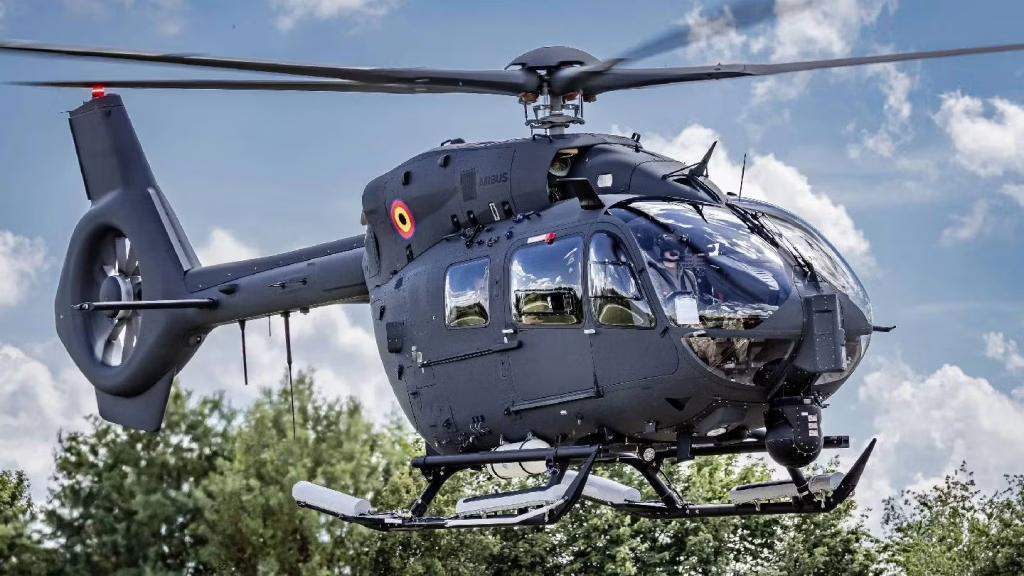
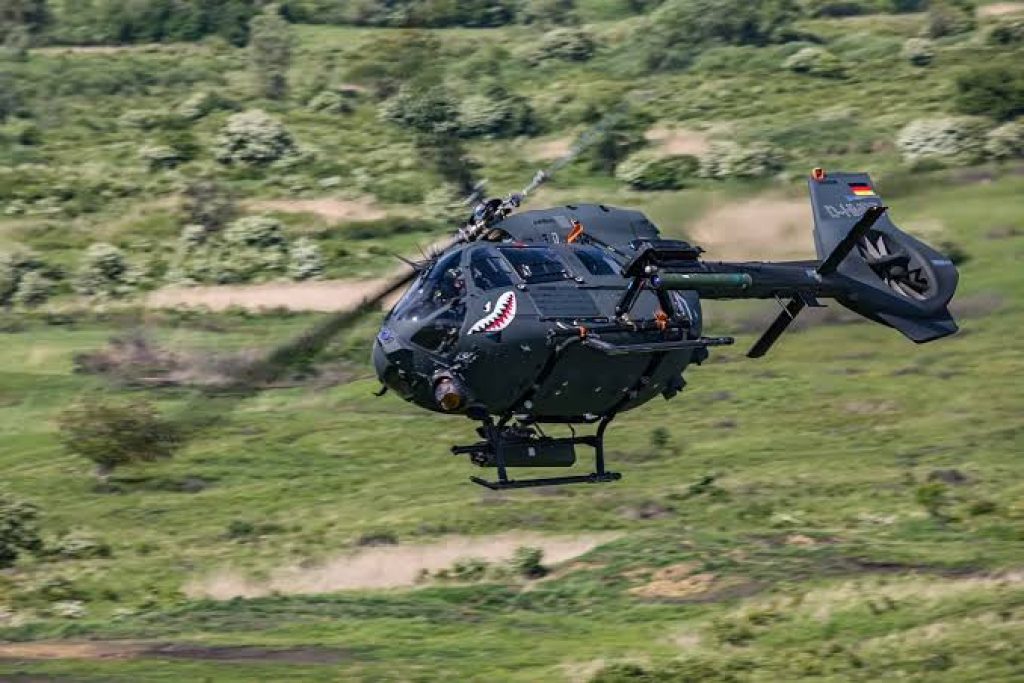
The H145M weighs approximately 3.8 tonnes and remains fundamentally a light multi-role helicopter. It can carry up to eight people and perform reconnaissance, transport, medical evacuation, special operations support, and crew-training missions. To turn it into an attack aircraft, Airbus offers the modular HForce weapons system.
HForce includes a fire-control computer, an electro-optical sensor, helmet-mounted sights, weapon controls, and external stores stations. Depending on the configuration, the helicopter can carry machine guns, a 20 mm cannon pod, guided and unguided rockets, and anti-tank guided missiles. Airbus promotes the system as a comparatively rapid way to transform a production multi-purpose helicopter into a light attack platform.
On paper, the German configuration appears convincing. A pod-mounted 20 mm cannon is intended to engage light vehicles and firing positions. For heavier armored targets, the helicopter is to employ the Spike ER2, a roughly 35-kilogram guided missile equipped with an electro-optical seeker and two-way data link.
When launched from a helicopter, the Spike ER2 can reportedly reach 16 kilometers using its radio-frequency data link or ten kilometers when controlled through a fiber-optic connection. A single H145M can carry up to four missiles.
These two systems have now become the sources of the program’s most serious difficulties.
The cannon is installed, but firing it may not be safe
The 20 mm cannon problem is reportedly connected less to the weapon itself than to its ammunition. According to German media reports, the rounds intended for the H145M have not been cleared for safe use because of the primer’s sensitivity to electrostatic discharge.
In practical terms, this means that there may be a risk of unintended ignition under certain conditions. Until the ammunition’s safety has been demonstrated, the military cannot simply load it into the cannon pod and send the helicopter on an operational mission. No public date has been given for when the manufacturer might resolve the problem.
The situation appears particularly strange because installing a 20 mm cannon on the H145M is not a new idea. Airbus conducted firing trials of the HForce system as early as 2017. Those tests included machine guns, unguided rockets, and the Nexter NC621 20 mm cannon pod, with the company announcing that the entire planned test program had been completed.
A successful demonstration firing, however, does not automatically authorize the use of a specific German configuration. The Bundeswehr must qualify not merely the cannon type but the entire combination: the designated pod, ammunition, fire-control system, software, mounting points, and operational procedures. A defect in a single primer can therefore prevent the entire weapon system from entering service.
The Spike missile is not ready either
The anti-tank armament is reportedly facing similar difficulties. According to information published following the emergence of the Federal Court of Auditors report, the first German Spike ER2 firing trials in May 2025 had to be suspended because of technical problems in the control system. This delayed the missile’s qualification aboard the H145M.
Once again, there is a paradox. EuroSpike officially lists the H145M among the platforms integrated with the Spike ER2, while Airbus has long advertised the missile as one of the helicopter’s main advantages. Integration on a demonstration or export aircraft, however, is not the same as full operational clearance for the specific version ordered by the Bundeswehr.
Germany is reportedly preparing to purchase a batch of guided missiles worth approximately €384 million. According to German reporting, the Federal Court of Auditors criticized the plan to sign the contract before testing was complete and the system’s operational readiness had been demonstrated. Missile deliveries are expected to begin in late 2027, after which the Bundeswehr will still have to continue evaluating the complete weapon system.
The sequence is therefore uncomfortable: helicopters are already reaching operational units, the missile purchase is being prepared, but the combination of carrier, fire-control system, and weapon has yet to complete the path to normal service.
Airbus acknowledges the complexity, but not the problem
When questioned by the German publication Hartpunkt, Airbus responded cautiously. The company declined to discuss confidential third-party documents or contractual details but said it agreed that the procurement program was highly complex and was cooperating closely with the responsible authorities.
Airbus also noted that it had already delivered numerous H145Ms with extensive armament options to international customers. Technically, this was not an admission of defects, but neither did the company directly deny the reports concerning the German configuration.
The German Defense Ministry has also confirmed that delays and problems exist, stating that industry must deliver the required capabilities. For now, the first aircraft can be used for crew training and non-combat missions. Full attack capability may arrive several years later than originally planned.
Why an off-the-shelf helicopter was not really off the shelf
The central lesson of the H145M story is the difference between a production helicopter and a combat-ready weapons system. The H145 itself is indeed a mature and widely operated aircraft. Its engines, transmission, avionics, and rotor system are well established. Mounting a cannon pod beneath its wing, however, does not automatically turn a civilian-derived platform into an operational attack helicopter.
Firing a weapon requires engineers to account for recoil, vibration, shifts in the aircraft’s center of gravity, the effect of propellant gases, structural loads, and safe weapon separation. The fire-control system must receive accurate information from the optical sensor, calculate ballistics, and transmit the appropriate commands to the weapon. A guided missile adds data links, targeting logic, software, and electromagnetic compatibility requirements.
Every individual component may already be proven. Once they are combined on a new platform, however, the entire system must be tested again.
According to the auditors, this is what Germany underestimated. Berlin intended to purchase an aircraft already available on the market, avoiding the cost and risk of developing another specialized platform. But after adding a cannon, targeting system, and anti-tank missiles, the H145M became a new weapons complex that still required an extensive qualification program.
Not a new Tiger, but an old problem in a smaller package

The H145M cannot be considered a complete replacement for the Tiger or Apache. It is lighter, carries fewer weapons, has less armor protection, and is based on a civilian helicopter. Its advantages lie elsewhere: lower operating costs, high availability, versatility, and the ability to change missions quickly.
Germany nevertheless expected this simplicity to help restore army aviation capabilities more rapidly. Now the most important part of the program—the ability to use weapons—risks falling behind deliveries of the helicopters themselves.
That does not mean all 82 aircraft are useless. They can perform training, reconnaissance, troop transport, medical evacuation, and special operations missions. The armament problems will also probably be resolved eventually.
For now, however, the outcome looks almost comical. Germany ordered dozens of light combat helicopters to obtain a ready-made, less troublesome alternative to the complicated Tiger. The helicopters arrived quickly, but the cannon lacks safely cleared ammunition, while the anti-tank missile has not completed its testing.
Buying a proven helicopter turned out to be easier than making it combat-ready.