In December 1941, one of the strangest fighters of the Second World War took to the air. From above, it looked almost like the famous Mitsubishi A6M Zero: the same slender wings, enclosed cockpit, and familiar silhouette. But instead of wheels, an enormous boat-shaped float hung beneath the fuselage, with two smaller stabilizing floats fitted under the wings. This was the Nakajima A6M2-N, the Japanese floatplane fighter known to the Allies by the reporting name Rufe.
At first glance, the entire idea seems absurd. The Japanese took one of the best fighters of the early war, sacrificed much of its speed and range, and then sent it into combat against aircraft that did not have to carry a small boat underneath them. Yet the A6M2-N was neither a technical curiosity nor an exercise in eccentric engineering. It was intended to solve one of the central problems of the Pacific War: Japanese forces were capturing islands faster than engineers could build airfields on them.

A fighter that could arrive before the airfield
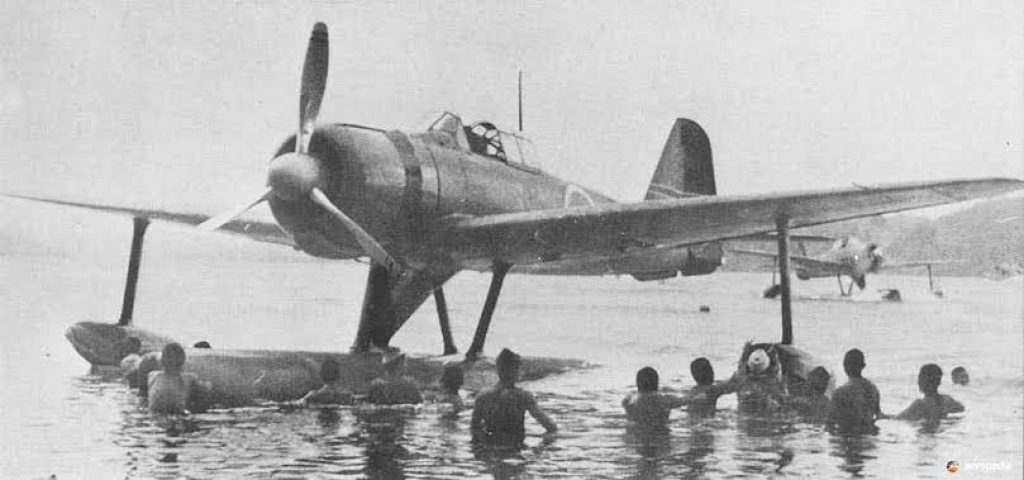
The Japanese Navy expected to advance across enormous distances where a small patch of land suitable for a runway could be more valuable than a port or town. After troops landed on a remote island, the new garrison could remain without fighter protection for weeks. Aircraft carriers could not stay near every captured atoll, while conventional Zero fighters required an airfield.
The proposed solution was tempting: a fighter capable of taking off from a lagoon, harbor, or sheltered bay. It could be transported aboard a seaplane tender, lowered onto the water by crane, and almost immediately employed to defend a base, conduct reconnaissance, and intercept enemy aircraft. Such a machine would cover the short but dangerous interval between the landing of Japanese troops and the completion of a proper runway.
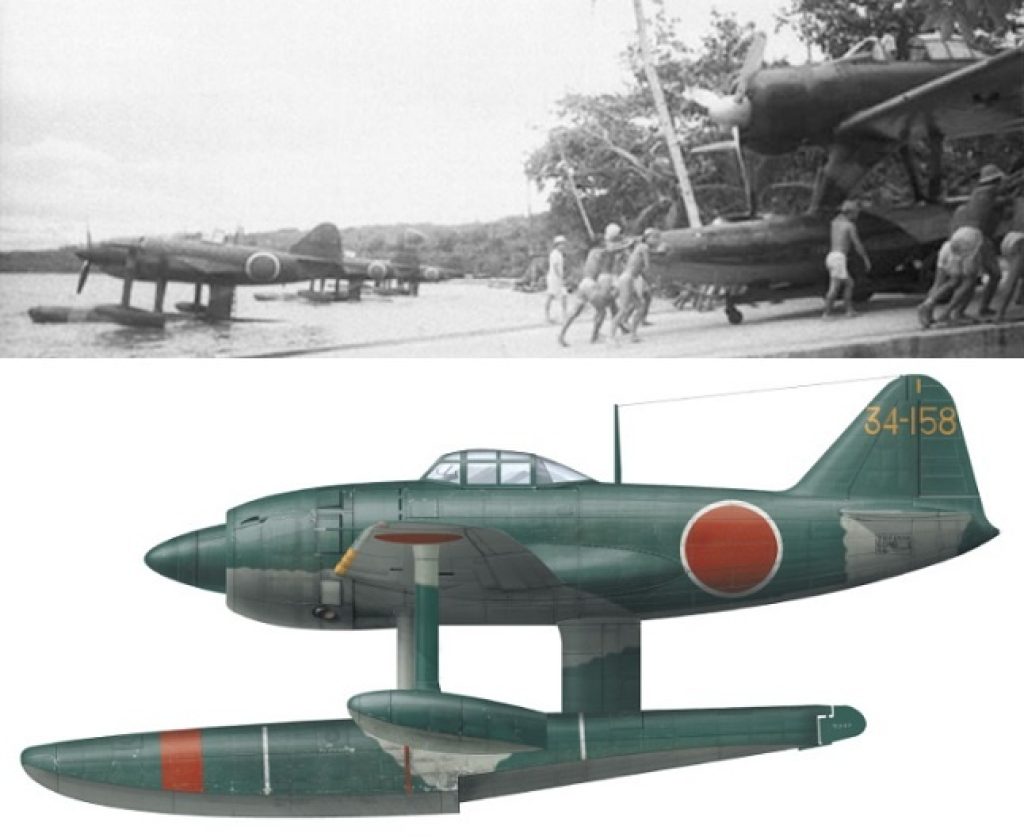
In 1940, the Navy ordered Kawanishi to develop a purpose-built floatplane fighter called the N1K1 Kyōfū. The design was technically ambitious but overly complicated. Its engineers experimented with retractable stabilizing floats, a powerful new engine, and even contra-rotating propellers. It soon became clear that the aircraft could not be made ready for production quickly enough. The Navy therefore needed a simpler “Plan B” that could enter service almost immediately.
In February 1941, Nakajima began converting the A6M2 Model 11 into a floatplane. The first prototype flew on December 8, 1941, Japanese time—almost simultaneously with the beginning of the Pacific War.
How to turn a Zero into a floatplane
On paper, the conversion appeared almost straightforward. The A6M2’s landing gear was removed, its wheel wells were faired over, and a large central float was installed beneath the fuselage. An auxiliary fuel tank holding approximately 320 liters was placed inside the float. Two smaller stabilizing floats were fitted beneath the wings, while the tail surfaces were enlarged to preserve stability with the bulky structure hanging underneath the aircraft.
The engine and armament remained largely unchanged. The A6M2-N retained the 940-horsepower, 14-cylinder Nakajima Sakae 12 radial engine, two synchronized 7.7 mm machine guns in the forward fuselage, and two 20 mm cannons in the wings. It could also carry two 60-kilogram bombs. In terms of firepower, the floating Zero was essentially equal to its land-based relative.
Aerodynamics, however, could not be cheated. A conventional A6M2 could reach roughly 530 km/h, while the Rufe struggled to exceed 435 km/h. Nearly 100 km/h disappeared because of the drag produced by the central float and its two smaller companions. The aircraft accelerated more slowly, had difficulty building energy, and lost it more quickly during combat maneuvers. Its climb performance nevertheless remained respectable: the A6M2-N could reach 5,000 meters in approximately six minutes and 43 seconds.
The result was a peculiar aircraft. The Rufe preserved much of the Zero’s maneuverability, carried serious armament, and could appear in places where no other fighter could operate. But in sustained combat against a conventional landplane, its enormous float inevitably became an anchor.
An aircraft built for a very brief moment in the war
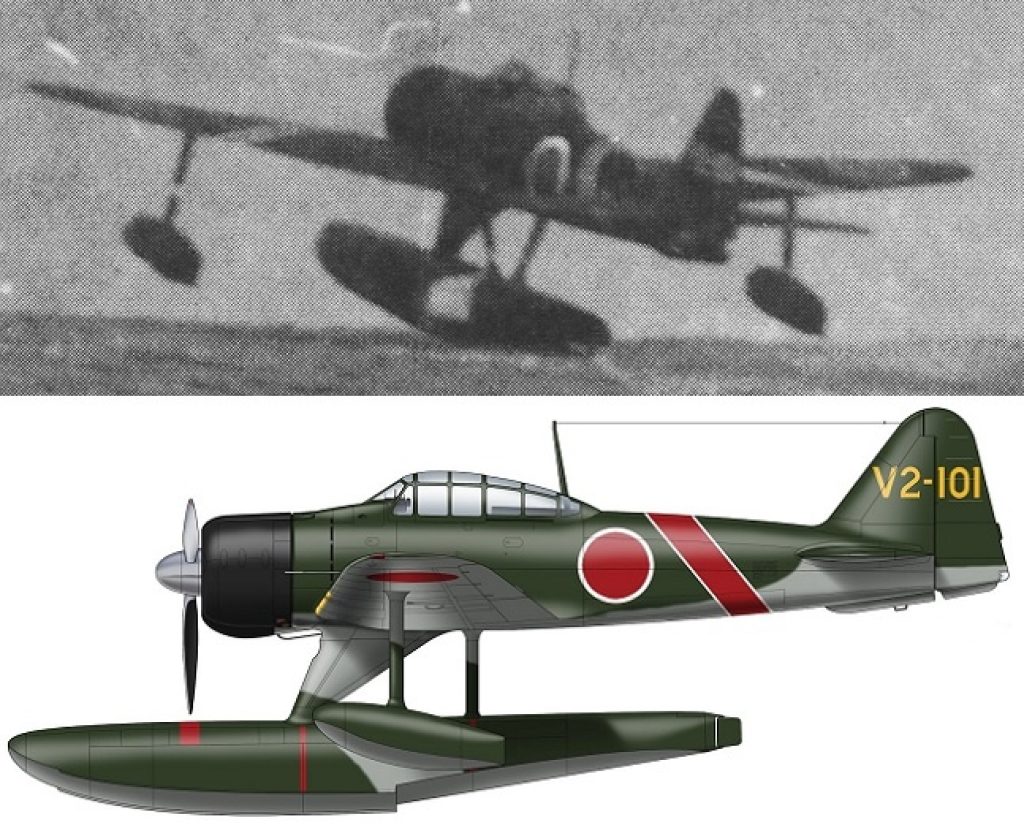
The A6M2-N entered service in the summer of 1942 under the official designation Navy Type 2 Floatplane Fighter. Production continued until September 1943, with Nakajima completing 327 aircraft. Some publications give a figure of 254, but standard references on Japanese aircraft production generally list 327 examples.
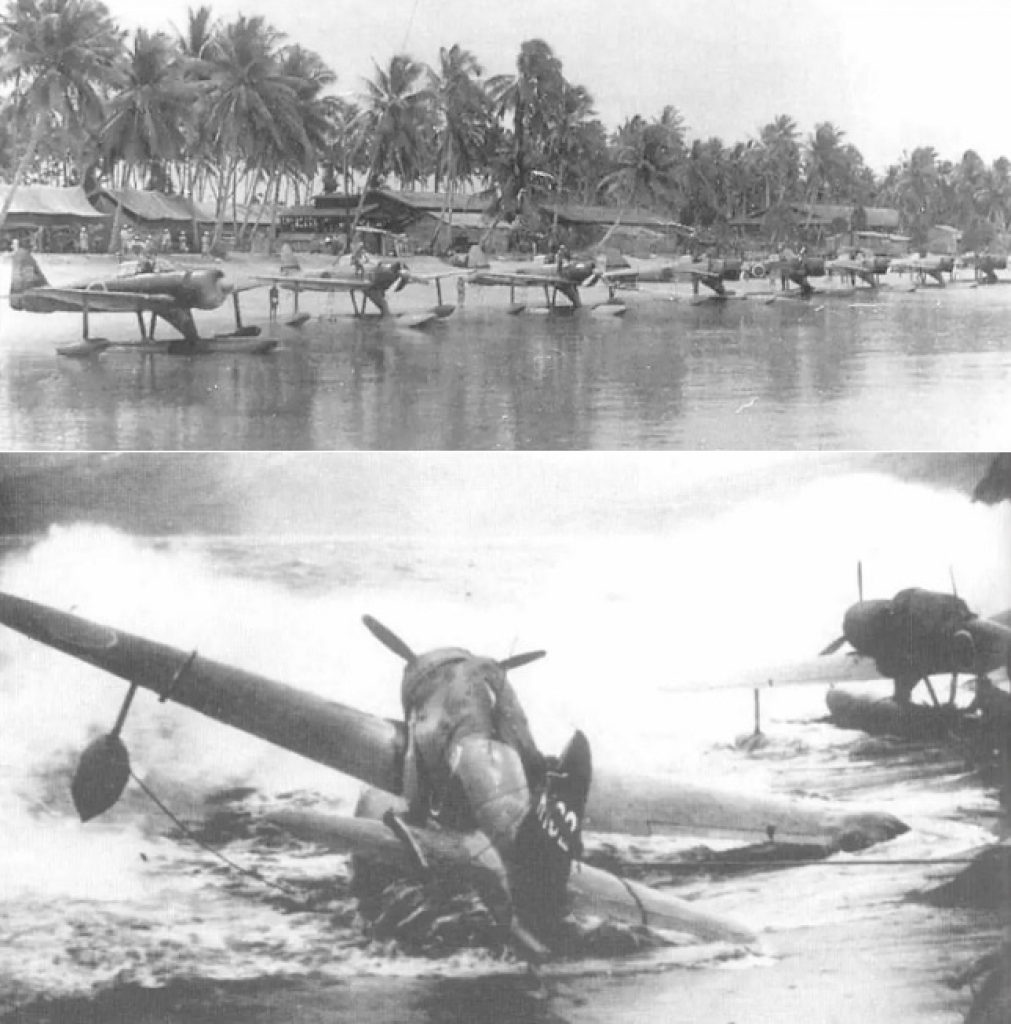
The first Rufes were deployed around Rabaul and the Solomon Islands. They defended seaplane bases, patrolled the coastline, escorted convoys, and attempted to intercept B-17 and B-24 bombers. Here, one of the concept’s major weaknesses quickly became apparent: an aircraft based on water was particularly vulnerable when it was not flying. It could not be hidden in a conventional revetment or rapidly dispersed among concealed jungle positions. The machines had to remain close to the shore or moored in the harbor, presenting inviting targets during a surprise air raid.
This was demonstrated around Tulagi in August 1942. During the American landings, Japanese seaplane facilities came under attack, and the Rufes stationed there were destroyed or abandoned. One damaged aircraft was later captured by the Americans and transported to the United States for evaluation.
In the air, however, the situation was less straightforward. The A6M2-N did not become an easy target the moment it left the water. At low altitude and modest speed, an experienced Japanese pilot could still exploit the Zero’s inherent maneuverability. Rufes scored occasional victories over patrol aircraft, bombers, and even fighters. The problems began when the enemy refused to enter a turning contest and instead used superior speed and altitude. Once attacked in this manner, the floatplane fighter usually lacked the performance needed either to escape or to dictate the engagement.
The Aleutians: where the Rufe was genuinely useful
The Japanese concept worked best in the Aleutian Islands. After occupying Kiska and Attu, Japanese forces needed fighter protection, but constructing airfields amid fog, cold, constant rain, strong winds, and waterlogged terrain proved extremely difficult. Here, the Rufe finally found the environment for which it had been designed.
The aircraft could operate directly from the water, intercept reconnaissance planes, and attack American bombers. Low cloud often forced combat down toward the surface, where outright speed mattered less and the A6M2-N’s maneuverability became a serious advantage. There were even occasions when Rufes successfully fought twin-engine P-38 Lightnings. If an American pilot allowed himself to be drawn into a turning engagement, the strange fighter with the enormous float could suddenly become a dangerous opponent.
The Aleutian campaign also demonstrated why the future nevertheless belonged to conventional land-based aviation. American engineering units landed on Adak Island and built a steel-mat runway in approximately 12 days. Another airfield was later established on Amchitka, even closer to the Japanese positions. With the runways came P-38s, P-39s, P-40s, and bombers capable of attacking Kiska regularly.
This was almost the perfect answer to the entire Rufe concept. A floatplane fighter remained valuable only as long as the enemy lacked an airfield. Once American bulldozers and engineering battalions had laid down a runway, Japan’s temporary advantage disappeared. The Rufe now had to fight faster aircraft that could select the moment of attack, disengage at will, and return to well-equipped bases.
It was defeated not by its float, but by the changing war
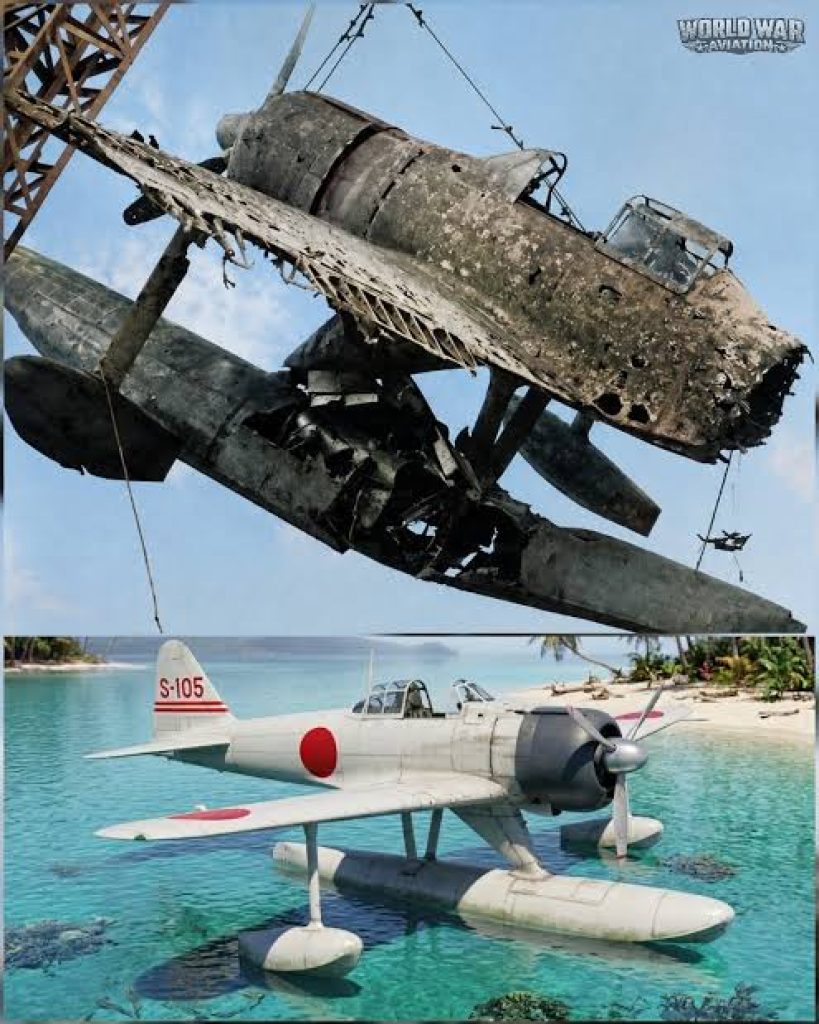
The A6M2-N’s greatest weakness was not simply its reduced speed. The aircraft had been created for an advancing fleet that expected to capture one island after another and needed temporary air cover. By the second half of 1942, however, Japan was already beginning to shift onto the defensive. The floatplane fighter was now expected to protect permanent bases against increasingly numerous and advanced Allied aircraft.
In that kind of war, the Rufe’s advantages disappeared. It was no longer the first and only fighter above an isolated lagoon. Instead of scattered reconnaissance aircraft, it faced bomber formations with fighter escorts. Instead of undeveloped islands, it confronted a rapidly expanding network of American airfields. The aerodynamic penalties were compounded by salt water, corrosion, dependence on sea conditions, and the maintenance burden of an aircraft that returned from every mission not to a concrete runway, but to the ocean.
The purpose-built Kawanishi N1K1 Kyōfū did not reach operational units until the spring of 1943, by which time the need for such aircraft was already fading. The final irony was that the most successful descendant of the project was not another floatplane, but the land-based N1K1-J Shiden. Japanese engineers removed the floats, installed conventional landing gear, and produced one of the Imperial Japanese Navy’s best fighters of the final years of the war.
Was the Rufe really a failure?
It would be unfair to dismiss the A6M2-N as a complete technical mistake. Japanese engineers quickly and relatively cheaply created a combat-capable fighter that could operate without an airfield. It retained the Zero’s armament, respectable climb performance, and sufficient maneuverability to remain dangerous under the right conditions.
The real problem was its extremely narrow operational niche. The Rufe was a weapon for a brief transitional period—the interval between the capture of an island and the completion of a proper runway. During that window, it could genuinely be indispensable. But once the enemy established an airfield, the enormous float transformed its unusual advantage into a potentially fatal liability.
Japan built a fighter that did not need a runway. The United States responded not with a superior floatplane, but with engineering units capable of constructing airfields almost anywhere. In the end, the contest between the aircraft and the float was decided by bulldozers, steel matting, and thousands of construction workers.