Hyperloop Actually Worked. Why It Still Failed to Become a Real Transportation System After 13 Years

In August 2013, the Hyperloop Alpha paper was released — 58 pages of calculations and diagrams promising something that seemed almost impossible. The proposal called for two low-pressure tubes between Los Angeles and San Francisco, with small passenger pods accelerating to roughly 1,200 km/h. A trip between California’s two major metropolitan areas would take about 35 minutes, pods could depart every few minutes, and the entire passenger system was initially estimated to cost less than $6 billion. It looked like transportation for the 21st century: faster than a train, competitive with air travel over medium distances, electrically powered, with minimal aerodynamic drag and no need for enormous railway trains. Thirteen years have passed. Hundreds of millions of dollars have been invested, test tubes have been built, pods have learned to levitate and travel through low-pressure environments, and in 2020 people were even placed inside one for a real passenger test. Yet in 2026, there is no Hyperloop between Los Angeles and San Francisco. There is none between Dubai and Abu Dhabi, Mumbai and Pune, or the major capitals of Europe. The largest American developer, Hyperloop One, is gone, while one of Europe’s most prominent developers, Hardt Hyperloop, went bankrupt. Yet the technology itself is not dead: the European Union continues to support research, test facilities remain active, and standards and new demonstrators are still being developed. A European Commission study published in 2025 effectively summed up Hyperloop’s current position: its basic technical principles have been demonstrated, but the technology remains somewhere between prototyping and full-scale demonstration, while its economics and regulatory framework remain uncertain.
This makes the story far more interesting than a conventional tale about a failed startup. Hyperloop did not collide with the laws of physics. A pod really can travel through a low-pressure tube; magnetic levitation works, linear electric propulsion works, and people have already been transported inside such a system. The real problem emerged one level higher: each individual component of Hyperloop turned out to be much easier than turning all of those components into an everyday transportation system. That is why the more interesting question today is not “Why didn’t Hyperloop work?” but something else entirely: why did the technology work while the transportation system never materialized?
Physics Was Never Hyperloop’s Main Problem
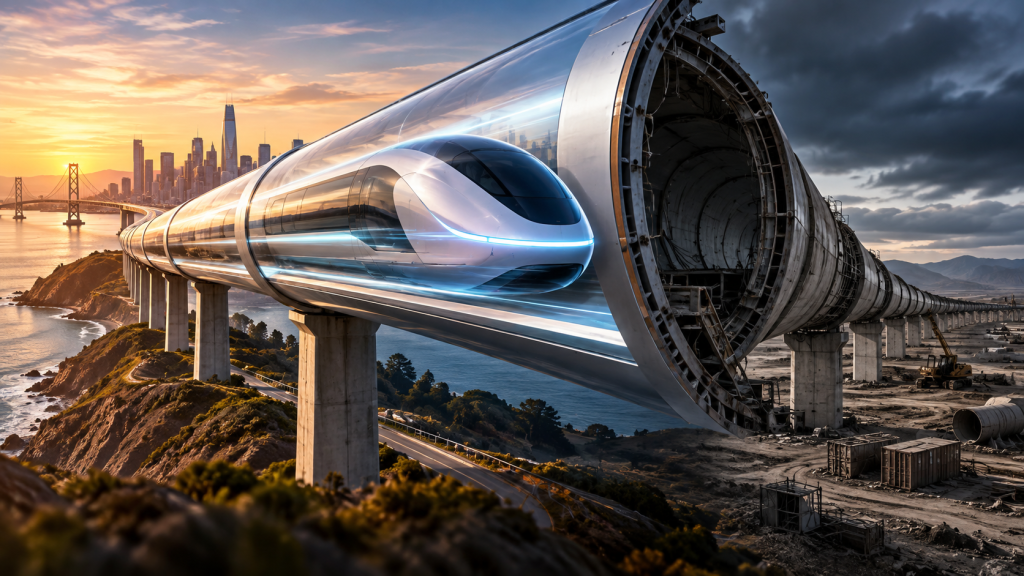
The underlying idea is much older than Elon Musk. Engineers have long understood one of the fundamental limitations of very high-speed ground transportation: aerodynamic drag increases so dramatically with speed that, beyond a certain point, further acceleration becomes extremely energy-intensive. One obvious solution is to remove most of the air. If a vehicle travels through a tube maintained at very low pressure, aerodynamic drag falls sharply; if conventional wheel-on-rail contact is also replaced with magnetic suspension, another source of resistance and mechanical wear disappears. Hyperloop Alpha proposed exactly this combination. Pressure inside the tube was supposed to be reduced to around 100 pascals — roughly one-thousandth of normal atmospheric pressure — while passenger pods would reach a maximum speed of approximately 1,220 km/h. It was not a true vacuum, which made the problem considerably easier, but there would be little enough air left to reduce aerodynamic losses dramatically.
Musk did not create a company to build the Los Angeles–San Francisco line himself. Instead, the concept was effectively handed over to the market, universities, and startups, and there was no shortage of volunteers. Hyperloop One, Hyperloop Transportation Technologies, Hardt Hyperloop, Zeleros, Swisspod, and numerous university teams appeared; SpaceX built its own test tube and for several years organized competitions for student-designed pods. It soon became clear that the individual technical elements of the concept were entirely feasible. A tube could be evacuated to the required pressure. A pod could be levitated. A linear motor could propel it. Control and braking systems could be developed. In other words, the central challenge of Hyperloop gradually moved out of fundamental physics and into ordinary engineering. And engineering turned out to be far less glamorous — and much more expensive.
In 2020, Hyperloop Finally Carried People
Hyperloop One, later renamed Virgin Hyperloop, went further than any of its competitors. In the Nevada desert, the company built the roughly 500-meter-long DevLoop test system and conducted hundreds of unmanned trials. On November 8, 2020, something happened that could have become a milestone in transportation history alongside the first passenger railway journey or the first commercial airline flight. Chief Technology Officer Josh Giegel and Director of Passenger Experience Sara Luchian climbed into the two-seat XP-2 experimental pod, the tube was depressurized, and the system launched them down the track. For the first time, Hyperloop had actually transported human passengers. The maximum speed, however, was only around 172 km/h — slower than a modern high-speed train. Yet that figure said very little about the technology’s ultimate potential: the test track was simply too short to accelerate a passenger pod to 1,000 km/h and then stop it safely.
The real significance of the experiment lay elsewhere. Hyperloop One had demonstrated the simultaneous operation of almost all the system’s fundamental elements with humans on board. The pod traveled through a low-pressure environment while its electromagnetic suspension, propulsion, control, and braking systems operated together. The simplest version of the question — “Can a Hyperloop actually be built?” — had received a positive answer. But that immediately raised a much harder question: could a 500-meter Hyperloop be expanded into a 500-kilometer one, carrying not one experimental pod but hundreds of daily services, and could it continue doing so for decades with the reliability expected of a railway? It was at this transition from prototype to transportation system that problems largely invisible on a test track began to emerge.
Five Hundred Meters of Tube and Five Hundred Kilometers Are Different Problems
A laboratory Hyperloop only needs to maintain the required conditions over a relatively short distance. A commercial system would require hundreds of kilometers of large-diameter tube, all of it continuously maintained at extremely low pressure. That means numerous pumping stations, valves, sensors, backup power supplies, leak-detection systems, and the ability to isolate a damaged section without shutting down the entire route. The tube itself also exists in the real world: it heats up in sunlight and cools at night, expands and contracts, experiences wind loads, ground movement, and, in some regions, earthquakes. A small change in geometry may be acceptable for an ordinary pipeline. For a transportation system carrying vehicles at airliner-like speeds, the tolerances are entirely different.
Stations make the problem even more complicated. Passengers begin at normal atmospheric pressure, while the main tube operates at roughly one-thousandth of that pressure. Stations therefore have to function as airlocks: a pod enters a separate chamber, air is pumped out, pressure is equalized with the main line, and only then can the next gate open. The process has to be reversed upon arrival. Building one such airlock is possible; moving a large stream of pods through it at intervals of minutes or even seconds is considerably more difficult. Add junctions, maintenance areas, and emergency sections, and the seemingly simple tube in the original diagrams begins to resemble an extraordinarily complicated transportation infrastructure.
The most difficult scenario appears when a pod stops between stations. With an aircraft, many technical failures still leave enough control to divert to another airport. On a railway, passengers remain inside a train surrounded by normal atmosphere, while rescuers can usually reach the vehicle from outside. Hyperloop passengers would be sealed inside a pressure vessel that is itself trapped inside another tube containing almost no air. Suppose a pod stops 70 kilometers from the nearest station. The system must keep its occupants supplied with air and power, diagnose the failure, reach the pod, equalize pressure in the necessary section, and organize an evacuation. Every one of those problems can be solved through engineering. But every solution requires more equipment, more emergency systems, more procedures and, inevitably, more money. The apparently simple concept of “tube plus pod” gradually acquires an infrastructure at least as complicated as that of a railway or metro system.
The Most Uncomfortable Number Was Not Speed, but Passenger Capacity
Transportation has another performance metric that looks much less impressive in promotional presentations than maximum speed: capacity. A modern airliner can carry several hundred passengers. A high-speed train can often carry 500 to 1,000 people in a single service. The original Hyperloop Alpha passenger pod was designed for only 28. This was not considered a problem because the concept proposed replacing large trains with frequent small pods: under normal conditions, departures might occur roughly every two minutes, while peak periods could theoretically reduce the interval to around 30 seconds. The result would no longer resemble a conventional railway. It would be a continuous conveyor belt of vehicles.
On paper, this is an elegant solution, but it dramatically increases the system’s reliability requirements. If pods are departing every 30 seconds and traveling at around 1,000 km/h, the control system must continuously know the exact position, speed, and technical condition of every vehicle. If one pod begins emergency braking, the vehicles behind it must respond immediately, while sufficient separation must always remain to stop safely. A malfunction affecting a single vehicle could potentially disrupt the entire stream. The shorter the intervals, the greater the capacity — but also the smaller the margin for error. None of this makes such a system impossible: automated metro systems and railways already manage dense flows of vehicles. Hyperloop, however, would have to do it at radically higher speeds and inside infrastructure where passing a disabled vehicle would be virtually impossible.
This creates another contradiction. Make the pod larger and it can carry more passengers, but it requires a larger tube, more powerful systems, and more complicated stations. Keep it small and achieving meaningful passenger capacity requires dramatically shorter intervals. Every solution increases either infrastructure costs or operational complexity. This is why maximum speed gradually stopped being the central Hyperloop question. Accelerating one pod is much easier than moving enough passengers safely along one line to justify building hundreds of kilometers of unique infrastructure in the first place.
Six Billion Dollars May Have Been Hyperloop’s Boldest Promise
In the original concept, cost was arguably even more important than speed. The passenger system between Los Angeles and the San Francisco area was estimated at less than $6 billion, while a larger version capable of transporting cars was projected at roughly $7.5 billion. California’s proposed high-speed railway, by comparison, was already expected to cost tens of billions. If Hyperloop really could have been built for that amount, it would have represented a transportation revolution even if it reached only 700 or 800 km/h rather than 1,200. But the original estimate was based on a very early concept in which many operational and infrastructure questions had simply not yet been worked out.
This is where the fundamental economic problem of the entire idea becomes visible. Hyperloop can make almost no use of existing infrastructure. A train can gradually be introduced onto an existing rail network, an aircraft uses airports and open airspace, and a car uses existing roads. Hyperloop requires its own continuous corridor from point A to point B: land, supports or tunnels, sealed tubes, stations, airlocks, power supplies, vacuum equipment, emergency exits, communications, control systems, and maintenance facilities. All of it has to be built first and then maintained for decades. Hyperloop therefore fell into a peculiar trap: to justify such expensive and unique infrastructure, it needs to offer a radical speed advantage, but those very high speeds make the infrastructure and safety requirements exceptionally difficult. Reduce the speed to 300–500 km/h to lower costs, and an uncomfortable question appears: why build hundreds of kilometers of sealed low-pressure tube when high-speed rail already solves a broadly similar transportation problem?
Hyperloop One Decided to Give Up on Passengers
After the historic passenger test in 2020, the obvious next step seemed to be a longer test track and gradual progress toward a commercial system. Instead, almost the opposite happened. In 2022, Virgin Hyperloop laid off more than a hundred employees and abandoned its previous emphasis on passenger transportation, shifting its attention toward freight. The Virgin name later disappeared and the company reverted to Hyperloop One. A freight-oriented system did remove some of the most difficult problems. A shipping container does not require passenger comfort, does not need to be evacuated because someone suffers a medical emergency, and is subject to very different regulatory requirements from a pod carrying dozens of people. For ports and major logistics hubs, very high-speed cargo movement could at least theoretically have been attractive.
But even this simplified model failed to produce a commercial line. Hyperloop One, which had raised more than $400 million during its existence, never secured a project that would take it from a test site to a genuine transportation network. At the end of 2023, the company ceased operations, dismissed its remaining employees, and began selling its assets; its intellectual property was expected to pass to DP World, the project’s largest investor. For Hyperloop, this was a major blow. This was not just another startup disappearing. It was the developer that had gone furthest and had become the first — and so far the only one — to conduct a real Hyperloop passenger test with people on board.
Yet Hyperloop itself did not disappear. The center of development gradually shifted toward Europe, where the approach became noticeably more cautious. Instead of promising a 1,200 km/h network within a few years, European programs began focusing on test tracks, standardization, safety, and interoperability between different developers’ systems. The European Hyperloop Center in Veendam, the Netherlands, received a test tube approximately 420 meters long and 2.5 meters in diameter. At the same time, programs such as Hyper4Rail began examining not only the pod itself but how such a system might eventually be integrated into Europe’s wider transportation network. It is far less spectacular than the 35-minute Los Angeles–San Francisco journey promised in 2013, but these are precisely the questions that have to be answered if an experimental system is ever to become real transportation.
In 2026, One of Europe’s Hyperloop Leaders Collapsed Too
In March 2026, Dutch company Hardt Hyperloop — one of the most prominent second-generation Hyperloop developers — was declared bankrupt. Hardt grew out of a Delft University of Technology team that had participated in the early SpaceX competitions and gradually became one of the symbols of Europe’s approach to the technology. The company worked not only on pods but also on route-switching technology intended to allow vehicles to change direction without conventional railway points. Yet technical progress could not solve the central problem facing the young industry: money. According to Dutch media reports, Hardt had accumulated multimillion-euro losses, while the immediate blow came when expected financing failed to materialize. A company that had recently been regarded as one of Europe’s most promising Hyperloop developers was suddenly insolvent.
Even Hardt’s bankruptcy, however, does not mean Hyperloop reached its final chapter in 2026. The European Hyperloop Center remains active, European research programs continue, and other teams are still testing their own approaches. Swisspod, for example, continues developing its experimental system, while Europe’s Hyper4Rail project is working on standardization and future interoperability. But the nature of the challenge has changed radically. In 2013, Hyperloop was presented as an almost ready-made alternative to air travel and high-speed rail. By 2026, European researchers are talking about the need to first demonstrate economic viability, establish common standards, create a regulatory framework, and build full-scale demonstration lines. In other words, after thirteen years of development, Hyperloop has not approached mass deployment nearly as quickly as its early advocates expected — but we now understand much more clearly just how many unresolved problems were hidden behind that elegant diagram of two tubes and a small pod.
So What Actually Happened to Hyperloop?
The simplest version of the story is appealing: Elon Musk promised transportation at 1,200 km/h, investors spent hundreds of millions of dollars, nothing worked, and the companies disappeared. But that version does a poor job of explaining what actually happened. Hyperloop progressed far beyond a futuristic illustration. Real low-pressure test tracks were built, levitation and linear propulsion systems were developed, pods were tested, and in 2020 two people actually traveled inside one. No fundamental law of physics suddenly emerged to prove Hyperloop impossible. Instead of one enormous unsolvable obstacle, engineers encountered dozens of individually solvable problems — and it was their combined weight that proved devastating to the original concept. Each required equipment, money, redundancy, regulation, and maintenance, gradually consuming the simplicity and low cost that had made Hyperloop so attractive in the first place.
That is why, by 2026, Hyperloop is better described not as a dead technology but as a technology that has lost its original status as transportation of the near future. Research continues, individual systems are still improving, European institutions are working toward common standards, and it remains possible that some commercially viable transportation system may eventually emerge from these efforts. But first it must prove something far more important than the ability of a pod to move through a low-pressure tube: it must prove that the entire infrastructure can carry enough people safely, reliably, and cheaply enough to justify building hundreds or thousands of kilometers of an entirely new network.
And that may be the central lesson of the entire story. In 2013, the most unbelievable part of Hyperloop seemed to be the small pod traveling at nearly the speed of sound through a tube containing almost no air. Thirteen years of experimentation demonstrated something almost opposite: engineers actually can build such a pod. The much harder task is building the stations, emergency systems, airlocks, routes, operating rules, and economic model around it that turn an elegant physical principle into everyday transportation. Hyperloop demonstrated that there is an enormous engineering gap between “it works” and “it is worth building.” The pod crossed that gap. The transportation system, so far, has not.