In the world of Dune, people travel between the stars, control their bodies with almost superhuman precision, and make plans spanning generations. Yet they live under the rule of an emperor, Great Houses, and hereditary aristocrats. Planets are granted as fiefs, armies serve families, privileged corporations control trade, and loyalty to a duke often matters more than any law. It is a strange vision of the future: technology has advanced by thousands of years, while society appears to have returned to the Middle Ages.
This was not just a backdrop invented to provide the story with splendid uniforms and palace intrigue. Frank Herbert deliberately constructed the Imperium as a feudal world. In a 1969 interview, he explicitly described the political order of Dune as classical feudalism and explained that he wanted its lines of power to be clear and recognisable. He was interested in an uncomfortable question: does technological progress really make society freer, or do human beings, under certain conditions, repeatedly rebuild the familiar pyramid of lords, vassals, and dependent people?
Today, that question has returned under a new name: technofeudalism. Its advocates argue that the digital economy is gradually ceasing to function like an ordinary market. Platforms take the place of land, payment for access to audiences and infrastructure takes the place of feudal rent, and the castle becomes a closed ecosystem of servers, algorithms, data, and artificial intelligence. If that argument is correct, Dune matters not because it predicted any particular technology. It matters because it portrayed a society in which extraordinarily advanced technologies did not destroy hierarchy, but made it almost invulnerable.
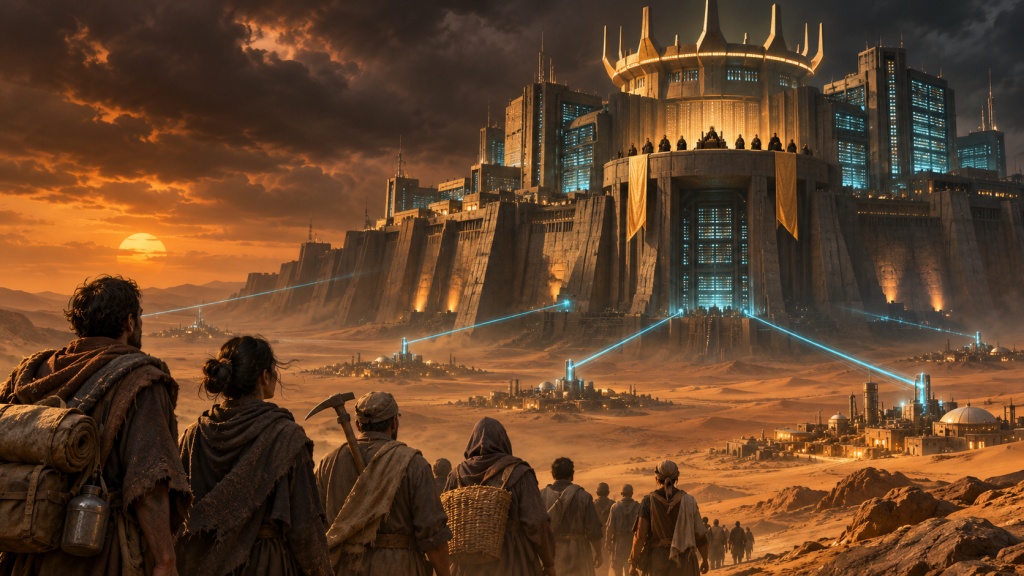
Feudalism Without Knights
A medieval lord possessed more than wealth. He controlled the territory without which other people could neither live nor work. A modern platform operates differently, but the resemblance is easy to see. It does not necessarily produce goods itself. Instead, it owns the space in which seller meets buyer, creator meets audience, driver meets passenger, and developer meets user. The owner of that space decides who may enter, whom the search system will display, what commission must be paid, and what offence can lead to expulsion.
Economist Yanis Varoufakis describes such systems as “cloud fiefdoms.” In his account, a conventional capitalist earns a profit by producing and selling a commodity, while a digital lord increasingly extracts rent for access to an environment he owns. Users fill that environment for free with photographs, texts, routes, reviews, relationships, and behavioural data. A small business builds its shop inside the platform, accumulates ratings, and becomes accustomed to a steady flow of customers. Formally, no one is bound to the platform. In practice, leaving may mean losing an audience, a reputation, and years of work.
That is why the comparison with feudalism is more persuasive than it may initially seem. The peasant was tied to the land; the modern individual is tied to a digital ecosystem. In one case, dependence was created by law and armed force. In the other, it is sustained by network effects, habit, and accumulated data. The more people already live inside a system, the less advantageous it becomes to remain outside it. The European Union has even adopted an official term for the largest platforms: “gatekeepers,” companies capable of controlling the crucial routes between businesses and their users.
The Great Houses of the Digital Age

In Dune, power is divided among organisations, each of which controls an indispensable technology. The Spacing Guild controls interstellar travel. The Bene Gesserit have turned training, memory, and mastery of human abilities into instruments for influencing dynasties. Mentats possess the art of advanced calculation. The Great Houses command armies and rule planets. The emperor stands above them, but even he cannot simply order everyone else around: power rests on a balance among monopolies.
The most important of those monopolies lies hidden beneath the sands of Arrakis. The spice is required by Guild Navigators; without the Guild, interstellar transport becomes impossible; and without transport, the Imperium disintegrates. One planet therefore becomes more important than thousands of others. Whoever controls the system’s bottleneck acquires power far beyond the apparent size of his territory.
The modern digital world is also organised around bottlenecks. They include operating systems, app stores, cloud computing, search engines, social graphs, payment infrastructure, data centres, and foundational artificial-intelligence models. No company has yet become the Spacing Guild, but the principle is familiar: there is no need to own the entire economy if you control the passage through which everyone else must travel.
The result is the emergence of something resembling Great Houses. Each has its own territory, subjects, allies, and dependent merchants. One ecosystem has one set of rules, while another follows different ones. Moving between them is possible, but transferring relationships, purchases, ratings, and familiar tools is often more difficult than the “delete account” button suggests. The user remains a citizen of a state, yet much of his work, communication, and consumption takes place under the laws of a private digital domain.
The Algorithm as Private Law
Feudal authority differed from the modern state because government, justice, and ownership were poorly separated. A landowner established the rules on his territory and profited from those same rules. The digital platform partly restores this arrangement, except that an algorithm takes the place of the estate manager.
It decides which product a customer will see, which video will spread, who will be offered a job, and whose post will disappear from recommendations. Such decisions can be automatic, immediate, and almost invisible. A person does not always know why his income has fallen: demand may have changed, a stronger competitor may have appeared, or the platform may have quietly rebuilt its ranking system. The laws of a state are published and can be challenged. An algorithmic rule can change overnight, while its exact logic remains a commercial secret.
This is not serfdom—at least not yet. Platforms compete, users leave, courts intervene, and governments impose restrictions. But the direction of travel matters: more and more economic decisions are being made neither in an open market nor by a public authority, but within privately owned infrastructure. The debate over technofeudalism is therefore not about whether billionaires will acquire coats of arms. It is about whether the owner of a digital environment can simultaneously become its legislator, judge, and rent collector.
Artificial Intelligence May Close the Gates
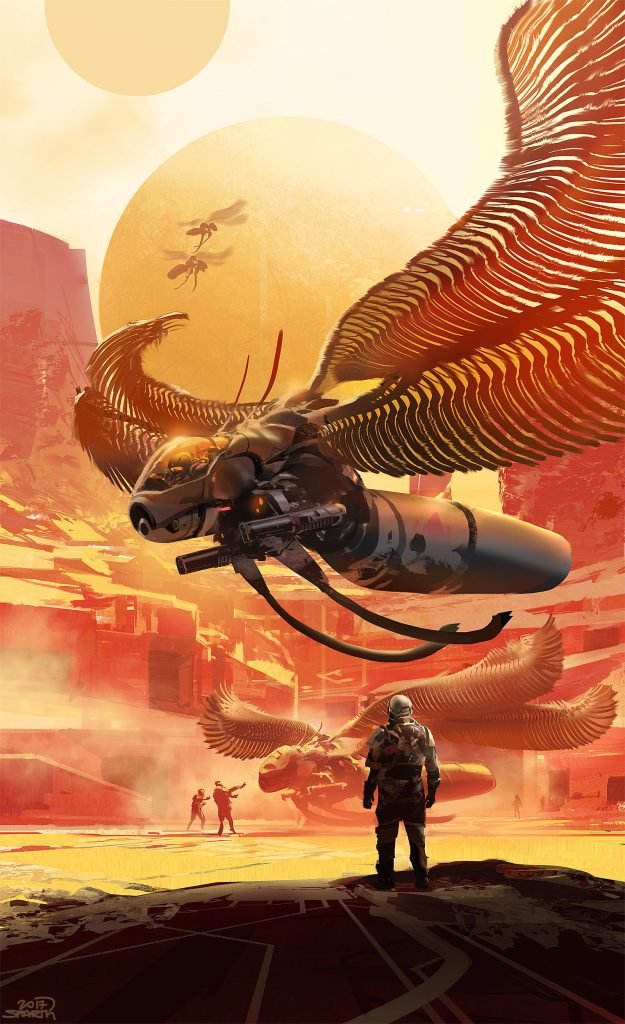
The next step could make this system far more rigid. Today, users still choose shops, visit websites, and compare offers themselves. A personal AI agent, however, will be able to do those things on their behalf: search for information, order goods, book journeys, conduct negotiations, and manage subscriptions. On the surface, this looks like liberation from routine. The important question is who owns the agent and what rules govern its choices.
If a small number of companies simultaneously control the AI model, access to data, cloud infrastructure, and the marketplace where purchases are made, they will be able to direct demand before an individual ever sees the alternatives. The gatekeeper will no longer stand in front of the market; it will live inside the user’s personal adviser. In November 2026, the OECD specifically warned that agentic AI systems might not only reduce transaction costs, but also strengthen vertical integration, foreclose markets to competitors, and reduce the transparency of decisions.
Here reality unexpectedly diverges from Dune. Thinking machines are forbidden in the Imperium, so calculation, navigation, and control over human abilities have become concentrated in closed orders. Our world is moving in the opposite direction, handing more and more decisions to machines. Yet the political result could be similar: critically important knowledge may once again become concentrated among a handful of intermediaries without whom the system cannot function.
Why “Technofeudalism” May Be Misleading
This attractive analogy has a weakness. Capitalism has not disappeared. Technology companies compete for profit, sell goods and services, employ workers, depend on investors, and can still lose. A platform user is not a medieval serf: he cannot be sold together with his account, while the state retains its courts, police, taxation, and power to change the rules. Sociologist Nicholas Gane therefore argues that the term “technofeudalism” wrongly declares the death of capitalism. In his view, this is still capitalism, although its new forms are increasingly slipping beyond the control of nation-states and traditional mechanisms of democratic oversight.
There is also a practical objection. If digital corporations have already become sovereign feudal lords, how did the European Digital Markets Act arise, compelling the largest gatekeepers to change their behaviour? The very existence of such regulation demonstrates that the struggle is not over. Platforms are powerful, but they are not yet sovereign. Governments can restrict them, guarantee data portability, open closed ecosystems, and prevent the owner of a marketplace from quietly favouring its own products.
Technofeudalism is therefore more useful as a warning than as an established diagnosis. It indicates the direction in which the market may move if infrastructure, data, and AI fall under the control of a small number of closed ecosystems. The metaphor becomes especially accurate where competition survives only formally and the cost of leaving a domain has grown prohibitively high.
A Future Resembling Dune
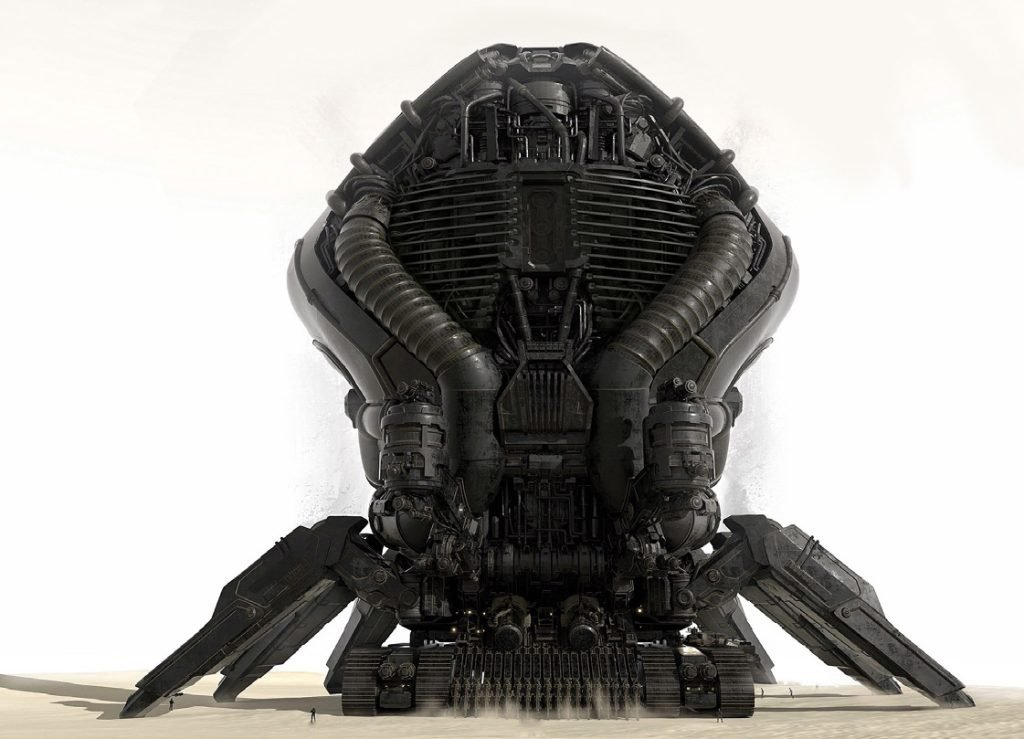
The twenty-first century is unlikely to end with an emperor of the known universe and dukes ruling entire planets. A mixed system is far more plausible: states will retain their flags, elections, and armies, while people’s daily lives take place inside a handful of private digital territories. The state will give an individual a passport; the platform will give him a name, an audience, a reputation, the tools with which to earn a living, and a personal AI. The first will regard him as a citizen and the second as a user. Yet it may be the second that determines whether anyone sees his work, whether he finds a customer, and whether he can preserve his accumulated digital past.
In this sense, Dune says more about the future than many works filled with robots and flying cars. Herbert reminds us that technology has no inherent political direction. It may distribute power among millions of people, or it may transform control over a few indispensable systems into a new aristocracy. Progress can change everything around us while returning society to a very old principle: whoever controls the passage sets the price.
The real question, therefore, is not whether our world will become a copy of the Imperium. It is whether digital systems will remain tools that can be replaced, inspected, and subjected to common law—or become domains in which the rules belong to the owner along with the gates. Sometimes the distance between a citizen and a vassal is not a thousand years of history, but a single account that has become impossible to delete.
Sources
- Frank Herbert, interview with Willis E. McNelly, February 3, 1969: the origins of Dune and its deliberately chosen feudal model.
- Yanis Varoufakis, Technofeudalism: What Killed Capitalism, and interviews discussing cloud capital and digital rent.
- Nicholas Gane, “Capitalism Is Capitalism, Not Technofeudalism,” Journal of Classical Sociology, 2024/2025.
- European Commission, Digital Markets Act: gatekeepers and the regulation of core platform services.
- OECD, Competition and Agentic AI, November 12, 2026.