A Perspective from the United States in May 1945 on the Tactics of the Red Army Air Force

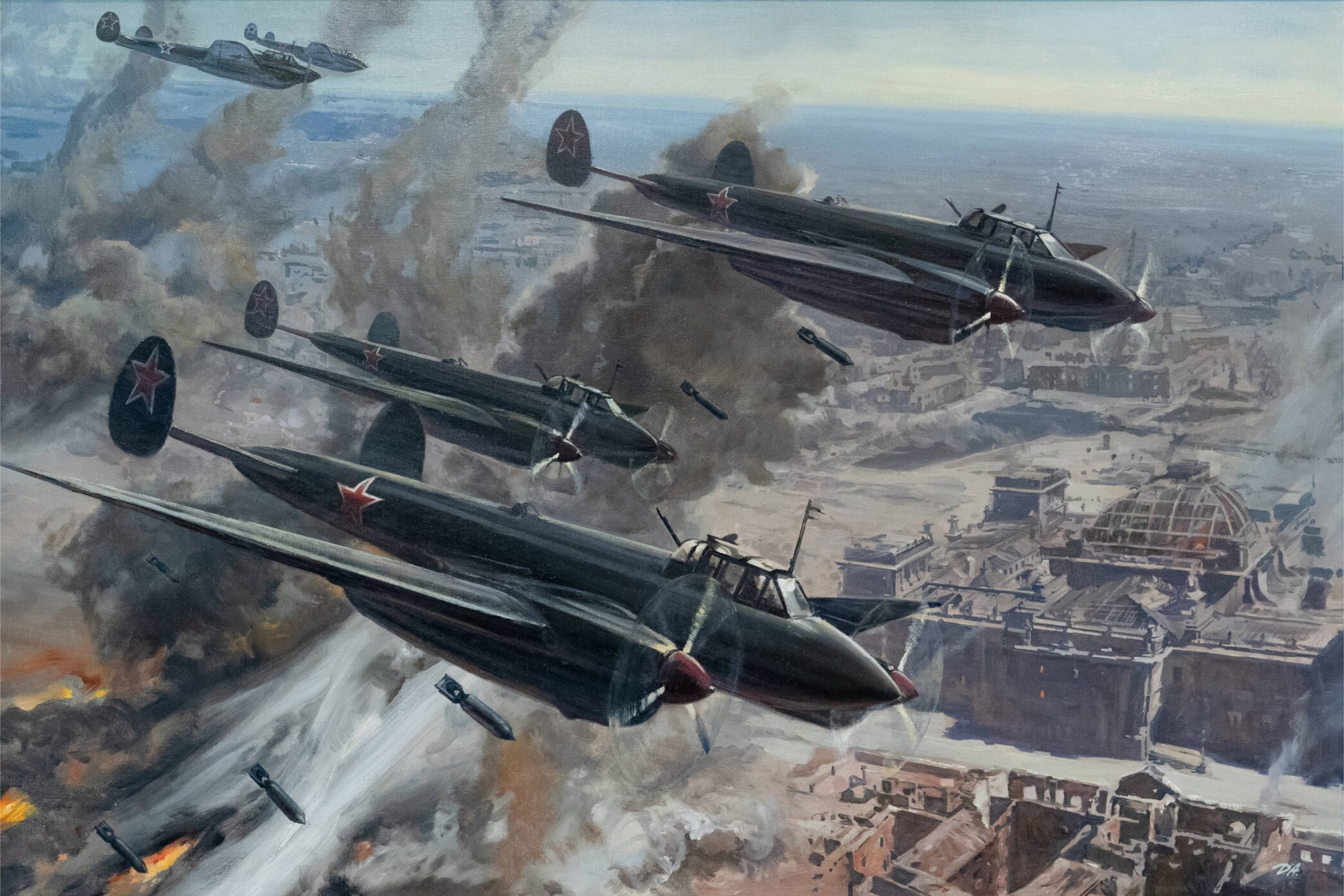
A vintage article from *Flying* magazine (May 1945 issue), published in honor of the 81st anniversary of the Great Victory, which I think will be of interest to readers and colleagues. The actual names of Soviet aircraft and equipment are given in square brackets.
How the Soviet Air Force Fights
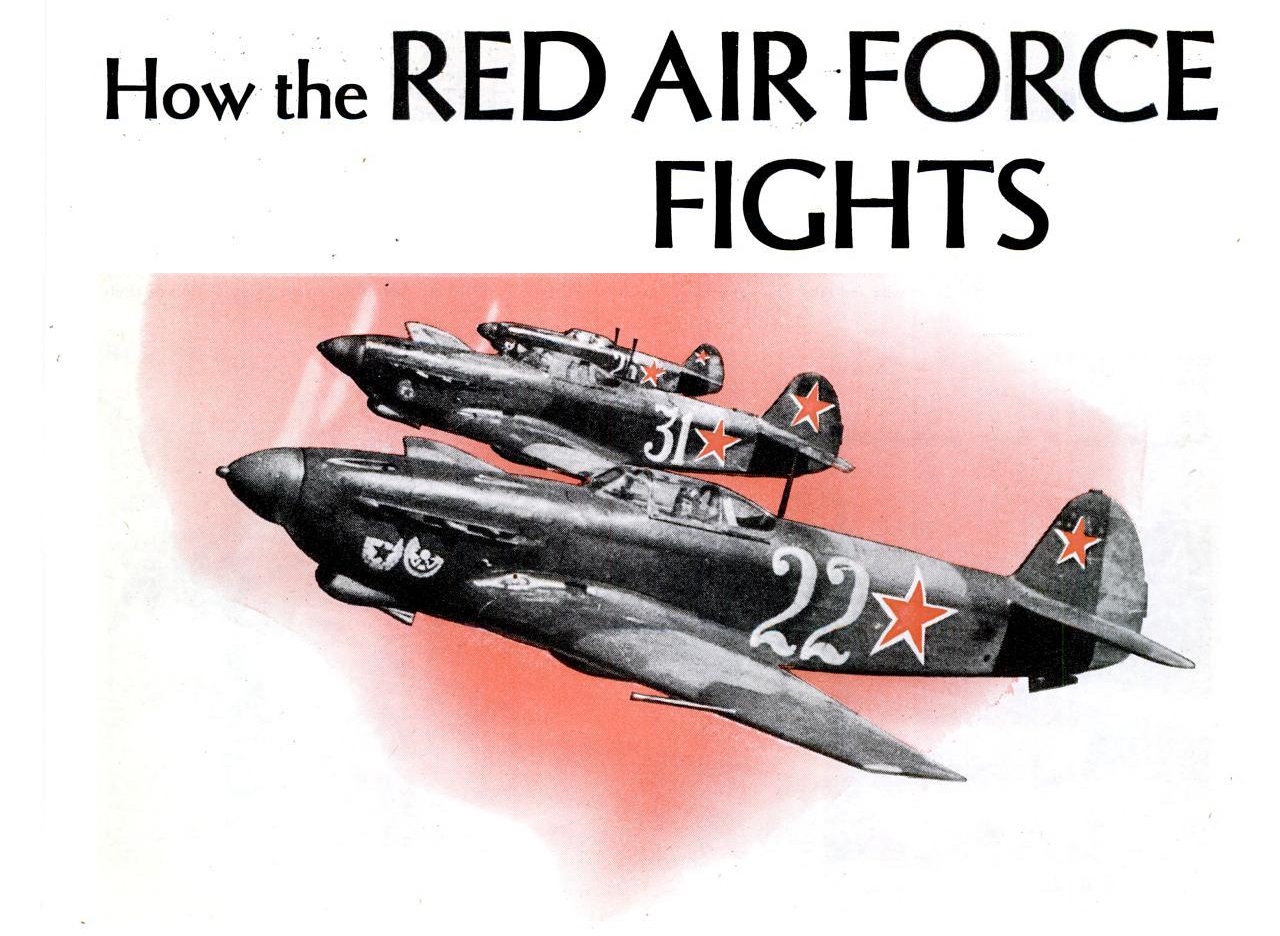
The Soviet Air Force focuses on tactics rather than strategy and is developing both aircraft to support ground forces and plans for direct support of ground forces
By CURTIS FULLER
, Assistant Editor-in-Chief of *FLYING* magazine
This article is based on telegrams from Colonel Nikolai Denisov, Major Khapaev, Captain K. Yurovsky, Captain P. Zheltukhin, Major S. Rybakov, and Major G. Zalutsky
The debates over air forces will not cease even after the war ends. Even setting aside the arguments still being made in newspapers and on the radio, the success of the vastly different air force concepts employed by various Allied nations will keep this debate alive. A comparison of the U.S. Air Force with the Soviet Air Force [1] will highlight these differences.
On the one hand, the Americans, like the British, emphasize aviation as a strategic weapon, while the Russians stress its tactical importance. In other words, the Western allies, following Dué’s theories, believed that aviation would become the decisive weapon in the war, whereas the Russians disagreed, viewing aviation as yet another powerful weapon added to ground forces. Nevertheless, both the Russians and the Americans use aviation for both strategic and tactical purposes.
The U.S. Army Air Forces believe that aviation can play a decisive role in destroying the enemy’s means of waging war—its industry and communications. Our Army Air Forces were designed primarily with this in mind. Our strategists selected the enemy’s most vulnerable industrial sectors and communications hubs as targets. The British went even further and wiped entire industrial regions off the face of the earth, having coldly calculated the amount of Allied labor required for the production of explosives, construction, maintenance, and the assembly of aircraft, compared to the enemy’s labor required to repair the damage they had inflicted.
When the U.S. Army Air Force uses aircraft for tactical purposes, it follows a strict plan, from which deviations are permitted only in exceptional circumstances. This framework, summarized as a set of “priorities,” consists, first, of gaining air superiority by neutralizing enemy airfields, destroying enemy aircraft, and disrupting fuel supplies; second, in “isolating the battlefield” by destroying lines of communication with troops on the front lines; and, finally, third, in providing direct support to our advancing ground forces.
How does the Soviet Air Force adhere to these priorities? But first, since we prioritize strategic bombing over tactical operations, how does the Soviet Air Force conduct strategic bombing?
There is hardly any need to list the areas targeted by bombing or to reproduce official statements to prove that the Russians do not view strategic bombing as a decisive method of waging war. It is enough simply to examine the types of aircraft being used. The Soviet Air Force has deployed only one type of four-engine bomber in combat operations—the TB-7 [TB-7; Pe-8], designed by Tupolev. The latest version of this bomber, as far as we know, is equipped with four two-row radial engines, each rated at 1,600 l.s. It is reported that the version with four 1,300-power liquid-cooled engines reaches a maximum speed of 300 miles per hour (480 km/h) at optimal altitude and has a range of 2,500 to 3,000 miles (4,000–4,800 km) with a bomb load of two to four metric tons. Little is known about the combat use of this bomber, and the first Russian aircraft to bomb Berlin were not the TB-7s, but the twin-engine DB-3F [DB-3F], which are now called the Il-4 [Il-4], since Ilyushin took over production of this aircraft. The Il-4 weighs 33,000 pounds (15,000 kg), accommodates a crew of four, and has a maximum speed of about 300 miles per hour (480 km/h) at optimal altitude. It can carry a two-metric-ton bomb load and is slightly larger than comparable American bombers, such as the Martin B-26 Marauder and the North American B-25 Mitchell.
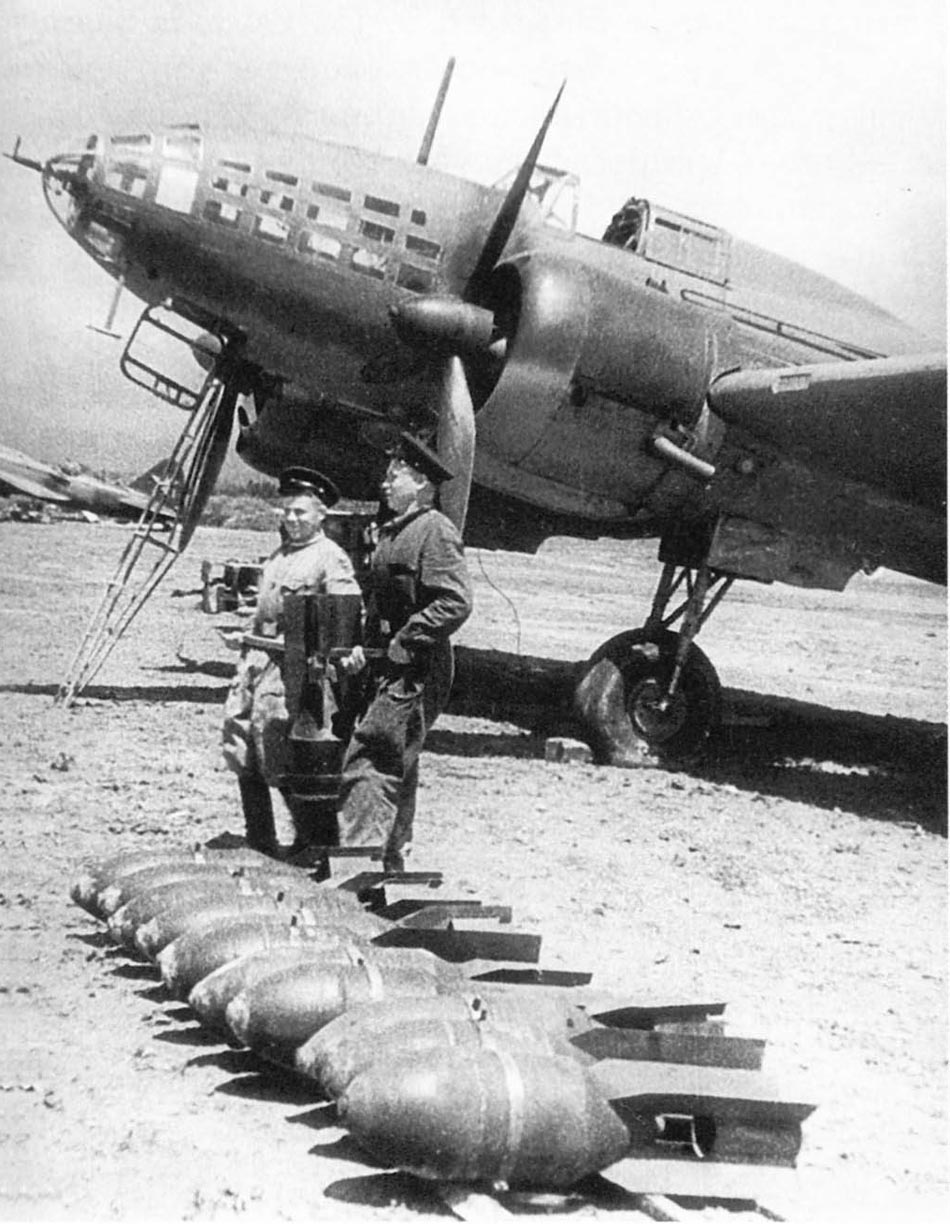
The Il-4, formerly designated DB-3F, weighs 33,000 pounds (15,000 kg), has a range of 2,500 miles (4,000 km), a maximum speed of 265 miles per hour (425 km/h), carries more than two metric tons of bombs, and has a wingspan of 70 feet 3 inches (21.4 m). Photo: airwar.ru
Another Russian twin-engine bomber is the Pe-2 (Пе-2), designed by Petlyakov, which carries a crew of three or four and has a maximum bomb load of 2,200 pounds (1,000 kg). The Pe-2’s cruising speed is 266 miles per hour (430 km/h), and its normal weight with a full load is 16,930 pounds (7,680 kg). Although by American standards the Pe-2 is not considered a strategic bomber, it is used to carry out strategic missions, as is the light attack aircraft known to us as the Stormovik [Il-2].
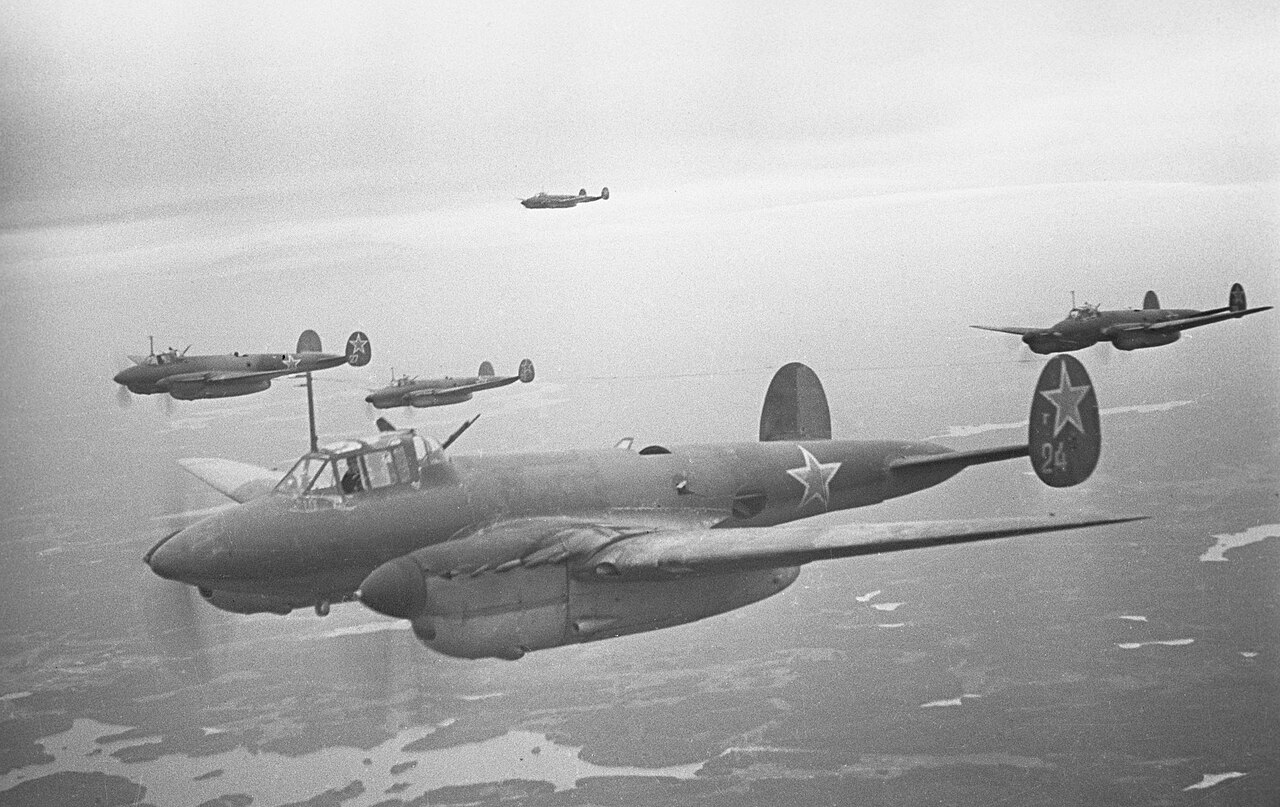
The Petlyakov Pe-2 light bomber, which weighs less than the Republic P-47 Thunderbolt fighter. The Pe-2 can carry a bomb load of one metric ton. Photo: ru.wikipedia.org
From the start of the offensive against the Germans at Stalingrad until December 1, 1944, the Soviet Air Force dropped 200,000 metric tons of bombs on strategic targets, such as airfields, railroads, and military-industrial facilities. About half of all strategic sorties flown after Stalingrad took place during the first 11 months of 1944.
Just as the study of Soviet bombers led to the conclusion that the Soviet Union paid little attention to strategic bombing, the study of Russian light bombers, ground-attack aircraft, and fighters leads to the conclusion that the USSR places great emphasis on tactical operations and, in particular, on direct support for ground forces.
The Russians used several types of American fighters, primarily the Bell P-39 Airacobra and the Bell P-63 Kingcobra, which were equipped with 37-mm cannons that fired through a hollow propeller hub. The Airacobra was ineffective at high altitudes, but the Russians still wanted to use it as a low-altitude fighter and ground-attack aircraft. It is reported that the “Kingcobra,” equipped with a supercharged engine and possessing good high-altitude performance, is being used by the Russians to carry out the same combat missions.
The most widely used Russian tactical aircraft is the ground-attack bomber developed by Ilyushin, known as the Stormovik. The only version about which we have extensive information is the Il-2, which has a maximum speed of 280 miles per hour (450 km/h). It is armed with two 32-mm cannons [two 23-mm VYA-23 cannons] and two or four machine guns. One variant is also equipped with eight 56-pound (25 kg) rocket-propelled shells [RS-132]. But more on the Stormovik below.
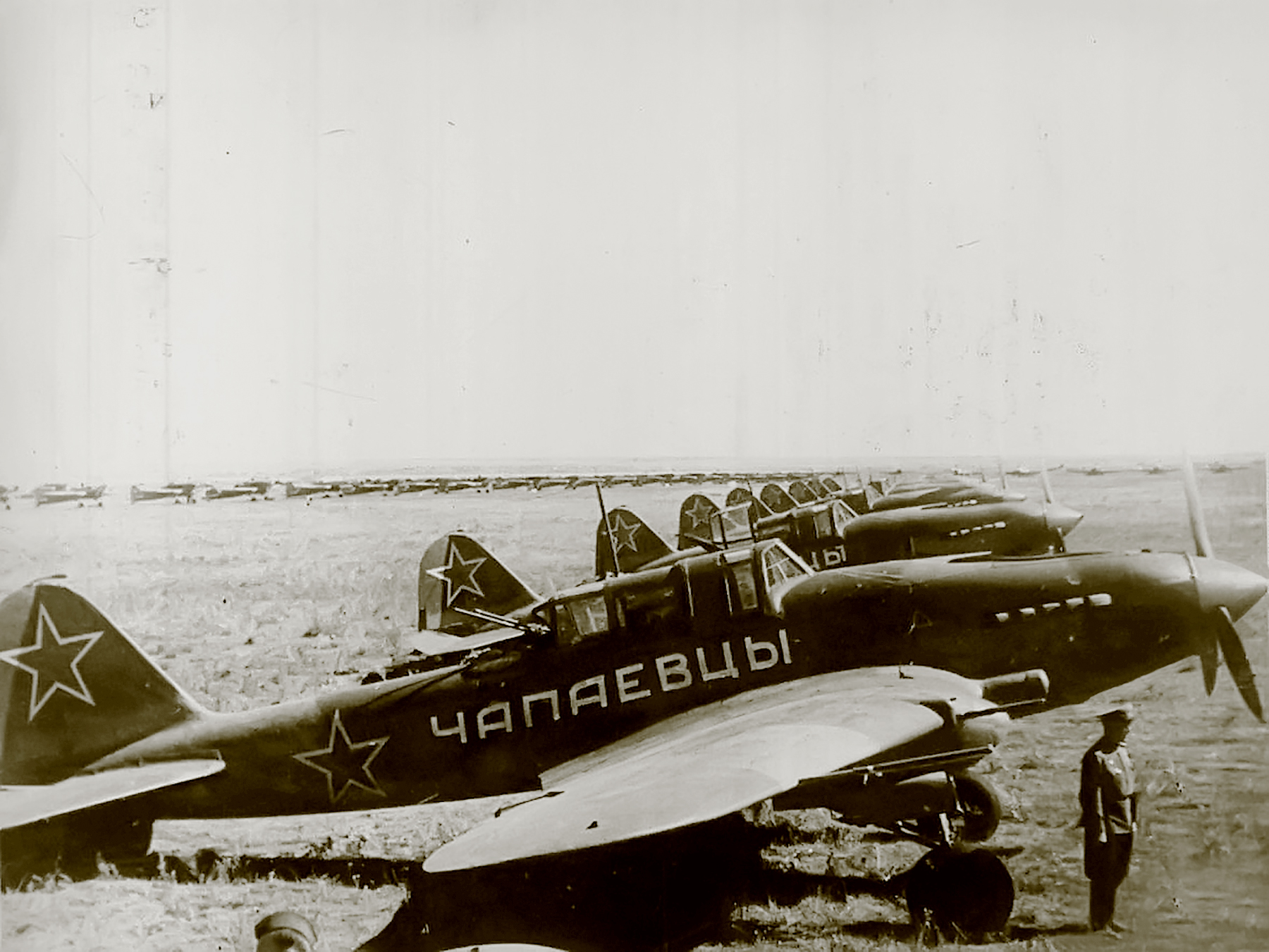
The two-seat, heavily armored Stormovik aircraft, which provide direct ground support to Red Army units, are armed with two 32-mm cannons, machine guns, and rocket launchers. The inscription on the fuselage indicates that the aircraft is a gift from the residents of Chapaevsk. Photo: asisbiz.com
Another type of fighter-bomber is the La-5, developed by Lavochkin [La-5], with a maximum speed of 370–375 miles per hour (595–605 km/h) and a single 1,600-horsepower two-row radial engine. It is armed with two cannons and two machine guns [two 20-mm ShVAK cannons]. The La-7 [La-7] fighter is also in service, but its technical specifications are unknown. The Russians also have the Yak-9 [Yak-9], a fighter with high flight performance, designed by Alexander Yakovlev and constructed primarily of wood with a skin of multilayer plywood bonded with synthetic adhesive. Swedish sources report that the Yak-9’s maximum speed is 390 miles per hour (630 km/h), and its new engine is believed to develop 1,800 l.s. of power. It is equipped with one cannon and two machine guns. The Russians also use Allied fighter aircraft: British Spitfires and American P-51 Mustangs and P-47 Thunderbolts.
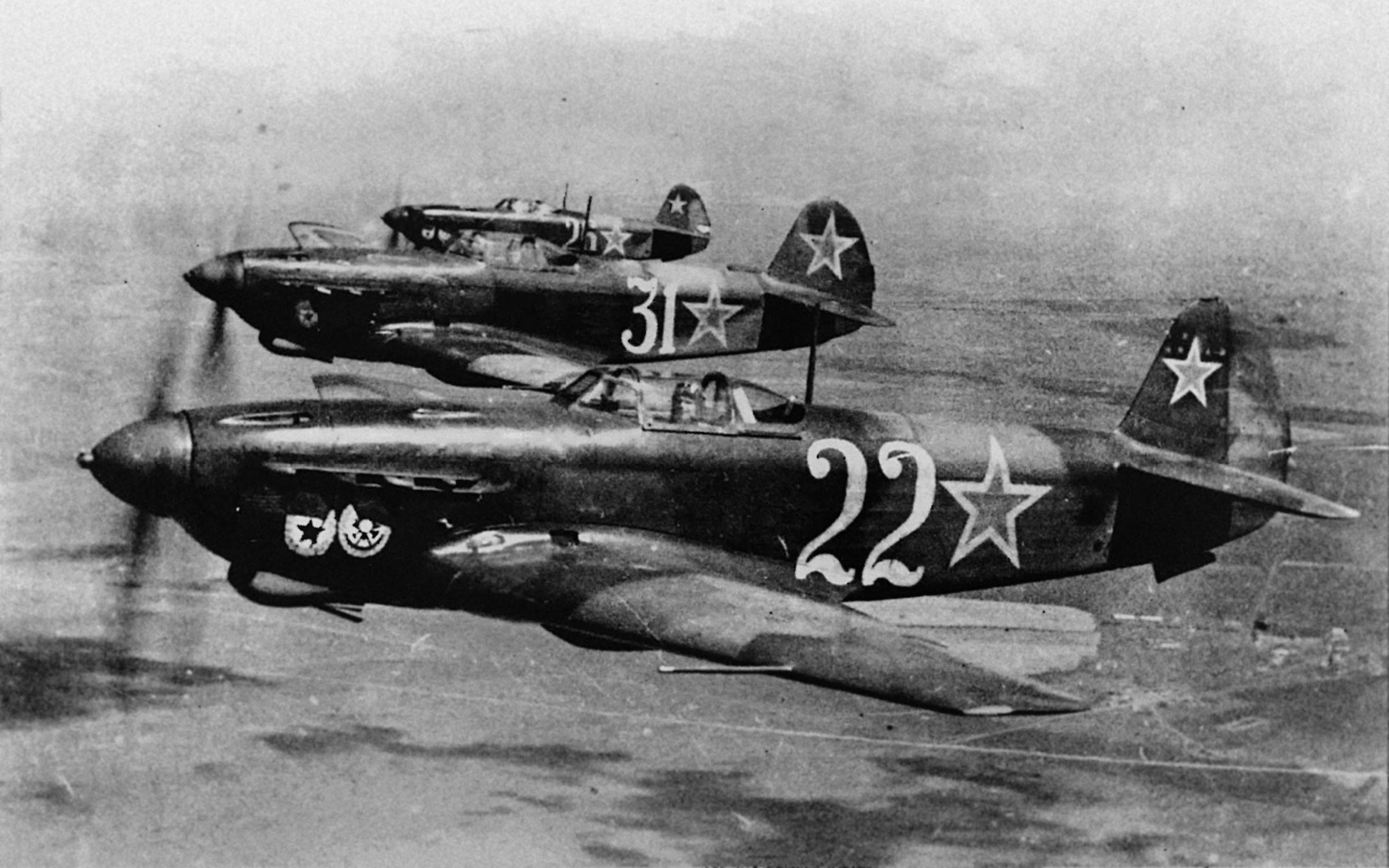
We don’t have any fighter planes like these Yak-9s, which are made mostly of wood and have plywood skin. Photo from imgur.com
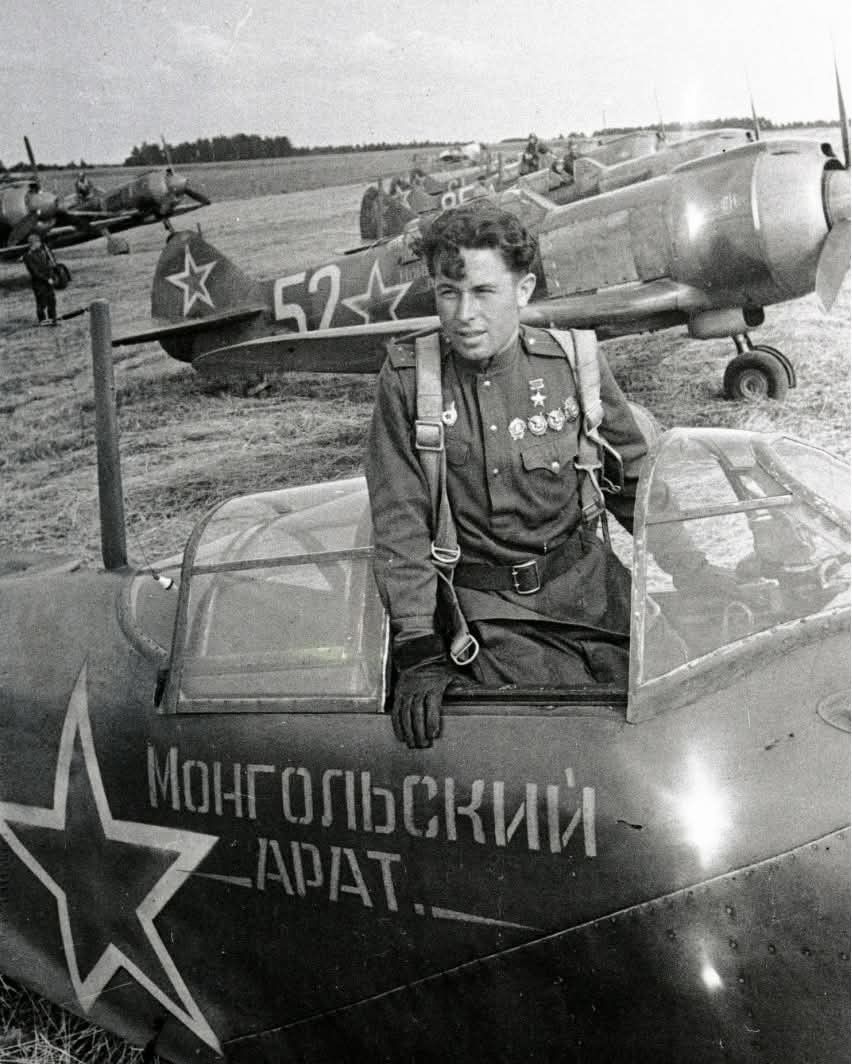
Standing in the cockpit of an La-5 is fighter pilot and Hero of the Soviet Union Captain Mayorov. He is a typical Soviet Air Force pilot who provides cover for ground-attack aircraft and carries out missions to support ground forces. Photo: asisbiz.com
Let’s compare British and American tactical concepts with Russian ones. The top tactical priority of the U.S. Army Air Force is to achieve air superiority. The Russians recognize its importance but do not insist that air superiority be a prerequisite for providing air support to ground forces. The Russians remember the bitter lessons of June 1941, when German attack aircraft caught Soviet aircraft off guard and destroyed hundreds of them at airfields near the front lines. They seek to replicate this maneuver during their own offensive operations. But the Soviet Air Force understands that air superiority is, as a rule, relative. They do everything possible to secure it, and at the same time they press forward and attack.
Last fall, during the offensive in the Baltic region, the Soviet Air Force attacked more than 100 enemy airfields and destroyed over 1,500 German aircraft. Fuel and ammunition depots were destroyed. Five particularly important German air bases were subjected to air raids more than 100 times. According to the Soviet Air Force, 126 aircraft were put out of action during one such raid.
These airfields were attacked at night using guidance aircraft and a tactic that differed significantly from the one used by the British. The bomber groups included guidance aircraft with specially trained pilots and navigators. However, instead of dropping flares to mark the target for a carpet bombing, as the British would have done, Soviet crews dropped flares with a luminosity of 2,000,000 candelas each and employed high-precision bombing techniques. During a single raid on a railroad marshalling yard in Breslau, between 20 and 40 flares were used, and the bombs were dropped from an altitude of 16,000 feet (4,900 m).
Another unusual feature of these raids is that they are under the constant supervision of an officer from the headquarters’ operations department, who flies to the target alongside the strike force, observes as the guidance aircraft drop flares, and then observes the bombing run. He maintains constant radio contact, guides the bombers from target to target, monitors enemy air defense, and either alters the bombers’ route to avoid anti-aircraft fire whenever possible or orders a direct attack on the anti-aircraft guns themselves.
Gaining air superiority became a key objective of the Soviet Air Force during the Soviet invasion of East Prussia, which began in January 1945. Despite poor flying conditions, more than 50,000 combat sorties were flown in East Prussia and western Poland within a short period of time. In one of the first days of the offensive, Soviet pilots flew more than 5,000 sorties in groups of 125 and 150 aircraft. These airstrikes, combined with the rapid advance of ground forces, prevented the Germans from concentrating any significant Luftwaffe forces, and the Germans were even forced to relocate their air bases to the west, and one of the airfields to which the German aircraft were transferred was mined.
Russian tanks captured many German aircraft that had not yet taken off, and the few groups of Luftwaffe aircraft that managed to get airborne were soon destroyed by Soviet aircraft. La-5s carried out massive bombing raids on German airfields, further exacerbating the Germans’ defeat in the air. It should be noted here that the Luftwaffe was crushed not only by the Soviet Air Force but also as a result of the simultaneous offensive by the Red Army, which captured the airfields. The army and the air force complemented each other on the ground and in the air.
Now let’s examine the second tactical priority of the U.S. Army Air Force—the isolation of the battlefield. The Soviet Air Force developed special methods for destroying roads and bridges and attacking troop columns.
Flares are used for nighttime tactical operations. Last spring, Soviet night bombers destroyed a forest bridge built from centuries-old trees just as German reinforcements were about to cross it to aid Nazi troops on the other side who were in a dire situation. In daylight, the Germans spotted the Soviet bombers overhead and scattered their forces, intending to cross after dark. Meanwhile, the Soviet bombers postponed their attack until the Germans had lined up to cross. Then, the bombers—coordinated by radio—attacked the crossing by the light of the moon and signal flares. They destroyed several tanks and self-propelled guns, as well as the bridge itself.
In another instance, the Germans were moving infantry and tank units across two bridges spanning a wide river, approximately 1,000 feet (300 m) apart. The advancing Red Army units urgently requested air support to destroy the bridges, since if the Germans crossed the river, they would find themselves on high ground; if the bridges were destroyed, the Germans, cut off by the river and trapped, would have been forced to fight on unfavorable terrain. Only three dive bombers were available, but they successfully struck the bridges during a bombing run from an altitude of approximately 2,500 feet (750 m). According to Soviet standards, an operation against such complex, small-scale targets would normally have required at least 30 bombers. The success of the operation is particularly noteworthy because both bridges were destroyed during the same bombing run—a difficult task that required careful calculation of speeds and angles.
Captain P. Zheltukhin, commander of an attack aircraft unit, explains the tactics of the Soviet Air Force when attacking convoys of vehicles on the highway. Pilots receive information about the movement and location of the convoys. Since the convoys change their location rapidly, reconnaissance aircraft keep a very close watch on them. Particular attention is paid to concentrations of personnel and equipment; reconnaissance aircraft call in ground-attack aircraft—usually groups of four to twelve planes—depending on the target, expected resistance, and weather conditions.
The Germans often protect their large convoys with mobile anti-aircraft guns and fighter patrols. In such cases, Soviet pilots fly in a wedge formation. When anti-aircraft fire is heavy, some aircraft are specifically assigned to attack the anti-aircraft guns. Captain Zheltukhin prefers to choose the right moment to strike the enemy and targets river crossings, road intersections, and areas where the terrain prevents the enemy from dispersing. Soviet pilots first strike the lead of the column, forcing the enemy to slow down or even stop.
There are various methods for attacking a formation, but the most effective is to descend in a straight line at an angle of approximately 10° to 15°. However, if anti-aircraft fire is very dense, the angle can be increased to 25°–30° to reduce the time each aircraft must remain within the range of the air defense systems. It is claimed that a wedge formation attack yields excellent results, allowing each pilot to maneuver freely, select their own target, and strike with greater precision. According to Captain Zheltukhin, a wedge formation attack also facilitates defense against enemy fighters.
When there are a large number of enemy fighters, Soviet pilots use a star-shaped attack formation, which, in their view, distracts the enemy gunners. The variety of attack methods prevents the Germans from anticipating upcoming maneuvers—the flexibility of the plan and tactics is a key element in the Soviet Air Force’s operations.
An unusual situation regarding the isolation of the battlefield occurred in January 1945 during the siege of Budapest. The German High Command made desperate attempts to resupply the besieged city by air, and the Soviet Air Force reported that it had shot down more than 200 combat aircraft that were attempting to clear the way for Nazi transport planes scheduled to land in the Budapest area. Soviet fighters provided cover for the city during daylight hours, while at night their light night bombers bombed the fields where the transport planes were attempting to land. This situation differed somewhat from that of two years earlier at Stalingrad, when the Germans simply lacked the forces to escort transport planes to von Paulus’s encircled army, and more than 1,000 German aircraft were shot down.
The third priority of the U.S. Army Air Forces’ operations for tactical purposes—direct support of ground forces—seems to be the source of the greatest pride among Soviet pilots. During the invasion of East Prussia that winter, in May 1945, the main efforts of Soviet aviation units were directed toward supporting tanks and infantry fighting deep within the enemy’s defensive zone. They were particularly active during enemy counterattacks.
Attacks on strong columns of enemy tanks were carried out by two main types of ground-attack bombers—the Tupolev [Tu-2] and Petlyakov [Pe-2] models—which approached their targets in waves. These bombers were excellent at diving onto enemy targets.
Colonel Denisov describes an attack in August by La-7 and Yak-9 fighters on a small sector covering an area of about 10 square kilometers. First, this small area was targeted with artillery and mortar fire, while approximately 130 Soviet fighters patrolled the sector to provide cover. Soon, bomber forces led by Pe-2 squadrons appeared, diving toward their targets and followed by 175 bombers. This was not a carpet bombing but a high-precision attack, as each bomber independently selected a specific target. While the bombers were climbing to repeat the attack, 200 Stormovik ground-attack aircraft flying at low altitude launched their strike. The attack was repeated several times, and once the target area had been cleared of enemy aircraft, Soviet fighters joined the attack aircraft, delivering cannon and machine-gun fire while flying at low altitude. Then the ground-attack aircraft and fighters launched another attack. In total, the attack by approximately 500 Soviet aircraft lasted two hours.
“Stormovik” is not the name of a specific aircraft type, but rather a class of attack aircraft (literal translation: “stormer” [shturmovik]). These aircraft most accurately reflect the Russian concept of air support for ground forces. The Ilyushin Stormovik is a two-seat aircraft, heavily armed with cannons, machine guns, and bombs, and designed to deliver direct strikes against the enemy’s stationary ground positions and armored forces. Critics who point to the Il-2’s relatively low speed tend to underestimate the revolutionary amount of armor plating it carries. The engine is protected by armor, and the entire front section is covered with sturdy steel plates. The windshield consists of nearly three inches of bulletproof glass, and the entire rear fuselage—from the gunner’s compartment to the tail—is a plywood structure covered with armor plates.
The Stormovik quickly led to a reevaluation of Nazi General Guderian’s theories on tank warfare. Stormoviks were widely used to combat tanks and infantry on the battlefield, as well as to strike enemy airfields, communications, and maritime transport. They were also used to provide direct support to attacking infantry.
The development of ground-attack aircraft sheds significant light on the requirement to which the U.S. Army Air Forces give top priority when carrying out tactical missions—establishing control over the battlefield. The Stormovik is too slow to be an effective fighter—it cannot engage in aerial combat with high-speed German fighters. Therefore, this crucial Russian aircraft cannot be used to destroy enemy fighters in the air. Although its armor provides excellent protection, there is a possibility that it will be unable to withstand the latest German fighters equipped with powerful cannon armament. Nevertheless, the Stormovik remains a successful combat aircraft because the Russians now escort ground-attack aircraft with fighters when necessary, and also because ground-attack aircraft operate at altitudes ranging from treetops to 500 feet (150 m). Here, the Stormovik is difficult to detect, and its heavy armor and rear gunner make it hard to hit. The Il-3 [Il-2KSS] is an improved model, shown in the photographs accompanying this article. The Il-3 has a more powerful engine, and the gunner now has a separate cockpit.
In Finland, during the breakthrough of the Mannerheim Line, Il-2s cleared the way for tanks and attacked enemy artillery positions. When enemy fire prevented the tanks from advancing, the tank crews called in air support and directed the ground-attack aircraft toward specific strongpoints. During these combat sorties, the Il-2s bombed enemy tanks, then climbed to disperse clusters of German fighters and bombers targeting Soviet rear areas, and then returned to bomb the tanks again. This versatile aircraft was even used for aerial reconnaissance.
The Stormovik, with a crew consisting of a pilot and a gunner, represents a different concept of a strike aircraft and a close-air-support aircraft for ground forces, differing from any conventional fighter in the U.S. Army Air Force. Our high-speed fighter-bombers were originally designed for missions entirely different from those they are currently performing. Only when the war ends will it be possible to fairly assess the Russians’ emphasis on tactical air support compared to our own emphasis on strategic operations.
[1] Here and throughout, references to the Soviet Union and the Soviet Air Force are presented in a neutral context, without terms such as “Reds,” “Soviets,” etc. – byakin
источник: Curtis Fuller, Assistant Managing Editor «How the Red Air Force Fights» «Flying» May, 1945, pages 21-23, 132, 134, 137
Translation first published at – https://vk.com/@710541705-how-the-red-air-force-fights