The Involvement of Russian Diplomacy in the Romanian-Bulgarian Conflict of 1912–13

Continuation of the series “The Balkan Crisis of 1912–14, Which Also Drew Russia In”
International relations in the Balkans at that time were a hotbed of conflict. They became particularly tense by the fall of 1912, when the Balkan League—comprising Bulgaria, Greece, and Serbia—declared war on the Ottoman Empire (the First Balkan War). Shortly after the war began, Romania advanced a claim to a portion of Bulgarian territory (Southern Dobruja). Romanians made up 2% of the population in that territory, which had never been part of Romania; the basis for its claim to Dobruja was simple: it was desperately needed. The Romanians backed up their claims with a military threat, declaring that they would seize the demanded territories by force. However, an attempt at an attack and military conquest was risky for the Romanians. They feared a Russian reaction to an attack on Bulgaria. Bulgaria itself had a large army. At the time the Romanians made their claims, the Bulgarian army was tied down on the Turkish front. But the most intense phase of the war with the Ottoman Empire was quickly over. In December 1912, a ceasefire was concluded. Moreover, Bulgaria had a military alliance with Serbia and Greece that was in effect at the time.
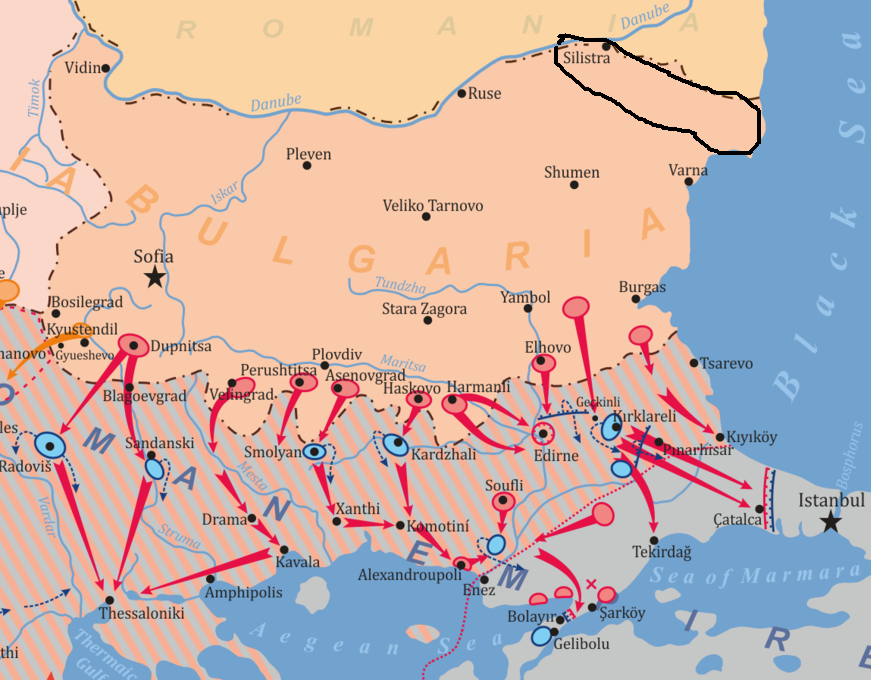
At the bottom is the Bulgarian-Turkish front; at the top, the area of Romanian territorial claims is circled
The Romanian leadership was quite cautious, and since the prospects for a military solution in that situation were uncertain, Bucharest decided to pursue its goals through diplomacy. In November 1912, the Romanian government appealed to St. Petersburg for mediation in a territorial dispute with Bulgaria; they asked Russia to exert influence on the Bulgarians so that they would satisfy Romania’s claims. The request was accompanied by promises that, should the claims be met, Romania would shift its policy to one that was anti-Austrian and friendly toward Russia.
In this situation, Russia could not remain indifferent or uninvolved; it was necessary to determine its position regarding Romania’s claims against Bulgaria. There were two options: to support the claims or to reject them. In St. Petersburg, it was decided to support the Romanians, though not to the full extent of their claims. The Russian Foreign Ministry, headed by S. Sazonov, interpreted the situation as an opportunity to improve relations with Romania by supporting its claims and thereby effectively remove it from Austro-German influence. This was seen as a significant shift in the overall situation in the Balkans—a weakening of the Austro-German position and a strengthening of the Russian one. And the starting point for this was to be Russia’s participation in satisfying Romania’s claims against Bulgaria. In other words, Sazonov and his patron, Nicholas II, decided to cede part of Bulgaria to Romania—and thereby improve relations with the latter, which, in their view, was in Russia’s vital interest.
There was another reason why the Russian leadership decided to support Romania’s claims against Bulgaria. Opposing the Romanians—and, as a result, straining relations with them—was seen as posing a significant risk. Because of Romania’s alliance with Austria-Hungary and Germany, officials in St. Petersburg feared that complications with the Romanians could provide a pretext for a confrontation with the Austro-Germans, which threatened to lead to a major war. By showing goodwill toward Romania, St. Petersburg hoped to avoid this risk and weaken Romania’s commitment to its alliance with Austria-Hungary and Germany.
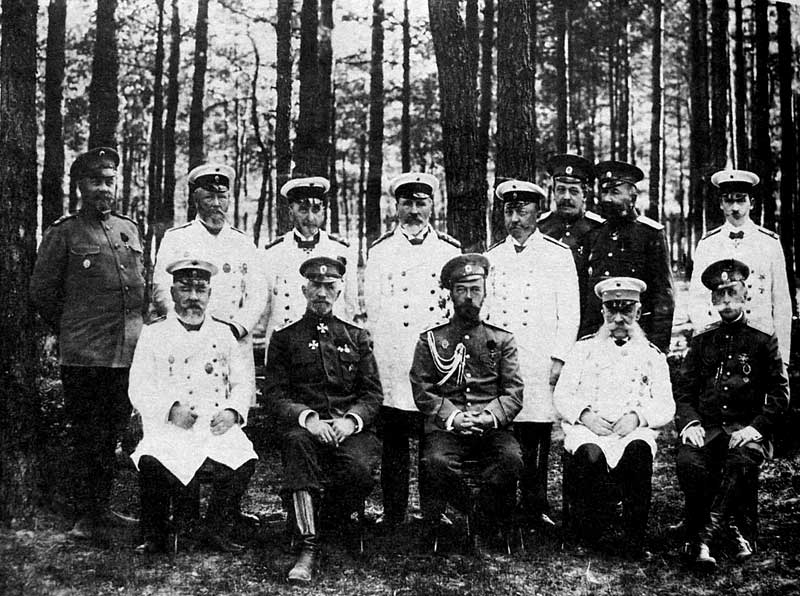
Nicholas II and his ministers; Sazonov is standing second from the left
Thus, St. Petersburg’s desire to improve relations with Romania and pull it out of its anti-Russian alliance with the Austro-Germans, as well as its desire to avoid the risks of confrontation with Romania—which could lead to an escalation with the Austro-Germans—led St. Petersburg to decide to support Romania’s claims against Bulgaria.
On the one hand, Russian diplomacy warned the Romanians against attempting a military resolution to the conflict with Bulgaria. On the other hand, acting as a mediator and peacemaker, St. Petersburg proposed that the Bulgarians cede at least part of the territories demanded by Romania to avoid a war with Romania over the seizure of those territories.
But a difference in how St. Petersburg and Sofia perceived the situation immediately became apparent. Sazonov saw Bulgaria’s concessions to Romania as a path to reconciliation between the countries and to an overall easing of tensions in and around the Balkans. He believed that, given Bulgaria’s circumstances, making concessions was a rational decision. In Bulgaria, however, they naturally did not want to give up even an inch of their land. Russia’s recommendations regarding concessions were received with distress. Bulgarian representatives put forward their own arguments, asserting that a concession imposed on them by the Romanians would not lead to reconciliation with them but, on the contrary, would intensify the hostility. Nor would there be any benefit to Russian interests in this—Russia would not gain Romanian friendship at the expense of Bulgarian territory, but it would lose Bulgaria. Sazonov soon lost enthusiasm for the idea of Russian mediation. But it was already awkward to refuse the Romanians outright.
To extricate itself from this delicate situation, St. Petersburg convened a conference of the Great Powers (Austria-Hungary, Britain, Germany, Italy, Russia, and France). None of the powers wanted to strain relations with Romania, and so, to a greater or lesser extent, they supported its claims against Bulgaria. In April 1913, the powers compelled Bulgaria to cede the city of Silistra to Romania.
Russia was no longer the only country to demand concessions from the Bulgarians. In St. Petersburg, officials concluded that they had managed to save face with Bulgaria (since the resolution adopted at the conference had significantly reduced the scope of Romania’s claims) and to continue their policy of improving relations with Romania.
Both the Bulgarian and Romanian sides were dissatisfied with the conference’s decision. From the Bulgarian perspective, the fair decision would have been to give the Romanians nothing at all. The Romanians, however, were not satisfied with the reduction of their claims; receiving Silistra only whetted Romania’s appetite. A few months later, the Second Balkan War began—and in Bucharest, it was decided that the time was ripe for further seizures of Bulgarian territory. To do this, they had to enter the war on the side of Bulgaria’s opponents. And here, Russian diplomacy once again supported the Romanians.
Combinations in which a player sacrifices some “material” to achieve the desired results—similar to chess—are called gambits. In 1912–13, Russian diplomats decided to sacrifice a piece of Bulgaria to Romania, hoping to gain advantages from this move. But St. Petersburg’s “Bulgarian gambit” turned out to be a disastrous mistake with serious consequences. More on this in future publications.