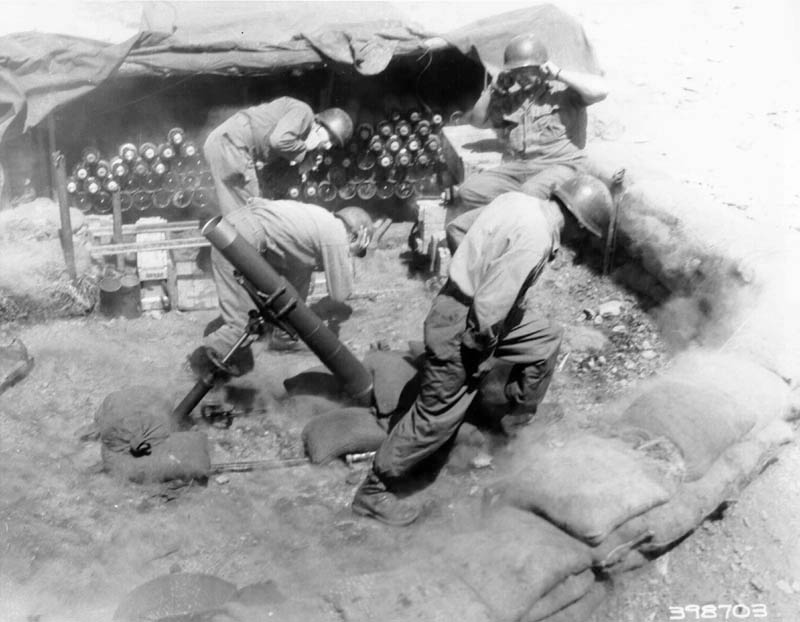
An article from the “Historical Weapons Studies” channel on Yandex Zen.
The “Historical Weapons Studies” channel continues its series of translations of excerpts from Brigadier General Marshall’s report on the U.S. Army’s experience with the use of weapons during the Korean War in the winter of 1950–1951. Today, readers are presented with a translation of the section titled “Mortars.”
Images from the Internet; technical specifications added by me.
Paragraph heading
Overall
The overall effectiveness of the entire family of mortars was excellent. All three types—the 4.2-inch (106.7-mm Model 1943 mortar—IO), the 81-mm, and the 60-mm—fully meet tactical requirements and are widely used. Under the conditions presented by the Korean terrain, each type plays its own specific role in organizing a balanced fire support program.
Mortars in the Korean War were perhaps more effective than they were during World War II. Infantry unit commanders were more familiar with mortars and made better use of their capabilities.
Korea, with its endless landscape of steep hills and jagged ridges, is a natural environment for mortars. Since the Chinese, in a nighttime attack, seek to suppress a position at close range, and their line of attack, by the time it is detected, often finds itself in a narrow pass exposed to our artillery fire, mortars are assigned a wide range of fire missions that prove decisive on the battlefield.
The limiting factor in mortar operations is usually the availability of ammunition, not the inability of commanders at any level to assess what mortars are capable of.
It is easy to understand why this is the case. Battalions—and sometimes even individual infantry companies—hold positions at a relative distance from other units. A unit may be 1,500–3,000 yards (1.4–2.7 km — IO) from its nearest support on the right and left and 2,000–4,000 yards (1.8–3.7 km — Author’s Note) ahead of supporting field artillery. Their position will typically be on a hilltop or ridge crest if they are on the front line, or in a ravine if they are covering a stream bed or road. Hilltops are a long way from the nearest supply point; this distance can only be covered on foot; therefore, 60-mm mortars (company-level mortars in the U.S. Army—IO) are transported to their positions with a limited amount of ammunition. If an 81-mm mortar is deployed to the front, ammunition for it will also typically be in short supply.
A typical 60-mm position is located in a low-lying area on the rear slope of a hill occupied by a unit or at its base. In a defensive situation, mortars are usually set up close to the command post. The Chinese almost never launch an attack designed to deliver a major blow to the rear; they usually attack either head-on or from the flank along the gentlest slope (especially if it is covered with trees and underbrush). As a result, the main threat to a company’s mortars is fire from enemy mortars.
Heavier mortars are generally capable of providing fire support to a unit from a great distance. This is one of the most significant firepower advantages stemming from Korea’s hilly terrain and the enemy’s lack of air support and effective artillery.
Within a few hundred yards behind the infantry line, there is always a spot where mortars can be positioned in a defile—if there is any danger of counter-battery fire. But often the situation is such that the 81s and 4.2s are boldly positioned in open terrain where there is a good vantage point, firing in full view of the enemy hill, beyond the practical range of its small arms.
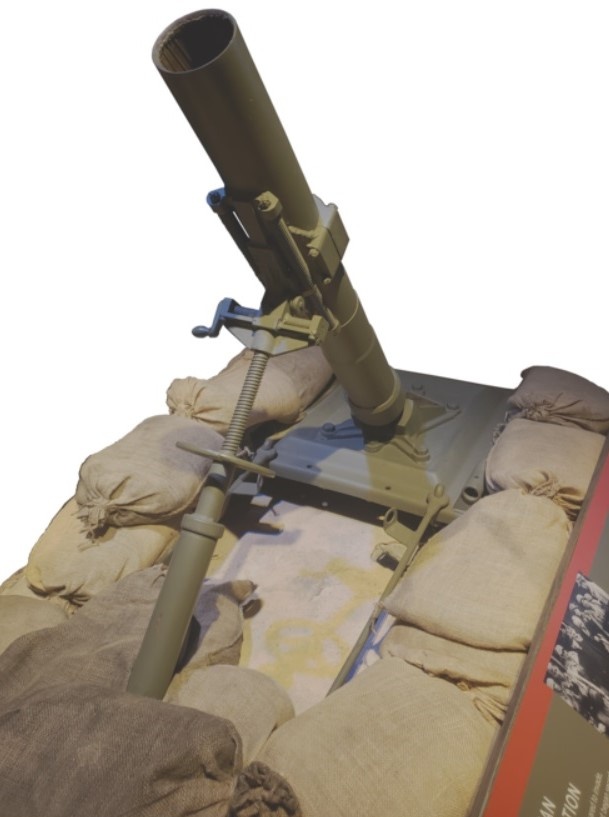
4.2 mortar
Breakdown in Cold Weather
Mortars withstand temperatures ranging from 0” to 32” well, and no major problems arise, the ground is still soft enough to absorb the impact on the support plates, and there is no excessive loosening or wear on the lifting screws. At temperatures ranging from -10° to -30°, this situation appears to change dramatically, and if mortars fire at a high rate for extended periods, the rapid failure of the firing pins and, especially, the base plates becomes a serious threat to operations. It is not possible to compare this rate—only the 1st Marine Division, during the operation at Chosen Reservoir, used mortars in such a way that they fired continuously for extended periods (12–14 days) at sub-zero temperatures. Overall, however, the durability of mortars of all calibers was well documented. The troops had no complaints in this regard, and in the 1st Marine Division—despite the fact that most mortars had to be completely or partially replaced at the end of the operation— commanders and crews did not consider this replacement to be due to the unreliability of the mortars, although they noted that a large supply of spare parts is necessary for operations in sub-zero temperatures. They explicitly stated that the rate of breakdowns was caused by excessive use in extreme cold, rather than by any design flaw.
4.2-inch mortars
This weapon is the workhorse of infantry operations in Korea. No other relatively new weapon has been used as extensively or has gained greater popularity among the troops. Enthusiasm for it is unanimous. The 4.2 mortar is accurate and durable; its shell inflicts as much damage as a 105-mm shell, and because of its continuous firepower and visible impact on the battlefield, it is valued perhaps more highly than any other weapon in an infantry regiment. A number of battalion and regimental commanders noted that they would like to see twice as many 4.2s in the regiment, and that they are confident the increase in firepower, under virtually any terrain and climate conditions, will more than justify the additional burden. This comment was made by Colonel Lewis Puller following the extensive use of the 4.2-inch mortar during the defense of Koto-ri: “It is an excellent weapon. With a fast and well-trained crew and all eight mortars firing, we found that we could launch 96 rounds into the air before the first one exploded.”
Technical Specifications of the M2 Mortar, Model 1943
Weight: 151 kg
; Overall length: 1.22 m
; Barrel length: 1 m
; Shell weight: 11–13 kg
; Maximum range: 4.4 km
81-mm mortars
This mortar served faithfully throughout the Korean campaign, and its illumination rounds were used to particularly good effect during combat—until the meager supply of these mines ran out. It was tasked with more work than during World War II—due to a shortage of 60-mm rounds at the company level. For direct support of an infantry company withstanding a night attack, the illumination provided by the 81-mm mortar was likely better than that of a 155-mm artillery shell, because the circle of light created by the latter often covers too large an area, giving the attacker a certain advantage.
A typical example is the battle for Hill 440 in February 1951, when a heavy-weapons unit first helped repel a nighttime enemy attack by firing 155 mines at a range of about 100 yards (91 m — Ed.), and then supported its battalion’s attack by firing 500 mines at a range of 2,800–3,000 yards.
As suggestions for modernizing mortars, unit commanders made the following recommendations:
-
- make it as light as possible;
- make the barrel detachable;
- make the baseplate collapsible;
- reinforce the lifting screw, which is the mortar’s main structural flaw.
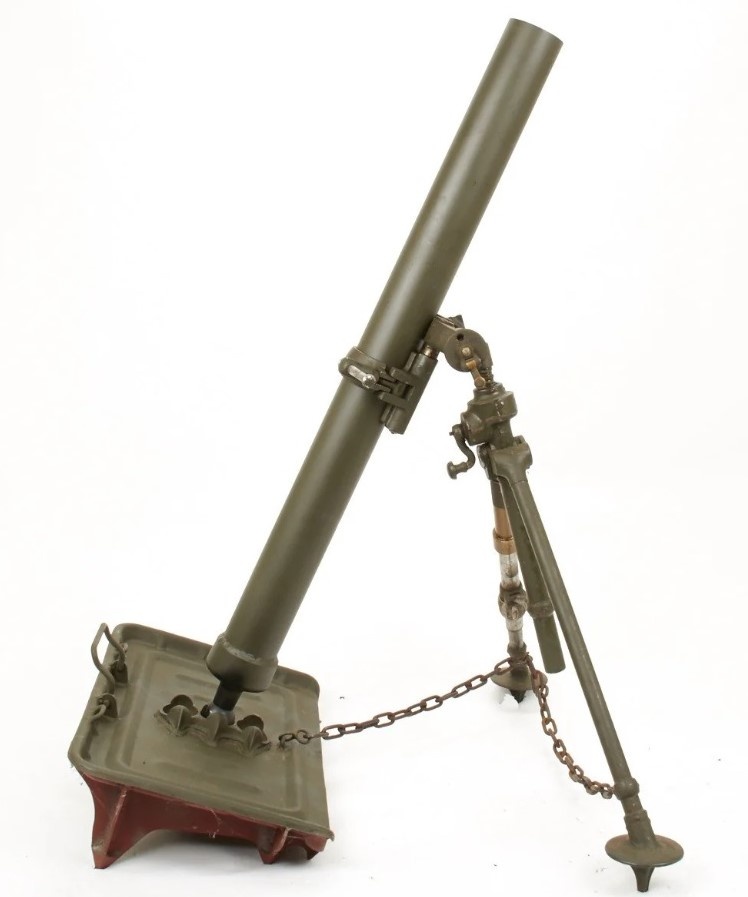
M1 81-mm Mortar
Technical Specifications of the 81-mm M1 Mortar, Model 1935
Weight
—barrel: 20 kg
—mount: 21 kg
—baseplate: 20 kg
Length: 1.19 m
Weight of shell: 3.2–6.8 kg
Maximum firing range: 3,000 m
60-mm mortars
The unreliability of several types of 60-mm mines is the main reason for the criticism of this mortar.
During test firings of a flare mine in January 1951, the 25th Infantry Division discovered that approximately 35% of the ammunition was defective—the mine left the barrel but did not emit light.
During combat firing in colder conditions, the 1st Marine Division at Koto-ri and Hagaru-ri recorded failure rates of 80 to 90 percent with the same mine.
With some caution, it can be said that during winter operations, at least one out of every five 60-mm mines failed.
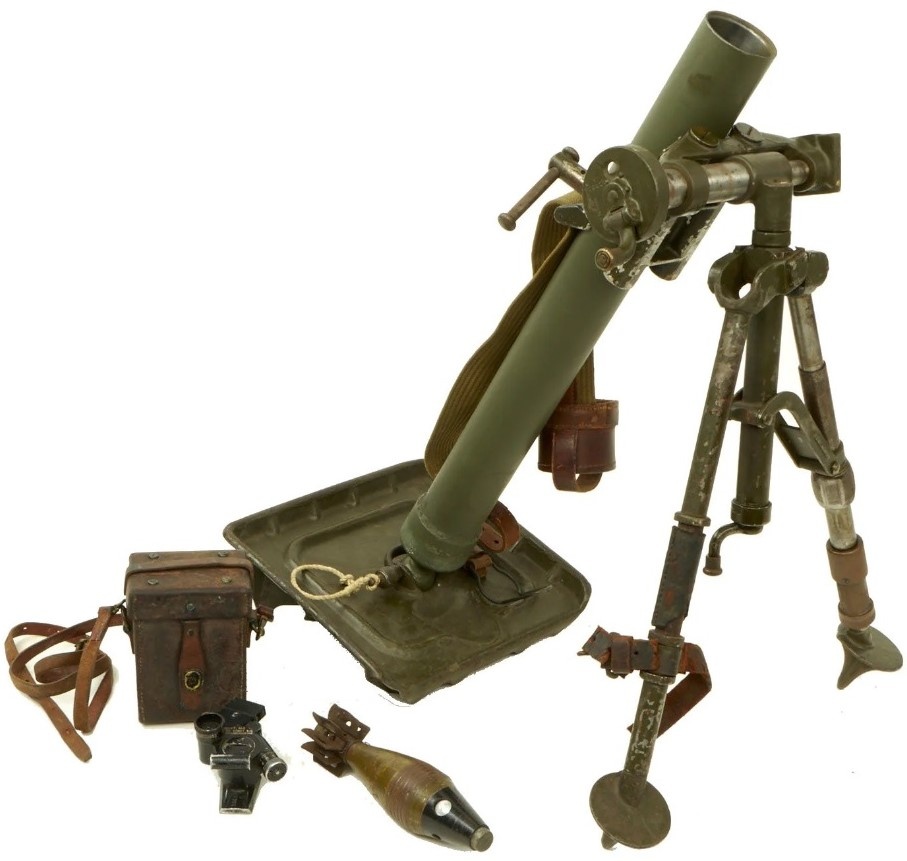
60-mm mortar, Model 1940
Technical Specifications
Weight: 19 kg
; Barrel length: 726 mm
; Maximum firing range: 1.8 km
; Shell weight: 1.2–1.3 kg
; Rate of fire: 18 rounds per minute
A brief comment from “Historical Weapons Studies”
I never had the chance to fire a mortar—our outposts weren’t equipped with them.
The series of translations of Brigadier General Marshall’s report will continue.