A World Without England: How Vikings, Normans, and One Accidental Death Created a Very Different Britain

We are accustomed to perceiving England as an almost eternal constant. Kings and dynasties changed, revolutions occurred, the British Empire was created and collapsed, but England itself seemed to have always existed. Meanwhile, this is a historical illusion. In the Early Middle Ages, there was no unified England—there were Wessex, Mercia, Northumbria, East Anglia, and other kingdoms that were gradually gathered under a single crown.
And what if this unification had never happened?
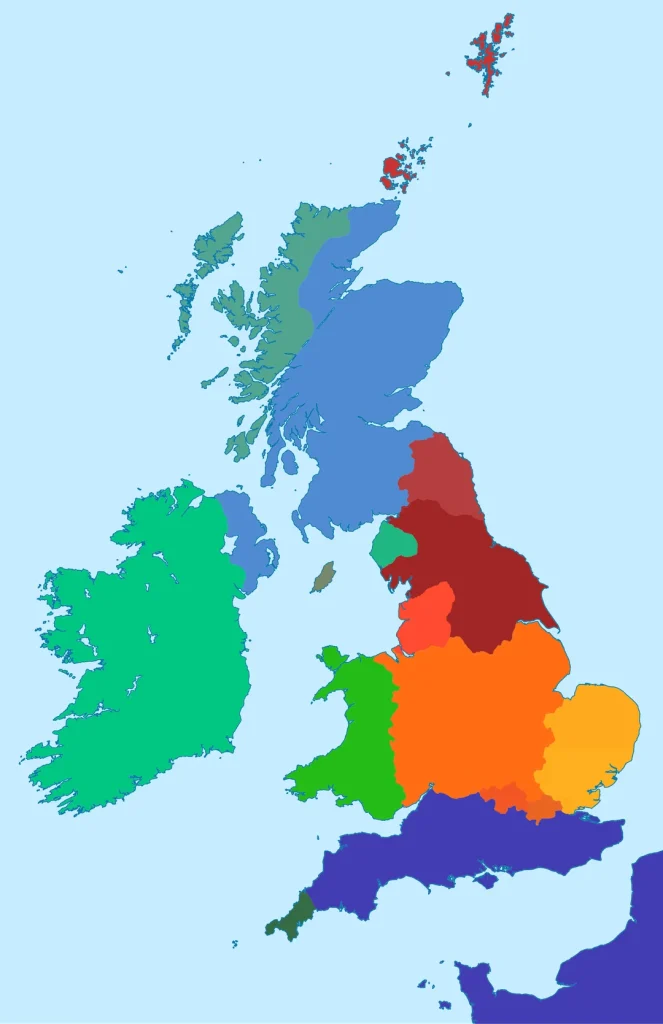
This is exactly the alternate reality depicted by the author of the map “A Green and Pleasant Land — The British Isles in 2026,” published by the user perfidiousalbion3 on Reddit. The point of divergence lies back in the 9th century: Wessex proves too weak to subjugate Mercia. Then come the Vikings, the Normans, religious wars, revolutions, industrialization, and two pan-European slaughterhouses—but a unified England never emerges.
As a result, we are presented with an astonishing 21st century, in which the island of Great Britain resembles a small Europe rather than a single nation: several peoples, languages, republics, and monarchies, their own political blocs and borders, some of which have existed for a thousand years.
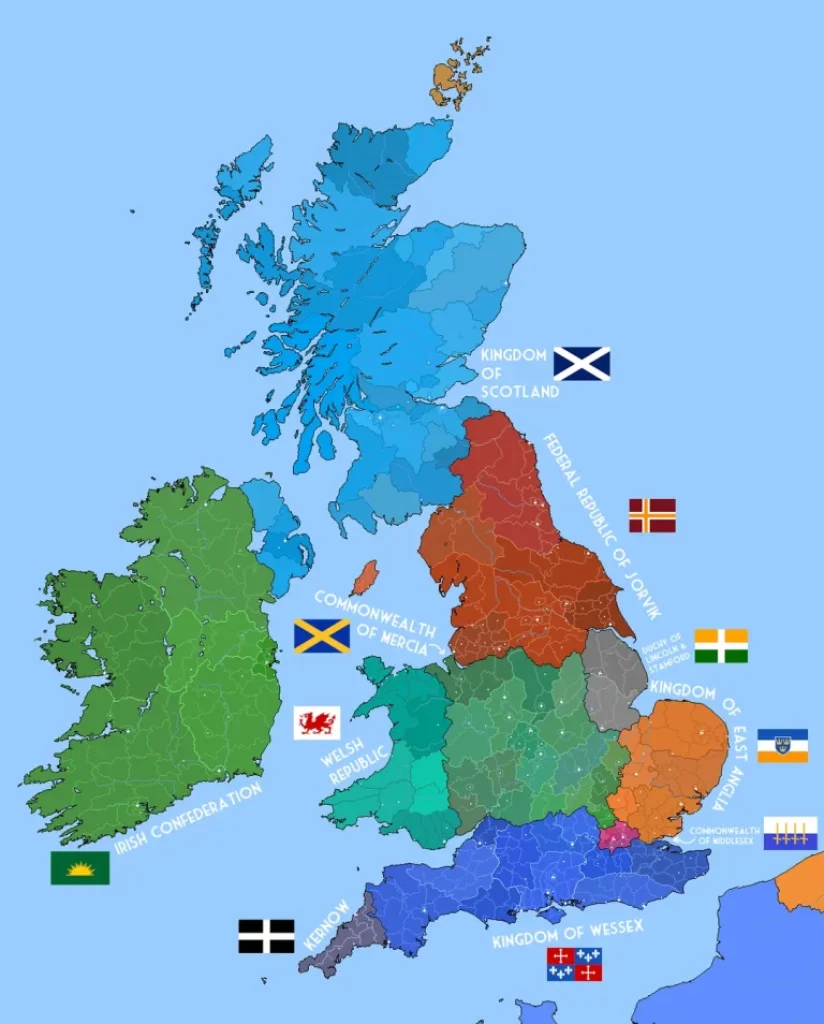
Britain in the early 21st century. There is no single country, and there never was.
The 9th-Century Fork: Wessex Loses the Struggle for England
In our history, it was Wessex that became the political core of future England. In the 9th century, the Anglo-Saxon kingdoms faced a massive Scandinavian onslaught, and the ensuing struggle gradually created the conditions for the unification of a significant part of the country under the rule of a single dynasty.
In the world of “A Green and Pleasant Land,” the mechanism breaks down even before the final unification.
Wessex fails to subjugate Mercia. Therefore, when the Great Heathen Army descends upon the island in 865, it is opposed not by lands already gradually gathering around the strongest southern dynasty, but by the same system of rival Anglo-Saxon states. The map’s author suggests that the Scandinavians exploit this much more successfully: Viking rule is established from Northumbria to East Anglia, while the weakened Wessex and Mercia are forced to pay tribute.
A crucial difference from our history emerges. The idea of a unified England appears, but it does not become an irreversible political reality.
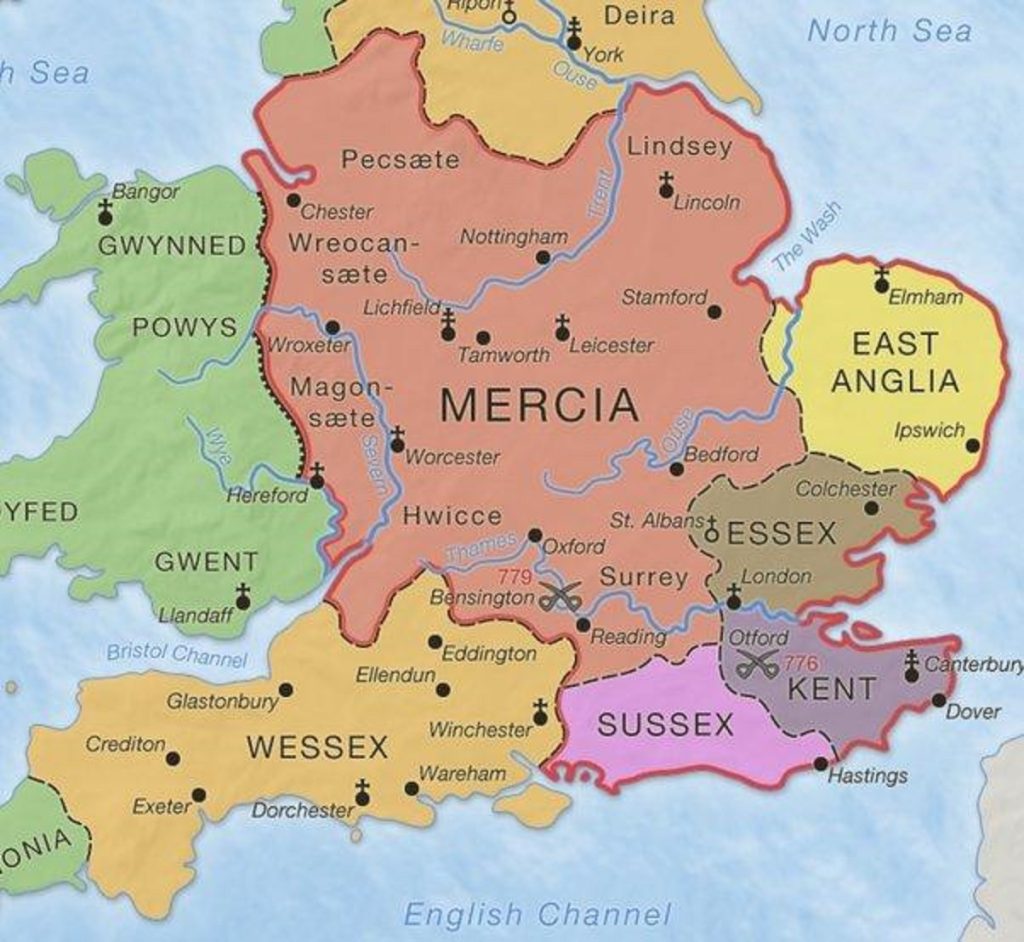
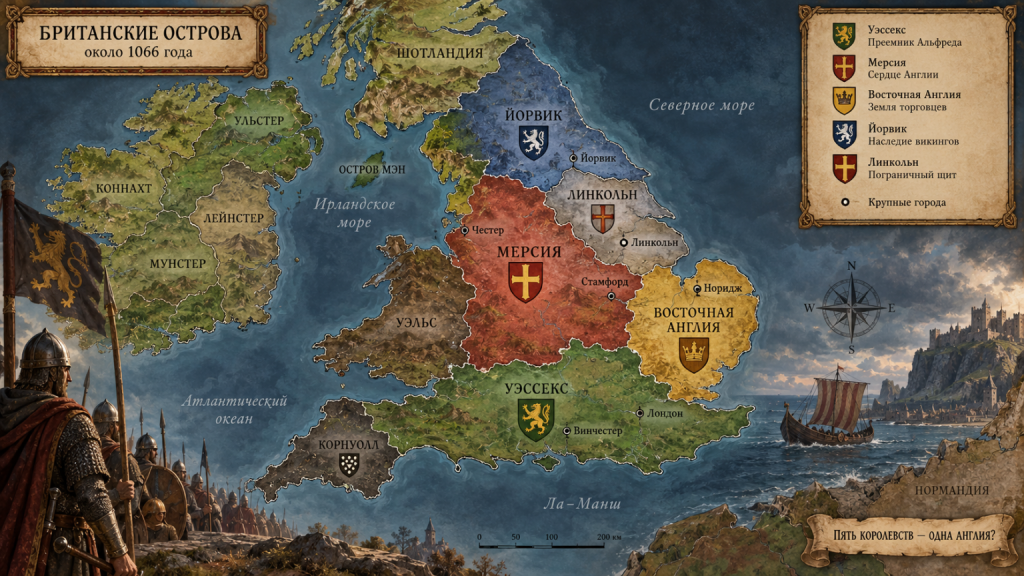
Three large cultural and political spheres take root on the island: the Scandinavian north, Anglo-Saxon Mercia in the center, and Wessex in the south. Between them lie territories that will change hands repeatedly over the following centuries.
Cnut Almost Creates England — And Fails Again
And yet history makes its first attempt to gather the country.
King Cnut unites the Viking possessions and creates the first relatively stable Kingdom of England. However, after the death of his sons, the system collapses. East Anglia falls into the hands of Godwin, and the north retains such a strong Scandinavian identity that it turns into virtually an independent world. (Reddit)
Thus, the word “England” exists. Moreover, subsequent rulers will long try to claim it for themselves. But it signifies rather a political claim—much like the title of “King of Italy” existed for centuries without a truly unified Italian state.
And then comes the year 1066.
And it is here that the fate of the island finally turns off the familiar road.
A Different 1066
In real history, the year 1066 was an incredible clash of three claimants. After the death of the childless Edward the Confessor, Harold Godwinson, the Norman Duke William, and the Norwegian King Harald Hardrada claimed the English crown. Hardrada did invade England and was defeated and killed at Stamford Bridge on September 25, after which Harold’s exhausted army hurried south to meet William.
In the alternate history, everything happens completely differently.
Hardrada brings the Kingdom of Jorvik and the Five Boroughs back under his rule. Meanwhile, William the Norman lands in the south and inherits the throne of Wessex. A war begins that could well have ended with the creation of England—only this time, a Norman one.
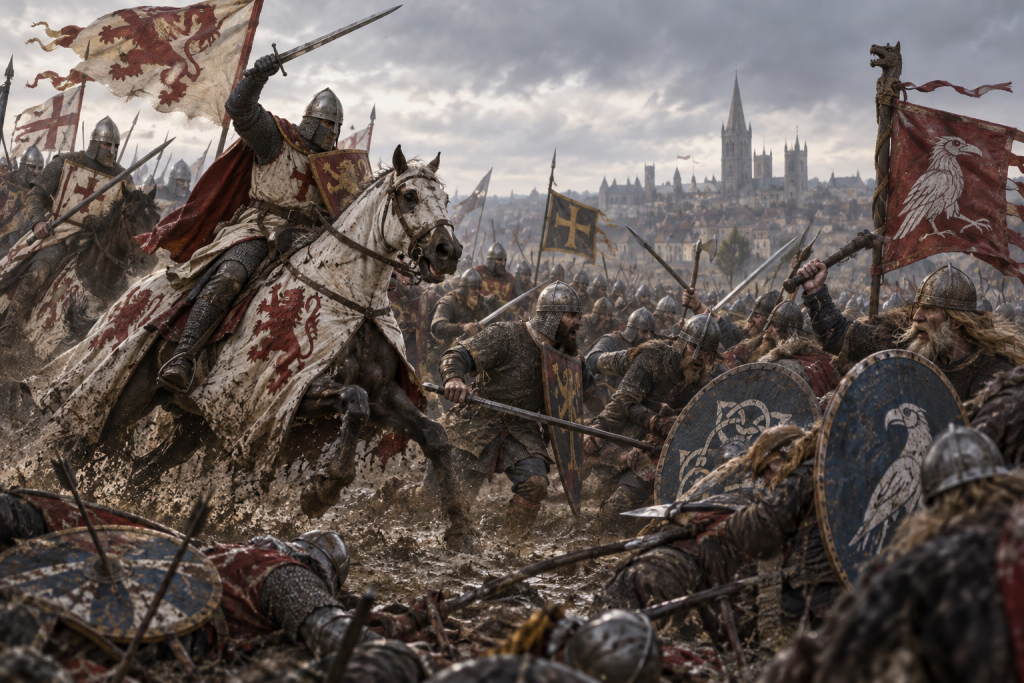
William makes a deal with the Mercians and marches against Hardrada. But the decisive battle takes place not at Hastings and not even at Stamford Bridge, but near Norwich. The Norwegian army suffers defeat, and Hardrada is killed.
It seems everything is over.
William becomes the man capable of uniting Wessex, Mercia, and East Anglia. They are already preparing to crown him as the new King of England.
And then an event occurs that changes the map of Europe for a thousand years.
William is assassinated.
Who was behind the assassination—Mercian aristocrats, Godwin supporters, Scandinavians, or his own Norman rivals—historians of this world still argue. But the political result is unambiguous: there is no second person capable of gathering England.
The Treaty of Chester: A Border That Is a Thousand Years Old
After William’s death, no one wants to continue the war anymore.
The Treaty of Chester divides the disputed Five Boroughs and effectively recognizes the political fragmentation of the island. The Mersey and the Pennines become a natural border between the Anglo-Saxon center and the Scandinavian north, while Lincoln and Stamford are preserved as buffer duchies. (Reddit)
It is here that a temporary military truce begins to turn into permanent political geography.
People living on opposite sides of the border gradually stop considering themselves parts of a single people.
The northerners become Jorvikians. The inhabitants of the center become Mercians. The southerners become Wessexians. East Anglia develops separately.
A unified Anglo-Saxon identity gradually becomes the preserve of historians.
French Wessex
Perhaps the most unusual state in this alternate Britain is Wessex.
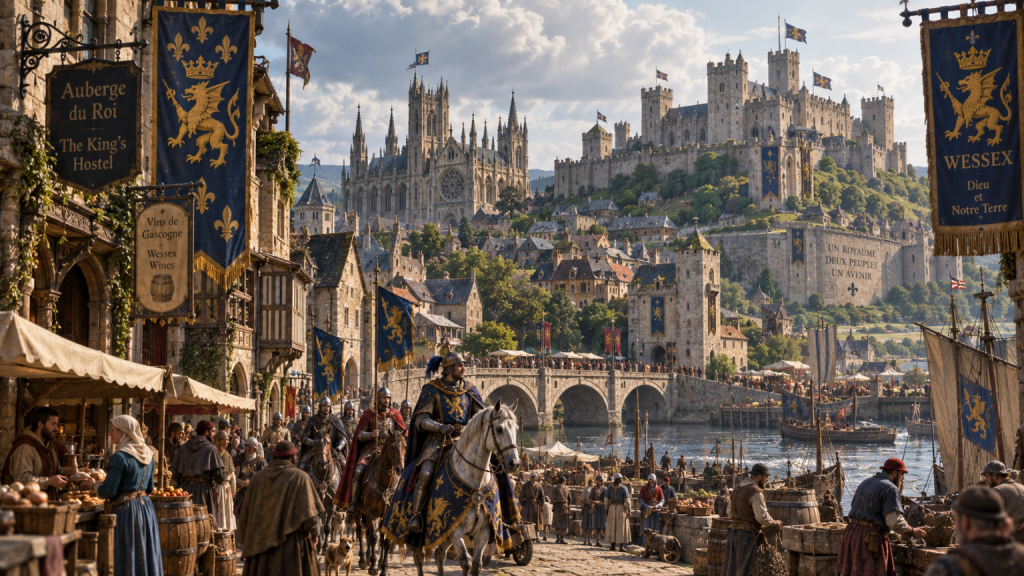
The Norman dynasty kept the throne but did not get the rest of England. Therefore, a completely different cultural process takes place. In our history, the Norman aristocracy gradually became Anglicized. Here, however, Wessex remains closely tied to France.
Royal marriages, trade across the Channel, the French nobility, and a deliberate language policy gradually turn the south of the island into practically a northern extension of the French cultural space.
By the 21st century, the Wessex language represents an independent variety of French. The map’s author explicitly explains that for a modern resident of Wessex, it is culturally and linguistically much easier to feel at home in Paris than in Birmingham. At the same time, on the northern periphery of the country, there exists Thamisien—an Anglic language with exceptionally strong French influence.
A remarkable historical paradox emerges.
The Norman Conquest, which in our reality became one of the most important stages in the formation of the English nation, here actually destroys the very possibility of its emergence in the south.
Jorvik — The Last Viking Country
At the opposite end of the island, the reverse process takes place.
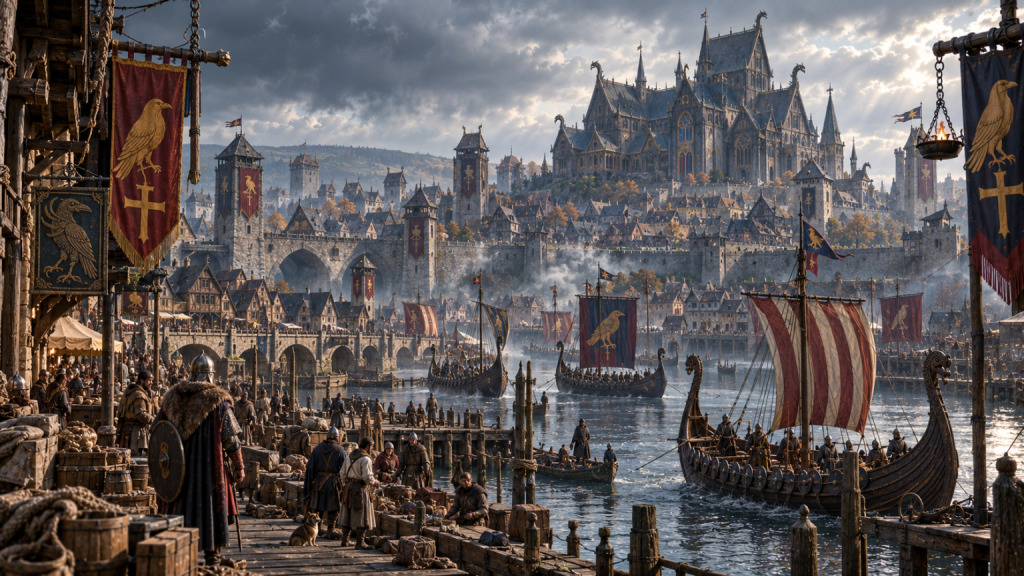
Jorvik preserves Scandinavian political traditions. The kingdom passes from one northern dynasty to another, and subsequently becomes linked with the Kalmar Union.
As a result, Northern England in our understanding simply does not exist. York becomes the center of a separate Northern European nation.
One can imagine how unusual such a country would look by the Early Modern period: cities grown from Anglo-Saxon settlements, a Scandinavian political tradition, its own variety of North Germanic cultural heritage, and a constant need to defend the southern border from Mercia.
The North Sea here does not separate Britain from Scandinavia.
It connects them.
The Last Attempt to Create England
However, the dream of a unified state periodically returns.
The most serious attempt is made in the 16th century by the Mercian King Wilfred the Great. In 1562, he conquers East Anglia and the buffer duchies of Lincoln and Stamford. The army moves on Jorvik. Wilfred proclaims himself ruler of all England—the last person in history to seriously try to realize this title. (Reddit)
And once again, chance intervenes.
The king dies of a heart attack right in the middle of the campaign.
The empire he created begins to fall apart almost immediately, and war-exhausted Mercia emerges from the era of conquest completely ruined. (Reddit)
After this, the idea of England finally turns into a political anachronism.
The 17th Century: The Island is Swept by Revolutions
If the Middle Ages fixed the borders, then the 17th century determined the political structure of the states.
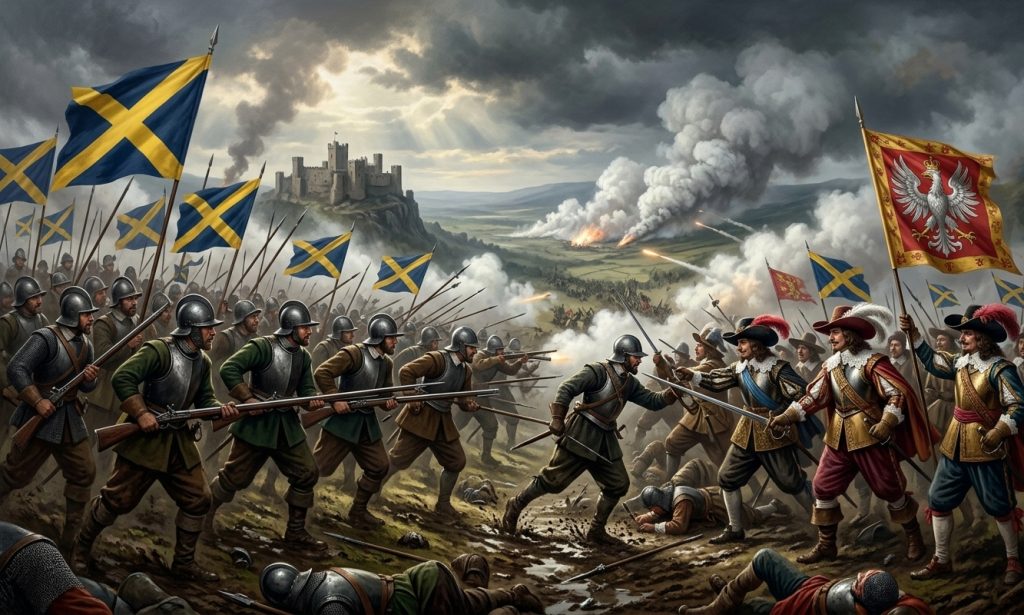
In Scotland, power falls to the Wessex royal family. Catholic monarchs try to impose changes on a staunchly Presbyterian country, which leads to the Covenanter uprising. A veritable religious revolution wins: the king is preserved but becomes almost a decorative figure, and Scotland turns into a state with the strongest influence of the Presbyterian church.
Even more radical events unfold in Mercia.
Here, power is gradually seized by a narrow group of earls, who effectively elect kings from their own ranks. The Staffordist reformers rise against the oligarchy. A short but bloody civil war begins.
The republicans win.
Analogues of John Bradshaw, Oliver Cromwell, and the Levellers appear in the alternate biography of the country. Only the revolution takes place not in England, which does not exist, but in Mercia. The kingdom turns into a republic.
London Also Becomes a Separate Country
The fate of London is even more astonishing.
In this reality, the largest city on the island does not become the undisputed capital of a huge kingdom. As early as the 14th century, local merchants rise up and create a sort of Hanseatic city-state.
The first experiment will last for several centuries.
Later, London will again fall under the rule of Wessex, but the idea of independence will not disappear anywhere. In the 1670s, a new uprising creates a republic with an extremely broad franchise for the era. After several years of siege, it perishes. In 1747, another short-lived republic emerges. (Reddit)
Finally, in 1844, taking advantage of the war between Wessex and East Anglia, Middlesex regains its independence and turns into a buffer state.
Thus, London becomes a sort of British Singapore or Luxembourg—a huge trading and financial center that absolutely does not need to control the surrounding territories.
Colonial Empires That Never Were
The absence of Great Britain completely changes the history of colonialism.
There is no single English state capable of building the world’s largest fleet. There is no British Empire. There is no British North America familiar to us.
But this does not mean at all that the inhabitants of the islands sit at home.
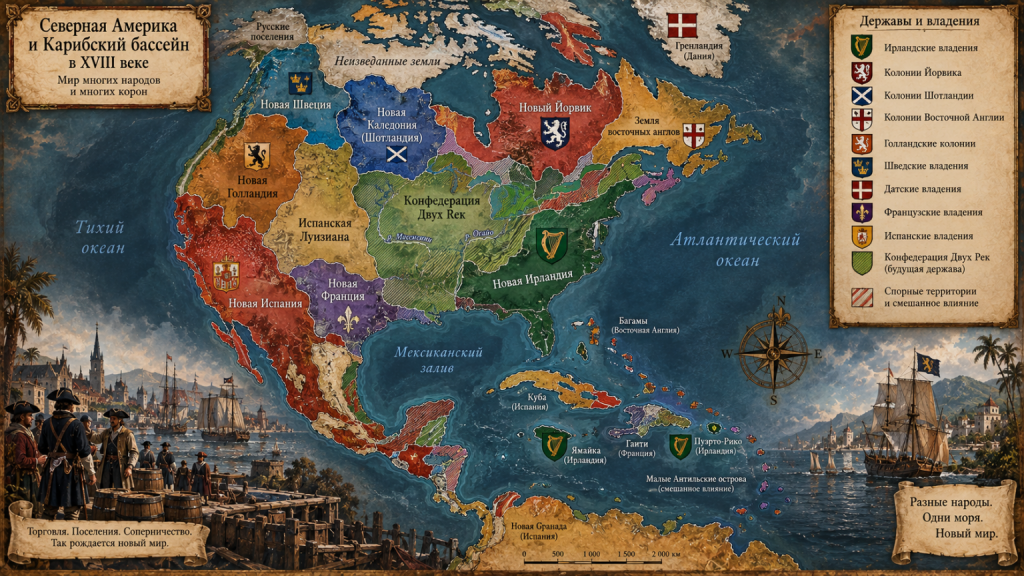
Wessex, Jorvik, Scotland, East Anglia, Wales, and Ireland participate in colonization independently. The fate of Ireland is particularly unusual, as it becomes Spain’s most important ally and gains significant influence in the Caribbean. According to the author’s scenario, the Irish controlled Jamaica, Puerto Rico, and a number of other islands until the mid-20th century.
In North America, a motley mix of Jorvikian, Scottish, East Anglian, Dutch, Swedish, and Danish settlements emerges. No single power is able to displace the others.
In the late 18th century, some of these colonies rebel and create the Confederation of Two Rivers—the Delaware and the Hudson—a multilingual state where its own creole language forms over time.
The English language, accordingly, never becomes the global lingua franca.
The Democratic 19th Century
By the 19th century, the map of the islands already seems completely natural to their inhabitants.
No one seriously asks why Wessex and Mercia are different countries, much like a modern European is not surprised by the existence of the Netherlands and Belgium.
Industrialization begins.
Mercia gets a powerful industrial belt around Birmingham. Jorvik uses the northern coal basins and the ports of the North Sea. Middlesex becomes a financial center. East Anglia grows rich thanks to maritime trade and ties with the Netherlands—moreover, it spends a significant part of the Early Modern period in a personal union with the Netherlands. Even its flag in the 21st century resembles an inverted Dutch tricolor.
Political reforms go even further. In Wales, radical Chartists win, and the Irish Revolution creates one of the first democratic federal systems in Europe. (Reddit)
By the beginning of the 20th century, the former Anglo-Saxon heptarchy had finally turned into a family of modern European states.
But then comes the year 1912.
The First Great War Begins in 1912
In this world, the European war begins two years earlier than our World War I.
And the British Isles are not a protected sea rear.
They themselves become the front.
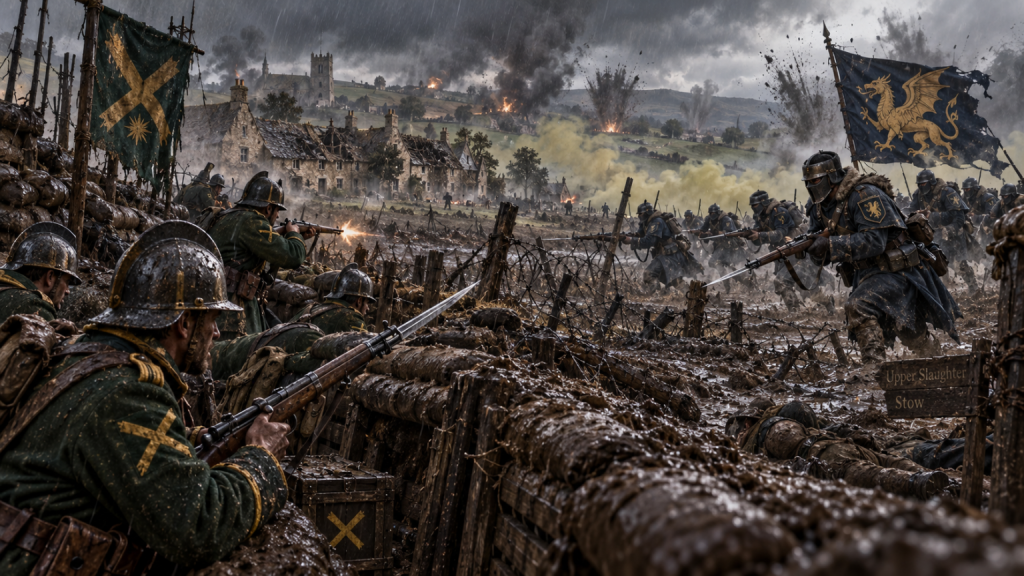
Mercia and Wales turn out to be allied with Germany, while Wessex fights on the side of France. The Cotswold Hills turn into a giant system of trenches. For five years, armies literally grind each other down on lands that in our history never saw the positional warfare of the 20th century.
Imagine the Somme—only near Oxford.
Jorvik initially also enters the war, but the population rises up against the monarchy. The Socialist Labour Party comes to power, and the ancient Viking kingdom turns into a republic. (Reddit)
Germany wins.
Mercia gains territories at the expense of Wessex, and France dreams of revenge.
Churchill — Not the Hero We Know
Another magnificent reversal of this reality is the fate of Churchill.
In the 1930s, Wessex is led by the radical anti-socialist Louis Churchill. There simply cannot be any British Prime Minister Winston Churchill in the role familiar to us here.
When the left-wing government of George Lansbury wins in Middlesex, Wessex invades the small republic and eliminates its independence.
Meanwhile, the continent is approaching catastrophe again.
In France, the ultranationalist regime of Philippe Pétain gains strength. The civil war in Italy turns into a pan-European proxy war. Wessex, wanting to regain the lands lost after the Great War, draws closer to France.
In 1935, the Western European War begins.
Apocalypse in the Thames Valley
Almost all the states of the islands are drawn into the war. Only East Anglia maintains neutrality.
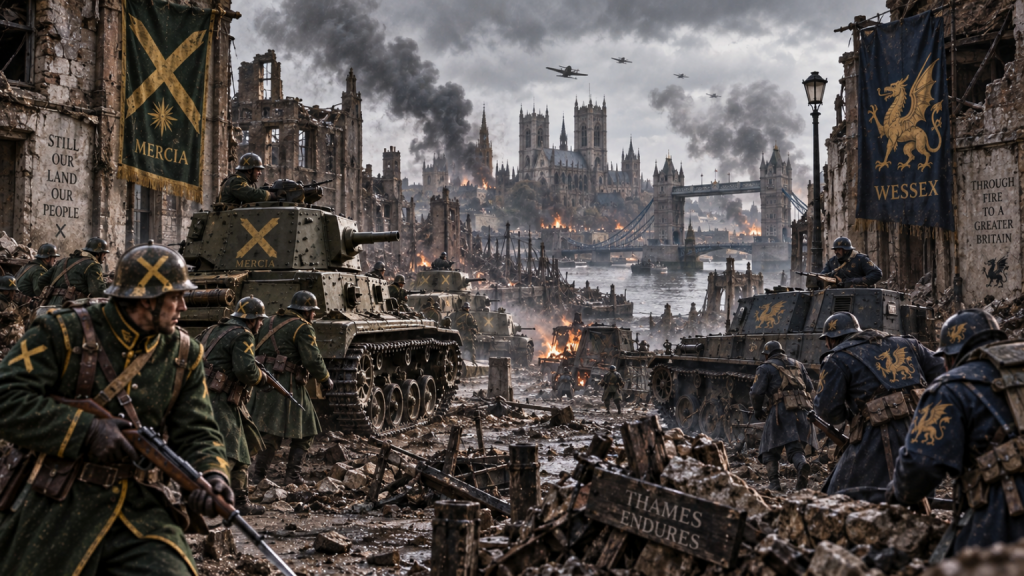
Wessex fights alongside France. Against it, an amazing coalition of Mercia, Jorvik, Wales, and Ireland is formed.
The Cotswolds and the Thames Valley once again become the front line.
If the First Great War left trenches here, now industrial warfare turns entire areas into a virtually post-apocalyptic desert.
On the continent, France wins by 1940.
But it fails to capture the islands.
The combined armies of Mercia, Jorvik, Wales, and Ireland stop the offensive. A peculiar Cold War emerges between the authoritarian Franco-Wessex bloc and the republican states of the islands.
Pétain’s Europe and the Thirty Lost Years
The French victory does not bring prosperity.
On the contrary, Europe finds itself under the rule of a far-right political order for about three decades. The author of the scenario describes this period as an era of prolonged economic depression and French domination.
Only the revolutions on the Rhine in the late 1960s break the old system.
But the split is already too deep.
The four republican wartime allies—Mercia, Jorvik, Wales, and Ireland—gradually create their own system of economic integration. The united Lincoln and Stamford join them.
Thus, the Britain and Ireland Association emerges.
Wessex and East Anglia go a different way and join an analogue of the European Community.
One island turns out to be divided between two integration projects.
The Return of London
There is also another very recent country on the map.
After the capture of Middlesex by Wessex in 1930, London’s independence seemed finally buried.
But in the late 20th century, the idea of a city-republic unexpectedly returns. The author of the alternate history links the movement for the restoration of Middlesex with such figures as Tony Benn and later Ken Livingstone. In the 1990s, a referendum is held, after which the state is restored.
And therefore, modern London is not the capital of Great Britain.
It is the capital of itself.
London in this world is more like Hong Kong than the London familiar to us
London in this world is more like Hong Kong than the capital of Great Britain familiar to us
The British Isles in 2026
And so we come to the map for which this whole story was invented.
Before us is an archipelago, simultaneously astonishingly familiar and completely alien.
There is Scotland. There is Wales. There is Ireland.
But instead of England, there are several states.
In the south is the French-speaking Wessex. In the center is the republican Mercia. In the northeast is Jorvik, the heir to the Viking state. East Anglia is historically oriented towards the Netherlands and continental Europe. London and its surroundings form the Commonwealth of Middlesex. Lincoln and Stamford preserve the legacy of the ancient buffer possessions.
At the same time, two parts of the islands belong to different supranational systems: Wessex and East Anglia are integrated with continental Europe, while Mercia, Jorvik, Wales, Ireland, Middlesex, and Lincoln-Stamford are part of the Britain and Ireland Association.
By 2026, a cautious rapprochement between the two blocs begins.
Borders are becoming increasingly transparent. Trade is growing. Railways once again connect cities between which fortifications stood just a few generations ago.
But no one seriously discusses political unification.
Could England Really Have Not Appeared?
It is here that the map author’s fantasy turns out to be more interesting than the usual “Balkanization of Britain.”
Because there was no collapse of Great Britain here.
It simply never emerged.
The same applies to England.
To a modern person, it seems natural that Mercia, Wessex, and Northumbria were bound to unite someday. But for an inhabitant of the 9th century, such an outcome was not at all predetermined. Moreover, the Scandinavian conquests really created alternative centers of power on the island, and in 1066 the fate of the country literally depended on a few battles and a few people. The real Harald Hardrada led about 8,000 warriors to York, defeated the northern earls at Fulford, but then died at Stamford Bridge; just three days after this battle, William landed in the south.
Change a few results—and further history becomes significantly less obvious.
However, the main merit of this alternative is not even in this.
The author shows how strongly a thousand years of independent existence changes identity.
By 2026, no one here considers Mercians, Jorvikians, Wessexians, and East Anglians to be “one people accidentally divided by borders.” They have different literary languages, different historical heroes, different revolutions, different wars, and different ideas about their own past.
Therefore, the idea of uniting them into a single England sounds about as strange as a proposal today to unite the Netherlands, Germany, and Denmark on the grounds that their languages are related.
The map’s author himself ironically notes that in 2026, the dream of a fully united England has remained the lot of “lunatics on Twitter.”
And the inhabitants of the islands call their homeland differently.
A Green and Pleasant Land.
Only now it is not one country.
It is a whole small continent.