As is well known, in the early days of its existence, Rome—then still a kingdom—was in a very vulnerable position. It was surrounded by city-states that were no less ambitious, and there was a very high probability that one of them would become the dominant power in the Apennines, while Rome would remain nothing more than a large city—and even that only if it were not completely destroyed and left to be overrun by grazing sheep or roaming wild wolves. That is why the theme of “what-if” worlds without Rome is one of the most popular in the field of alternative history, and there could be an infinite number of such worlds. Even on our website, there are descriptions of several of them.
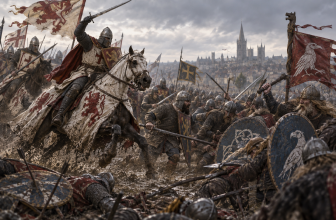
The turning point in this world occurred sometime around the 5th or 6th century B.C.E. At that time, the legendary Etruscan king Mesentinus defeated the Latin tribes and annexed Rome, along with its surrounding territories, to his realm. And so the history of Rome ended before it even began. But the world was radically transformed.

This is what the Etruscan king Mezentin looked like, according to the Midjourney neural network

The Etruscans’ Conquest of Rome

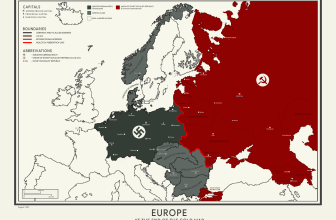
The map depicts either the 13th or 14th century. The author didn’t say a word about what had been happening in the world since the fall of Rome. So let’s try to picture it for ourselves.
So, in the absence of Rome, nothing would prevent Carthage from establishing its own empire. However, over time, during another crisis in the empire, it will lose its Spanish territories, which will be replaced by a scattering of small kingdoms ruled by the indigenous peoples of the Pyrenees.
In the Middle East, the Persian Empire will reclaim its territories by driving out the Greeks and will extend across vast lands from Central Asia to the Mediterranean Sea.
Christ will appear in this world, but his fate will be quite different, and Christians will remain a small sect in the Middle East.
In Europe, the Germans will be the hardest hit. The people— or more precisely, the tribes that formed modern civilization in RI, will face numerous Celts who, in this world without Roman “protection,” will remain just as warlike; they will suffer defeats and will never be able to cross the Rhine. To make matters worse, an equally numerous wave of Slavs will arrive from the east, driving the Germans into a narrow strip of land between the Rhine and the Elbe. Meanwhile, Scandinavia will remain under their control.
Kievan Rus’ will also emerge in this world. And just as in RI, it will be conquered by the Mongol-Tatars in the 13th century. At the same time, since the Mongols’ campaign into Asia will fail—due to the powerful Persian Empire, which will defeat them—they will settle the conquered territories in large numbers, removing the old Slavic elite. However, a fairly large fragment of Rus’ will survive in the north, centered in Novgorod, which will loom over the Golden Horde, waiting for a crisis to break out there so it can begin its reconquista.
And finally, a brief note on Britain. The islands remained under the rule of the local Celts—the Britons—who repelled Viking invasions and established and maintained their three kingdoms:
- Lloegir,
- Brigantia,
- Albania
Actually, that’s all I wanted to write. I think everyone can figure out for themselves what was going on in the various smaller countries.

World Map with Country Symbols