An article by Alexander Tomzov and Vladimir Pinaev from the WARSPOT website, dated April 9, 2016.
Contents:
By noon on the first day of the Sandomierz-Silesian Offensive, Soviet infantry had broken through the first line of German defenses and were now facing the second. Quickly assessing the situation, Marshal I. S. Konev, commander of the 1st Ukrainian Front, brought in the heavy artillery—several hundred tanks and self-propelled guns. Thanks to them, by the afternoon of January 12, 1945, Soviet troops had advanced to the second line of defense.
Faced with the threat of a breakthrough, the German command decided on January 13 to launch a powerful counterattack using the forces of General V. Nering’s 24th Panzer Corps. If successful, this would have allowed the enemy to encircle part of the Red Army’s forces and tie down D. Lelyushenko’s 4th Tank Army in protracted battles. In the documents of the Soviet 4th Tank Army, a direct participant in the events, the ensuing battle was referred to as the Battle of Kielce-Khmelnikiv. The tank battle near the small Polish village of Lisuw marked the climax of its initial phase.
Flexing One’s Muscles
Neringa’s corps was not merely a formidable tank force consisting of two and a half hundred tanks and self-propelled guns. This fist also had a brass knuckle—the 424th Heavy Battalion, which included 29 “Tigers” and 23 “King Tigers.” The corps commander planned to launch an attack from converging directions, from Khmelnytskyi in the south and from the Kielce area in the north. Formally, the commander of the Soviet 4th Tank Army, D. Lelyushenko, had a threefold superiority in equipment. But his 750 tanks and self-propelled guns were spread out across the entire front of the army’s offensive. So the Soviet tank crews had a tough time of it.
The Germans were unable to fully coordinate their offensive and strike with all their forces simultaneously. Nevertheless, on January 13, fighting broke out with German tank reserves across the entire front where Lelyushenko’s army was advancing. The 10th Guards Tank Corps faced the fiercest fighting. German infantry and tanks attacked it from three sides at once: from the south, the north, and the center. Corps Commander Colonel N. Chuprov had to draw on all his skills not only to halt the enemy’s counterattacks but also to continue the offensive.
It was the 10th Corps that fought against Nering’s tanks near the village of Lisuv. For the Soviet tank crews, this battle turned out to be not only the most difficult, but also the most successful. It all began on January 12, when the corps’ advance unit encountered a German attack near the village of Maleshchovy. After destroying 10 German vehicles and losing seven of their own, our tankers captured the village and completely routed the German troops stationed there. The detachment did not pursue the enemy in the vicinity of Malešchovy, instead continuing its advance toward Kielce. As a result, the 61st Guards Tank Brigade, which was following behind, encountered fierce enemy resistance.
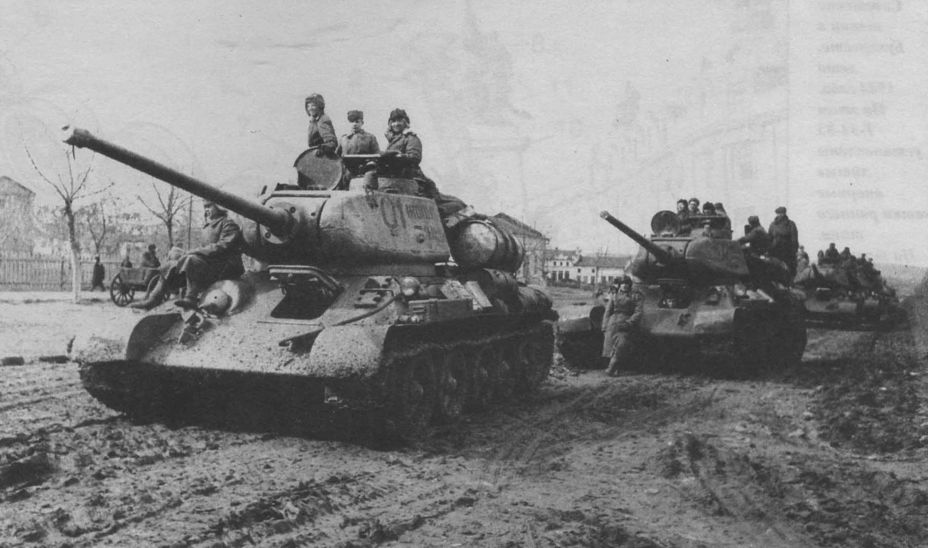
Soviet T-34–85 Tanks
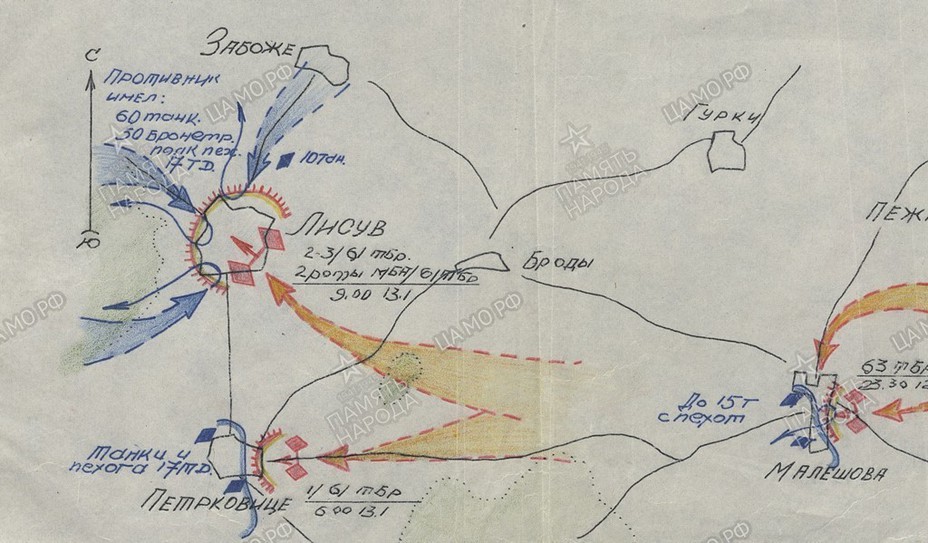
Colonel N. Zhukov, commander of the Guards Brigade, left 20 tanks near Malechova to provide cover, while he himself continued moving westward with the brigade’s main forces. In the morning, the brigade’s reconnaissance unit captured a German “prisoner,” who reported that about 60 German tanks were moving toward the brigade’s area. Upon receiving this information, Colonel Zhukov decided to turn the tanks northwest and capture the village of Lisuv. Forty T-34–85 tanks took the paratroopers on board and rapidly advanced toward the village.
“The Tigers” in the Mud
At around 9:00 a.m. on January 13, Soviet tanks reached Lisuv. Their appearance came as an unpleasant surprise to the Germans, so the enemy began to scatter without putting up any resistance. The first to storm into Lisuv was the tank commanded by Guard Lieutenant M. Pobedinsky, the platoon commander. Machine-gunners fired point-blank from the armor of the “Thirty-Fours” at the fleeing German soldiers and officers. Soon, Lisuv was captured. The tank crews of the 61st Brigade secured rich spoils: abandoned vehicles and several warehouses full of supplies. In addition, they managed to capture two anti-tank guns and take 40 Germans prisoner, among whom was the commander of the artillery regiment of the 168th Infantry Division.
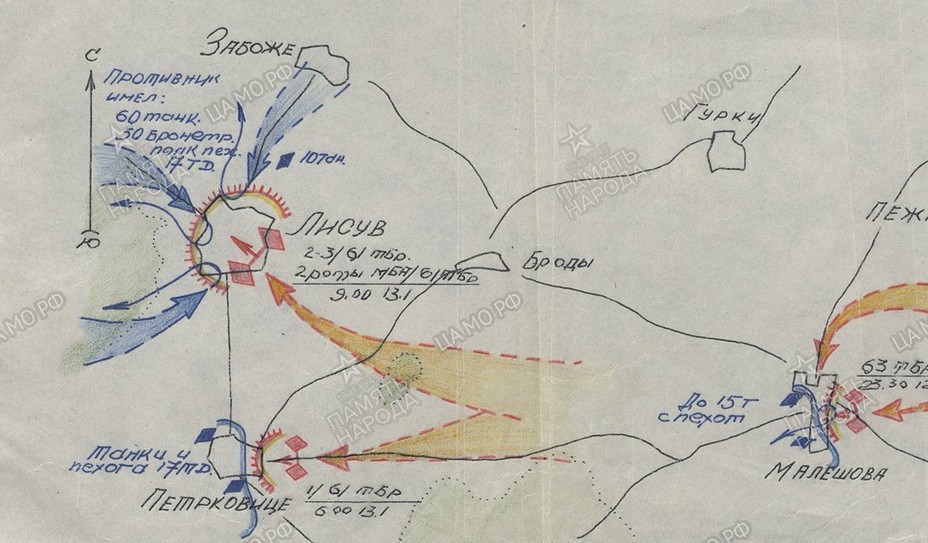
Excerpt from a map of the battles near Lisov on January 13, 1945 (Central Archives of the Ministry of Defense of the Russian Federation)
Despite their success in Lisuv, the tank crews of the 61st Brigade were unable to continue their advance. On the contrary, they were forced to defend the village for an entire day. Here, N. Zhukov’s troops carried out the most important and difficult task of the day, repelling a total of twelve attacks by German heavy tanks supported by infantry. The Germans attacked Lisuv from three directions. From the south and west, 23 “Royal Tigers” and 27 “Tigers” advanced, while from the north, 13 “Panthers” from the 16th Panzer Division attacked the village.
The first attack from the south came less than an hour after Soviet troops had captured Lisuv. The Germans committed up to an infantry battalion (400–500 men) to the battle, supported by 20 “Tigers.” However, not all of the German tanks were able to take part in the attack. One had already fallen through a bridge on the approach to the village, which could not bear its 56-metric-ton weight. Several others veered off the road and got stuck while attempting a flanking maneuver. The “Tigers” that remained operational continued along the road, seeking to break through to the center and the southern outskirts of Lisov.
The Soviet tanks took cover behind houses to avoid being spotted prematurely and waited for the enemy to get closer. When the “Tigers” were 150 meters away, the “34s” opened precise and devastating fire, first taking out four German tanks, then several more. The tanks that remained operational were forced to halt their attack and retreat. During the retreat, the “Tiger” with side number 332 attempted to evacuate one of its comrades that had become stuck south of Lisuv, but as a result, it broke down, and the Germans later had to blow it up. As for the rest of the stranded tanks, some of them also had to be abandoned or blown up because they could not be evacuated.
The Battle of Lisuvsk
After the failure of their first attack, the Germans regrouped and decided to strike harder. This time, 30 “Tigers” went into battle at once, half of which were “Royal” models. The enemy attack was supported by fire from 10-barrel rocket mortars. But this time, the Soviet tank crews prevailed, though they did suffer losses.
In the afternoon, in addition to the “Tigers,” Lisuv was attacked by 13 “Panthers” approaching from the north, accompanied by an infantry battalion. The battle grew more intense with every passing minute, as German tanks and soldiers surged toward Lisuv from various directions. They were met with fire from Soviet tank guns and machine-gunners. The enemy would retreat, then advance again—and so it continued until the evening of January 13.
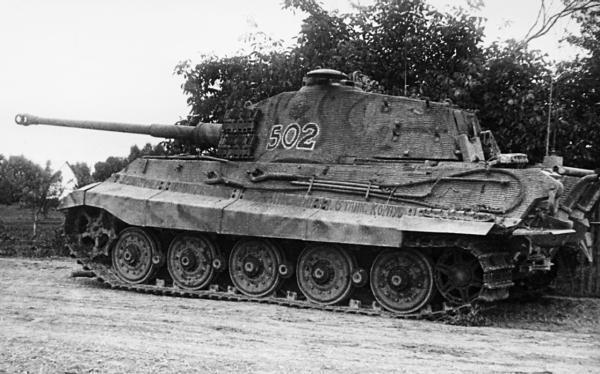
“Royal Tiger” from the Sandomierz bridgehead. In Lisów, the Germans lost five of these tanks in a single day
Although the Germans had achieved a numerical superiority near Lisuv, they were unable to make any headway. The T-34–85s constantly maneuvered among the burning buildings and continued to fire, often at close range. The tank company commanded by Senior Lieutenant M. Verteletsky of the Guards was particularly effective. His ten T-34s, maneuvering across the terrain and taking cover behind buildings, destroyed six “Tigers” and “King Tigers,” sustaining only minor losses in the process. Vereteltsky himself was seriously wounded while repelling one of the German attacks, but he remained in the battle until the very end. He was subsequently awarded the Order of the Red Banner for his actions.
When our tank crews encountered the “Royal Tigers” near Lisuv, they often mistook them for “Panthers” because of their similar silhouettes. Although, of course, the “Tiger” was harder to take out. For example, on the southern outskirts of the village, one of them had both tracks destroyed before it could be brought to a complete stop. Even so, the German crew, led by Lieutenant Oberbracht, was in no hurry to abandon the immobilized tank and even took out several “34s” with return fire. Eventually, the German tankers did leave, and their abandoned vehicle was added to the list of German total losses.
Colonel N. Zhukov was killed while repelling one of the fiercest German attacks; he not only commanded his brigade but also took part in the battle himself. There were no other options: every tank at Lisuv’s disposal counted, so the brigade commander could not afford to protect himself. A shell that struck his “34” caused the ammunition load to detonate. Shortly thereafter, Guard Lieutenant Colonel V. Zaitsev arrived in Lisuv and took command of the 61st Brigade. Major Semish, commander of the German 424th Heavy Tank Battalion, also met his death near Lisuv during one of the attacks.
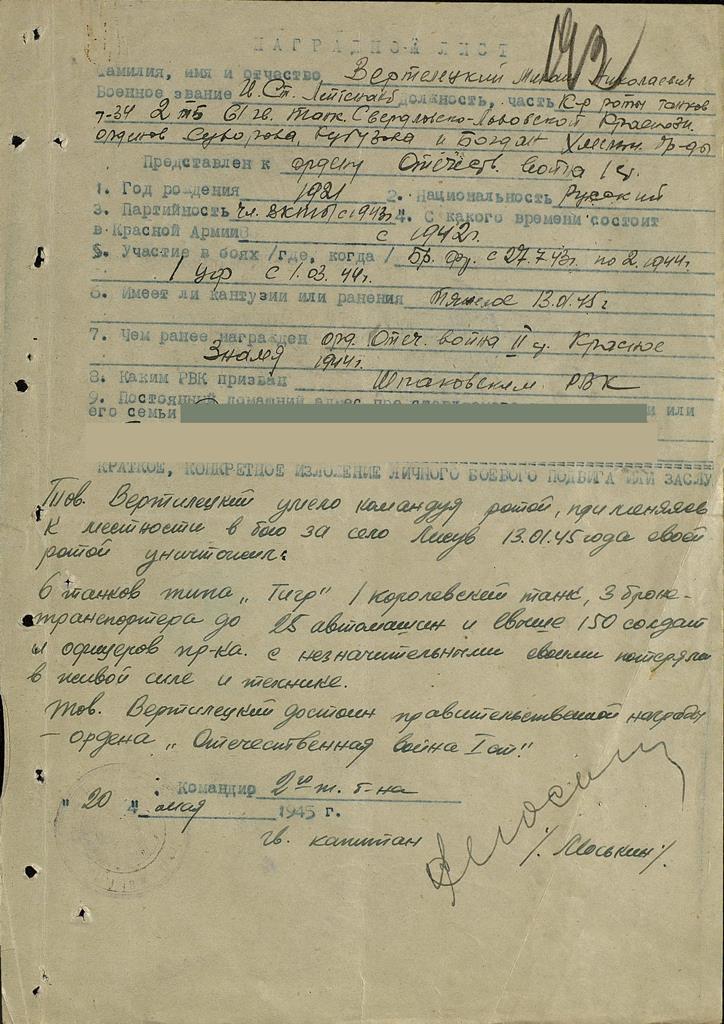
Award Sheet for Guard Senior Lieutenant M. Verteletsky (from the “Podvig Naroda” website)
The Germans ran out of steam and ceased their attack around 8:00 p.m. on January 13. Seven “Tigers,” five “King Tigers,” and five “Panthers” were destroyed or abandoned near the village. The Germans were able to evacuate several more damaged tanks. The 61st Guards Tank Brigade lost four tanks to fire and had 19 others knocked out. However, repair crews were able to restore many of the damaged tanks by the morning of January 14.
The German setback at Lisuv triggered a series of problems. The enemy was unable to either halt the advance of the 4th Tank Army or draw it into protracted battles. Colonel Chuprov’s 10th Corps reinforced its ranks and continued its advance. Together with the tanks of P. Rybalko’s 3rd Guards Tank Army, the corps routed the German 17th Tank Division in the battles of January 13–14 in the Khmelnytskyi area. All that remained of the 424th Heavy Battalion was its name. Two days after Lisov, the battalion ran out of “Tigers,” and instead, they gathered whatever equipment was available from repair depots to replace them.
Soon, the German defenses in front of the Sandomierz bridgehead collapsed, and Marshal Konev’s troops began pursuing the enemy.
Sources and References
-
- Zaitsev, V. I. The Guards Tank Division. Sverdlovsk, 1989.
- Lelyushenko, D. D. Moscow–Stalingrad–Berlin–Prague: Memoirs of a Corps Commander. Moscow, 1987.
- Isaev, A. V. 1945: Triumph in Offense and Defense: From the Vistula-Oder to Lake Balaton. Moscow, 2008.
- Jentz, T. Germany’s Tiger Tanks: Tiger I & II—Combat Tactics. Schiffer Military History. Atglen, PA.
- Kamen Nevenkin Fire Brigade. The Panzer Divisions 1943–1945. Publisher: JJ Fedorowicz, 2008.
- Schneider, W. *Tigers in Combat I*. Stackpole Books, 2004.
- Combat Log of the 10th Guards Tank Corps for January 1945.
- Combat Report of the 61st Guards Sverdlovsk-Lviv Red Banner Tank Brigade / For the period from January 12 to January 31, 1945.
- Counterattack by the 10th Guards Tank Corps on January 13–14, 1945.
- Report on the Vistula-Oder Operation of the 4th Tank Army. Vol. 1. January 12–February 22, 1945.
- Documents from the “Podvig Naroda” website.
- Documents from NARA (U.S.) OKH T78 R529.
Source: https://warspot.ru/5806-tigrovyy-armageddon-u-lisuva