An article from the Telegram channel “Alexey Isaev. ‘Iron Wind’”.
AZTM stands for the Almaty Heavy Machinery Plant. It is commonly stated that the plant’s history began with the evacuation to Kazakhstan of the Voroshilovgrad Locomotive Plant named after the October Revolution (formerly the Hartmann Plant).
Machines out in an open field in winter—just the way we like it, but somehow not very realistic. I don’t deny that they might have set something up under extreme conditions, but it couldn’t have been a systematic practice.
Especially since it is a large enterprise—originally the Russian Joint-Stock Company of Hartmann’s Machine-Building Plants, founded in 1896 and expanded during the industrialization of the USSR in the early 1930s.
By GKO Decree No. 222ss of July 20, 1941, locomotive manufacturers were ordered to organize the production of armored hulls and turrets for T-60 tanks for the Kharkiv Tractor Plant (KhTZ), with a production target of 50 units in August, 200 in September, and 300 in October.
However, the plant did not have time to become the center of production for the all-conquering “Wunderwaffe”: in September 1941, the “Kyiv Cauldron” broke out, and the front line surged toward the Donbas; on October 13, 1941, State Defense Committee Decree No. 774 was issued ordering the evacuation of the first phase of the plant.
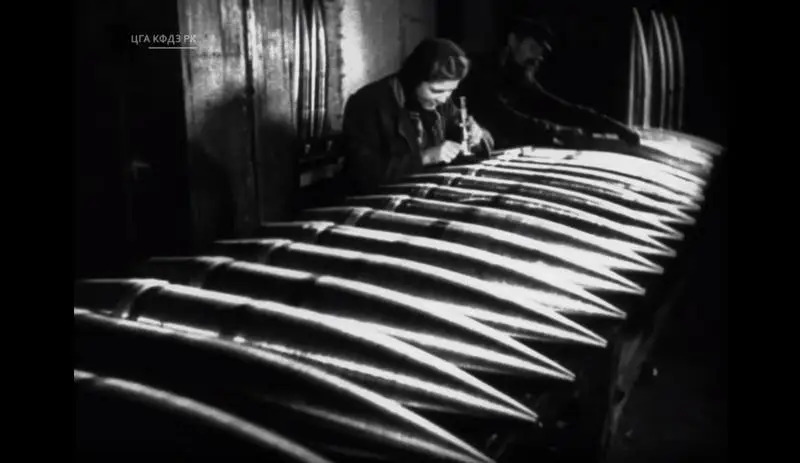
Two of the plant’s workshops (the tool shop and the forge and press shop) were evacuated to Alma-Ata. However, such enterprises were not sent out into the open countryside. The facilities of a car repair plant under construction in Alma-Ata served as the base for their relocation. If the war had been delayed, the plant would have been completed, and the relocation conditions would have been more compact. As it was, there were three sites in the city for the evacuated plant’s equipment, located 6–8 km apart from one another.
The bulk of the equipment arrived between mid-December 1941 and January 1942 and was installed during the first quarter of 1942. It is believed that the plant began operations in March 1942. At the same time, construction continued (which, I should emphasize, had begun before the war and received an additional boost).
In August 1943, the Almaty Machine-Building Plant became the Almaty Heavy Machinery Plant (AZTM). This was due, in part, to the transition to civilian production beginning in 1943. It operated as AZTM until the era of major reforms in the 1990s.
To save a trip, let’s talk right away about the Luhansk Cartridge Plant No. 60 (which is just as well-known as the locomotive-building plant).
The Luhansk ammunition production was spread across several cities: Irkutsk (the plant was designated Plant No. 540), Kazan (Plant No. 543), Chkalov (Orenburg, Plant No. 545), Chelyabinsk (No. 541), and Kirov (Plant No. 537, which produced machine-gun link rounds). Part of the production was moved to Frunze, Kyrgyzstan (now Bishkek), to the site of the Narkomzem Mechanical Plant and the Narkomestprom Repair and Mechanical Plant of the Kyrgyz SSR. It was precisely the portion evacuated to Kyrgyzstan that retained No. 60. This facility produced rifle and pistol cartridges. While the new Plant No. 60 produced 261 million rifle cartridges in 1942, by 1943 that figure had risen to 748 million. Production of TT cartridges was effectively limited to 1942; it was subsequently phased out.
Once again, we must note that the industrialization of the country as a whole—and of all its republics—served as the foundation for the evacuation.
Source: https://t.me/iron_wind/1737