Roman Ponomarenko. The Cavalry at Gettysburg: The Battle at Lott’s Farm and Colonel Farnsworth’s Charge

An article by Roman Ponomarenko from the WARSPOT website, dated February 6, 2022.
The cavalry not only began but also ended the Battle of Gettysburg. On the decisive third day of the battle, July 3, Confederate cavalry brigades under the command of Jeb Stuart launched a raid into the rear of the Union Army of the Potomac. They were met by General David Gregg’s cavalry division, leading to a fierce cavalry battle at Lott’s Farm. Later that same day, on the southern flank of the battle, Union General Judson Kilpatrick sent Colonel Farnsworth’s cavalry brigade on a suicidal attack against enemy infantry positions.
Hampton goes on the attack at Lott’s Farm
After the Confederates held on to Rammel Farm, Colonel Lawrence Baker’s 1st North Carolina Cavalry Regiment and Lt. Col. Joseph Waring’s “Jefferson Davis Legion” from Hampton’s brigade attacked the Union cavalry in a mounted formation. They were joined by Hampton himself, who had been wounded the day before by a saber blow to the head but had remained at his command post.
The Confederates attacked in cavalry formation, in tight squadron columns, with their sabers drawn. According to legend, “the gleam of the attacking Confederate cavalrymen drew murmurs of admiration from the Union troops.” Captain William Miller of the 3rd Pennsylvania Cavalry Regiment later wrote: “They moved in orderly ranks, holding their reins firmly. The blades of their sabers, glinting in the sun, were blinding.” From the Southerners’ perspective, things looked far from rosy—Stuart’s men and horses were exhausted from an eight-day raid “on meager rations.” Stuart wrote: “Their haste had taken them too far; the attack was very prolonged, and their horses, already exhausted from the grueling march, could not hold out. Their advance was too rapid for the couriers to halt it, and the enemy, noticing this, attacked them with fresh horses.”
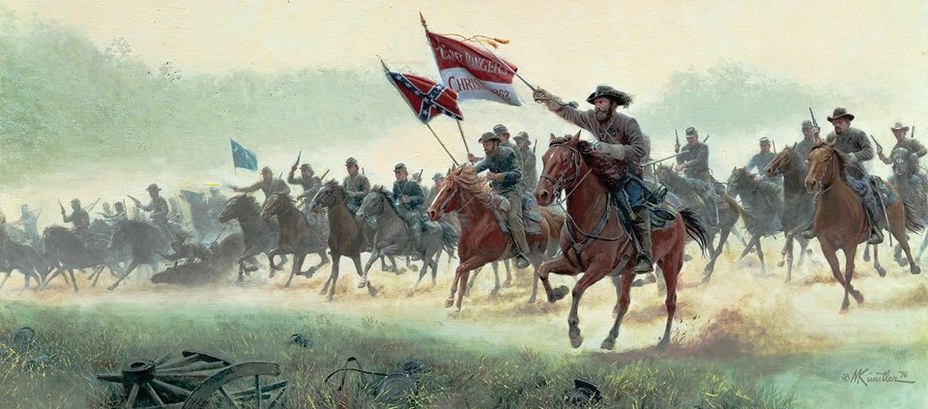
Wade Hampton leads his brigade into battle. Painting by Mort Castler
The Southerners immediately came under artillery and rifle fire, but continued to advance nonetheless. Miller wrote: “Shells and shrapnel met the advancing Confederates and tore through their ranks. Closing their ranks, they pressed on as if nothing had happened. As they drew nearer, our artillerymen switched to grapeshot, and horse after horse staggered and fell. But they were still advancing.” The Union troops could even hear the Confederate officers shouting: “Hold on to your sabers, boys, hold on to your sabers!”
The 1st Michigan Cavalry Regiment, commanded by Colonel Charles Town (427 men), stood in the Confederates’ way. Town drew his saber and shouted, “Sabers at the ready! Men, be steadfast, calm, and resolute! Remember Michigan! Forward, march!” At that moment, the brigade commander, Brigadier General George Custer, appeared. Shouting “Forward, Wolverines!” (“Wolverines” is the nickname for the people of Michigan) and brandishing his saber, Custer led the regiment forward. The Michiganders charged with loud shouts.
Both cavalry formations broke into a gallop almost simultaneously and collided with a sound like “a falling tree.” The collision was so violent that many horses toppled over, crushing or injuring their riders. The ranks quickly became intermingled, and a fierce cavalry melee ensued. It was impossible to command the units in such a situation; everything came down to the individual skill and tenacity of the fighters.
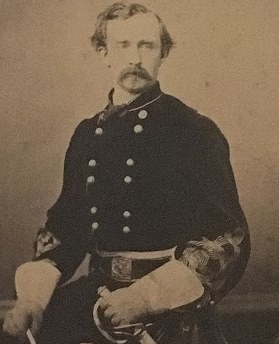
George Custer, commander of the Michigan Brigade and one of the most famous military figures in U.S. history. A dashing cavalryman, he distinguished himself repeatedly in the battles of the Civil War and was killed in action against Native Americans eleven years after the war ended. pinterest.com
Gradually, other Confederate units began to arrive at the battlefield. Major McClellan, Stuart’s aide-de-camp, recalled after the war:
“The battle resumed across the entire plain, and Hampton’s entire brigade, with the exception of the ‘Cobb’s Legion,’ and the entire Fitz Lee Brigade, with the exception of the 4th Virginia Cavalry, was engaged in the fierce hand-to-hand combat that followed. For many minutes, sabers and pistols raged furiously.”
However, the rest of the two brigades entered the battle by mistake. Hampton noted in his report that the arrival of the remaining units of his brigade and the regiments of Fitzhugh Lee’s brigade came as a “surprise” to him. He wrote that the attack by the entire brigade was prompted by an order from Captain Barker, one of Stuart’s aides-de-camp, “who believed that the entire brigade should be sent to support Colonel Chambliss—a mistake that was, of course, caused by the events unfolding on the battlefield.”
The Northerners’ Response
Seeing that a significant portion of the enemy cavalry had become embroiled in combat with the Michigan troops, Gregg decided to outflank the enemy on both sides with McIntosh’s brigade. The 3rd Pennsylvania Cavalry Regiment charged the Confederates’ right flank with two squadrons (led by Captains Charles Trachel and William Rogers). Captain James Hart’s squadron from the 1st New Jersey Cavalry Regiment struck the left flank, supported by dismounted cavalrymen from the other units of the same regiment.
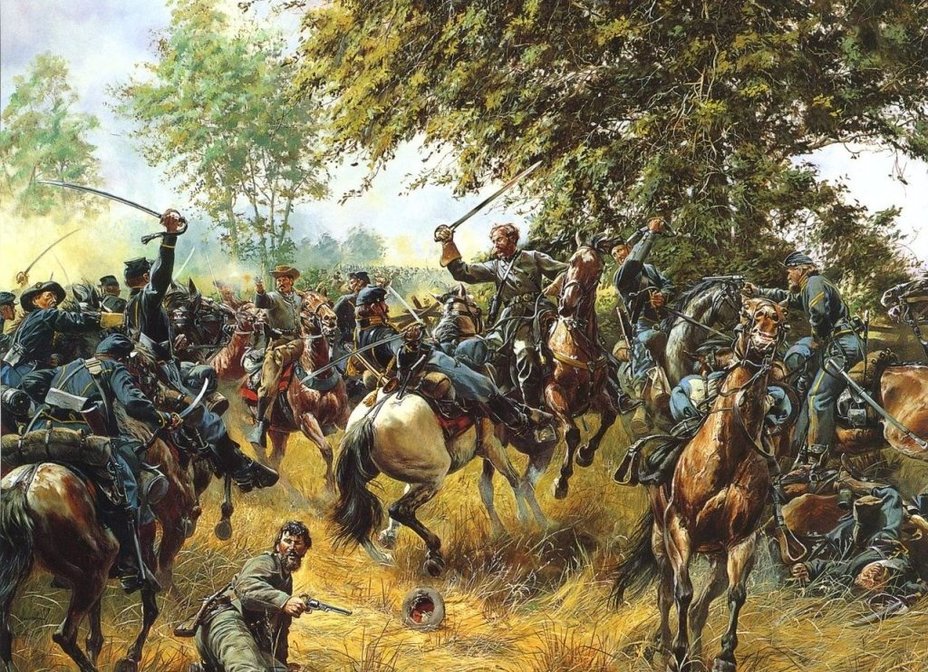
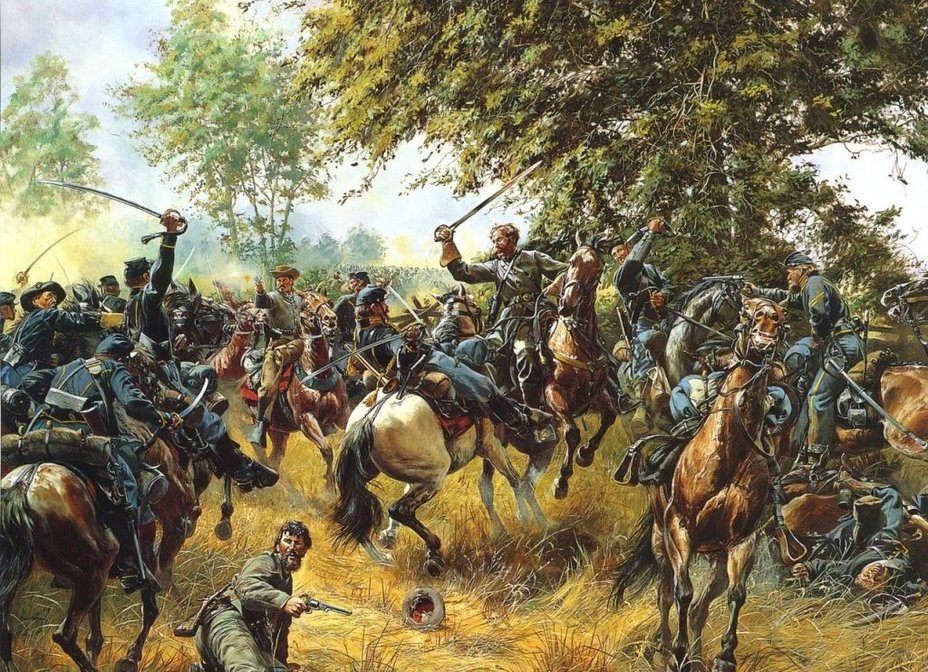
The cavalry battle at Gettysburg on July 3, 1863. In the center is Wade Hampton. Painting by Don Troiani
“Captain Hart’s squadron attacked the Confederate command group, in which Hampton stood out on his stallion, Butler.” The general entered the fray, knocking one enemy off his horse with a saber blow and shooting another with his revolver. But then Hampton was struck by a saber blow to his head wound, received a second saber blow to the head, and was wounded in the leg. Bloodied and dazed, he was rescued by several cavalrymen from the 1st North Carolina Regiment, led by Sergeant Nat Price. Hampton’s wounds proved to be more painful than serious, and he soon returned to duty. In the meantime, command of the brigade was assumed by Colonel Lawrence Baker, commander of the 1st North Carolina Cavalry Regiment.
Meanwhile, from a position on the Confederate left flank, 27-year-old Captain William Miller, commander of a squadron of the 3rd Pennsylvania Cavalry Regiment, watched the cavalry battle unfold. He had clear orders to hold his position at all costs and to support the 1st New Jersey Regiment with fire from dismounted riflemen. Miller was eager to join the fight, and it seemed to him that the moment was very favorable for an attack. Before the attack, he addressed his aides: “I have been ordered to hold this position, but if you will stand by me should I be court-martialed for insubordination, I will order the attack.” The officers supported their commander. Thus, Miller attacked on his own initiative and in defiance of orders.
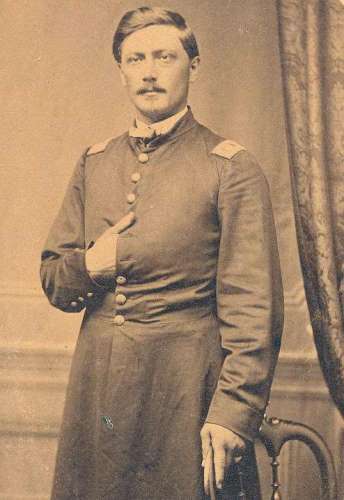
Captain William Miller, commander of a squadron in the 3rd Pennsylvania Cavalry Regiment. He began his military service as a private in his state’s mounted militia, where he served for nine years before the war began and was commissioned as an officer. For his distinguished service in battle in 1862, he was promoted to captain. Despite his heroism at Gettysburg, Miller did not have a distinguished military career and was discharged from service in August 1864. The fame resulting from his decision to attack in defiance of orders came to Miller only 32 years after the war—in 1897, he was awarded the Medal of Honor. He immediately gained the status of a hero, as well as fame and popularity. He died in 1919 at the age of 83. findagrave.com
Miller’s squadron broke through the Confederates’ rear, cutting through their battle lines, scattering, and driving off some of the cavalrymen in the rearguard. This attack is considered the turning point of the cavalry battle, as the Southerners quickly retreated to their original positions near Cross Ridge. Miller himself was wounded by a bullet in his right arm.
The federal forces did not pursue the enemy, as they had suffered heavy losses and were completely demoralized. They also withdrew to their original positions. It was around 6:00 p.m.
The End of the “Gettysburg Raid”
Meanwhile, the mounted batteries commanded by Captains James Breathhead and William McGregor, having replenished their ammunition, approached Stewart. They deployed alongside Griffin’s batteries and opened fire on the Union artillery positions. An artillery battle ensued, during which the poor quality of the Confederates’ ammunition became apparent—their shells often exploded long before hitting their targets. The Union forces returned fire, shelling the Confederate batteries several times and inflicting casualties on them.
Sporadic skirmishes continued until dark. Stuart remained at Cress Ridge until nightfall, then withdrew, leaving the 1st Virginia Cavalry Regiment to cover his retreat and returning to Lee’s army’s positions. Custer, meanwhile, headed back to his division that evening—a division that had also seen heavy fighting that day—leaving General Gregg’s men to hold the position. It is noteworthy that the Union forces still had Irvin Gregg’s brigade, which had seen virtually no action, in reserve. As for Stuart, he had no reserves left.
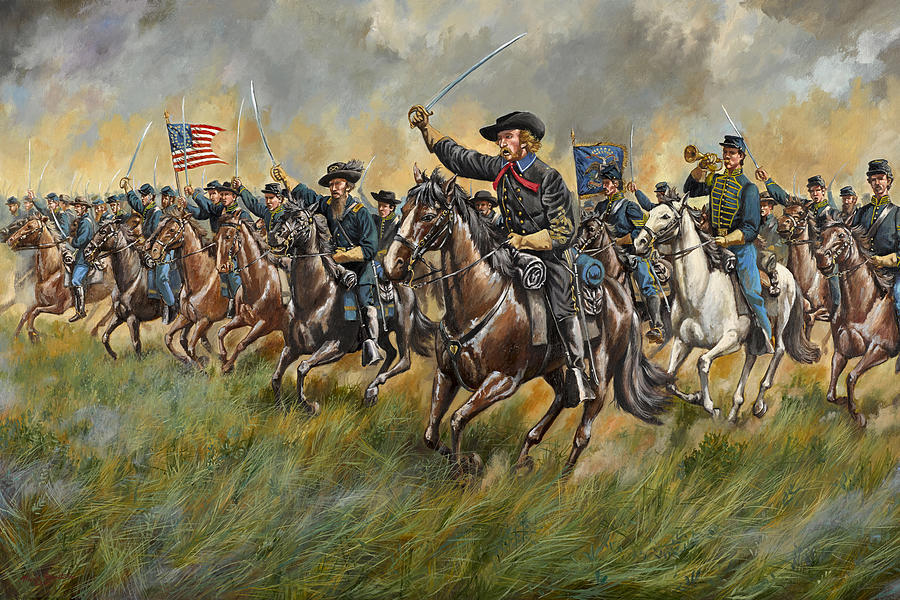
Custer leads the 7th Michigan Cavalry Regiment into battle at Gettysburg. The regiment lost 86 men in this battle. Painting by Mark Maritato
Union casualties in the Battle of Lott’s Farm totaled 254—30 killed, 149 wounded, and 75 missing. Of these, 219 were from Custer’s brigade. According to Custer’s report, the 1st Michigan Cavalry Regiment lost 6 officers and 80 soldiers in the cavalry engagement.
McIntosh’s brigade lost 33 men—25 wounded (including 7 officers) and 8 missing in action. Of these, 20 were from the 3rd Pennsylvania Cavalry Regiment—14 wounded (5 officers) and 6 missing in action.
The Southerners, excluding Jenkins’s brigade, suffered 157 casualties—22 killed, 81 wounded, and 54 missing. Seven officers were killed, including five from the “Cobb Legion” of Hampton’s brigade. After suffering fairly heavy losses, the enemy was no longer willing to continue active operations.
Both sides claimed victory. However, an analysis of the battle still suggests that the Northerners had the upper hand, even though they suffered greater losses. There is no doubt that if Stewart had managed to break through to the rear of the Potomac Army, the consequences could have been very serious. Therefore, the significance of this battle is immense, and General Gregg can rightly be considered one of the commanders who played a crucial role in the Union forces’ ultimate victory at Gettysburg. As the Union cavalrymen later boasted with good reason, “we saved the day at the most critical moment of the Battle of Gettysburg.”
Nevertheless, this battle had one advantage for the Confederates as well. General Meade, commander of the Potomac Army, cited the fact that Stuart was threatening the army’s rear as one of the reasons for his decision not to launch a counterattack against the Army of Northern Virginia on the afternoon of July 3, after repelling “Picket’s Charge.” This may have spared the Confederates from a complete rout.
Union cavalry is gathering on the right flank of Lee’s army
On the morning of July 3, Major General Alfred Pleasonton, commander of the Potomac Army’s Cavalry Corps, planned a powerful cavalry attack on the Confederate army’s right flank south of Big Round Top. To this end, he intended to deploy Brigadier General Judson Kilpatrick’s cavalry division. The division had recently distinguished itself by unsuccessfully pursuing Jeb Stuart during his raid while attempting to recapture a supply train seized by the Confederates, and had arrived at the army’s position on July 2. Pleasonton reinforced Kilpatrick with Brigadier General Wesley Merritt’s cavalry brigade, which had originally been part of Beaufort’s division but had been held in reserve since the start of the battle.
However, Plezonthon’s plan quickly fell apart, since Brigadier General George Custer’s 2nd Brigade from Kilpatrick’s division was on the right flank by morning, and then remained there entirely to counter Jeb Stuart’s flanking maneuver. Kilpatrick was left with only one brigade—Brigadier General Elon Farnsworth’s 1st Brigade (1,925 men). He was assigned Wesley Merritt’s reserve brigade (1,321 men) from Buford’s division. It arrived around 3:00 p.m., taking up a position on Farnworth’s left flank, and consisted of two regiments, while the third—the 6th Cavalry Regiment—had been sent that day to Fairfield, west of Gettysburg. Kilpatrick was also supported by Captain William Graham’s battery of six three-inch guns.
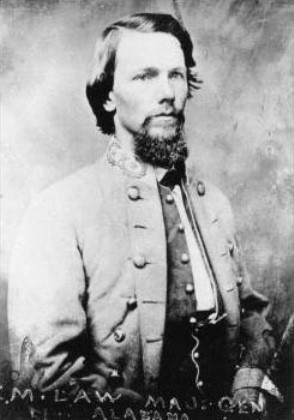
27-year-old General Evander Lowe, acting commander of Hood’s division on the third day of the Battle of Gettysburg. Before the war, he was a history teacher at a military school; after the war, he founded a military school in Tuskegee, Alabama. wikipedia.org
On the other side of the front, facing Kilpatrick’s brigade, was the 3rd Infantry Division of the 1st Army Corps, which found itself on the far right flank of the Army of Northern Virginia. At that time, the division was temporarily under the command of Brigadier General Evander Lowe (the division commander, Major General John Hood, had been wounded on July 2, and Lowe had taken his place). As early as the night of July 2, Low had begun organizing a brigade to counter a possible Union attack against the Confederate right flank.
On the morning of July 3, Lowe received reinforcements in the form of Colonel John Black’s 1st South Carolina Cavalry Regiment (according to Lowe, about 100 men, some of whom were recovering from wounds and not all on horseback; a regiment from Hampton’s brigade) and Captain James Hart’s mounted South Carolina artillery battery (three guns). Later, noticing a concentration of Union cavalry in front of his line, Low maneuvered his regiments to select the optimal defensive position. Ultimately, the Confederates formed a defensive line on uneven terrain covered with boulders and thickets—terrain well-suited for defense.
Kilpatrick Takes Action
At 3:00 p.m., the Confederates launched “Picket’s Charge,” and Kilpatrick decided to strike at the enemy. Merritt’s brigade struck first, not in cavalry formation but on foot. It attacked Black’s 1st South Carolina Cavalry Regiment and Hart’s battery, pushed them back, and advanced into the area west of Emmitsburg Road, where it encountered stiff resistance from the regiments of Brigadier General George Anderson’s Georgia Brigade, which had taken up positions in a wheat field. Merritt’s advance stalled, and after a 15-minute battle, he retreated with heavy losses.
Meanwhile, “Picket’s Charge” had failed, and many Union generals began to believe that the Army of the Potomac was on the verge of launching a counteroffensive. Perhaps Kilpatrick thought so too, or perhaps, as a disciplined officer, he simply wanted to carry out Pleasonton’s morning order. At 5:30 p.m., Kilpatrick ordered Brigadier General Farnsworth to attack in cavalry formation. Farnsworth was taken aback, considering such an attack suicidal: “A successful attack in my sector is impossible.” Farnsworth assumed that he was facing a stone wall topped with an additional wooden palisade, behind which the infantrymen of Brigadier General Jerome Robertson’s Texas Brigade were entrenched. According to Captain Henry Parsons of the 1st Vermont Cavalry Regiment, Kilpatrick replied: “So, you refuse to obey my orders? If you are afraid to lead this attack, then I will lead it myself.”
Rising in his stirrups, Farnsworth said firmly, “Take back what you said!” Kilpatrick sat up defiantly in the saddle but replied, “That’s not what I meant. Forget it.” Then Farnsworth said, “General, if you order an attack, I’ll go, but the responsibility will rest entirely with you.” Kilpatrick said, “I accept the responsibility.”
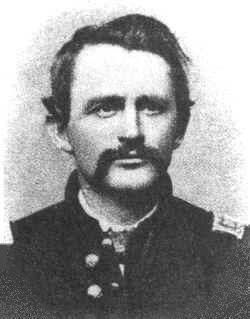
Ilon Farnsworth, 25, was not a combat officer — he served primarily in headquarters, was an aide-de-camp to General Pleasonton, commander of the Potomac Army’s cavalry, and was promoted to general and appointed brigade commander three days before the Battle of Gettysburg began. Despite his lack of experience commanding troops, Farnsworth understood the futility of the attack he had been ordered to carry out. wikipedia.org
The brigade’s attack was led by Colonel Nathaniel Richmond’s 1st West Virginia Cavalry Regiment (395 men). Fire from Lieutenant Colonel Philip Work’s 1st Texas Infantry Regiment disrupted the cavalry’s ranks, but they managed to reach the stone wall and, according to Major Charles Capehart, even break through it. Hand-to-hand combat broke out in some areas, with sabers, rifles, knives, and even stones being used. In the end, the attackers were repelled, suffering 12 casualties (four killed, four wounded, and four missing).
As soon as the 1st West Virginia Regiment attacked the Texans, General Evander Lowe dispatched three Georgia infantry regiments (the 9th, 11th, and 59th) to support them. He also ordered his staff officer, Lieutenant Wade, to ride out and locate other units, directing them to the battlefield. Wade encountered the 4th Alabama Infantry Regiment under Lieutenant Colonel Lawrence Scragg, which was also moving urgently toward the front lines.
To the left of the 1st Virginiaattacked the 18th Pennsylvania Cavalry Regiment under Lieutenant Colonel William Brinton, supported by the 5th New York Cavalry under Major John Hammond (929 men in the two regiments). Lieutenant Henry Potter, who took part in the attack, recalled: “The rebels appeared before us by the thousands. It seemed as if they were emerging from the ground, like bees.” In fact, the attackers were met at the stone wall by about two hundred Texans, who kept their composure and opened fire. Hit by a volley of gunfire, the Union regiments quickly turned back. The New Yorkers lost 6 men, and the Pennsylvanians lost 14.
The 1st Vermont Regiment’s Charge—The Final Note of the Battle of Gettysburg
Meanwhile, it was the turn of Lieutenant Colonel Addison Preston’s 1st Vermont Cavalry Regiment, which attacked to the right of the 1st West Virginia Regiment. Before the attack, Farnsworth divided the regiment’s 600 cavalrymen into three battalions of four companies each. The battalions were led by Lieutenant Colonel Preston, Major William Wells, and Captain Henry Parsons. Farnsworth joined Wells’s battalion, which was bringing up the rear. The cavalrymen formed ranks of four and drew their sabers.
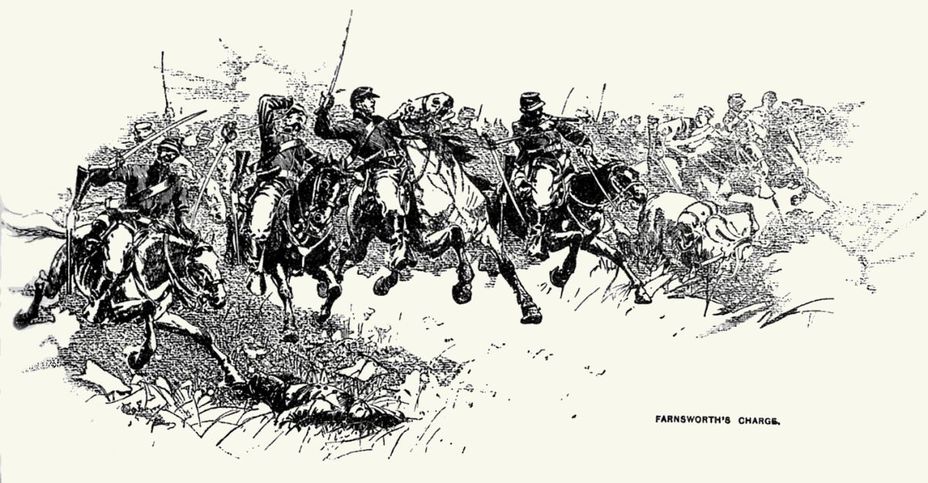
The 1st Vermont Regiment’s Attack at Gettysburg. civilwarfineart.com
Parsons was the first to attack, easily breaking through the ranks of the 1st Texas Infantry Regiment’s skirmishers, getting behind them, and turning toward John Slade’s farm. General Lowe wrote:
“Meanwhile, Farnsworth and his cavalry rode bravely up the valley with their sabers drawn, encountering no resistance. When they approached Slider’s house, where I was standing watching them, I saw a tattered Confederate battle flag fluttering among the trees at the foot of the opposite ridge, and shortly thereafter, men appeared.”
It was the 4th Alabama Infantry Regiment that had approached the farm. Spotting the Union cavalry, an Alabama lieutenant exclaimed, “Cavalry, boys, cavalry! This isn’t a battle—it’s just for fun. Give ’em hell!”
That’s how Parsons’ battalion came under fire from the infantry. The Alabamans’ first volley was aimed too high, but the second one knocked several cavalrymen from their saddles. The Southerners made skillful use of the terrain, so the Northerners could only make out the enemy riflemen by the plumes of smoke. One of the Alabamians recalled: “Our boys really enjoyed that battle.”
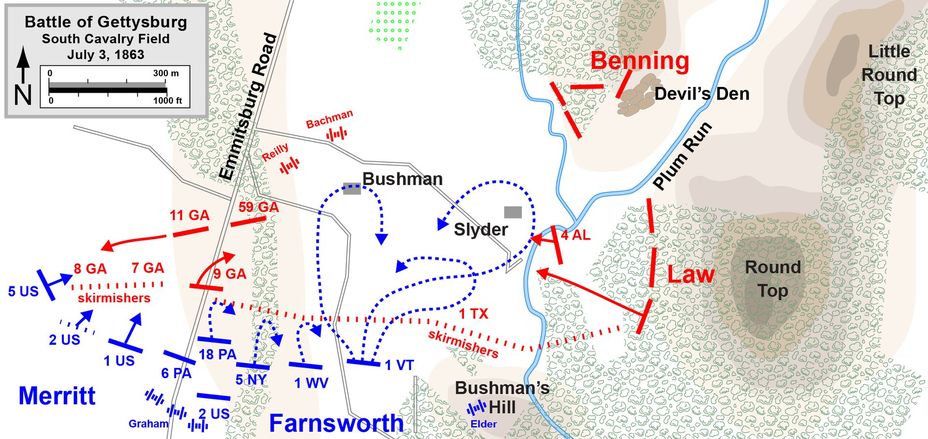
A modern map of the attack by the 1st Brigade of Kilpatrick’s Division at Gettysburg on July 3, 1863. wikipedia.org
Parsons withdrew his men from the line of fire and paused to regroup on a wooded hill. From his position, he observed the attack by Wells’s battalion, which was advancing to the right of Parsons’s battalion. Wells’ men immediately found themselves trapped in a fire trap and began scrambling to break free. The Georgian infantry regiments mentioned earlier joined in the firefight, though their shots proved inaccurate. Near Farnworth, his horse was killed, and a corporal gave him his own horse. This did not help the general, and shortly thereafter he was killed, having been struck a total of five times in the chest, abdomen, and leg. Under fire from all sides, the battalion split into three groups, which began to withdraw from the battle.
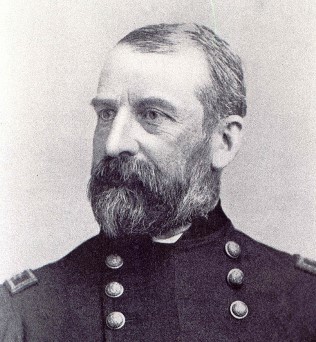
A postwar photo of Major William Wells, who was awarded the Medal of Honor for the “Farnsworth Raid.” He was 26 years old at the time of the incident. wikipedia.org
Meanwhile, Preston’s battalion joined Parsons, and together they went to the aid of Wells’s men. Wells himself withdrew his detachment from the battle; as they retreated, they managed to take several Texans prisoner. In 1891, Wells was awarded the Medal of Honor for this battle. The Vermonters managed to break through under heavy fire and came to a halt in a sector slightly west of their original position.
Results
In this attack, the 1st Vermont Cavalry Regiment lost 68 men (13 killed, 19 wounded, 36 missing). Colonel Nathaniel Richmond took command of the brigade. Farnsworth’s brigade suffered a total of 112 casualties (including 20 killed). Merritt’s brigade suffered 353 casualties on July 3 (20 killed, 57 wounded, and 276 missing). Among the Confederates, known casualties for the 1st South Carolina Cavalry Regiment, which faced Merritt’s Brigade, totaled 14 men (1 killed, 9 wounded, 4 missing).
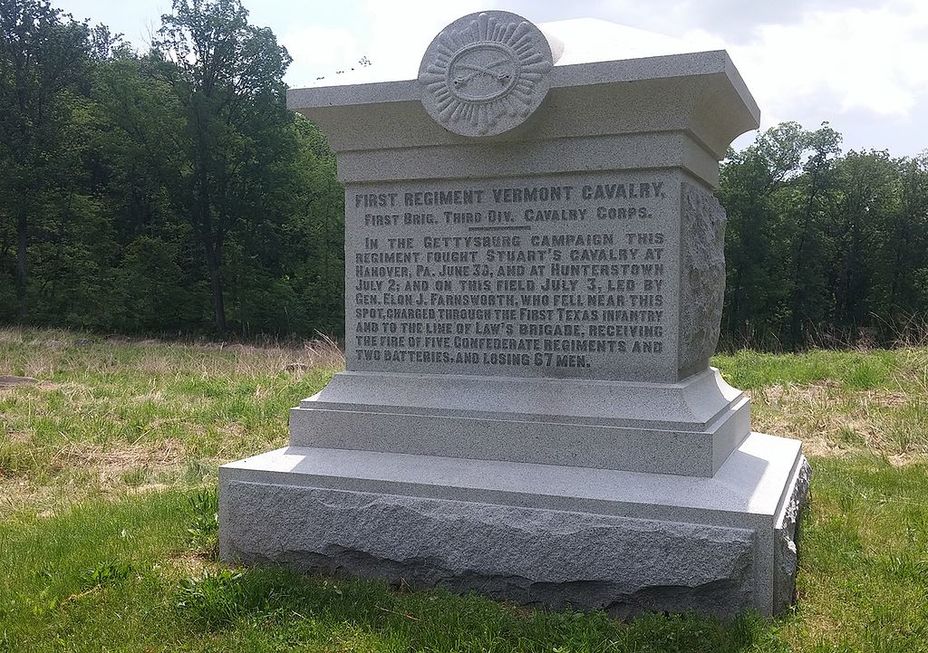
Monument honoring the 1st Vermont Cavalry Regiment in the memorial park near Gettysburg. wikipedia.org
It was precisely because of this incident that Kilpatrick earned his nickname, “The Cavalry Killer” (a play on the words “Kilpatrick” and “Kill Cavalry”). However, this incident had no impact whatsoever on his career or reputation. For example, Plezonthon, in his final report, spoke highly of Kilpatrick’s actions:
“General Kilpatrick distinguished himself with the First Brigade under the command of General Farnsworth, attacking the enemy infantry and, with the support of Merritt’s brigade and the assistance of their batteries, forcing them to detach part of their forces from the main attack to the left toward our line. This was one of the most outstanding attacks, in which the noble and brave General Farnswort fell, having heroically led his brigade against the enemy infantry.”
Kilpatrick went on to have a brilliant career, receive numerous combat decorations, and earn a highly controversial reputation.
This attack, poorly planned and doomed to failure from the start, marked the final act of the Battle of Gettysburg. Although it ended in a Confederate victory, it did not affect the final outcome of the battle—the Potomac Army emerged victorious.
Sources and References
-
-
- Макферсон Д. Боевой клич свободы — Екатеринбург: Гонзо, 2012
- Смит К. Геттисберг 1863 год. Битва, создавшая Соединенные Штаты. — М.: Эксмо, 2012
- Clark C. Gettysberg. The Confederate High Tide. — Time Life Books, 1985
- Davenport P. The role of the cavalry at Gettysburg, June 30, 1863-July 3, 1863. A Guide to the battlefield. — U.S. ARMY WAR COLLEGE, CARLISLE BARRACKS, PA, 1988
- Don Trojani’s American Battles. — Stackpole books, 2006
- McClellan, Henry Brainerd. The life and campaigns of Major-General J.E.B. Stuart: commander of the cavalry of the Army of northern Virginia. — New York: Houghton, Mifflin and Co., 1885
- Reardon C., Vossler T. The Gettysburg Campaign, June-July 1863. – Center of Military History US Army, Washington, D.C., 2013
- Official Records of the Union and Confederate Armies in the War of the Rebellion. Series I, Volume 27, Chap. 39 — Operations in North Carolina, Virginia, West Virginia, Maryland, Pennsylvania, and Department of the East. June 3-August 3, 1863. — Part 1
- Official Records of the Union and Confederate Armies in the War of the Rebellion. Series I, Volume 27, Chap. 39 — Operations in North Carolina, Virginia, West Virginia, Maryland, Pennsylvania, and Department of the East. June 3-August 3, 1863. — Part 2
- Wagner A. Organization and tactics. — Franklin Hudson Publishing, 1906
-